Modern agriculture is at a turning point. According to the Food and Agriculture Organization of the United Nations, the world will need to produce 70 percent more food by 2050 to feed a projected global population of nearly 10 billion people, yet arable land is shrinking, water resources are under severe stress, and the average age of a farmer in most developing nations is rising past 60. AI in agriculture is no longer a futuristic experiment reserved for university labs or well-funded agri-tech startups. It is an operational necessity that is actively being deployed on farms across continents, from wheat fields in the American Midwest to rice paddies in Southeast Asia. This blog will walk through the current state of the industry, how specific AI technologies are being applied to specific farming problems, the measurable business outcomes companies are achieving, a practical implementation roadmap for agricultural businesses, and an honest assessment of where the challenges still lie.
Agriculture sits at the intersection of biological complexity, climate volatility, and intense economic pressure, and the combination is becoming increasingly difficult to manage with traditional methods alone. Input costs have risen dramatically over the past decade. Fertiliser prices spiked by more than 80 percent between 2020 and 2022, driven by supply chain disruptions and energy price inflation. Fuel, irrigation, and labour costs have followed similar upward trajectories, compressing the margins that were already among the thinnest of any industry.
At the same time, the climate is making farming less predictable. Unpredictable monsoon patterns, prolonged droughts, early frosts, and new pest migration routes are introducing a level of volatility that seasonal experience alone cannot compensate for. A farmer who has worked the same land for 30 years now faces conditions that have no historical parallel on that land, which means that inherited knowledge is no longer sufficient on its own.
The labour shortage crisis is another structural problem with no easy fix. In the United States, agricultural labour shortages have pushed average farm wages up by over 40 percent in the last five years, and even at those wages, farms cannot consistently fill seasonal positions. In Europe, post-Brexit immigration restrictions have left fruit and vegetable growers without harvest workers at critical moments. In developing economies, rural-to-urban migration is pulling younger workers out of agriculture entirely, leaving an ageing farming population managing increasingly large acreages.
Pest and disease management has grown more complex as well. The development of herbicide-resistant weeds, the spread of new fungal strains, and the expanding range of insects due to warming temperatures mean that blanket chemical applications are both less effective and increasingly restricted by regulators. The European Union's Farm to Fork strategy, for example, targets a 50 percent reduction in pesticide use by 2030, creating both a compliance challenge and a precision imperative for producers who operate in or export to European markets.
Supply chain inefficiencies compound all of the above. Post-harvest losses in developing countries account for between 25 and 40 percent of total production, according to the World Bank, largely because of poor cold chain infrastructure, inaccurate demand forecasting, and fragmented logistics coordination. Globally, food waste represents an estimated economic loss of roughly 1 trillion US dollars annually. The industry, in short, is being asked to produce more with less, under worse conditions, with fewer people, at lower environmental cost, all while operating on thin margins. That is the context into which AI is being introduced.
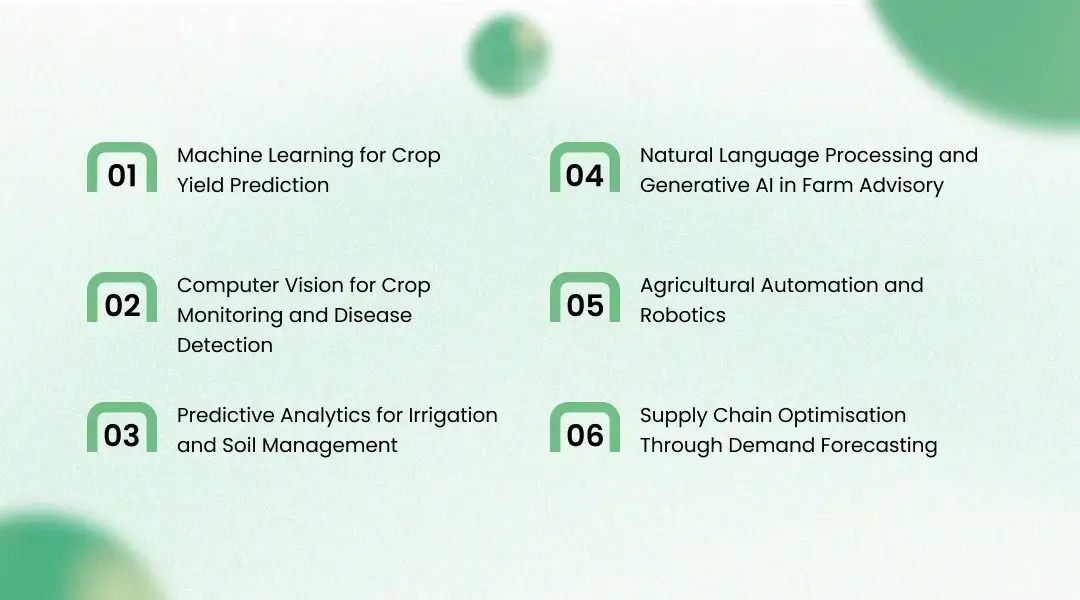
The transformation being driven by AI in agriculture is not happening through a single technology. It is a convergence of several distinct AI disciplines, each of which addresses a different layer of the farming operation.
Crop yield prediction has historically depended on a combination of farmer experience, agronomist consultation, and basic weather forecasting. Machine learning models trained on satellite imagery, historical yield data, soil sensor readings, and microclimate weather stations are now capable of predicting yield outcomes at the field-zone level with accuracy margins that outperform human experts. Companies like Granular and Climate Corporation have built yield prediction models that integrate over 10 trillion data points from weather, soil, and crop performance records. Precision farming AI tools built on these models allow producers to adjust input applications, irrigation schedules, and harvest timing before problems become visible to the human eye.
Unmanned aerial vehicles equipped with multispectral cameras and computer vision models can survey hundreds of hectares in hours, identifying plant stress indicators, nutrient deficiencies, and early-stage disease outbreaks at a resolution that ground scouts could never match at scale. These systems use convolutional neural networks trained on thousands of annotated images of diseased crops to classify problems by type and severity in near real time. A farmer reviewing a drone survey report in the morning can have a targeted treatment plan generated and uploaded to a variable-rate sprayer before noon, addressing only the affected zones rather than treating the entire field uniformly.
Water is the single most constrained resource in global agriculture, and smart farming technology built on predictive analytics is enabling irrigation management at a precision that reduces water consumption without sacrificing yield. Soil moisture sensors networked across a field feed real-time data into models that calculate evapotranspiration rates, root zone moisture levels, and optimal irrigation windows for each crop growth stage. Studies from the University of California's Agricultural Water Center have shown that AI-driven irrigation management reduces water usage by 20 to 40 percent compared to conventional scheduling, an outcome that is commercially significant and environmentally essential.
Agricultural advisory services have always been bottlenecked by the limited availability of qualified agronomists, particularly in smallholder farming regions. Generative AI platforms trained on agronomic research, pest management guidelines, soil science literature, and local crop calendars are now being deployed as advisory chatbots accessible via mobile phone, in multiple languages. These tools allow a farmer in Maharashtra or Zambia to describe a crop symptom in natural language and receive a diagnosis and treatment recommendation in seconds, effectively scaling agronomic expertise across geographies that have never had adequate access to it.
Agricultural automation extends beyond drone surveillance into physical robotic systems that are eliminating the most labour-intensive and cost-sensitive field operations. Autonomous weeding robots such as those developed by Carbon Robotics use high-powered laser systems guided by computer vision to destroy weeds at the root without herbicides, at a per-acre cost that is competitive with chemical treatment once amortised over a season. Autonomous tractors from companies like John Deere's TechStack division and CNH Industrial now complete soil preparation, planting, and nutrient application tasks with centimetre-level GPS precision, operating across multiple shifts without driver fatigue.
AI-powered demand forecasting models trained on point-of-sale retail data, weather patterns, historical consumption data, and macroeconomic signals are helping agricultural cooperatives and food processors reduce overproduction and post-harvest waste. These systems generate week-ahead and month-ahead demand signals that can be used to calibrate planting schedules, cold storage allocation, and transport logistics, connecting the production decision on the farm to the consumption signal at the supermarket shelf in a way that was not previously possible at scale.
The business case for AI in agriculture is no longer theoretical. Measurable results are being documented across crop types, geographies, and farm sizes, and the numbers are significant enough to shift investment decisions.
Crop yield prediction systems deployed at scale have demonstrated yield improvements of 10 to 20 percent in controlled comparisons against conventional management approaches. A 2023 report from McKinsey's Center for Agriculture estimated that precision farming AI could unlock between 500 billion and 1 trillion US dollars in additional global agricultural value annually by the end of this decade, driven primarily by input optimisation and yield stabilisation.
On the input cost side, variable-rate application technology guided by AI models reduces fertiliser usage by an average of 15 percent without reducing yield, according to research published in the journal Precision Agriculture. At current fertiliser prices, a 1,000-hectare grain operation saving 15 percent on nitrogen alone represents a cost reduction of approximately 40,000 to 70,000 US dollars per season. For farms operating on 5 to 8 percent net margins, this is a transformative improvement.
Pest and disease early detection systems are producing equally compelling results. Early identification of Septoria leaf blotch in wheat, for example, using AI-powered drone surveillance allows targeted fungicide application 12 to 18 days earlier than visual scouting would detect the disease. This earlier intervention window has been shown to protect yield by 8 to 14 percent in commercial field trials in the UK and France, while simultaneously reducing the volume of fungicide applied by 30 percent.
Labour cost reduction through agricultural automation is perhaps the most straightforward financial case. An autonomous weeding robot capable of treating 5 hectares per hour at an annualised machine cost of under 100 US dollars per hectare can replace hand-weeding labour that costs between 250 and 400 US dollars per hectare in high-wage markets. In high-value crop systems such as strawberries or specialty vegetables, the return on investment from a single autonomous weeding system typically occurs within one to two growing seasons.
On the water cost side, AI-driven irrigation systems in almond and pistachio orchards in California have achieved documented water savings of 25 to 35 percent while maintaining yield parity with conventionally irrigated blocks. Given that water costs in California's Central Valley can exceed 1,000 US dollars per acre-foot during drought years, the financial impact of a 30 percent reduction in water application on a 200-hectare orchard is measured in hundreds of thousands of dollars annually.
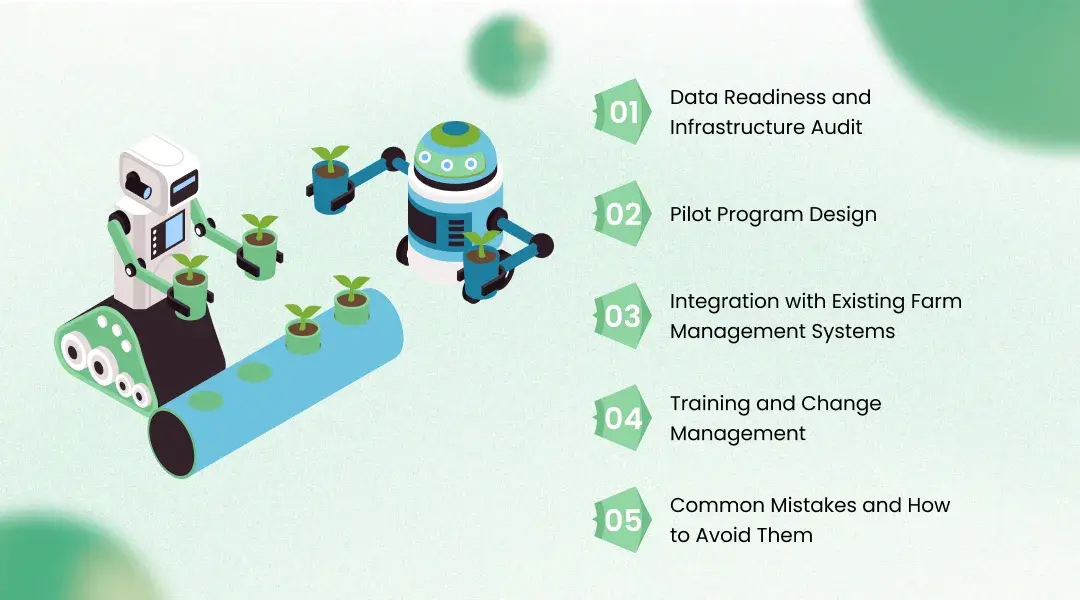
Implementing AI in an agricultural business is not a technology project. It is an operational transformation that requires careful sequencing, internal buy-in, and a realistic assessment of the data infrastructure that exists before any model can be trained or deployed.
Before any AI system can generate value, the data it needs must exist in a usable form. Most farms and agricultural businesses are not starting from a position of clean, structured, accessible data. The first step is a comprehensive audit that maps what data is currently being captured, in what format, at what frequency, and with what gaps. This includes soil test records, yield maps from harvester terminals, weather station logs, input application records, and any satellite or drone imagery that has been accumulated. The audit should identify which critical data streams are missing entirely and what hardware or software investments are needed to establish them.
Attempting to deploy AI across an entire farming operation simultaneously is one of the most common and costly mistakes in agricultural technology adoption. A well-designed pilot program selects a single, measurable problem, whether that is irrigation scheduling on a specific crop, disease detection in a defined field block, or demand forecasting for a single product category, and builds a controlled comparison against the current approach. The pilot should run for at least one full growing cycle so that seasonal variability is accounted for in the outcome measurement. KriraAI, which specialises in building practical AI solutions for enterprises, recommends that agricultural businesses define their success metrics before deployment rather than after, ensuring that the pilot generates a clean business case for full-scale rollout.
AI tools that operate in isolation from existing farm management software create data silos and adoption resistance. Integration with platforms such as John Deere Operations Center, Trimble Ag, or regional cooperative management systems is essential for the AI outputs to be actionable within the workflows that farm operators and managers already use. This integration work is often underestimated in project scoping and should be treated as a first-class deliverable rather than an afterthought.
The technology is only as valuable as the operators who use it. A comprehensive training program that addresses both the technical operation of the system and the reasoning behind its recommendations builds the user trust that is essential for consistent adoption. KriraAI's approach to enterprise AI deployment includes structured change management frameworks that address the human dimension of technology adoption, recognising that resistance from experienced farm managers is often rooted in legitimate concerns about over-reliance on models that they cannot interrogate.
Several implementation failures follow predictable patterns in agricultural AI adoption:
Deploying AI models trained on data from different geographies or soil types without local validation, which produces recommendations that are confidently wrong.
Purchasing precision farming AI hardware before establishing the connectivity infrastructure, such as reliable farm-level internet or cellular coverage, that the hardware requires to function.
Failing to assign internal ownership of the AI program to a named individual with both technical literacy and operational authority, leaving the system orphaned after vendor onboarding ends.
Selecting AI vendors on the basis of feature lists rather than demonstrated outcomes in comparable agricultural contexts.
Underestimating the time required for model calibration to local conditions, particularly for yield prediction and disease detection models that perform poorly until they have been trained on at least one to two seasons of local data.
Honest engagement with the limitations of agricultural AI is essential for any business making investment decisions in this space. The technology is powerful, but it is not a universal solution, and the gap between vendor marketing claims and operational reality is often wider than buyers expect.
Data quality is the foundational constraint. Agricultural data is notoriously fragmented, inconsistently collected, and frequently incomplete. Yield maps from harvester terminals often contain GPS drift errors. Soil test records are frequently taken at intervals too wide to represent field-scale variability. Weather station density on most farms is insufficient to capture the microclimate variation that drives pest pressure and irrigation demand at the sub-field level. Any AI model trained on poor data will produce unreliable outputs, and the consequences of an unreliable recommendation in agriculture are real crop losses and real financial damage.
The talent gap is a second structural barrier. The agronomists, data scientists, and precision agriculture specialists needed to implement and maintain AI systems are in short supply globally. Agricultural universities are producing graduates with AI and data science skills at a fraction of the rate that the industry requires. Small and medium-sized farming operations, cooperatives, and regional agribusinesses typically cannot afford to recruit or retain the internal talent that sophisticated AI deployment demands.
Regulatory and data sovereignty concerns add another layer of complexity. In many jurisdictions, the data collected from farms through precision agriculture systems is legally ambiguous in its ownership, and several high-profile cases in North America and Europe have raised farmer concerns about the use of their yield and soil data by technology vendors for commercial purposes. The EU's Data Act, which came into full effect in 2024, introduces new rights for agricultural data holders, but compliance requirements also add friction to cross-platform data sharing.
Integration complexity with legacy equipment is a persistent operational challenge. Much of the mechanised equipment in use on farms today was designed and manufactured before the era of connected agriculture, and retrofitting sensors, connectivity modules, and actuation systems onto older tractors, irrigation systems, and storage facilities involves engineering work that is often expensive and not always technically feasible.
Finally, the climate itself introduces a model reliability problem that is not easily solved. AI models trained on historical data assume that the patterns in that data will continue to hold in future seasons. In a climate that is shifting measurably year on year, the historical training window becomes less representative over time, requiring more frequent model retraining and more conservative confidence thresholds on model outputs.
The next three to five years will see agricultural AI move from isolated point solutions to fully integrated autonomous farm management systems that operate with minimal human intervention in routine decisions.
Crop yield prediction models will evolve from field-level forecasts to plant-level predictions, enabled by the continued cost reduction of hyperspectral imaging sensors and the deployment of edge computing units on farm equipment that can process imagery in the field without depending on cloud connectivity.
Autonomous multi-task robots will begin replacing the specialised single-function machines that dominate the current market. Rather than deploying separate machines for weeding, soil sampling, and crop monitoring, farms will operate fleets of multi-modal robotic platforms that switch between tasks based on AI-generated field management plans, coordinated by a central farm operating system.
Agricultural automation will extend further into the supply chain, with AI-powered grading, sorting, and packing systems in packhouses and processing facilities eliminating the last major labour-intensive post-harvest operations. Computer vision systems already operating in premium fruit packing lines will become standard infrastructure across commodity crops as equipment costs continue to fall.
The competitive landscape will bifurcate sharply. Farms and agribusinesses that have built data infrastructure, developed internal AI capability, and established vendor relationships with proven AI solution providers will compound their advantages each season as their models accumulate more training data. Farms that have delayed adoption will face a widening efficiency gap that translates directly into cost disadvantage at the commodity level. In markets with thin and falling commodity prices, this gap will not be survivable for the most capital-constrained operators.
Smart farming technology will also reshape the relationship between producers and downstream buyers. Retail and food service companies seeking to demonstrate sustainability credentials and supply chain traceability to regulators and consumers will increasingly require farm-level AI monitoring data as a condition of supply agreements, making precision agriculture capability a market access requirement rather than a performance advantage.
Three points emerge clearly from any honest analysis of AI in agriculture. First, the business case is real, specific, and available today. The documented outcomes in yield improvement, input cost reduction, water savings, and labour efficiency are not marginal gains. They are the difference between profitability and loss for operations facing the margin pressures described throughout this analysis. Second, the window for early adoption advantage is still open but closing. The farms and agribusinesses that invest in data infrastructure and AI capability now will compound that advantage through model improvement each season, creating an efficiency gap that will be difficult for late adopters to close. Third, implementation quality determines outcomes. The technology only delivers its potential when it is deployed thoughtfully, integrated properly, calibrated locally, and supported by human operators who understand both the system and the crop.
For agricultural businesses looking to move from awareness to action, KriraAI builds practical AI solutions designed specifically for enterprises that need measurable outcomes rather than experimental technology. KriraAI's approach combines deep technical capability in machine learning, computer vision, and predictive analytics with an operational understanding of how agricultural businesses actually function, ensuring that the solutions deployed create value in the field rather than in a product demonstration. Whether you are a large-scale grain producer evaluating precision farming AI for the first time, a food processor looking to reduce post-harvest waste through demand forecasting, or a cooperative seeking to offer AI-powered advisory services to your members, KriraAI has the expertise to scope, build, and deliver an implementation that matches your operational reality. Reach out to the KriraAI team to begin a conversation about what AI-driven agriculture could mean for your business.
AI in agriculture refers to the application of machine learning, computer vision, predictive analytics, natural language processing, and robotic automation to farming and agribusiness operations. These technologies work by ingesting large volumes of data from sources such as satellite imagery, soil sensors, weather stations, drone surveys, and farm management software, and then using trained models to identify patterns, generate predictions, and produce actionable recommendations. In practical terms, an AI system in agriculture might analyse multispectral drone imagery to detect early fungal infection in a wheat crop, calculate the affected area, recommend a targeted fungicide application, and communicate that recommendation directly to a variable-rate sprayer, all within a few hours and without requiring a human agronomist to visit the field.
Precision farming AI improves crop yields by optimising the inputs and interventions applied to each zone of a field based on the specific conditions of that zone, rather than applying uniform treatments across an entire farm. By analysing soil variability, historical yield maps, plant growth stage data, and real-time weather forecasts, precision farming AI models calculate the optimal timing, rate, and placement of fertiliser, water, and crop protection products for each area. This reduces the waste associated with over-application in high-performing zones and addresses the deficiencies that limit yield in underperforming zones. Commercial deployments of precision farming AI have consistently demonstrated yield improvements of 10 to 20 percent compared to conventional uniform management approaches, with simultaneous reductions in input costs.
The biggest barriers to AI adoption in agriculture are data readiness, connectivity infrastructure, cost of entry, and the shortage of qualified technical support. Most farm operations do not yet have the structured, high-quality data streams that AI models require to generate reliable outputs, and building those data streams requires investment in sensors, connectivity hardware, and data management systems before any AI application can function effectively. The cost of precision agriculture hardware and software subscriptions remains prohibitive for smallholder and small commercial operations in many markets. Rural connectivity, particularly reliable broadband and cellular coverage, is still inadequate in many farming regions globally. And the shortage of agronomists and data scientists with combined expertise in AI and crop science means that even well-resourced farms struggle to find the technical support needed to deploy and maintain AI systems.
The timeline for implementing AI in an agricultural business depends on the scope of the application, the existing data infrastructure, and the complexity of integration with current systems. A focused pilot program targeting a single application, such as AI-driven irrigation scheduling for a specific crop, can be designed, deployed, and evaluated within a single growing season of four to six months. A full-scale deployment covering multiple AI applications across an entire farm or processing operation, including data infrastructure buildout, equipment integration, staff training, and model calibration to local conditions, typically requires 18 to 36 months before reaching operational maturity. Companies that attempt to compress this timeline by skipping the pilot phase or underinvesting in data infrastructure consistently report poor outcomes and high project abandonment rates.
AI will not replace farmers, but it will fundamentally change what farmers and agricultural workers do. The judgment-intensive, relationship-based, and adaptive decision-making that defines skilled farming is not replicable by current or near-term AI systems. What AI will replace is the physically demanding, repetitive, and data-processing-intensive work that currently consumes a disproportionate share of farm labour capacity, including manual weeding, uniform chemical application, visual crop scouting, and manual data recording. This shift will reduce demand for unskilled seasonal labour while increasing demand for technically literate farm operators who can work alongside autonomous systems. The net effect on agricultural employment is expected to be a reduction in total headcount but an increase in skill requirements and average wage levels for the roles that remain.
Founder & CEO
Divyang Mandani is the CEO of KriraAI, driving innovative AI and IT solutions with a focus on transformative technology, ethical AI, and impactful digital strategies for businesses worldwide.