Small travel businesses are losing an average of 23 percent of potential direct bookings to online travel agencies every year, and the primary reason is not price: it is speed of response and personalisation at scale. If you run a travel agency, tour operation, or destination management company with a team of ten to fifty people, you already know the pressure. Customers expect instant answers, personalised itineraries, and 24-hour availability. You have a team of fifteen people and a marketing budget that a global OTA spends before breakfast.
This is not a story about small businesses being too small to matter. It is a story about a narrow window of competitive advantage that is open right now, specifically for businesses of your size. AI tools that were economically and technically out of reach for small operators two years ago are now accessible, affordable, and deployable without a dedicated IT department. The question is not whether AI will transform small travel businesses. It already is. The question is whether your business will be among the ones using it to grow, or among the ones reacting to the businesses that did.
This blog covers everything a small travel or tourism business with ten to fifty employees needs to know about AI adoption in 2026: what the tools actually cost at your scale, which applications give the fastest return, how to implement them without disrupting operations, and what the competitive landscape looks like for those who move now versus those who wait eighteen months. Every recommendation here is calibrated for your team size, your budget, and your operational reality.
A small travel business with ten to fifty employees exists in a genuinely difficult position in the current travel market. You are large enough to have real complexity, multi-destination products, supplier relationships, commission structures, and a CRM with thousands of contacts, but you are not large enough to have a technology team, a dedicated data analyst, or a marketing department with specialised tools. Most businesses in this range operate with a generalist team where a sales consultant also handles customer complaints, a manager also approves itineraries, and the person running social media is also the one reconciling supplier invoices.
Technology stacks in this segment are typically patchwork. Most small travel businesses use one booking engine, a separate CRM (often a basic one like HubSpot free tier or even a well-managed spreadsheet), an email tool like Mailchimp, and some combination of WhatsApp and email for customer communication. Very few have integrated these systems cleanly. Data lives in silos. A customer who enquired three months ago but did not book may be receiving no follow-up whatsoever because nobody has time to mine the CRM for warm leads.
Decision-making in this segment is fast by necessity but often reactive. Owners and managers are approving pricing changes, handling escalated complaints, briefing new staff, and managing supplier relationships simultaneously. There is very little structured time for strategic review. New technology investments are typically evaluated informally, approved based on gut feel, and deployed without a formal change management process because the business does not have the bandwidth for one.
The competitive pressures are specific and intense at this scale. You compete against OTAs with infinite marketing budgets, against larger regional operators with more sophisticated customer data capabilities, and against solo operators who undercut on price because they have no overhead. Your differentiation has always been personal service and destination expertise. AI does not replace that differentiation. Used correctly, it amplifies it by giving your team more time to deliver the human touch rather than spending that time on administrative work that a machine can handle more reliably and more cheaply.
The AI transformation story you read about in mainstream business media almost always describes what a company with five thousand employees does. A Fortune 500 hotel group builds a proprietary AI recommendation engine trained on ten million bookings. An international airline deploys machine learning across pricing, baggage prediction, and crew scheduling simultaneously. These projects cost millions of dollars, take years, and require a dedicated team of data scientists, engineers, and project managers. None of that is relevant to your business.
What is equally unhelpful is the advice aimed at solo operators and one-person tour guide businesses, which typically focuses on using ChatGPT to write social media captions. That is genuinely useful at that scale, but it does not address the operational complexity you manage every day. You have staff to coordinate, supplier relationships to maintain, booking pipelines to manage, and compliance obligations to meet. A chatbot that writes Instagram posts does not move the needle on any of those.
AI adoption for a business of ten to fifty people in travel sits at a specific and advantageous middle ground. You have enough volume to benefit meaningfully from automation, where saving three hours per employee per week across a team of twenty is sixty hours of recovered capacity. You have enough data to train and customise AI tools meaningfully, particularly around customer communication patterns and booking behaviour. And you have enough organisational flexibility to implement changes quickly without the procurement cycles, security reviews, and change management processes that slow enterprise adoption to a crawl.
The vendor landscape for this segment has matured significantly. Platforms like Tidio, Intercom, and Freshchat offer AI-powered chat solutions starting at $25 to $75 per month, far below enterprise pricing. Tools like Jasper, Copy.ai, and even Claude via API allow sophisticated content personalisation at costs that are proportionate to a small business budget. Travel-specific platforms like Rezdy, Checkfront, and FareHarbor have begun embedding AI features directly into their booking management interfaces, meaning small operators can access AI-enhanced functionality without adopting entirely new platforms.
The timeline to returns also differs sharply by segment. A large enterprise implementing AI across a complex operation might take eighteen months to see measurable ROI. A small travel business deploying an AI chatbot for booking enquiries can see measurable time savings within the first two weeks of deployment, because the use case is simple, the volume is manageable, and the before-and-after comparison is immediate and obvious.
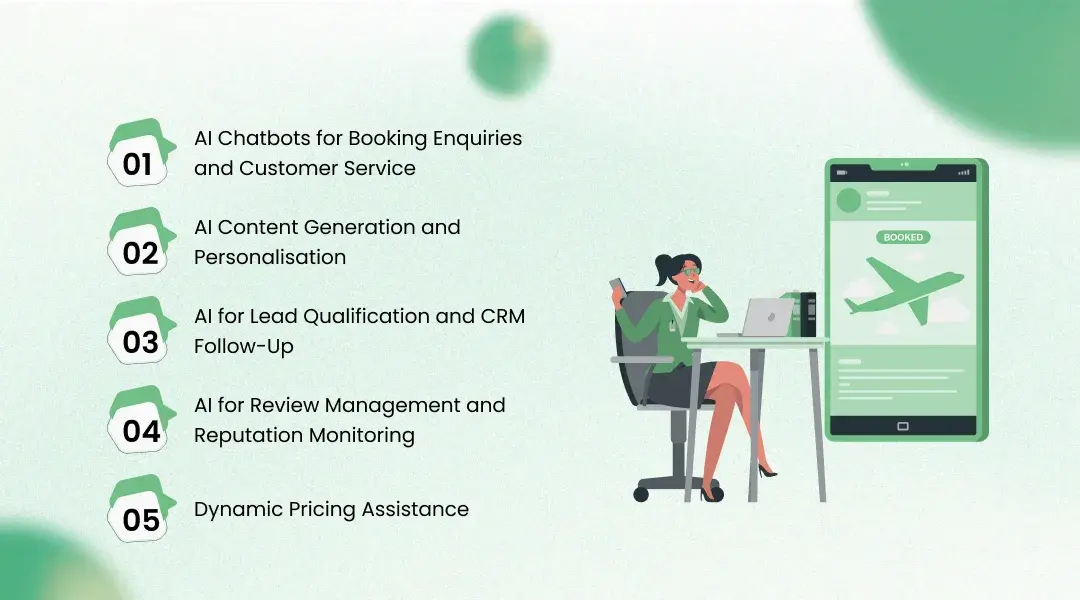
The single highest-return AI application for a small travel business is an AI-powered chatbot for handling initial customer enquiries. In a typical ten to twenty person travel agency, staff spend between thirty and forty percent of their working hours answering repetitive questions: what is included in this tour, can I customise the itinerary, what is the cancellation policy, do you offer travel insurance. These questions are important to the customer but do not require expert human judgment to answer. An AI chatbot trained on your product catalogue, pricing, and policies can handle these questions accurately, instantly, and outside business hours.
The practical cost at small business scale runs from $30 to $150 per month depending on the platform. The realistic outcome is a reduction of 40 to 60 percent in first-response time for incoming enquiries, plus genuine coverage outside the nine-to-five window when many leisure travellers are actually doing their research. This is not hypothetical. Small travel operators who have deployed AI chat report recovering an average of eight to twelve staff hours per week within the first month.
Small travel businesses create a disproportionate amount of content relative to their team size. Itinerary descriptions, destination guides, promotional emails, social media posts, and customised proposal documents for group bookings all require time-consuming writing work. AI writing tools can produce first drafts of all of these in minutes, tuned to your brand voice and adapted for different customer segments.
The economic case is straightforward. A content task that took ninety minutes now takes twenty minutes. Across a team where several people contribute to content creation, the weekly time savings accumulate quickly. More importantly, AI-assisted personalisation allows a small business to send meaningfully customised communication at a scale that was previously only possible with a dedicated marketing team.
Most small travel businesses have a leaky sales funnel. Enquiries come in, they receive an initial response, and then a significant percentage of warm leads are never followed up because the team is busy servicing existing customers. AI tools integrated with your CRM can score incoming leads, trigger follow-up sequences based on customer behaviour, and flag high-intent prospects for personal outreach by a human consultant.
At a cost of $50 to $200 per month for a CRM with AI features, this application directly addresses what is often the most significant revenue loss point in a small travel business. Recovering even two additional bookings per month from leads that would otherwise have gone cold can represent $4,000 to $10,000 in additional revenue depending on your average booking value.
Online reviews drive a disproportionate share of booking decisions for small travel businesses, and managing them consistently is a task that falls between the cracks in a busy team. AI tools can monitor review platforms, draft personalised responses for approval, identify sentiment trends across customer feedback, and flag emerging service issues before they escalate. This application costs $30 to $100 per month and protects the most valuable asset a small travel business has: its reputation for personal, high-quality service.
Pricing decisions in small travel businesses are often made based on intuition, competitor observation, and historical booking patterns held in a manager's head. AI-assisted pricing tools can analyse booking pace, seasonal demand signals, and competitor rate changes to recommend pricing adjustments. Even basic implementation of data-informed pricing can improve margin by three to eight percent across a season, which at the revenue scale of a small travel business represents meaningful profit improvement.
The question every small business owner asks before investing in any new technology is: what will this actually do for my numbers? For AI in small travel businesses, the evidence is building into a clear picture, and the results are calibrated specifically for businesses operating at ten to fifty staff level.
Businesses in this segment that deploy AI chatbots for customer enquiries report average response time improvements from four to six hours (typical for a small team managing email alongside other duties) to under two minutes for common questions. That is not a marginal improvement. For a leisure travel customer comparing three agencies at eight in the evening, an instant response versus a response the following morning is often the difference between winning and losing the booking.
Time recovery is the most consistent measurable benefit. A small travel agency with twenty employees where five people handle customer communication regularly recovers an average of twelve to eighteen staff hours per week within sixty days of deploying AI for enquiry management. At an average fully loaded staff cost of $25 to $35 per hour, that represents $15,000 to $30,000 in annual recovered capacity. The business can choose to use that capacity to handle more customers without hiring, to improve service quality for existing customers, or to redirect staff toward higher-value activities like group sales and partnership development.
On the revenue side, AI-assisted lead follow-up shows consistent improvement in booking conversion rates of twelve to twenty percent among small travel operators who implement structured AI-triggered follow-up sequences. For a business converting fifty enquiries per month at an average booking value of $2,500, a fifteen percent conversion improvement means approximately ten additional bookings monthly, adding $25,000 in monthly revenue.
Review management AI shows measurable impact on booking intent among customers who read reviews before booking. Consistent, personalised, prompt responses to both positive and negative reviews improve overall rating scores by an average of 0.3 to 0.5 stars over a twelve-month period for small operators. Given that 83 percent of travellers say reviews influence their booking decisions, even small rating improvements have measurable downstream revenue effects.
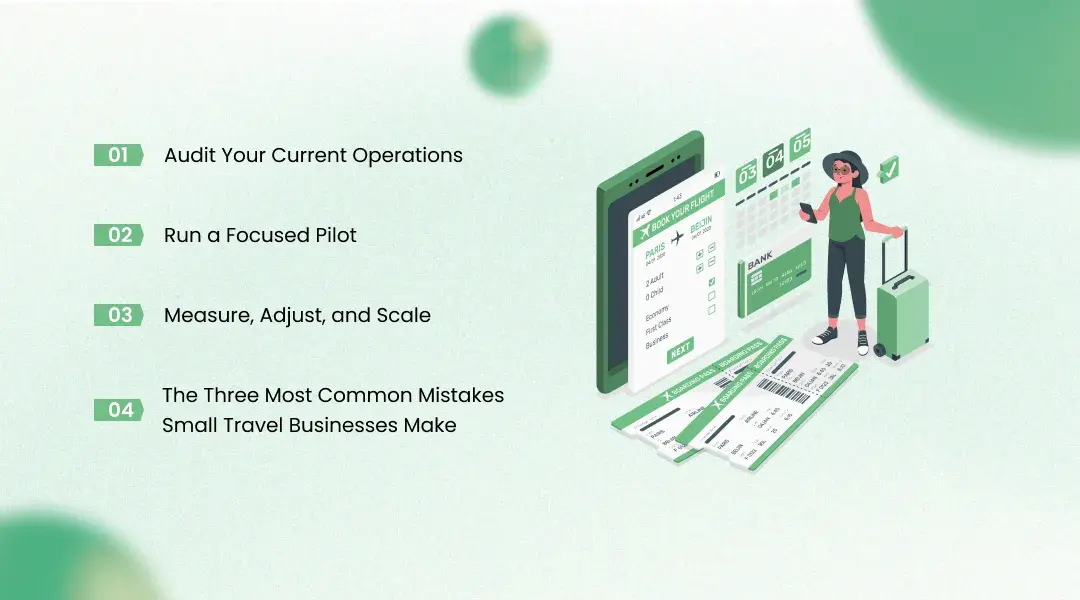
The first step in AI adoption for a small travel business is not to buy any software. It is to understand where your team's time actually goes. Spend two weeks doing a realistic time audit across your key roles. Ask your booking consultants, customer service staff, and marketing person to log what they do in thirty-minute blocks for five working days. The patterns that emerge will almost always be the same: a surprisingly large percentage of time goes to repetitive, low-judgment tasks that are perfect candidates for automation.
Once you have mapped the time distribution, identify the single workflow that consumes the most hours, involves the most repetition, and has the clearest inputs and outputs. For most small travel businesses this is initial enquiry handling, but for some it is itinerary document creation, post-booking communication, or review responses. That one workflow becomes your pilot AI use case.
Select one AI tool that addresses your pilot use case and deploy it in a controlled way. Set a clear success metric before you start, whether that is hours saved per week, response time improvement, or conversion rate change. Assign one person to own the pilot, not as their full-time job but as a defined responsibility that includes weekly review of the tool's outputs.
During the pilot phase, do not attempt to automate multiple workflows simultaneously. The most common mistake small travel businesses make is deploying three or four AI tools at once before they have learned how to manage one. This creates confusion about which tool is responsible for which outcome, makes it impossible to attribute results, and overwhelms staff who are adapting to new workflows while still managing their day-to-day responsibilities.
After two months of pilot operation, you should have enough data to make a genuine assessment. If the pilot tool is delivering measurable value, expand its scope or begin a second AI deployment. If it is not performing as expected, diagnose why before abandoning it. Most underperformance in early AI deployments at small business scale comes from inadequate training data (the tool does not know enough about your products), insufficient staff adoption (people are still defaulting to the old manual process), or mismatched use case selection (the task was not actually repetitive enough to justify automation).
The first mistake is choosing the most impressive tool rather than the most useful one. Small travel businesses frequently get attracted to AI tools with elaborate feature sets and sophisticated demonstrations but no clear fit with their specific workflow problems. The most useful AI tool is the one that solves your highest-volume repetitive problem, not the one with the most features.
The second mistake is underinvesting in staff adoption. Deploying an AI tool and assuming staff will naturally integrate it into their workflow is a consistent failure pattern. Allocate two to three hours of structured staff training per person, create simple guidelines on when to use the AI output versus when to add human judgment, and designate a point person who can field questions during the first month.
The third mistake is measuring success too quickly or too late. Checking results after one week is too soon to see meaningful patterns. Waiting six months without any review means problems compound without correction. Build in a formal four-week review and an eight-week review for any AI deployment.
Small travel businesses face a set of AI adoption challenges that are genuinely distinct from those of larger operators. Understanding them honestly is more useful than pretending they do not exist.
Budget constraints are real but often overstated as a barrier. The actual cost of meaningful AI deployment for a small travel business is $200 to $800 per month for a well-chosen stack of two to three tools. The more accurate budget challenge is not the monthly cost but the time investment required in the first sixty days: configuring tools, training them on your specific products and policies, onboarding staff, and reviewing outputs. For a team where everyone is already at full capacity, finding that implementation time is genuinely difficult.
Data quality is a specific challenge in this segment. AI tools perform best with clean, structured, comprehensive data. Many small travel businesses have customer and booking data distributed across systems that do not talk to each other, accumulated over years without consistent data entry standards, and containing significant gaps. Before deploying AI tools that rely on your own data for personalisation or lead scoring, a basic data hygiene exercise is often necessary. This is not glamorous work, but it is the foundation on which AI accuracy depends.
Staff resistance in small businesses is different from staff resistance in large organisations. In a small team, one or two individuals who are sceptical about AI can materially slow adoption because there is no critical mass of enthusiastic early adopters to create positive peer pressure. Address this honestly by involving staff in tool selection and being transparent about what AI is intended to replace (repetitive administrative tasks) versus what it is not intended to replace (relationship management, expert advice, and the personal service that is your competitive advantage).
Companies like KriraAI, which specialises in building practical AI solutions for businesses at exactly this scale, consistently find that the gap between small business AI potential and actual implementation is almost always a workflow design and change management problem rather than a technology problem. The tools exist and are affordable. The challenge is building them into your specific operational context correctly.
Project forward three years and the gap between small travel businesses that adopted AI in 2024 and 2025 versus those that waited will be visible and compounding. This is not a prediction about technology becoming more powerful. It is a prediction about the operational habits, data assets, and customer relationships that AI-adopting businesses are building right now.
A small travel business that deploys AI for customer communication in 2025 will, by 2027, have two years of structured data on customer enquiry patterns, booking preferences, objection types, and seasonal demand signals. That data becomes a proprietary asset that informs every future decision, from product development to pricing strategy to marketing targeting. A business that waits until 2027 to start collecting that data starts from scratch when competitors already have a two-year head start.
The compounding advantage operates in staff capability as well. Teams that have been working alongside AI tools for two years develop fluency with AI-assisted workflows that cannot be replicated quickly. They know which AI outputs to trust, which need human review, how to prompt tools for better results, and how to integrate AI assistance into client conversations naturally. That institutional knowledge is a genuine competitive asset.
Customer expectations are also shifting in one direction. By 2027, instant response, personalised itinerary suggestions, and proactive communication will not be differentiators. They will be table stakes. Small travel businesses that cannot deliver them will lose customers to those that can, regardless of the quality of their destination expertise.
The businesses that will lose ground are those treating AI adoption as a future project, as something to consider once the technology matures further or once they have more bandwidth to implement it properly. The technology is mature enough. The bandwidth argument is a loop that never resolves on its own. Early movers in this segment are not ahead because they had more resources. They are ahead because they made a deliberate decision to start, with what they had, when the window was open.
Three points from this blog are worth anchoring as you assess your next steps. First, AI adoption for small travel businesses is not about matching what large enterprises do. It is about finding the three or four specific operational improvements that your team size and budget make possible right now, delivering measurable returns within weeks, and building from there. Second, the economic case is already favourable. The tools have matured, the pricing is calibrated for small business volumes, and the returns are visible early enough to justify the investment without a leap of faith. Third, the competitive window is open but not permanent. The small travel businesses building AI-assisted operations in 2026 are accumulating data, capabilities, and customer experience advantages that will compound into structural leads by 2027.
KriraAI helps small travel and tourism businesses navigate exactly this opportunity. Rather than scaling down enterprise solutions that were never designed for your context, or applying generic startup tools that cannot handle the complexity of a multi-product travel operation, KriraAI builds practical AI implementations designed around the actual workflows, budgets, and team structures of businesses in the ten to fifty employee range. From initial workflow audit through tool selection, configuration, staff onboarding, and ongoing optimisation, KriraAI's approach is built on the reality that AI adoption success at this scale is a process problem as much as a technology problem.
If you are ready to understand exactly which AI applications will deliver the clearest returns for your specific travel business, reach out to KriraAI to start a conversation about where to begin.
A realistic AI implementation budget for a small travel business with ten to fifty employees is between $200 and $800 per month for ongoing tool costs, plus a one-time setup investment of $500 to $2,000 covering configuration, training, and any custom integration work. This is substantially lower than the enterprise AI investment figures that dominate business media coverage. At this price point, the economics are straightforward: if your AI chatbot recovers ten staff hours per week and your average staff cost is $25 per hour, the monthly labour saving is $1,000, which covers the tool cost and delivers a net positive return within the first month of deployment. The critical factor for small travel businesses is choosing tools with pricing models designed for low to mid volume usage, avoiding enterprise platforms that charge based on seat counts or feature tiers scaled to large organisations, and starting with a single well-chosen tool rather than a broad platform.
For most small travel operators and agencies, the best first AI tool is a customer-facing chatbot integrated with their website and WhatsApp, trained on their product catalogue, pricing, and FAQs. The reason this use case outperforms others as an entry point is the directness of its impact on two critical metrics: response time and staff hours recovered. Unlike AI content tools or CRM automation, a customer enquiry chatbot produces measurable results within the first two weeks of deployment, making it easy to evaluate and justify to owners or partners who are sceptical of the investment. Platforms such as Tidio, Freshchat, and Intercom offer plans suitable for small business volume starting at $30 to $80 per month, with setup interfaces that do not require technical expertise. The chatbot should be positioned as a first-response and triage tool, with clear handoff protocols to a human consultant for complex enquiries, group bookings, or any situation requiring expert destination knowledge.
Yes, and this is one of the most important facts about the current AI tool landscape for small travel businesses to understand. The generation of AI tools available in 2024 and 2025 is specifically designed for non-technical business users, with graphical interfaces, pre-built templates for common business functions, and onboarding processes that guide users through setup without requiring any coding knowledge. A travel agency owner or manager can configure an AI chatbot, set up automated email sequences, and connect AI tools to existing booking platforms using interface-based workflows in the same way they would set up a new email account or configure a booking calendar. For implementations that involve connecting multiple tools or customising AI behaviour in more sophisticated ways, a small number of hours from a specialist provider such as KriraAI can handle the technical configuration while leaving day-to-day tool management entirely in the hands of non-technical staff.
The timeline to visible results for AI in small travel businesses depends on which application is deployed, but the pattern is consistent: early wins appear within two to four weeks, meaningful operational impact is measurable within sixty days, and full integration into business rhythm typically takes four to six months. An AI chatbot shows results almost immediately, with response time improvements and staff hours recovered visible from the first week of real usage. AI content tools show results within the first month, typically in the form of reduced time per content task and increased content output volume. CRM automation and lead follow-up AI shows measurable results over a sixty to ninety day window, as the follow-up sequences work through the existing lead database and conversion improvements accumulate. The businesses that see fastest results are those that set clear before-and-after metrics before deployment, assign clear ownership to the AI pilot, and conduct weekly reviews of performance during the first eight weeks rather than waiting for a quarterly assessment.
AI in small travel businesses works best as an amplifier of personal service, not a replacement for it. The competitive advantage of a small travel business has never been the ability to answer basic FAQs quickly. It has been expert knowledge, trusted relationships, and the ability to craft experiences that automated booking engines cannot replicate. AI handles the administrative and repetitive layer of customer interaction, which currently consumes a significant fraction of staff time and attention without requiring the human qualities that actually differentiate small operators. When a consultant is freed from answering thirty enquiries per day about cancellation policies, they have more time and attention for the high-value conversations where their expertise genuinely matters: the group booking requiring destination intelligence, the repeat customer planning a significant anniversary trip, the family with complex accessibility requirements. AI, implemented correctly in small travel businesses, does not make service less personal. It makes personal service more available by removing the administrative burden that crowds it out.
Founder & CEO
Divyang Mandani is the CEO of KriraAI, driving innovative AI and IT solutions with a focus on transformative technology, ethical AI, and impactful digital strategies for businesses worldwide.