AI for Small Logistics Companies: A Practical Adoption Guide
A 2026 survey of 300 transportation decision makers found that 96 percent of transportation leaders currently use AI across planning and operations. Yet the vast majority of that adoption is concentrated in companies running hundreds or thousands of trucks. If you operate a logistics business with 10 to 50 employees, whether you are a regional carrier, a growing freight brokerage, or a specialized last-mile delivery outfit, you likely feel a growing gap between what the industry leaders are doing with technology and what you can realistically afford. That gap is not just uncomfortable. It is becoming a competitive threat.
The U.S. freight trucking industry is composed overwhelmingly of small businesses. As of early 2024, over 575,000 active motor carriers were registered with the Federal Motor Carrier Safety Administration, with 95 percent operating 10 or fewer trucks. Companies in the 10-to-50-employee range sit at a critical inflection point. They are too large to run on spreadsheets and phone calls alone, but too small to deploy the enterprise platforms that C.H. Robinson or XPO Logistics uses to automate thousands of transactions daily. AI for small logistics companies is not about replicating what the giants do. It is about finding the specific, high-return applications that match the budget, team structure, and operational reality of a business at this scale.
This guide walks you through exactly how a small logistics company should approach AI adoption in 2026, drawing on the kind of practical, phased thinking that shapes KriraAI's AI consultancy services for growing operators. You will learn which applications deliver the fastest payback at your scale, what realistic costs and timelines look like, what mistakes to avoid, and how to build a phased implementation plan that does not overwhelm your team or your cash flow. Every recommendation in this article is calibrated for companies running between 10 and 50 employees, not scaled-down enterprise advice, and not startup hype.
The Operational Reality of a 10- to 50 Employee Logistics Company
Understanding why AI adoption looks different at this scale starts with understanding the daily reality of companies in this segment. A typical small logistics business with 10 to 50 employees operates with a flat organizational structure. The owner or general manager often handles strategic decisions, customer relationships, and operational oversight simultaneously. There may be a small dispatch team of two to five people, a handful of drivers or warehouse staff, one or two people managing billing and compliance, and perhaps a part-time bookkeeper. There israrelyr a dedicated IT department or a Chief Technology Officer.
The technology stack at this size is usually built around a basic Transportation Management System, or in some cases just QuickBooks combined with load board subscriptions and a patchwork of spreadsheets. Many companies at this scale still rely heavily on email, phone calls, and even fax for carrier communications and document exchange. The budget for technology is constrained, typically ranging from $2,000 to $10,000 per month for all software combined. Capital expenditures for new technology projects are evaluated against immediate operational needs like truck maintenance, fuel costs, and insurance premiums.
Decision-making at this company size happens fast compared to enterprises, which is actually an advantage. The owner can decide to try a new tool on Monday and have the team testing it by Wednesday. But the flip side of that speed is risk sensitivity. A failed technology investment at a company this size is not a line item that gets absorbed into a corporate budget. It is money that could have gone toward a new driver hire or a truck lease payment. These companies also face acute pressure from both directions. Larger competitors are using AI to undercut them on pricing and speed. Smaller owner-operators, with almost no overhead, can sometimes underbid them on simple lanes. The 10-to-50-employee logistics company must find ways to operate with the efficiency of a larger firm while maintaining the flexibility and customer intimacy of a smaller one. That is precisely where the right AI tools, deployed thoughtfully, create the most leverage.
Why AI Adoption Looks Different at This Scale
The AI advice dominating logistics trade publications is written for companies with dedicated data science teams, multi-million-dollar technology budgets, and complex integration requirements. That advice is not just irrelevant for small logistics companies. Following it can actually be harmful, leading to overspending on platforms built for a scale of operations you do not have, or worse, creating analysis paralysis that delays any action at all.
Enterprise AI vs. Small Business AI: The Real Differences
A Fortune 500 logistics company deploying AI might spend $500,000 to $2 million on a custom machine learning model for demand forecasting, train it on years of proprietary data across thousands of lanes, and assign a team of data engineers to maintain it. A small logistics company with 30 employees does not need that and should not attempt it. Instead, the same forecasting benefit can come from a $200 to $500 per month SaaS tool that uses pre-trained models and requires only your historical load data to generate useful predictions.
The vendor landscape for AI tools will have matured significantly by 2026. Where two years ago, most AI logistics tools were built for enterprise buyers, today there is a growing ecosystem of products designed specifically for small to mid-sized carriers and brokerages. Platforms like Numeo, Alvys, and Parade offer AI capabilities at price points accessible to companies running 15 to 40 trucks. KriraAI has observed that small logistics companies achieve the best results when they adopt AI through these purpose-built tools rather than trying to customize enterprise platforms. The implementation complexity is also fundamentally different. An enterprise deployment might take 6 to 12 months with dedicated project managers. A small logistics company should be looking at tools that deliver value within 2 to 6 weeks, with minimal configuration and no need for custom development.
The internal skill requirements differ as well. You do not need to hire a machine learning engineer. What you need is one or two team members who are comfortable learning new software, a willingness to standardize your data inputs, and a clear understanding of which operational bottleneck you want to solve first. The timeline to see returns is compressed at this scale, which is good news. Because your operations are more contained and your decision loops are shorter, you can often see measurable improvements within the first month of using an AI tool correctly.
The Right AI Applications for Small Logistics Companies
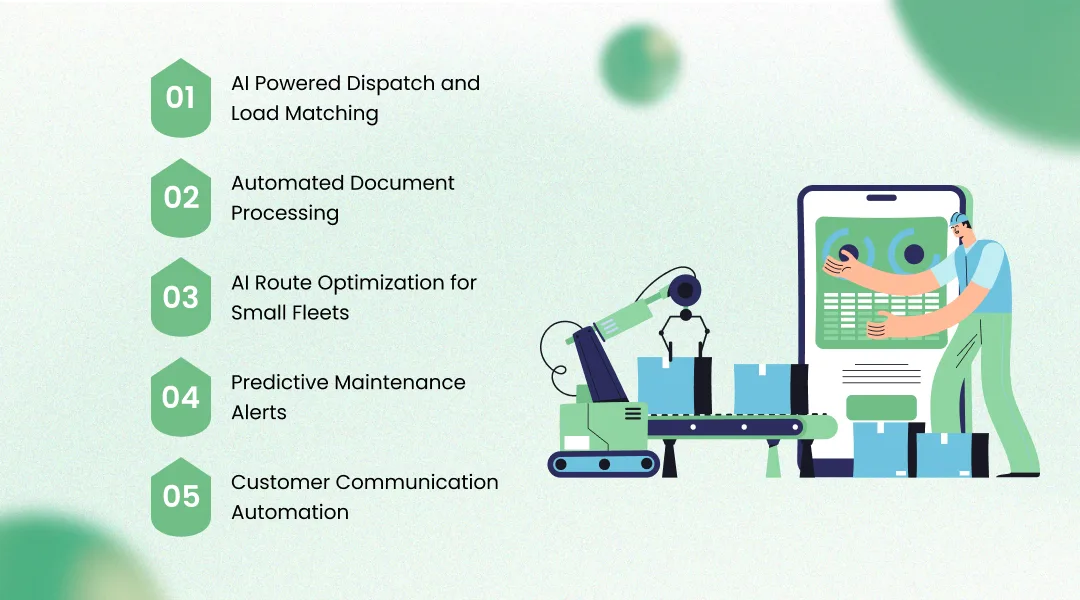
Not every AI application makes sense at this scale. The key is selecting tools that solve your most expensive or most time-consuming problems first, with the lowest implementation friction. Here are the applications that consistently deliver the best return for logistics companies with 10 to 50 employees.
AI-Powered Dispatch and Load Matching
For small carriers and brokerages, dispatch is where the most time disappears. A dispatcher managing 15 to 30 trucks may spend 3 to 4 hours daily searching load boards, cross-referencing rates, and matching available capacity to freight. AI freight matching tools cut this time dramatically by scanning multiple load boards simultaneously, analyzing rate history for specific lanes, and recommending optimal load assignments based on truck location, driver hours, and delivery deadlines. At this scale, expect to pay $150 to $400 per month for an AI dispatch assistant. The realistic result is a 40 to 60 percent reduction in time spent on load search, plus a 5 to 10 percent improvement in revenue per truck per week through better load selection.
Automated Document Processing
Small logistics companies process dozens to hundreds of bills of lading, proof of delivery documents, rate confirmations, and invoices weekly. Manual processing of these documents consumes significant back-office hours and introduces errors that delay payment. AI document processing tools extract data from scanned or photographed documents, classify them automatically, and populate your TMS or accounting system. Modern platforms achieve 95 to 98 percent accuracy in document extraction, reducing manual data entry by up to 80 percent. For a company with 10 to 50 employees, this typically translates to freeing up 15 to 25 hours per week of administrative labor.
AI Route Optimization for Small Fleets
AI route optimization small fleet solutions analyze traffic patterns, delivery windows, fuel costs, and driver schedules to generate routes that minimize miles and maximize on-time delivery, the same logic behind KriraAI's supply chain optimization solutions built for operations moving physical goods. Unlike basic GPS routing, AI optimization considers dozens of variables simultaneously and updates routes dynamically. For a fleet of 10 to 40 trucks, route optimization AI typically reduces total miles driven by 8 to 15 percent and improves on-time delivery rates by 10 to 20 percent. Monthly costs for small fleet route optimization tools range from $10 to $25 per vehicle, making this one of the most accessible entry points for AI adoption.
Predictive Maintenance Alerts
Unplanned truck breakdowns cost small fleets an average of $500 to $700 per day in lost revenue, not counting repair costs. AI powered predictive maintenance systems analyze data from electronic logging devices and telematics sensors to identify patterns that precede mechanical failures, an approach detailed further in a manufacturing predictive maintenance case study where KriraAI cut unplanned downtime by 47 percent. These systems can alert you to potential issues days or weeks before a breakdown occurs. For small fleets, the most practical approach is to use AI features already embedded in modern ELD and telematics platforms rather than purchasing standalone predictive maintenance software. KriraAI recommends that small logistics companies evaluate their existing telematics provider for AI maintenance features before adding another vendor to their stack.
Customer Communication Automation
AI chatbots and automated communication tools, including AI voice agents automating dispatch and check calls, can handle routine customer inquiries about shipment status, estimated arrival times, and basic rate quotes without requiring a team member to respond manually. For a brokerage with 20 to 40 employees, automating these interactions frees up 10 to 20 hours per week of customer service time while actually improving response speed. Modern logistics chatbots integrate with TMS platforms to pull live tracking data and can respond to status inquiries within seconds rather than the 15 to 30 minutes it might take a human to check, compose, and send a response.
Quantified Business Impact: What Small Logistics Companies Actually Gain
The numbers that matter for a 10 to50-employeee logistics company are different from enterprise metrics. When McKinsey reports that AI can reduce supply chain costs by 15 percent, that translates into millions of dollars for a large corporation. For your business, the question is more specific. How many hours does this save my team each week, how much does it improve my margins per load, and how quickly does it pay for itself?
Logistics automation ROI for small businesses is best measured in three categories. The first is time recovery. Small logistics companies that implement AI dispatch tools report saving their dispatch team an average of 12 to 20 hours per week across all dispatchers. At a fully loaded labor cost of $25 to $35 per hour, that represents $1,200 to $2,800 in weekly labor savings, or roughly $5,000 to $12,000 per month. The second category is margin improvement. AI rate analysis and load matching tools help dispatchers select loads with better revenue per mile. Companies at this scale typically see a 3 to 7 percent improvement in average revenue per load within the first quarter of using AI matching tools. For a company moving 200 loads per month at an average of $2,000 per load, a 5 percent improvement represents $20,000 in additional monthly revenue. The third category is error reduction. Automated document processing and billing reduce invoicing errors by 60 to 80 percent, which directly improves cash flow by reducing payment disputes and shortening days sales outstanding.
The combined effect of these improvements is substantial at this scale. A 30-person logistics company spending $1,500 per month on AI tools can realistically expect a total monthly benefit of $15,000 to $30,000 in combined labor savings, revenue improvement, and error reduction. That represents a 10 to 20x return on the technology investment, which is why logistics automation ROI for small businesses is often stronger than the returns larger companies achieve with their much more expensive AI deployments.
A Step-by-Step Implementation Roadmap for Small Logistics Companies
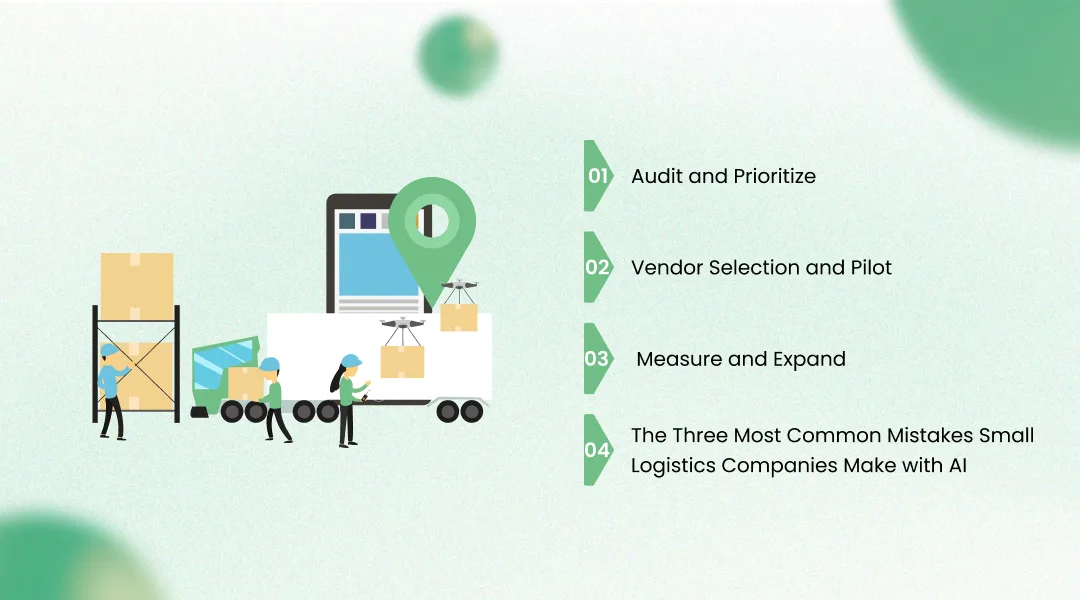
Implementing AI in trucking operations does not require a massive transformation project. For companies with 10 to 50 employees, the most effective approach is phased, starting with one high-impact application and expanding from there. Here is the roadmap that works best at this scale.
Phase 1: Audit and Prioritize (Weeks 1 to 2)
Before selecting any tool, spend two weeks documenting where your team spends the most time on repetitive, low-value tasks. Have each team member track their daily activities for one week, noting which tasks are manual, repetitive, and could potentially be handled by software. Common findings at this company size include excessive time on load searching, manual data entry from documents, repetitive status update communications, and rate comparison across multiple sources. Rank these by the combination of time consumed and business impact. The task that consumes the most hours and has the most direct impact on revenue or cash flow should be your first AI target.
Phase 2: Vendor Selection and Pilot (Weeks 3 to 6)
Select one AI tool that addresses your top priority. Evaluate no more than three vendors to avoid decision fatigue. Key criteria for small logistics companies should include monthly pricing under $500 for the initial tool, setup time under one week, integration with your existing TMS, no requirement for dedicated IT support, and a free trial period. Begin with a pilot involving two to three team members, not the entire company. This limits risk while generating real data on the tool's effectiveness. Set clear success metrics before starting the pilot, such as hours saved per week, loads matched per day, or documents processed without manual intervention.
Phase 3: Measure and Expand (Weeks 7 to 12)
After 30 days of piloting, compare your results against the baseline you established in Phase 1. If the tool is delivering measurable improvement, roll it out to the full team and begin standardizing workflows around it. Once the first tool is fully adopted, typically by weeks 8 to 10, begin evaluating your second priority area for AI adoption. This phased approach prevents the team from feeling overwhelmed and ensures each tool is properly integrated before adding the next one.
The Three Most Common Mistakes Small Logistics Companies Make with AI
The first mistake is buying too much too soon. Companies that purchase a full suite of AI tools simultaneously before mastering any single one almost always see poor adoption and wasted spend. Start with one tool, prove its value, build team confidence, then expand. The second mistake is choosing enterprise-grade platforms that are too complex for your operation. A 25-person brokerage does not need the same platform that manages 50,000 daily shipments for a global 3PL. Enterprise tools require enterprise-level data, enterprise-level integration, and enterprise-level training. Choose tools built for your size. The third mistake is neglecting data quality. AI tools are only as effective as the data they receive. If your TMS has inconsistent lane naming conventions, missing fields, or duplicate entries, your AI tools will produce unreliable results. Spend time cleaning your core data before expecting AI to work magic with it. KriraAI frequently helps small logistics companies address this exact challenge, building practical data cleanup processes that do not require technical expertise but dramatically improve the performance of every AI tool deployed afterward.
Challenges Specific to Small Logistics Companies Adopting AI
Small logistics companies face friction points that larger organizations simply do not encounter. The most significant is the absence of internal technical expertise. When an AI tool requires even moderate customization, such as building a custom integration between your TMS and a new dispatch AI, there is no IT team to call. You are either paying a consultant, relying on the vendor's support team, or asking your most tech-savvy dispatcher to figure it out. This dependency on vendor support means that your AI adoption speed is partly determined by the quality and responsiveness of the vendors you choose.
Budget timing is another challenge unique to this segment. A 40-person logistics company operating on thin margins cannot easily commit to annual contracts for AI tools before proving their value. This makes vendors with monthly billing, free trials, and no long-term commitments significantly more attractive, even if their per-month cost is slightly higher than annual contract pricing. The cash flow structure of small logistics businesses, where payment cycles can stretch 30 to 60 days while operating expenses are due immediately, means that any new technology cost needs to show returns within the first billing cycle to gain internal support.
Team resistance is also more impactful at this scale. In a company of 500 employees, if five people resist a new tool, the organization absorbs the friction. In a company of 20 employees, if two dispatchers refuse to use a new AI matching tool, that represents 10 percent of the workforce actively undermining the investment. Change management at this scale is less about formal training programs and more about direct, honest conversations with each team member about how the tool helps them personally, not just the company. Showing a dispatcher that AI frees them from 90 minutes of daily load board scrolling so they can focus on building carrier relationships is more persuasive than any ROI spreadsheet.
The Future Competitive Landscape: What Happens in the Next Three to Five Years
The transportation and logistics industry is entering a period where AI adoption will separate companies that grow from companies that stagnate. For small logistics companies in the 10-to-50-employee range, the compounding advantage of early AI adoption is particularly powerful because it directly addresses the constraints that limit growth at this size.
Companies that adopt AI now will be able to handle 30 to 50 percent more volume without proportionally increasing headcount. A 25-person brokerage using AI dispatch, automated document processing, and AI rate analysis can process the same number of loads as a 35- to40-personn brokerage operating manually. Over three to five years, that efficiency advantage compounds. The AI-adopting company reinvests savings into better driver pay, expanded lane coverage, and customer acquisition, while the manual operation struggles to keep up with rising labor costs and competitive pricing pressure.
Between 2028 and 2030, industry analysts project that AI will be involved in the majority of freight matching and pricing decisions across the industry. Companies that have not adopted AI in trucking operations by then will find themselves unable to compete on speed, accuracy, or price. The freight brokerage segment has already seen significant consolidation, with the number of active brokerages declining from over 31,000 in 2022 to approximately 27,000 by mid 2024. AI adoption will accelerate this consolidation, and the companies that survive will disproportionately be those that used technology to operate above their weight class. KriraAI projects that small logistics companies implementing AI in 2026 will achieve a 15 to 25 percent cost advantage over non-adopting competitors within 18 months, a gap that will be extremely difficult to close once established.
Conclusion
Three points stand out from everything covered in this guide. First, AI for small logistics companies is no longer expensive or complex to implement. The ecosystem of affordable, purpose-built tools has matured to the point where any company with 10 to 50 employees can find solutions that fit their budget and require no technical expertise to deploy. Second, the biggest risk for small logistics companies in 2026 is not adopting AI too early. It is waiting too long and allowing competitors to build efficiency advantages that compound over time. Third, the right approach is phased and practical: start with one tool that solves your biggest bottleneck, prove its value within 30 to 60 days, then expand deliberately.
KriraAI works specifically with small and mid-sized logistics companies to identify thehighest-impactt AI applications for their operations, implement solutions that integrate with their existing tools, and build the data foundations that make every AI investment more effective over time, implement solutions that integrate with their existing tools, and build the data foundations that make every AI investment more effective over time. Rather than offering one-size-fits-all enterprise software or generic AI consulting, KriraAI designs implementations around the actual constraints and growth objectives of companies at this scale, because the logistics companies that move goods across this country deserve technology partners who understand their reality. If you are running a logistics operation with 10 to 50 employees and want to explore which AI applications would deliver the strongest return for your specific situation, reach out to KriraAI for a practical assessment built around your operations, not a sales pitch.
FAQs
The total cost of implementing AI for small logistics companies typically ranges from $500 to $2,500 per month for the first year, depending on how many tools you adopt and how quickly you expand. Initial deployment costs are minimal because most AI logistics tools in 2026 are cloud based SaaS products that require no hardware, no installation, and no upfront license fees. A typical small logistics company starts with one tool at $150 to $400 per month, then adds a second application within three to four months. The key cost consideration at this size is not the software subscription itself but the time your team invests in learning and adopting the tool. Budget approximately 10 to 15 hours of total team time for initial training and workflow adjustment per tool. At a labor cost of $30 per hour, that represents a one time adoption cost of $300 to $450 per tool, which is recovered within the first month of productivity gains in nearly all cases.
The best starting point for most small trucking companies is an AI powered dispatch and load matching tool, because dispatch is where small fleets lose the most time and revenue. Tools like Numeo and similar platforms are specifically designed for small to mid size carriers and offer AI load search across multiple boards, automated rate analysis, and integrated dispatch management at price points under $300 per month. If your primary bottleneck is back office rather than dispatch, start with an AI document processing tool that automates invoice and BOL handling instead. The critical principle is to start with the tool that addresses your single biggest operational bottleneck. Do not start with the most advanced or most hyped AI application. Start with the one that saves your team the most hours in the first week.
AI will not replace dispatchers or back office staff at small logistics companies, but it will fundamentally change what they spend their time doing. The pattern observed across small logistics companies adopting AI is that existing staff become significantly more productive rather than being eliminated. A dispatcher who previously managed 12 trucks can often manage 18 to 22 with AI assistance, handling the increased volume without additional hires. Back office staff who spent 70 percent of their time on data entry and document processing find that AI reduces that to 15 to 20 percent of their time, freeing them for higher value work like customer relationship management, exception handling, and strategic planning. For a company with 10 to 50 employees, this productivity gain typically means you can grow revenue by 30 to 50 percent before needing your next hire, which is a transformative advantage in an industry with persistent labor shortages and rising wage costs.
Small logistics companies typically see measurable ROI from AI tools within 30 to 60 days of active use, which is significantly faster than the 6 to 12 month timeline common at enterprise scale. The speed of return is driven by two factors specific to small companies. First, the problems being solved are immediate and tangible, such as reducing load search time or automating document handling, so benefits appear as soon as the team starts using the tool consistently. Second, the small team size means that even modest per person productivity gains translate to noticeable business impact quickly. A 30 percent reduction in dispatch time for three dispatchers at a 25 person company frees up roughly 30 hours per week, which is visible in the very first week of use. The full ROI picture, including revenue improvements from better load selection and margin gains from rate optimization, typically becomes clear within 60 to 90 days as the AI tools accumulate enough operational data from your specific lanes and customers to generate increasingly accurate recommendations.
You do not need perfect data to start using AI, but you do need minimally organized data to get useful results. The most common data issue at small logistics companies is inconsistency rather than absence. Your TMS may have the same customer entered three different ways, lane names that vary between dispatchers, or rate fields that mix per mile and flat rate formats without clear labels. Most modern AI logistics tools can work with imperfect data, but they will produce better results if you spend a few days cleaning your most critical data fields before launching. Focus on standardizing customer names, origin and destination formats, and rate structures. You do not need a data warehouse or a database administrator. A few hours of cleanup in your TMS by someone who understands your operations will dramatically improve the accuracy of any AI tool you deploy. Companies that skip this step entirely often blame the AI tool for poor results when the real problem is inconsistent input data.
Ridham Chovatiya is the COO at KriraAI, driving operational excellence and scalable AI solutions. He specialises in building high-performance teams and delivering impactful, customer-centric technology strategies.