
AI in Transportation and Logistics: The 2026 Industry Guide
The global AI in logistics market reached an estimated $26.35 billion in 2025, growing at a compound annual growth rate of 44.4% and projected to surpass $700 billion by 2034. That figure alone tells a story that logistics executives can no longer afford to ignore. AI in transportation and logistics has shifted from a technology experiment to an operational necessity, and the companies that fail to recognize this shift are already losing ground to competitors who have embraced it.
Consider what is happening on the ground. UPS processes over 30,000 route optimizations per minute through its ORION system, saving approximately 38 million liters of fuel every year. Predictive maintenance systems are cutting fleet downtime by 30% or more, turning what used to be emergency breakdowns into scheduled, low cost repairs. These are measurable outcomes from companies operating at scale today, not aspirational projections from a research lab.
This blog provides a detailed, data driven analysis of how AI is transforming transportation and logistics. It covers the core technologies driving change, quantified business results, a practical implementation roadmap, real challenges, and a forward looking view of where this industry is headed. Whether you are a logistics director evaluating your first AI pilot or a C suite executive building a multi year technology strategy, the information here is designed to help you make better decisions.
The State of Transportation and Logistics Before AI
Transportation and logistics is one of the world's largest industries, with the global logistics market valued at over $11 trillion in 2025 and projected to exceed $24 trillion by 2035. Despite its massive scale, this industry has long been characterized by thin margins, operational fragility, and a heavy reliance on manual processes. Understanding these baseline challenges is essential before evaluating what AI can realistically solve.
Fuel costs represent one of the most persistent pain points. For most logistics operators, fuel accounts for 30% to 40% of total operational expenses, and those costs fluctuate unpredictably based on geopolitical events, regulatory changes, and commodity markets. The Red Sea shipping crisis in early 2025, which forced cargo vessels to reroute thousands of miles, demonstrated how a single disruption can spike freight costs across entire supply chains within days.
Labor shortages compound the problem. The trucking industry faces a chronic driver deficit, and over 30% of diesel technician positions remain unfilled across the United States. Meanwhile, 42% of current technicians plan to retire by 2028. Warehouse operations face similar pressures, with seasonal demand spikes creating staffing volatility. These workforce gaps drive up wages, increase overtime spending, and force companies to accept lower productivity.
Inventory management remains another area of widespread inefficiency. Traditional demand forecasting methods, built on historical sales curves and human judgment, routinely produce errors that lead to overstocking or stockouts. Excess inventory ties up working capital, while stockouts erode customer trust and drive revenue losses. In an era of same day delivery expectations, the tolerance for forecasting errors has shrunk to nearly zero.
Supply chain visibility is also limited for most operators. Many logistics companies still rely on fragmented systems that cannot provide real time tracking across a shipment's full journey. When disruptions occur, the response is often reactive, with planners spending hours manually rebuilding transportation plans in a process that is slow, error prone, and unsustainable as supply chains grow more complex.
How AI in Transportation and Logistics Is Solving Industry Problems
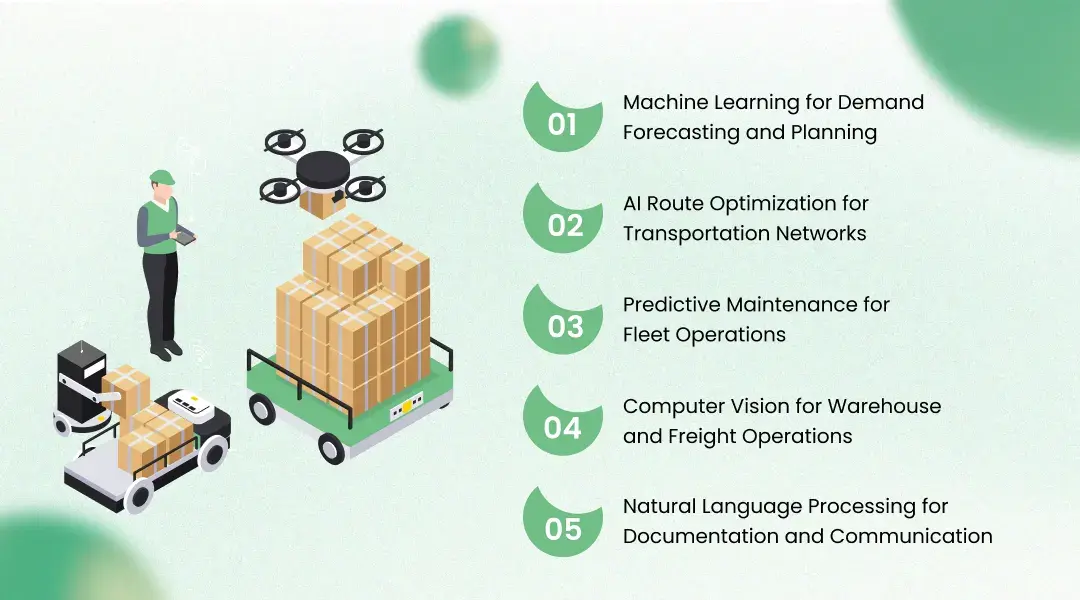
The technologies driving AI adoption in transportation and logistics are not monolithic. Each addresses a specific set of operational challenges, and understanding the mapping between technology and problem is critical for any company evaluating where to invest. KriraAI works with logistics enterprises to identify precisely these mappings, ensuring that AI deployments target the highest value operational friction points rather than chasing generic automation.
Machine Learning for Demand Forecasting and Planning
Machine learning models have become the backbone of modern demand forecasting in logistics. Unlike traditional statistical methods, ML algorithms can ingest dozens of external signals, including weather patterns, economic indicators, promotional calendars, and competitor activity, to generate significantly more accurate forecasts. AI demand forecasting logistics solutions deployed across retail and CPG supply chains have demonstrated error reductions of 20% to 50% compared to legacy systems.
Companies using AI driven demand forecasting have achieved up to 35% reductions in inventory levels while boosting service levels by 65%. These represent a fundamental shift in how companies balance the tradeoff between inventory investment and customer satisfaction. The models also improve over time, continuously learning from new data to refine predictions.
AI Route Optimization for Transportation Networks
AI route optimization logistics is arguably the most immediately impactful application of artificial intelligence in this industry. Modern route optimization engines analyze real time traffic data, weather conditions, construction zones, delivery time windows, vehicle capacities, driver schedules, and fuel efficiency profiles to generate routes that minimize total cost while meeting service commitments.
Companies implementing AI powered route optimization report cost reductions of 15% to 30% on transportation spend. Fleet operators typically see a 15% to 25% reduction in total miles driven, which directly extends vehicle lifespans and reduces maintenance expenses. Administrative time spent on route planning drops by 30% to 50%, freeing dispatchers to focus on exception handling and strategic decisions. The technology also enables dynamic rerouting in response to real time disruptions, a capability manual planning cannot replicate at scale.
Predictive Maintenance for Fleet Operations
Predictive maintenance fleet management represents one of the highest ROI applications of AI in transportation. By analyzing sensor data from engines, brakes, transmissions, and other critical components, machine learning models can predict when a part is likely to fail and recommend maintenance at the optimal time, not too early (wasting parts and labor) and not too late (risking a breakdown).
The financial case is compelling. Maintenance and repair account for approximately 11% of total fleet operating costs, and that percentage is rising year over year. Predictive maintenance reduces overall maintenance costs by 25% to 30% through optimized parts inventory, fewer emergency repairs, and extended component lifecycles. Companies in the transportation sector that have deployed predictive maintenance report a 30% reduction in unplanned downtime. Fortune 500 fleets lose an estimated $2.8 billion annually to unplanned downtime, illustrating the scale of opportunity.
Computer Vision for Warehouse and Freight Operations
Computer vision technology is transforming warehouse operations and freight inspection. AI powered cameras and sensors can identify damaged packages, verify shipment contents, count inventory, and monitor loading dock operations without human intervention. In warehouse environments, computer vision systems guide robotic picking and packing operations, increasing throughput while reducing error rates. For freight operations, computer vision enables automated inspection of cargo containers and trailer loading patterns, detecting anomalies that human inspectors might miss during routine checks.
Natural Language Processing for Documentation and Communication
The logistics industry generates enormous volumes of documentation, from bills of lading to customs declarations and compliance records. Natural language processing enables AI systems to extract, classify, and validate information from these documents automatically, reducing manual data entry errors and accelerating processing times. AI supply chain automation through NLP is particularly valuable in cross border logistics, where documentation errors can result in costly customs delays. NLP also powers intelligent chatbots that handle routine shipment tracking inquiries and delivery schedule changes, freeing human agents for complex issues.
Quantified Business Impact: What the Numbers Actually Show
The financial impact of AI adoption in transportation and logistics is now well documented across multiple categories. What distinguishes AI from previous waves of logistics technology is the compounding nature of its benefits: improvements in one area, such as route optimization, create downstream gains in fuel efficiency, vehicle maintenance, and customer experience.
Research from McKinsey indicates that integrating AI into supply chain operations can cut logistics costs by 5% to 20%. For a mid-sized logistics company spending $50 million annually on transportation, even a 10% reduction translates to $5 million in annual savings, a figure that typically exceeds the total cost of AI implementation. In route optimization specifically, a medium sized fleet operating 50 vehicles typically wastes $300,000 to $500,000 annually due to suboptimal routing, and AI recaptures the majority of this waste.
AI powered freight matching platforms have demonstrated the ability to reduce empty miles by up to 45%. Every empty mile represents wasted fuel, wasted driver time, and unnecessary carbon emissions. XPO, a mid-sized logistics provider, reduced transportation costs by 15% through AI powered freight matching while automating 99.7% of load assignments. Penske's 2025 Transportation Leaders Survey found that 40% of fleets using AI reported at least a 50% improvement in fuel savings, operational expenditures, and route efficiency. KriraAI has observed similar patterns among its enterprise logistics clients, where AI deployments focused on the right operational pain points consistently deliver ROI within the first six to twelve months.
Inventory optimization powered by AI demand forecasting logistics tools is delivering equally dramatic results. Companies report 35% reductions in inventory levels combined with 65% improvements in service levels. Dynamic pricing models powered by AI can improve profit margins by up to 10% by adjusting rates in real time based on fuel costs, demand shifts, and capacity constraints.
Building Your AI Implementation Roadmap
Implementing AI in transportation and logistics is not a single project. It is a multi phase journey that requires careful planning, executive alignment, and a willingness to iterate. The companies that succeed with AI treat it as a strategic capability, not a technology purchase. This section outlines the practical steps for moving from initial assessment to full scale deployment.
Phase 1: Audit and Readiness Assessment
The first step is understanding where your organization stands today. This means conducting a thorough audit of your data infrastructure, operational workflows, and technology stack. Key questions to answer during this phase include the following.
What data do you currently collect, and how is it stored, accessed, and governed?
Which operational processes consume the most time, cost, or management attention?
Where do errors, delays, or inefficiencies occur most frequently?
What is the organization's appetite for change, and who are the internal champions for AI adoption?
This phase typically takes four to eight weeks and should involve stakeholders from operations, IT, finance, and leadership. The output is a prioritized list of AI use cases ranked by expected impact, feasibility, and alignment with business strategy.
Phase 2: Pilot Program Design and Execution
Selecting the right pilot is critical. The ideal pilot project has a clearly defined scope, measurable success criteria, a manageable data requirement, and a timeline of three to six months. AI route optimization logistics and AI demand forecasting logistics are common starting points because they offer relatively fast time to value without requiring wholesale workflow changes. During the pilot, focus on validating model accuracy, measuring quantified business impact against your baseline, and documenting the operational changes required for broader adoption.
Phase 3: Scaling and Integration
Once a pilot demonstrates clear ROI, the next step is scaling across additional routes, regions, or business units. This phase requires investment in data integration, system connectivity, and change management. AI systems deliver the most value when connected to your transportation management system, warehouse management system, and customer facing applications.
Common Mistakes and How to Avoid Them
Many AI implementations in logistics fail not because of the technology itself, but because of avoidable errors in planning and execution. Here are the most common pitfalls.
Starting with technology instead of problems. Companies that select an AI platform before identifying their highest value use cases often end up with solutions looking for problems. Always start with the operational challenge.
Underinvesting in data quality. Companies achieving 95% or higher data accuracy see 40% better optimization results. Allocate time and budget for data cleanup before launching any AI initiative.
Ignoring change management. Driver adoption of AI recommended routes has been documented as low as 35% in organizations that fail to involve frontline workers. Companies using feedback systems and efficiency incentives have raised adoption to 96%.
Expecting overnight transformation. AI capabilities improve as models learn from more data. Plan for a learning curve of three to six months before drawing conclusions.
KriraAI's approach to AI implementation emphasizes these practical realities, helping logistics enterprises build phased roadmaps that prioritize quick wins while laying the foundation for long term advantage.
Challenges and Limitations of AI Adoption
No honest assessment of AI in transportation and logistics can ignore the significant challenges companies face during adoption. The technology is powerful, but the obstacles are both technical and organizational.
Data quality remains the single largest barrier. Logistics operations generate massive volumes of data from GPS trackers, IoT sensors, warehouse management systems, and manual entry processes. Much of this data is incomplete, inconsistent, or siloed across incompatible systems. Cleaning and integrating this data is often the most time consuming and expensive part of an AI project, yet it is frequently underbudgeted.
The talent gap is another persistent challenge. Building and maintaining AI systems requires data engineers, machine learning specialists, and domain experts who understand both the technology and the logistics industry. These professionals are in short supply, and many logistics companies find that partnering with specialized AI firms is the most practical path forward.
Regulatory complexity adds difficulty for companies operating across multiple jurisdictions. Data privacy regulations, customs compliance requirements, and transportation safety standards vary by country and region, limiting the ability to deploy a single global solution without significant customization. Integration with legacy systems should not be underestimated either, as many logistics companies run core operations on platforms that were never built to support real time data exchange with AI applications.
Finally, there is the human factor. Frontline workers may resist AI driven changes if they perceive the technology as a threat to their jobs or autonomy. Effective change management requires transparent communication, genuine investment in retraining, and a commitment to using AI as a tool that augments human capabilities rather than replacing them.
The Future of AI in Transportation and Logistics
Looking three to five years ahead, the transportation and logistics industry will be fundamentally different from what it is today. The companies that invest strategically in AI now will compound their advantages, while those that delay will find the gap increasingly difficult to close.
Autonomous trucking will move from limited pilot corridors to broader commercial deployment. About 65% of global merchandise transport occurs by truck, and autonomous vehicles are projected to reduce associated operating costs by up to 45%. The economics are too compelling for the industry to ignore, and early adopters will gain structural cost advantages that reshape competitive dynamics.
AI native planning systems will replace bolt on copilots. Logistics professionals will work within platforms where AI is embedded directly into every workflow, from order management to warehouse allocation. This shift from "AI as a tool" to "AI as infrastructure" will reduce the change management burden and accelerate adoption across the industry.
Digital twins of entire supply chains will become standard for large operators. Combined with AI driven scenario planning, these virtual replicas will transform how companies manage risk, test strategies, and optimize network design before committing real world resources. Graph based AI and multi agent systems will enable more sophisticated coordination across supply chain partners, evaluating cascading effects across entire networks rather than optimizing individual journey legs in isolation.
The competitive implications are clear. Companies that build strong data foundations over the next two to three years will operate with structurally lower costs and greater resilience to disruption. The window for achieving competitive parity through AI adoption is narrowing.
Conclusion
Three themes emerge from this analysis with particular clarity. First, AI in transportation and logistics is no longer experimental. The technologies are mature, the business cases are proven, and the companies achieving measurable results number in the thousands. Second, the benefits of AI are compounding. Organizations that start with route optimization discover downstream gains in fuel efficiency, fleet maintenance, customer satisfaction, and workforce productivity that multiply the initial return. Third, the cost of inaction is growing. As AI enabled competitors reduce their cost structures and improve their service levels, companies that have not invested in AI capabilities will face increasing pressure on margins and market share.
KriraAI helps transportation and logistics enterprises navigate this transformation by building practical, measurable AI solutions designed for complex supply chain operations. From readiness assessments through pilot design and full scale deployment, KriraAI partners with logistics leaders to ensure AI investments deliver tangible business outcomes. If your organization is evaluating how AI can reduce costs and build competitive advantage, exploring what KriraAI offers is a practical next step.
FAQs
AI reduces transportation costs through several interconnected mechanisms that compound over time. Route optimization algorithms analyze real time traffic, weather, delivery windows, and vehicle constraints to generate efficient paths, reducing total miles driven by 15% to 25% and cutting fuel consumption proportionally. Since fuel accounts for 30% to 40% of operational costs, these reductions translate directly to the bottom line. AI powered freight matching platforms reduce empty miles by up to 45% by connecting available capacity with shipment demand in real time. Predictive maintenance systems lower repair costs by 25% to 30% by identifying component failures before they happen. When combined, companies implementing comprehensive AI strategies achieve total logistics cost reductions of 10% to 30%.
AI route optimization logistics uses machine learning algorithms and real time data processing to determine the most efficient delivery routes across a fleet. Unlike traditional routing that considers only distance or travel time, AI optimization simultaneously evaluates dozens of variables, including live traffic conditions, weather forecasts, delivery time windows, vehicle load capacities, and driver hours of service regulations. The system continuously learns from historical delivery data and driver feedback to improve predictions over time. When disruptions occur, the AI dynamically recalculates routes across the entire fleet, redistributing stops to minimize cost and maximize on time delivery rates. Companies using AI route optimization typically see a 15% to 30% reduction in transportation costs alongside significant improvements in customer satisfaction.
Predictive maintenance fleet management uses AI and IoT sensor data to forecast when vehicle components are likely to fail, enabling fleet operators to schedule repairs at the optimal time. Sensors continuously monitor engine performance, brake wear, transmission health, and tire condition, feeding data to machine learning models that detect anomalies invisible to routine inspections. Predictive maintenance reduces overall maintenance costs by 25% to 30% and cuts unplanned downtime by up to 50%. For large fleets, unplanned downtime costs can reach millions of dollars annually through lost productivity, emergency towing, and missed delivery commitments. The technology also extends vehicle lifespans by ensuring maintenance is performed based on actual condition rather than arbitrary schedules.
AI supply chain automation enhances visibility by integrating data from GPS trackers, IoT sensors, warehouse systems, and carrier platforms into unified dashboards that provide real time tracking across every stage of a shipment's journey. When anomalies occur, AI systems automatically flag the issue and recommend corrective actions before human operators would typically become aware. On the demand forecasting side, AI models analyze historical sales data alongside external signals such as weather patterns, economic indicators, and promotional calendars to generate predictions that are 20% to 50% more accurate than traditional methods. This improved accuracy allows companies to reduce inventory levels by up to 35% while increasing service levels, creating a supply chain that is both leaner and more responsive.
Logistics companies evaluating AI adoption should begin by assessing data readiness, because the quality and accessibility of operational data is the single most important determinant of AI success. Companies need clean, consistent, and well integrated data from their transportation management systems, warehouse platforms, and IoT sensors before AI models can deliver reliable results. The next consideration is identifying the right starting point, ideally a use case with measurable outcomes and a timeline of three to six months. Organizations should also plan for change management, since frontline adoption of AI tools varies dramatically based on how well companies communicate purpose and involve workers in the rollout. Finally, companies should evaluate whether to build AI capabilities internally or partner with specialized firms like KriraAI that bring both technical expertise and logistics domain knowledge to accelerate time to value.
Founder & CEO
Divyang Mandani is the CEO of KriraAI, driving innovative AI and IT solutions with a focus on transformative technology, ethical AI, and impactful digital strategies for businesses worldwide.