Let me start with something honest: most businesses don’t struggle with AI because it’s “complex.” They struggle because no one explains it in a way that respects their intelligence.
I’ve spent years inside meeting rooms with founders, CEOs, and operations heads who all ask me one version of the same question:
“How do AI developers build smarter business solutions… and does this actually work for companies like mine?”
And I get it. AI development for business is loud. Oversold. Wrapped in fancy words. But underneath all of that noise, real AI developers are doing real work, work that quietly saves money, removes manual effort, improves accuracy, and simplifies workflows.
That's what this article is about. The real process. The real decisions. The real value.
No mystification. No sci-fi mood lighting. Just clarity.
I’ll tell you exactly what I tell my clients at KriraAI:
AI developers are problem-solvers first, coders second. Our job isn't to 'add AI '; it's to deliver end-to-end AI development services that understand your business deeply enough to build something that works even when no one is watching.
We analyze workflows, find inefficiencies, identify patterns in data, and build systems that improve one core thing:
How your business runs.
Everything else — machine learning, NLP solutions for business, predictive analytics for business, AI voice agents for business — is just the toolkit.
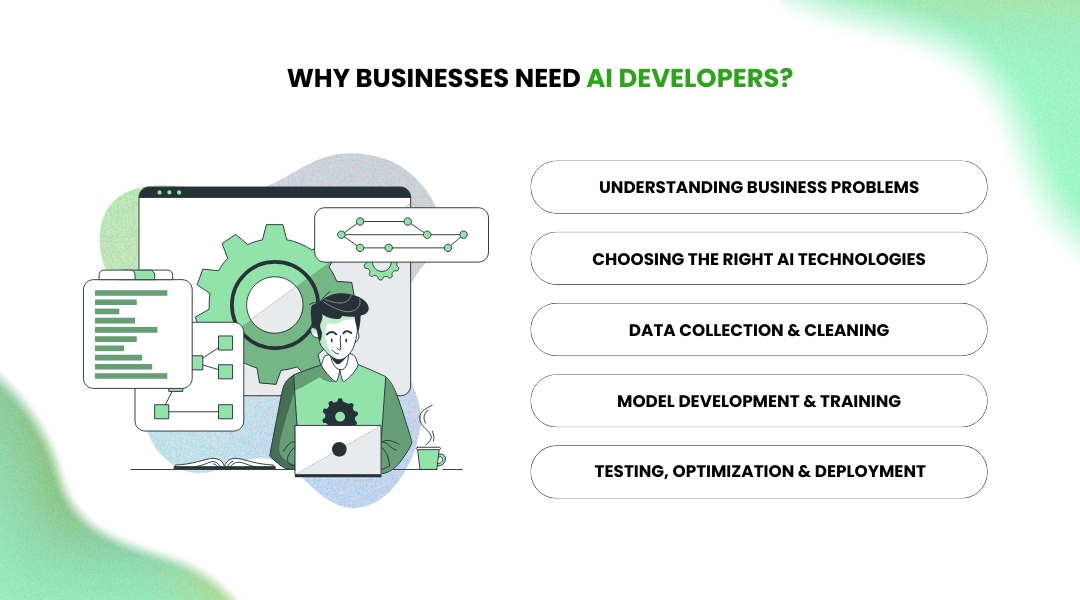
Here’s the part business leaders never see. The actual blueprint.
This step separates good AI developers from code enthusiasts.
A founder once came to me saying, “We need AI.” After 10 minutes, I told him, “You don’t need AI. You need to stop entering orders manually.
He laughed. Then he realized I wasn’t joking.
Before writing a single line of code, I ask:
What’s slowing you down?
Which tasks feel painful?
Where does human error creep in?
What decisions depend on guesswork?
What’s costing you time or money every week?
BI development services mean nothing if the problem isn’t defined.
Now comes the selection stage. Not everything requires a neural network or generative model.
Sometimes a small predictive model does the job. Sometimes NLP is perfect. Sometimes computer vision solutions are the answer. Sometimes a rules engine is the adult in the room.
Here’s the quick breakdown I use:
Need automation? → AI for business automation
Need conversations? → AI Chatbots or voice AI
Need forecasting? → ML or predictive analytics, especially when it comes to predictive analytics for fintech businesses managing risk and demand at scale.
Need smarter insights? → Custom AI solutions
Need classification or detection? → Computer vision applications
Question for you, and this is one of those pattern-interrupt moments:
Do you actually know which category your problem belongs to? Most people don’t. And that’s completely fine.
That’s why AI developers exist.
Data is never as “ready” as we hope. Most of my time isn’t spent building models;s it’s spent cleaning messy spreadsheets, renaming columns, removing duplicates, and fixing weird inconsistencies created by human beings… human.
This step includes:
Pulling historical data
Structuring unstructured data
Removing noise
Labeling data (if required)
Creating a unified dataset
Not glamorous. By necessity.
This is the part everyone imagines - “the AI brain.”
Depending on the project, this includes:
Training machine learning models
Designing custom AI solutions
Fine-tuning NLP solutions
Creating AI-powered business solutions
Building AI application development pipelines
A model isn’t magic. It’s math, statistics, and pattern recognition.
But when done right? It feels like magic.
Let me tell you a secret: The first version of any AI model is never perfect.
Testing is where we find:
Bias
Weak accuracy
Missed edge cases
Slower than expected outputs
Then we optimize, fix, retrain, replace datasets, patch logic, and deploy in phases.
Good deployment means the system runs quietly, consistently, and without making your team anxious.
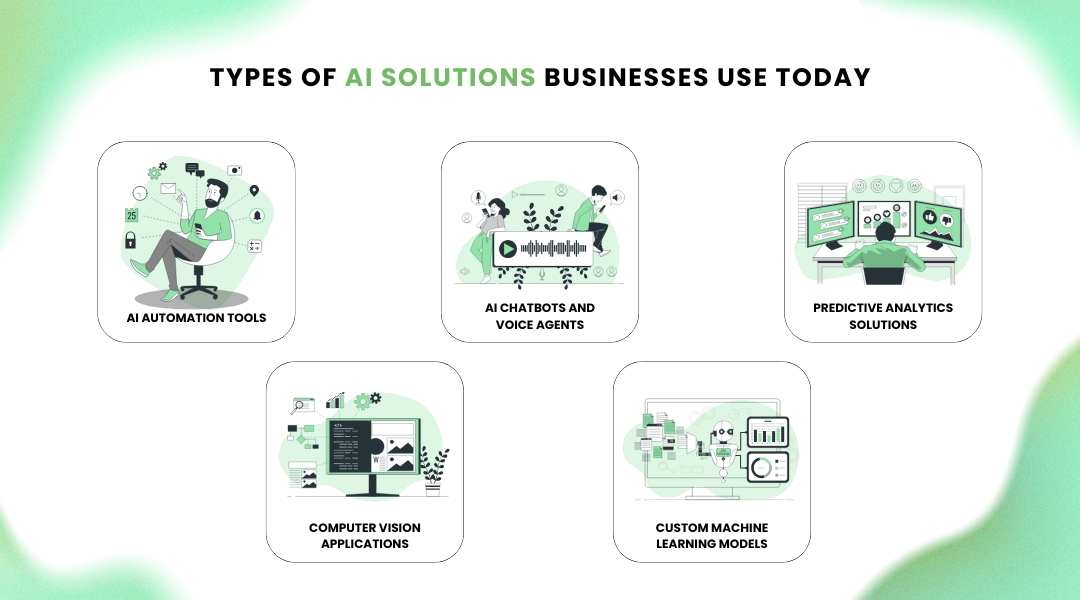
Here’s what companies actually adopt—the practical list.
Automating invoices, order processing, support workflows, approvals, and repetitive tasks.
For customer support, sales, appointment booking, and multilingual communication.
Demand forecasting, sales predictions, risk detection, churn prediction, supply optimization.
Quality checks, scans, recognition, counting, defect identification.
Tailor-made models built around your unique workflow - not generic templates.
Real AI engineers for business bring several advantages:
They understand both tech and business logic.
They can translate business goals into model parameters.
They prevent costly overengineering.
They build systems designed for scale.
They avoid unnecessary complexity.
They train your team to use the final solution.
In short: They build AI solutions for businesses that actually solve problems, and if you want a deeper framework, here's how to choose the best AI development company before you commit
Let me give you examples from my own experience:
A logistics brand saved 30% of its workforce costs using business automation with AI.
A D2C company increased order accuracy using machine learning for business.
A fintech team reduced response time by 40% using NLP solutions for business.
A service brand achieved 24/7 support using AI voice agents for business.
AI isn’t about hype. It’s about operational clarity.
Based on real projects I’ve delivered:
Retail & eCommerce
Fintech & BFSI
Healthcare
Logistics & transport
Manufacturing
Hospitality
Real estate
SaaS products
Edtech
From predictive analytics for business to enterprise AI development, every sector has clear opportunities.
Here's my blunt checklist, and if you want the full field guide, see what separates the best AI development company for startups and enterprises from the rest.
Do they ask smart questions instead of pushing tech?
Can they explain things in simple English?
Do they understand your data?
Have they built custom AI solutions before?
Do they measure outcomes instead of outputs?
Do they avoid buzzwords and focus on business needs?
Do they share case studies?
If not, walk away. And yes, KriraAI meets all of these.
Let me make a prediction:
The future belongs to companies that combine AI with human intention. Not companies chasing trends. Not companies buying random tools. But companies are building AI-powered business solutions that make their teams stronger, faster, and sharper.
Soon, AI developers in India and globally will shift from “building models” to “building long-term intelligent systems” that improve every quarter.
If you came in confused, I hope you’re walking out clear. AI isn’t a mysterious black box; it’s a structured, thoughtful process shaped by developers who care about outcomes.
When done right, AI development for business feels less like technology… and more like relief.
And if you ever want to explore what AI could look like inside your company, you know where to find me.
At KriraAI, we build systems that work. Not systems that impress for a moment and disappear.
Most projects take 4–12 weeks, depending on complexity, data quality, and required accuracy.
Yes, even simple automation or prediction models can reduce workload, mistakes, and running costs.
Any historical data related to your process: text, numbers, images, chat logs, transactions, or operational records.
It depends on the scope. Many businesses start with affordable pilot projects before scaling.
If you deal with repetitive tasks, forecasting gaps, customer support load, or data-driven decisions - AI can help.
Founder & CEO
Divyang Mandani is the CEO of KriraAI, driving innovative AI and IT solutions with a focus on transformative technology, ethical AI, and impactful digital strategies for businesses worldwide.