Let me confess something.
The first AI chatbot I built for customer support… failed.
Spectacularly.
It answered perfectly. Grammatically flawless. Technically correct. And customers still hated it.
Why?
Because automation without empathy is just noise.
I’m a Senior AI Solutions Architect at KriraAI. For the last twelve years, I’ve lived inside customer support systems - ticket queues, angry emails, late-night escalation calls. In the past five years alone, I’ve led more than thirty AI customer support automation projects across e-commerce, SaaS, fintech, and healthcare.
Some saved companies millions.
Some quietly damaged trust.
So when people ask me, “Is AI customer support automation worth it?” My answer is always the same.
It depends on how honestly you design it.
And that’s what this article is about.
Not hype. Not vendor promises. What actually works.
AI customer support automation is the use of artificial intelligence to handle, assist, or optimize customer service interactions - across chat, voice, email, tickets, and CRM systems.
Not just scripts. Not just menus.
Real learning systems that understand intent, context, and emotion.
At its core, AI customer service automation does four things:
Understands what the customer is asking
Decides the best action
Responds or routes intelligently
Learns from every interaction
That’s it.
Everything else is an implementation detail.
Traditional automation: “If the user presses 1, go here.”
AI automation: “If the customer sounds frustrated, escalate. If it’s a billing query, resolve automatically. If confidence is low, hand over to a human.”
One follows rules. The other learns patterns.
Huge difference.
Let’s lift the hood.
An AI chatbot for customer support handles FAQs, order tracking, returns, onboarding, and simple troubleshooting — but getting that right takes custom AI chatbot development trained on your real conversations, not a generic template. With NLP and intent detection, modern bots resolve 50–70% of queries without human help.
When done right, customers don’t even realize they’re talking to a machine.
When done wrong… they definitely do.
An AI voice bot for customer service answers calls, authenticates users, checks balances, books appointments, and routes calls based on urgency and emotion.
Yes, emotion. We now detect stress in voice patterns.
(It’s both fascinating and slightly terrifying.)
Conversational AI for customer support uses natural language processing to understand variations like:
“Where’s my order?”
“My parcel didn’t arrive”
“Tracking, please”
Same intent. Different words.
That’s where intelligence lives.
AI helpdesk automation classifies tickets, predicts priority, routes to the right team, and sometimes resolves them automatically.
This alone reduces backlog by 30–50%.
Without integration, AI is useless.
Good systems connect with Zendesk, Freshdesk, Salesforce, HubSpot, custom CRMs — pulling history, updating tickets, logging sentiment.
Automation must live inside your workflow.
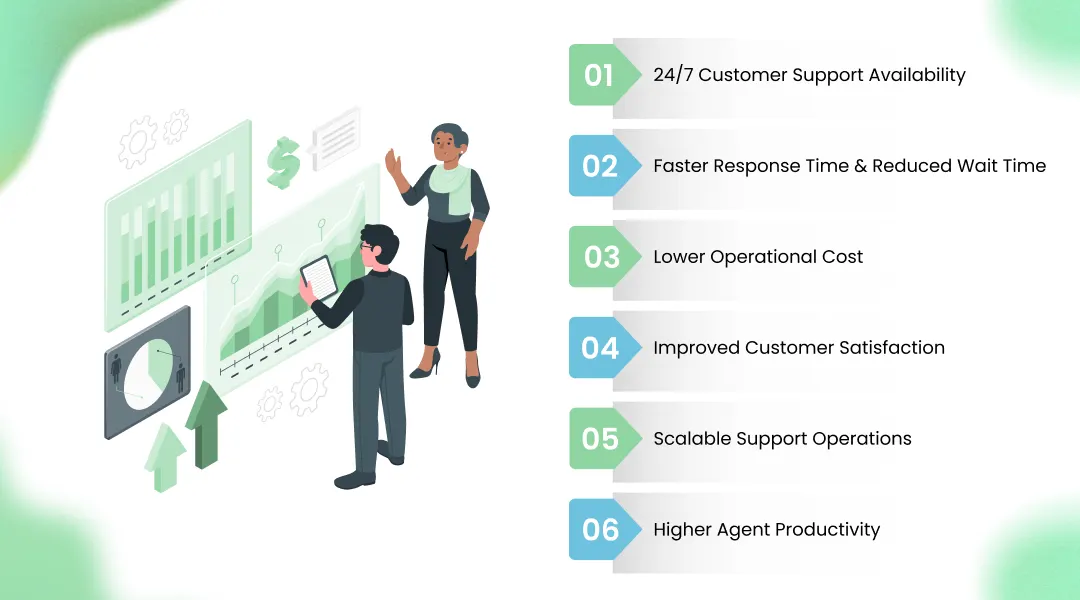
This is where numbers matter.
Customers don’t care about your office hours.
AI-powered customer support works all night, weekends, and holidays. Zero fatigue. Zero sick leave.
Average first response time drops from minutes to seconds.
I’ve seen queues fall by 68% in two weeks.
Automated customer support handles repetitive queries at a fraction of the human cost.
Not replacing agents. Freeing them.
When answers are instant and accurate, CSAT rises.
Simple math.
Festive sale? Product launch? Viral moment?
AI scales without hiring fifty temporary agents.
Humans focus on complex, emotional, high-value conversations.
Machines handle the boring parts.
This is the future. And honestly, it’s kinder to everyone.
Order tracking, returns, refunds, delivery issues — this is exactly where AI-powered e-commerce solutions earn their keep. Peak season? AI keeps you alive.
Onboarding, password resets, usage guidance, tier upgrades.
One SaaS client reduced L1 tickets by 74% in three months.
Balance checks, transaction queries, card blocking, KYC support.
Accuracy and compliance matter here. We design carefully.
Appointment booking, prescription reminders, insurance queries.
Always with human fallback. Always.
Billing issues, plan upgrades, outage notifications.
High volume. Perfect for automation.
Feature | AI Chatbots | AI Voice Bots |
Best for | Text channels, web, apps | Call centers, IVR replacement |
Cost | Lower | Higher |
Setup time | Faster | Moderate |
Customer comfort | High | Medium (depends on quality) |
Use cases | FAQs, tracking, onboarding | Authentication, urgent issues |
High chat volume
Digital-first customers
Simple workflows
Call-heavy businesses
Authentication needs
Urgent support scenarios
My favorite.
Chatbot first. Voice bot second. Human when needed — and if you're still weighing the two, this breakdown of AI chatbot vs AI voice agent for customer support covers exactly when each format wins.
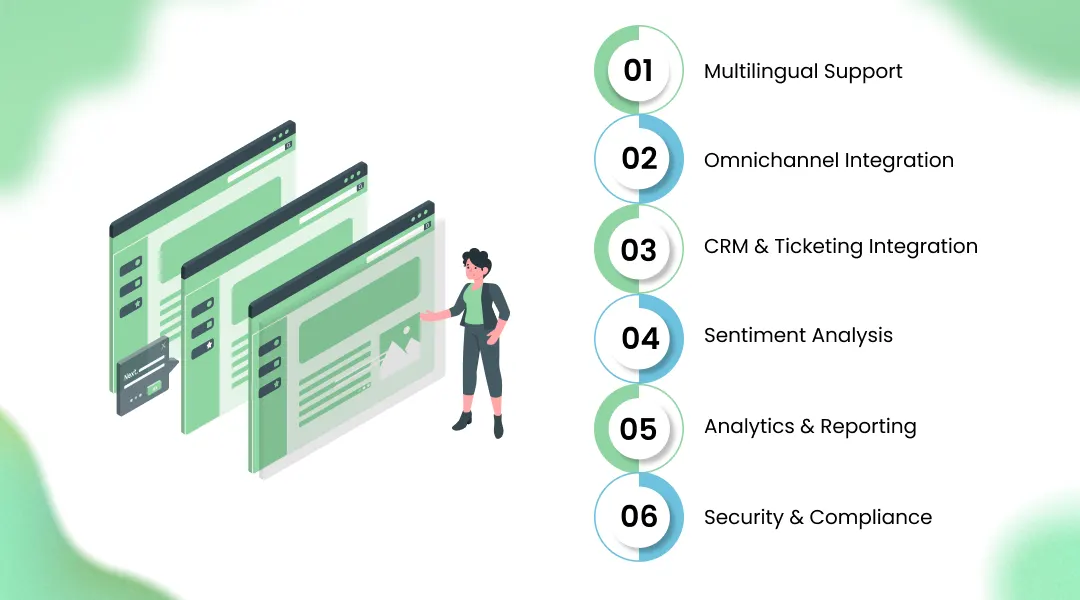
This section saves companies from expensive mistakes.
India alone has 22 official languages.
Your AI must speak to your customer.
WhatsApp. Website. App. Email. Voice.
One brain. Many mouths.
Non-negotiable.
No history = bad experience.
Detect anger. Detect confusion. Escalate early.
This prevents disasters.
You can’t improve what you can’t see.
Resolution rate. Containment rate. CSAT impact. Cost per ticket.
Banking? Healthcare? GDPR?
If your vendor ignores this, run.
Let’s talk money.
Manual support vs AI customer service automation:
Cost per ticket drops by 40–70%
First contact resolution improves by 25–45%
Agent workload reduces by 50%
ROI usually appears in 3–6 months.
But here’s the part nobody tells you.
Bad automation costs more than no automation.
Refunds. Churn. Brand damage.
Which brings me to…
Garbage data = garbage answers. Solution: clean datasets + real conversation logs — the same foundation that separates the best generative AI services for customer support automation from the rest.
AI doesn’t magically know your business.
We train it. Test it. Break it. Fix it.
Again. And again.
AI should assist agents, not compete with them.
The best systems feel invisible.
If customers feel tricked, trust evaporates.
Always disclose automation. Always offer human help.
Ethics matter.
This is where most projects fail.
Here’s the process I personally follow.
Channels. Volumes. Repetitions. Escalations.
Find automation gold.
Ready-made tools or custom systems?
Depends on complexity.
CRM. Helpdesk. ERP. Telephony.
No shortcuts here.
Shadow mode first. Limited rollout. Human supervision.
Never full automation on day one.
If someone promises “go live in 3 days,” smile politely and leave.
This matters more than the software.
Look for:
Ask for real deployments. Real metrics.
At KriraAI, we design AI customer support solutions only after understanding your workflows, your customers, and your risks.
Templates work for simple businesses.
Serious businesses need tailored systems.
That’s where a Best AI development Company earns its title.
Certifications. Data policies. Hosting options.
No compromise.
AI is not “install and forget.”
It learns. It drifts. It needs care.
If you’re evaluating an AI Customer Support Automation company, choose one that behaves like a partner, not a vendor.
Conclusion
Here’s my honest belief.
AI will not replace customer support.
But customer support without AI will fall behind.
The future isn’t bots replacing humans.
It’s humans finally free to do what humans do best — listen, empathize, solve.
Automation handles the noise. People handle the meaning.
That’s how smarter business growth actually happens.
And if you design it with respect…
Your customers will thank you.
AI customer support automation uses artificial intelligence to handle customer queries, route tickets, and resolve issues automatically across chat, voice, and helpdesk systems.
No. AI handles repetitive tasks efficiently, while humans manage complex and emotional conversations. The best systems combine both.
Costs vary by scale and complexity, but most businesses recover investment within 3–6 months through reduced support expenses.
Yes. Modern customer support automation software integrates with popular CRMs and ticketing tools for unified workflows.
With proper security, encryption, and compliance controls, AI systems can safely handle sensitive customer information.
Founder & CEO
Divyang Mandani is the CEO of KriraAI, driving innovative AI and IT solutions with a focus on transformative technology, ethical AI, and impactful digital strategies for businesses worldwide.