
How AI Companies Are Changing the Future of Work
Three years ago I walked into a meeting that still sticks with me.
A logistics company had just deployed its first AI system. Their leadership team was excited… but also nervous.
One manager asked me a question I hear constantly:
“Is AI going to replace our employees?”
I paused.
Then I told them something that surprised the entire room.
“No. But it will change what those employees do every single day.”
That distinction matters.
Because the story of AI companies changing the future of work is not about robots taking over offices. It’s about businesses redesigning how work happens.
And I’ve watched this shift unfold across startups, factories, healthcare systems, and online businesses.
The change is real.
And it's accelerating.
What Is the Future of Work with AI?
Understanding AI-powered workplaces
When people imagine the future of work with AI, they often picture fully automated companies.
In reality, most workplaces are becoming AI-assisted environments.
Think of AI as a digital colleague.
One that processes massive data, identifies patterns, and handles repetitive tasks faster than any human team could.
Humans still make decisions. Humans still build relationships. Humans still drive strategy.
But AI handles the heavy analytical lifting.
That partnership is the real transformation.
How AI is reshaping traditional work models
Traditional workflows looked like this:
Collect data → Analyze data → Decide → Execute.
AI changes that sequence dramatically.
Now the process often looks like this:
AI analyzes data in real time → suggests insights → humans act faster.
Which means decisions that once took weeks now happen in minutes.
And yes… that shift explains how AI is changing jobs.
Employees spend less time on repetitive work and more time on creative or strategic tasks.
That’s the future workplace.
How AI Companies Are Transforming Businesses
AI automation in daily operations
Many business processes are surprisingly repetitive.
Invoice processing. Customer support tickets. Inventory monitoring.
AI companies are building systems that automate these tasks.
Not completely removing people, but removing the tedious parts of their work.
I once helped a retail company automate product categorization.
Before AI? Five employees spent hours tagging inventory.
After AI? The system handled 90% of it automatically.
Those employees moved to product strategy instead.
That’s what AI in the workplace really looks like.
AI-driven decision making
Another shift I see constantly is data-driven decisions powered by AI.
Executives used to rely on dashboards and manual reports.
Now AI models analyze customer behavior, operational performance, and financial trends automatically.
Instead of asking “What happened last quarter?”
Companies ask:
“What should we do next week?”
That’s a completely different level of decision speed.
AI improving productivity
Let me ask you something.
How much time does your team spend searching for information?
Documents. Emails. Reports.
Now imagine an AI assistant that finds answers instantly.
Productivity jumps dramatically when employees stop hunting for data.
And that’s why AI companies in the future workplace are becoming critical partners for businesses.
Key Technologies Driving the AI Workplace
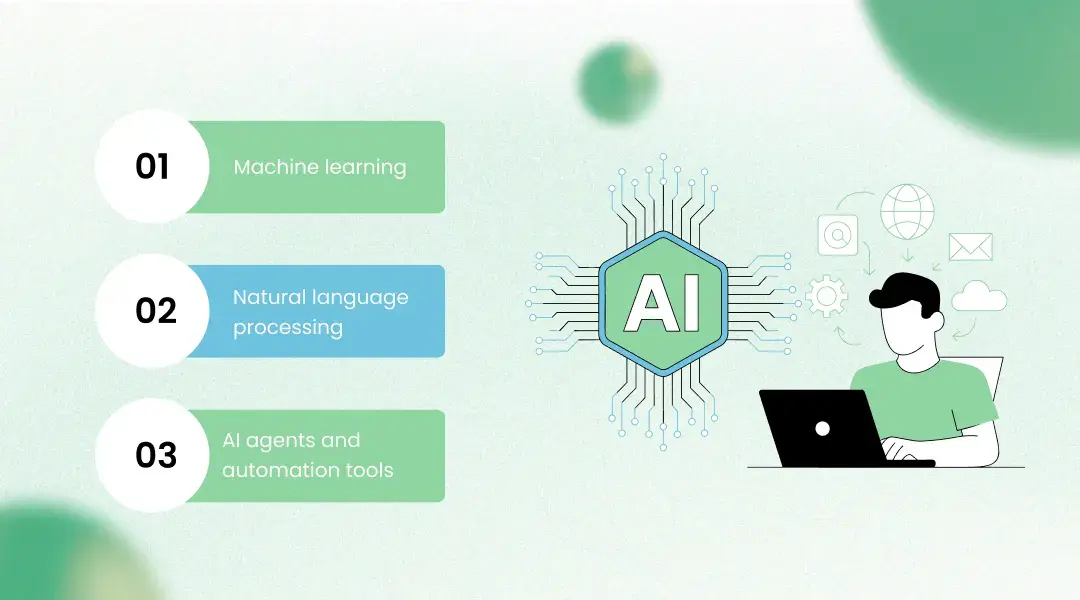
Behind every AI workplace transformation are a few core technologies.
Machine learning
Machine learning models identify patterns in data.
They help businesses predict demand, detect fraud, and recommend products.
This is the backbone of modern AI systems.
Natural language processing
Natural language processing allows machines to understand human language.
This technology powers chatbots, virtual assistants, and document analysis tools.
If you’ve ever interacted with automated customer support… you’ve seen this technology in action.
AI agents and automation tools
The newest trend I’m seeing across companies is the rise of AI agents.
These systems perform tasks autonomously, analyzing information, making decisions, and executing workflows.
In fact, many organizations are now deploying tools like an AI voice agent to manage customer calls and support requests.
It’s one of the clearest examples of the role of AI in the future of work.
Industries Where AI Is Changing Work the Most
Some industries are experiencing the shift faster than others.
Let’s look at a few.
Healthcare
AI helps doctors analyze medical images, predict disease risks, and manage hospital resources.
Doctors make the final decisions.
But AI speeds up diagnosis dramatically.
Finance
Banks use AI to detect fraud, evaluate loan risk, and monitor transactions.
Without AI, many of these systems simply wouldn’t scale.
Retail
Retail companies use AI to forecast demand and optimize pricing.
Ever notice how online product recommendations feel uncannily accurate?
That’s AI working behind the scenes.
Customer support
Customer service is one of the biggest transformations.
Chatbots and AI assistants now handle thousands of support requests automatically.
Human agents focus on complex issues.
Manufacturing
Factories now use AI to predict equipment failures before they happen.
This prevents downtime and saves enormous operational costs.
Benefits of AI for Modern Businesses
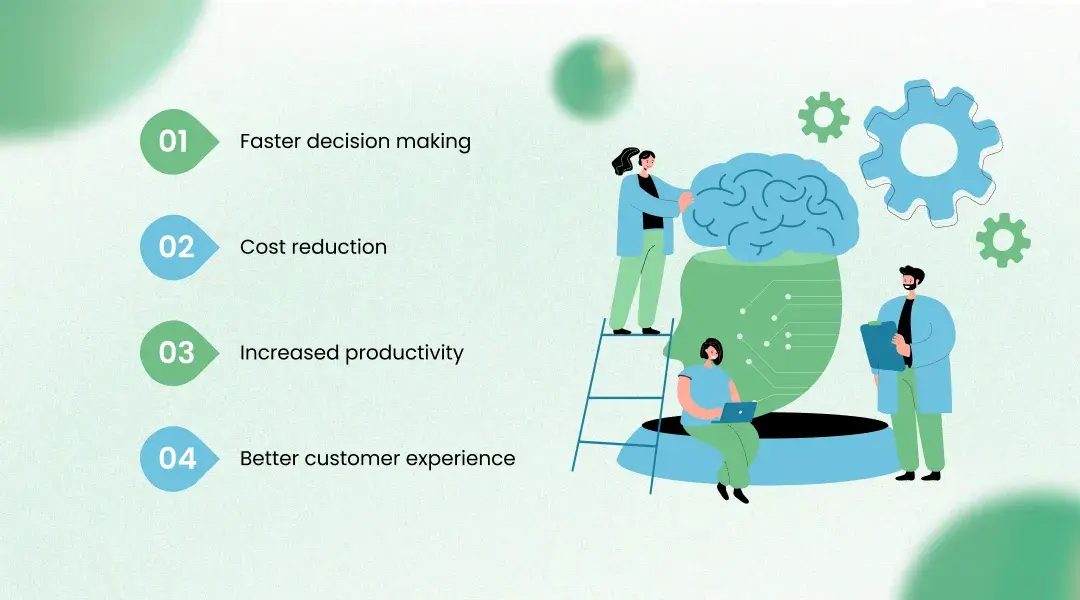
Companies adopting AI often experience several measurable benefits.
Faster decision making
AI processes massive data in seconds.
That speed improves business response times dramatically.
Cost reduction
Automation reduces operational costs by handling repetitive processes.
Teams become smaller but more effective.
Increased productivity
Employees spend less time on manual tasks.
And more time on strategic work.
That shift is powerful.
Better customer experience
AI allows companies to personalize interactions at scale.
Customers receive faster responses and better recommendations.
Which, unsurprisingly, increases loyalty.
Challenges Businesses Face When Adopting AI
AI adoption isn’t always smooth.
I’ve seen plenty of companies struggle.
Here’s why.
Data quality issues
AI systems are only as good as their data.
Messy data leads to inaccurate models.
This is one of the most common problems we encounter.
Integration with existing systems
Many companies run legacy software that doesn’t easily integrate with AI tools.
Connecting everything can take time.
Skill gaps
Employees need training to work effectively with AI systems.
Technology alone doesn’t transform a company.
People do.
Real Examples of AI in the Workplace
Let’s talk about real implementations.
Because theory is nice.
Reality is better.
AI chatbots in customer support
Many companies deploy AI chatbots that answer common customer questions instantly.
Human agents step in only when problems become complex.
AI in data analysis
AI tools analyze sales data, customer trends, and operational performance automatically.
This helps leaders identify opportunities faster.
AI automation in operations
Companies use AI to automate logistics planning, supply chain monitoring, and inventory management.
Work that once required dozens of analysts can now run continuously.
How Businesses Can Prepare for the AI-Driven Future
Preparing for AI adoption doesn’t require becoming a tech giant.
But it does require strategy.
Building AI strategies
Start by identifying processes that could benefit from automation.
Repetitive tasks are usually the first candidates.
Training employees
Employees must understand how AI tools support their work.
When teams trust the technology, adoption becomes easier.
Choosing the right AI partner
Not every AI vendor understands real business problems.
Companies should work with experienced partners who focus on outcomes, not flashy demos.
The Future of Work: Humans + AI Collaboration
Here’s the truth that rarely makes headlines.
AI will not replace humans.
But humans who use AI will outperform those who don’t.
The most successful organizations I’ve seen embrace collaboration between people and machines.
Humans provide creativity, empathy, and strategy.
AI provides speed, scale, and analysis.
Together?
They create a workplace that’s smarter than either could achieve alone.
That’s the real future of work with AI.
Conclusion
So yes.
AI companies changing the future of work is absolutely real.
But not in the dystopian way people imagine.
The real transformation is more subtle and more powerful.
AI removes repetitive work. Humans focus on meaningful work. Businesses move faster.
And companies that adapt early will have a massive advantage.
The future workplace isn’t humans versus AI.
It’s humans with AI.
And that collaboration is only getting started.
FAQs
AI will automate repetitive tasks, but most jobs will evolve rather than disappear. Humans will focus more on creativity, strategy, and decision making while AI handles data-heavy tasks.
AI companies develop tools that automate workflows, analyze large datasets, and improve decision making. These technologies help businesses operate faster and more efficiently.
Healthcare, finance, retail, manufacturing, and customer service are among the industries experiencing the biggest changes from AI adoption.
Building AI systems requires specialized expertise in data science and software engineering. AI development companies help businesses design and deploy solutions faster.
Businesses should identify automation opportunities, train employees to work with AI tools, and partner with experienced AI providers to implement practical solutions.
Founder & CEO
Divyang Mandani is the CEO of KriraAI, driving innovative AI and IT solutions with a focus on transformative technology, ethical AI, and impactful digital strategies for businesses worldwide.