I’ve watched customers abandon carts, cancel subscriptions, and walk away from brands for one painfully simple reason.
They waited too long for a reply.
Sometimes minutes. Sometimes hours. Occasionally days. And no, price wasn’t the issue. Product wasn’t the issue. Support was.
I’m a Senior AI Consultant at KriraAI, and I’ve spent the last decade fixing customer experience systems that broke under growth. Not because the team didn’t care. But because traditional support models don’t scale the way customers expect.
This is where AI chatbots for customer experience stop being a trend and start becoming infrastructure.
But only when done right.
Let me be blunt.
Human-only support works beautifully… until it doesn’t.
As businesses grow, three things happen:
Ticket volume explodes
Response times stretch
Support teams burn out
I’ve seen support inboxes become graveyards of unanswered questions. Not due to laziness. Due to math.
Humans need sleep. Customers don’t.
And customers don’t judge you by effort. They judge you by experience.
That's why AI chatbot adoption for customer service has accelerated - not to replace humans, but to protect customer trust when volume spikes with our comprehensive AI chatbot solutions designed for enterprise scalability.
This isn't a theory. This is implementation reality.
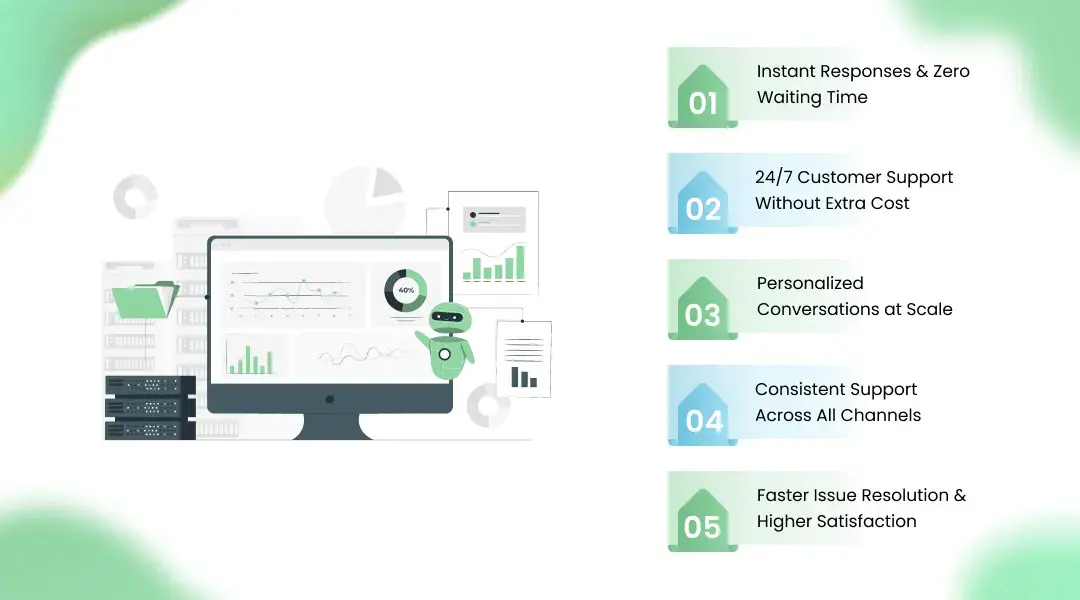
Customers don’t want “fast.” They want now.
AI chatbots for businesses answer instantly. No queues. No “please hold.” No frustration buildup.
That first response time - often under one second-, sets the emotional tone of the entire interaction.
And yes, it matters more than you think.
AI chatbots for 24/7 customer support don’t ask for night shifts or overtime.
Your customer in another time zone doesn’t care that your office closes at 7 PM IST. They care that their order is stuck.
Customer service automation with AI fills that gap quietly and reliably, particularly for e-commerce businesses managing high-volume customer interactions across multiple time zones. Particularly for e-commerce businesses managing high-volume customer interactions across multiple time zones.
(And your team finally gets to sleep.)
This is where conversational AI for businesses changed the rules.
Modern business AI chatbots don’t just reply. They remember:
Past purchases
Browsing behavior
Previous complaints
So instead of “How can I help you?”, customers hear: “Hi Alex, are you checking on your last order again?”
That feels human. Even when it’s not.
Website chat. WhatsApp. Facebook Messenger. In-app support.
Humans struggle with consistency. AI chatbots don’t.
Chatbots in customer support deliver the same accurate answers everywhere, every time, without mood swings, bad days, or missed details.
Consistency builds trust. Trust builds retention.
Speed isn’t just about replies. It’s about resolution.
AI-powered customer support can:
Pull order data instantly
Trigger refunds
Escalate only when needed
When customers get answers without repeating themselves, satisfaction jumps. Quietly. Measurably
Let’s talk numbers. Because feelings alone don’t get budgets approved.
AI chatbot benefits for business start here. Chatbot automation for customer service handles 60-80% of repetitive queries, reducing ticket load without reducing service quality - and our detailed analysis covers the full ROI picture.
Customers stay where they feel heard. Customer experience automation with AI keeps response times tight even during peak demand.
Your human agents stop answering “Where is my order?” They start solving real problems. That’s a better job. For everyone.
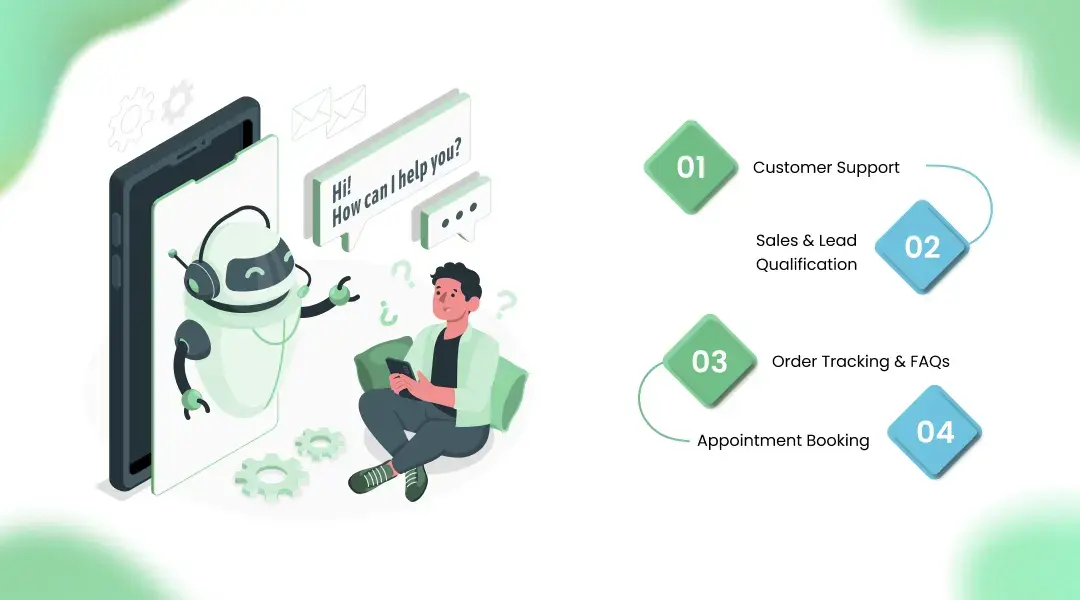
I’ve deployed AI chatbot use cases in business across multiple sectors. The patterns repeat.
FAQs, refunds, delivery status, account issues. This is the backbone.
AI chatbots for customer engagement ask the right questions before your sales team ever steps in.
Zero frustration. Zero human effort.
Healthcare, consultants, service businesses- this alone saves hundreds of hours monthly.
Let me clear something up.
AI chatbots are bad at empathy. Humans are bad at repetition.
The best systems respect both truths.
AI handles:
Volume
Speed
Data retrieval
Humans handle:
Emotional situations
Edge cases
Relationship repair
This hybrid approach is where AI chatbots for customer experience actually shine.
Anything else is either wasteful or reckless.
This is where most businesses stumble.
If your chatbot feels robotic, customers notice. Immediately.
Here’s what actually matters:
Custom conversation flows
Integration with your systems
Clear escalation logic
Real training data (not generic scripts)
This is why working with an experienced Chatbot Development Company matters more than buying an off-the-shelf tool and hoping for magic.
At KriraAI, we build AI chatbots for businesses the same way we build software - around real user behavior, not demo slides.
(Yes, I’ve dismantled plenty of failed bots built the other way.)
How AI chatbots improve customer experience isn’t about replacing people.
It’s about respecting customers’ time.
When done right, an AI chatbot for customer service becomes invisible. It just works. Customers feel supported. Teams feel lighter. Businesses grow without support.
That’s not hype. That’s architecture.
And architecture always beats improvisation
No. They’re better at speed and volume. Humans are better at empathy. The smartest businesses use both together.
Yes, up to a point. Modern AI-powered customer support can resolve most issues and escalate the rest intelligently.
When designed properly, yes. Faster responses and fewer handoffs directly improve satisfaction scores.
Costs vary based on complexity, integrations, and customization. Expect more than a plugin, but far less than scaling a support team.
Any business with high customer interaction volume - especially e-commerce, SaaS, healthcare, and service-based companies.
Founder & CEO
Divyang Mandani is the CEO of KriraAI, driving innovative AI and IT solutions with a focus on transformative technology, ethical AI, and impactful digital strategies for businesses worldwide.
