AI Calling Agent: Architecture, Design, and Deployment Guide
Enterprises running high-volume phone operations are facing a compounding problem: handle times are increasing, agent attrition is accelerating, and customers expect resolution on the first call. The manual scaling math no longer works. A contact centre handling 50,000 calls per month at an average fully loaded cost of $8 per call spends $400,000 monthly on calls that are, in the majority of cases, resolvable without human judgment. Implementing custom AI voice agent development services from an experienced engineering partner changes that equation permanently.
An AI calling agent is a production-grade software system that conducts real telephone conversations autonomously, handles inbound calls routed from your contact centre infrastructure, places outbound calls at scale, resolves customer intents across multiple conversational turns, integrates in real time with your CRM and business systems, and transfers to a human agent when the situation genuinely requires one. It is not an IVR with better menus. It is not a chatbot that reads responses aloud. It is a full-stack conversational system built specifically for the latency, noise, and ambiguity constraints of live telephone audio.
The market has reached a tipping point. Neural speech recognition is now accurate enough for production at over 95% word accuracy in clean telephony audio. Large language models have reduced dialogue management complexity by an order of magnitude. Neural text-to-speech synthesis produces voices that callers cannot reliably distinguish from human agents in blind tests. The technology is ready. The question is how to build it correctly.
This guide covers the complete technical architecture of an AI calling agent, the engineering decisions that determine whether it works well in production, the implementation journey a team goes through to deploy it, the business case and ROI profile, and the common failure modes that separate working systems from expensive pilots that never scale.
The Full Technology Stack of an AI Calling Agent
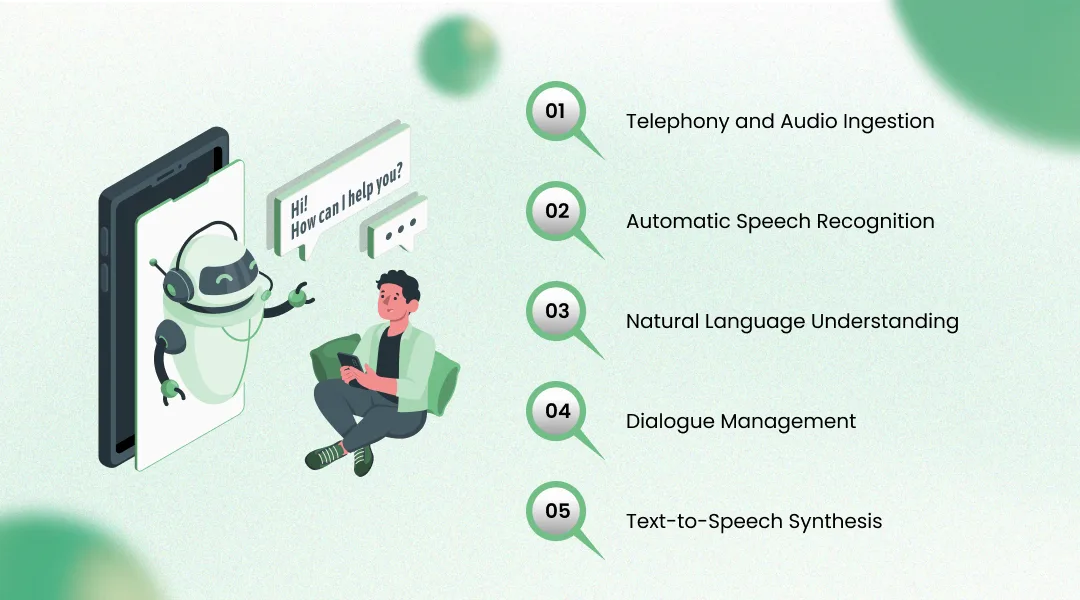
An AI calling agent is not a single model or a single API. It is a pipeline of specialised components, each with its own latency budget, accuracy requirement, and failure mode. Understanding the full stack is the prerequisite for making any intelligent decision about building, buying, or evaluating one.
Telephony and Audio Ingestion
The conversation begins at the telephony layer. Calls reach the AI calling agent through one of three paths: a SIP trunk integration where your carrier or contact centre platform routes calls via Session Initiation Protocol, a WebRTC connection for browser- or app-originated calls, or a PSTN gateway managed by a CPaaS provider such as Twilio, Vonage, or Amazon Connect. Each path delivers raw Real-time Transport Protocol audio, typically encoded as G.711 ulaw or alaw at 8kHz sampling.
That 8kHz sampling rate is important. It is narrowband audio, significantly lower fidelity than the 16kHz or 44kHz audio that most ASR benchmarks are measured on. A production AI calling agent must be evaluated and optimised for narrowband telephony audio, not for microphone or podcast-quality recordings. The difference in word error rate between a model tuned for telephony audio and one evaluated on studio recordings can exceed 15 percentage points in real deployments.
Voice activity detection sits immediately after audio ingestion. VAD determines where utterances begin and end, which directly drives how quickly the system starts processing and how naturally it handles interruptions. A well-tuned VAD with a 200ms trailing silence threshold enables natural turn-taking. A poorly tuned one either cuts off users mid-sentence or introduces 800ms to 1200ms of apparent lag at every turn.
Automatic Speech Recognition
The ASR layer converts the incoming audio stream to text in real time. For production AI calling agents, streaming ASR is mandatory. Batch transcription, where you wait for the full utterance before beginning transcription, adds 400ms to 1500ms of unnecessary latency that destroys conversational naturalness.
Two ASR architectures dominate production deployments. RNN-Transducer models offer the best streaming performance with per-token emission as audio arrives, enabling partial transcript generation that can feed downstream NLU processing before the utterance ends. Conformer-based CTC models offer excellent accuracy and noise robustness, with the Whisper family of models providing strong baseline accuracy for English and multilingual calls, though Whisper's architecture was not designed for streaming and requires adaptation layers to reduce its inherent latency from its standard batch mode of 800ms to 2000ms.
For domain-specific deployments requiring sector-specific AI voice agent deployment across healthcare, insurance, or financial services, custom language model biasing is essential . A base ASR model will transcribe "Metformin" as "met for men" and "HIPAA" as "hippa" without domain adaptation. N-gram language model biasing applied at the ASR decoding stage can boost accuracy on domain vocabulary by 20 to 40 percentage points.
Natural Language Understanding
The NLU layer takes the transcribed text and extracts the caller's intent, the entities that fill that intent's parameters, and the contextual state that links this utterance to the conversation history. This layer is where most naive implementations fail.
The two dominant architectural approaches are fine-tuned discriminative classifiers and LLM-based zero-shot or few-shot classifiers. A fine-tuned BERT or RoBERTa model with a classification head delivers intent recognition accuracy above 92% for well-scoped intent spaces and adds only 15 to 40 milliseconds of inference latency on a GPU. An LLM-based classifier using a 7 billion parameter instruction-tuned model delivers better generalisation to novel phrasings and handles multi-intent utterances more gracefully, but adds 80 to 200 milliseconds of latency per turn and costs significantly more per call at scale.
The hybrid approach used in the most sophisticated production systems runs the discriminative classifier as a first pass. When confidence is above a threshold of roughly 0.85, the classifier result is used directly. When confidence falls below the threshold, the utterance is routed to an LLM-based classifier that reasons more carefully about the caller's intent. This hybrid achieves both the speed of the discriminative approach for the 75 to 85 percent of common cases and the flexibility of the LLM for edge cases, without paying the LLM latency cost on every turn.
Dialogue Management
Dialogue management is the reasoning layer that decides what the AI calling agent should say next given what the caller said, what has been said before, and what the agent is trying to accomplish. This is the most architecturally consequential layer, and the one that has changed most dramatically with the advent of large language models.
Traditional finite state machine dialogue managers encode every possible conversational path as an explicit graph of states and transitions. They are predictable, debuggable, and auditable, but they break on any conversational path the designer did not anticipate, which in real deployments covers 20 to 35 percent of calls. Frame-based dialogue managers improved on FSMs by tracking slot filling across turns without requiring explicit paths, but still struggled with topic changes, multi-intent utterances, and conversational repair.
LLM-based dialogue managers with retrieval-augmented generation represent the current state of the art for complex call types. The LLM receives the conversation history, the current caller intent and entities, a retrieved set of relevant policy documents or knowledge base entries, and a system prompt encoding the agent's persona, goals, and constraints. It generates the next agent response. This approach handles novel conversational paths gracefully, supports multi-intent turns naturally, and produces fluent responses without requiring exhaustive scripting.
The engineering challenge with LLM dialogue management is latency. A 13 billion parameter model generating a 30-token response adds 300 to 700 milliseconds per turn depending on hardware and quantisation. The solution used in production is a combination of speculative decoding, streaming token generation to the TTS layer before generation is complete, and constraining the LLM's output length through prompt engineering. The target for dialogue management latency contribution is under 400 milliseconds for a typical response length.
Text-to-Speech Synthesis
The TTS layer converts the generated text response to audio that is played back to the caller. Neural TTS using VITS (Variational Inference with adversarial learning for end-to-end Text-to-Speech) or related architectures produces voice quality that scores above 4.0 on mean opinion score evaluations, indistinguishable from human voice for many callers.
Latency in TTS is measured as time-to-first-byte, the time between when text begins arriving at the TTS model and when the first audio chunk is available for playback. With streaming TTS, text tokens are synthesised as they arrive from the dialogue manager without waiting for the full response. On optimised inference infrastructure, TTFB below 300 milliseconds is achievable, contributing under one-third of a second to the overall turn-taking latency.
Voice persona design for an AI calling agent requires more than selecting a voice. Prosody control, the shaping of pitch, rate, and energy, determines whether the agent sounds engaged, calm, or robotic. Custom voice fine-tuning on 30 to 60 minutes of recorded speech from a target voice can produce a branded voice identity that is consistent across every call. This matters for enterprise deployments where voice is part of brand identity, and for use cases such as outbound sales or appointment reminders where voice warmth affects conversion rates.
End-to-End Latency: The Number That Makes or Breaks the Experience
The most important performance characteristic of an AI calling agent is end-to-end conversational latency: the time from when the caller finishes speaking to when the agent begins its response. Human conversational latency in face-to-face interaction is typically 200 to 400 milliseconds. On telephone calls, listeners tolerate up to 1500 milliseconds before perceiving a pause as unnatural. Beyond 2000 milliseconds, callers become uncomfortable or assume the connection has dropped.
A well-engineered production AI calling agent achieves end-to-end latency in the range of 800 to 1300 milliseconds across the following budget:
VAD trailing silence detection: 200 to 250ms
Streaming ASR final transcript: 100 to 150ms (most of this overlaps with VAD)
NLU inference (hybrid classifier): 20 to 80ms
Dialogue management and response generation: 250 to 450ms
TTS TTFB with streaming synthesis: 150 to 300ms
Audio encoding and network delivery: 40 to 80ms
The key engineering insight is that most of these stages can overlap. ASR partial results can begin feeding NLU before the utterance is complete. Dialogue management can begin constructing a response before NLU returns its final output when interim high-confidence intents are available. TTS can begin synthesising the first sentence of a multi-sentence response before generation of the second sentence is complete. Systems that pipeline these stages in parallel rather than waiting for each to complete sequentially reduce end-to-end latency by 300 to 600 milliseconds compared to naive sequential implementations.
Telephony Integration Architecture
Connecting an AI calling agent to real phone infrastructure requires decisions at every layer of the telephony stack. The integration architecture determines call quality, reliability, scalability, and cost.
CPaaS Platform Integration
When deploying high-performance AI voice agent software for customer care, the system connects to the public switched telephone network through a cloud communications platform. Twilio, Vonage, Amazon Connect, and Genesys Cloud all offer programmable voice APIs that allow the AI calling agent to receive and place calls via SIP or via proprietary WebSocket-based media streaming protocols.
Twilio's Media Streams API delivers bidirectional 8kHz G.711 audio over WebSocket to your AI calling agent in near real time, with latency from the caller's device to your application typically in the range of 50 to 150 milliseconds one way. Amazon Connect supports real-time audio streaming to Kinesis Video Streams, which can feed a custom AI calling agent backend. Genesys Cloud's AudioHook protocol provides a similar bidirectional audio stream for agent replacement use cases.
The critical integration requirement is that the audio stream must be processed in a stateful, session-aware manner. Each call session requires its own ASR, NLU, and dialogue management state, which must be initialised at call start, updated on every turn, and cleaned up at call end. In a high-concurrency deployment handling 200 simultaneous calls, this means 200 independent stateful processing pipelines running in parallel.
SIP Trunk Direct Integration
For organisations that operate their own contact centre infrastructure with on-premises or hosted private branch exchanges, direct SIP trunk integration is often more appropriate than CPaaS. The AI calling agent registers as a SIP endpoint with the PBX or Session Border Controller and receives calls via standard SIP INVITE transactions. Media is exchanged as RTP streams directly between the PBX and the AI calling agent infrastructure.
SIP direct integration reduces per-minute costs compared to CPaaS routing but requires more infrastructure engineering. Codec negotiation, DTMF handling, hold and transfer signalling, and SIP re-INVITE for call modifications all need to be implemented correctly in the AI calling agent's SIP stack. Production systems typically use a media server such as FreeSWITCH or Asterisk as a SIP media gateway that normalises audio to the format the AI pipeline expects before passing it to the ASR layer.
Human Escalation and Warm Transfer
Every AI calling agent must implement reliable human escalation. The system must detect escalation trigger conditions, initiate a warm transfer to a human agent queue, and pass context so the human agent does not ask the caller to repeat themselves.
Escalation trigger conditions include explicit caller requests for a human, repeated failed intent recognition across three or more consecutive turns, negative sentiment signals exceeding a calibrated threshold, calls falling into out-of-scope intent categories, and configurable time-based escalation for calls that have exceeded a maximum autonomous handling duration.
Context transfer at escalation is implemented by passing a structured call summary, including recognised intents, extracted entities, conversation transcript, and caller authentication status, to the receiving agent's desktop application via a screen pop through the CRM or contact centre platform API.
Key Design Decisions That Determine Production Success
Building an AI calling agent that performs well in a controlled test environment is straightforward. Building one that performs reliably across the full distribution of real caller behaviour, audio quality, and conversational variance is an engineering discipline. KriraAI, a company that designs and deploys production-grade AI voice agent systems across industries including financial services, healthcare, and retail, has identified the following design decisions as the highest-leverage determinants of production success.
Confidence Calibration and Graceful Degradation
Every recognition and classification decision in the pipeline produces a confidence score. A production AI calling agent must have explicit policies for what to do at every confidence level. High confidence drives direct action. Medium confidence drives clarification prompts. Low confidence drives graceful escalation rather than a wrong answer delivered confidently.
Poorly calibrated systems either escalate too aggressively, producing high human transfer rates that eliminate the cost benefit of the AI system, or act on low-confidence results, producing incorrect responses that damage customer trust. Calibration requires running the system against a representative sample of real calls and adjusting thresholds until the escalation rate, the incorrect response rate, and the resolution rate reach the target balance for the specific use case.
Interruption and Barge-In Handling
Human callers interrupt. They begin speaking before the AI agent has finished its response. A production AI calling agent must detect this immediately, stop TTS playback within 100 to 200 milliseconds of barge-in detection, and begin processing the new utterance. Systems that do not handle barge-in gracefully force callers to wait for the agent to finish speaking before they can respond, creating a frustrating, IVR-like experience that violates the conversational contract.
Personalisation Through Real-Time Data Integration
An AI calling agent that knows nothing about the caller cannot resolve most calls without asking questions that callers consider insultingly basic. Production deployments integrate with the CRM in real time at call start, retrieving the caller's account status, recent interaction history, open cases, and pending actions within the first 500 milliseconds of the call while the initial greeting is playing. This data feeds the dialogue manager's context window and enables personalised, efficient resolution without unnecessary information gathering.
Implementation Journey: From First Sprint to Production Scale
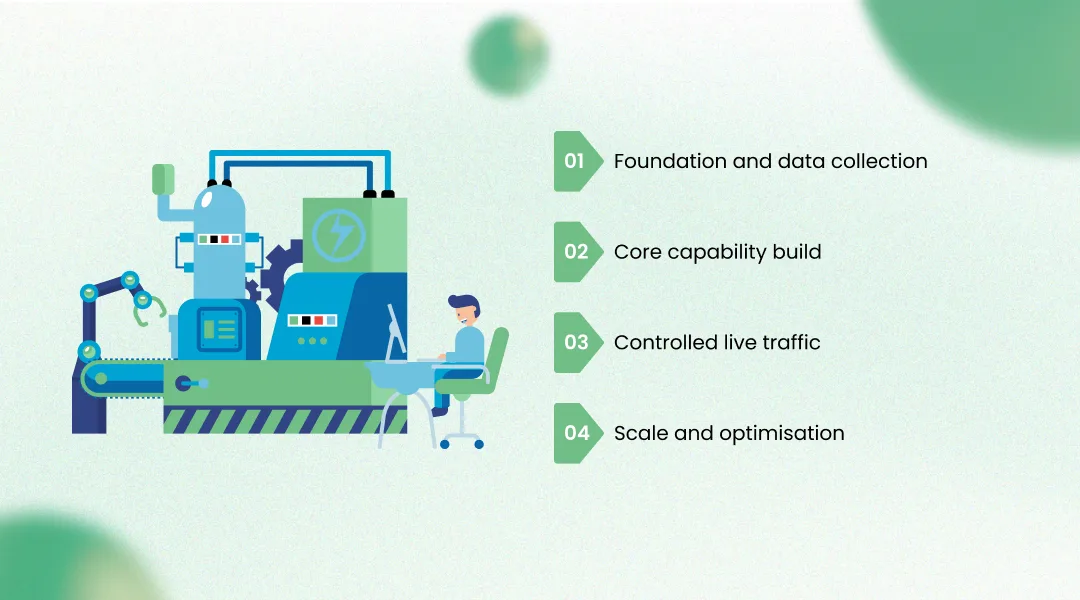
Deploying a production AI calling agent is a phased engineering programme, not a weekend integration project. Teams that underestimate the implementation complexity consistently produce systems that perform well on demo calls and fail on live traffic.
The implementation typically proceeds through four phases:
Phase 1: Foundation and data collection (weeks 1 to 6)
This phase establishes the telephony integration, ASR baseline, and initial intent taxonomy. The AI calling agent handles no live traffic yet. The team records and transcribes 500 to 2000 real calls from the target use case, labels intents and entities, measures ASR word error rate on this call sample, and identifies the top 10 to 20 intents that represent 80 percent of call volume.
Phase 2: Core capability build (weeks 7 to 16)
The team builds the ASR layer with domain adaptation, trains or configures the NLU classifier on labelled data, implements the dialogue manager for the top intent set, builds CRM and backend integrations, implements escalation logic, and deploys to a staging environment with synthetic call testing.
Phase 3: Controlled live traffic (weeks 17 to 24)
The AI calling agent receives a controlled slice of live traffic, typically 5 to 15 percent of calls for the target call type. Monitoring covers intent recognition accuracy, resolution rate, escalation rate, call duration, and post-call CSAT where available. Rapid iteration on dialogue design, escalation thresholds, and NLU training data based on real call observations.
Phase 4: Scale and optimisation (weeks 25 onwards)
Traffic allocation increases to 50 percent, then to full volume for in-scope call types. Latency optimisation, voice quality refinement, and expansion to additional intent categories proceed in parallel. KriraAI typically targets resolution rates above 70 percent on in-scope calls by the end of Phase 4, with escalation rates below 20 percent.
AI Calling Agent ROI and Business Case
The business case for an AI calling agent is quantifiable and, when the system is well-built, compelling. The key variables are call volume, average handling time, fully loaded cost per agent hour, and the fraction of calls the AI agent can resolve autonomously.
A realistic production AI calling agent achieves autonomous resolution on 60 to 75 percent of in-scope calls. For a contact centre handling 30,000 calls per month with an average handling time of 4.5 minutes and a fully loaded agent cost of $28 per hour, the cost per human-handled call is approximately $2.10. The cost of an AI calling agent handling a call, including infrastructure, LLM API costs, and telephony costs, runs $0.08 to $0.25 per call depending on call duration and whether the LLM inference is hosted or cloud-based.
At 70 percent autonomous resolution on 30,000 monthly calls, the AI calling agent handles 21,000 calls per month at an average cost of $0.15 each, totalling $3,150. The equivalent human cost for 21,000 calls at $2.10 each is $44,100. Monthly savings exceed $40,000, delivering return on implementation investment within 4 to 8 months depending on implementation cost.
Beyond direct cost reduction, AI calling agents deliver three additional business outcomes that do not appear in the cost-per-call calculation. First, consistent service quality across 100 percent of calls, eliminating the variance in human agent performance that drives customer satisfaction score volatility. Second, infinite concurrent capacity with no queue wait times during volume spikes, which is particularly valuable for industries with predictable surge periods such as insurance claims after weather events or retail during promotional campaigns. Third, complete call recording, transcription, and structured intent logging on every call, providing an analytics dataset that human call centres cannot practically generate at comparable quality.
The team at KriraAI has deployed AI calling agents for enterprises across multiple industries and consistently observes that the systems delivering the strongest ROI are those where the intent taxonomy is tight, the CRM integration is deep, and the escalation logic is conservative. Systems that try to automate too broad an intent set in the first deployment run into accuracy issues that damage caller trust and increase escalation rates, eroding the cost benefit.
Common Failure Modes and How to Avoid Them
Understanding why AI calling agent deployments fail is as important as understanding how to build one correctly.
The most common failure mode is designing for average caller behaviour while ignoring the tail. In a real call distribution, 15 to 25 percent of callers have regional accents, background noise, or speech patterns that fall outside the comfortable operating range of an ASR model that was evaluated only on clean recordings. These callers experience high ASR error rates, which cascade into NLU misclassifications, which produce incorrect responses, which erode trust. The mitigation is acoustic stress testing before launch: deliberately run the ASR layer against calls with background noise, low signal-to-noise ratio, and accented speech, and address error rates before going live.
The second most common failure mode is overbuilding the intent taxonomy before validating core performance. Teams designing their first AI calling agent often want to handle 80 intents from day one. The result is a sprawling intent space with insufficient training data per intent, poor generalisation, and an NLU classifier that is confidently wrong on a large fraction of calls. The correct approach is to start with the 10 highest-volume intents, achieve above 90 percent intent recognition accuracy on each, and expand the taxonomy incrementally as performance is validated.
The third failure mode is neglecting post-call analytics. An AI calling agent that does not have a robust analytics pipeline is a black box that cannot be improved. Every call should produce a structured record of recognised intents, confidence scores, conversation turns, resolution outcome, and escalation reason. This data is the primary input for dialogue improvement, ASR biasing updates, and escalation threshold calibration.
Conclusion
Three conclusions stand out from the architecture and evidence presented in this guide. First, the AI calling agent technology stack is mature enough for production deployment, but only when all layers are engineered specifically for telephone audio constraints, not adapted from general-purpose voice AI benchmarks. Second, the business case is compelling and quantifiable: autonomous resolution of 60 to 75 percent of in-scope calls at $0.08 to $0.25 per call versus $1.50 to $6.00 per human-handled call produces positive ROI within a year in virtually any contact centre operating above 10,000 monthly calls. Third, the difference between a successful production deployment and an expensive failed pilot comes down to disciplined intent scoping, robust escalation architecture, and a post-call analytics pipeline that enables continuous improvement.
KriraAI designs and deploys production-grade AI calling agent systems with the engineering depth that this problem genuinely demands. The company brings expertise across every layer of the voice AI stack, from telephony integration and ASR domain adaptation to LLM dialogue management and neural TTS voice design, and has delivered voice automation systems that perform reliably at enterprise scale across demanding industries. KriraAI treats every deployment as a systems engineering programme, not a product integration, because that is what the technology requires to produce results that hold up on live traffic. If you are evaluating an AI calling agent for your organisation, the team at KriraAI is ready to discuss your specific call types, volumes, and integration environment and provide an honest assessment of what a production-ready system would require.
FAQs
An AI calling agent is a full conversational AI system that conducts autonomous telephone conversations using a pipeline of automatic speech recognition, natural language understanding, dialogue management, and text-to-speech synthesis. It understands free-form spoken language, maintains context across multiple conversational turns, integrates with business systems in real time, and generates contextually appropriate responses. An interactive voice response system, by contrast, presents a fixed menu of options and routes callers based on keypad presses or single-keyword spoken commands. The fundamental difference is that an IVR forces callers to adapt to the system's vocabulary, while an AI calling agent understands natural speech across a wide range of phrasings, accents, and conversational patterns. An IVR cannot resolve a request that falls outside its scripted menu. An AI calling agent can handle novel utterances, ask clarifying questions, retrieve account data, and complete transactions in a way that mirrors a human agent conversation.
Building a production AI calling agent from scratch typically requires 3 to 6 months of engineering effort from a team of 4 to 8 engineers with expertise in speech AI, backend integration, and telephony, representing a development cost of $150,000 to $500,000 depending on scope and team cost. Deploying on a managed platform from a vendor reduces this to 6 to 12 weeks of integration and configuration work but introduces ongoing platform fees. Per-call operating costs in production range from $0.08 to $0.30 per call, encompassing telephony costs at $0.01 to $0.02 per minute, ASR inference at $0.004 to $0.012 per minute, LLM dialogue management at $0.01 to $0.06 per call depending on model size and call duration, and TTS synthesis at $0.004 to $0.015 per thousand characters. The business case depends on comparing these costs against the fully loaded cost per human-handled call, which in most contact centres falls between $1.50 and $6.00 depending on handle time and agent cost.
A production AI calling agent should meet the following minimum performance thresholds before handling live traffic at scale. ASR word error rate on the target call type's audio should be below 8 percent, which corresponds to roughly one word error per 12 words spoken, a level at which downstream NLU can typically recover through language model context. Intent recognition accuracy should exceed 90 percent on the top 10 intents and 85 percent across the full in-scope intent taxonomy. Entity extraction accuracy, the correct identification of account numbers, dates, names, and other slot values, should exceed 92 percent. End-to-end conversational latency, measured from end of caller utterance to start of agent audio playback, should be below 1500 milliseconds at the 90th percentile. Autonomous resolution rate on in-scope calls should reach at least 55 percent in controlled testing before production launch, with a clear optimisation path to 65 to 75 percent at scale. Systems that launch below these thresholds typically generate negative caller feedback that creates organisational resistance to continuing the programme.
A well-designed AI calling agent uses a multi-layer escalation architecture. The first layer is clarification: when the agent has low confidence about the caller's intent, it prompts for clarification rather than guessing. The second layer is graceful constraint acknowledgment: when a caller's request is outside the agent's authorised action set, the agent acknowledges this clearly and offers to connect the caller with a specialist rather than attempting to handle it incorrectly. The third layer is warm transfer escalation: when a caller explicitly requests a human, when negative sentiment exceeds a threshold, when the same clarification fails three consecutive times, or when the call type is flagged as requiring human judgment, the agent initiates a warm transfer to a human agent queue. The transfer includes a structured context summary delivered via screen pop to the receiving agent, containing the recognised call reason, any data already collected, the conversation summary, and the caller's authentication status. This prevents callers from needing to repeat themselves, which is the primary complaint about poorly implemented escalation paths.
A production AI calling agent can support multiple languages with appropriate engineering investment at each layer of the stack. The ASR layer requires either a multilingual model such as Whisper large-v3, which covers over 90 languages with varying accuracy, or language-specific models deployed behind a language identification router that detects the caller's language in the first 2 to 3 seconds of speech. The NLU layer requires either multilingual training data for each supported language or language-specific models. The dialogue management layer using an LLM inherently handles multiple languages if the underlying model supports them, though system prompt engineering for tone, formality, and cultural expectations should be language-specific. The TTS layer requires a voice model for each supported language that maintains consistent voice character across languages. Accent robustness within a language is addressed through acoustic model fine-tuning on accent-diverse training data. A well-built multilingual AI calling agent can achieve comparable accuracy across its supported languages, but each language requires independent validation and the total engineering investment scales approximately linearly with the number of supported languages.
Krushang Mandani is the CTO at KriraAI, driving innovation in AI-powered voice and automation solutions. He shares practical insights on conversational AI, business automation, and scalable tech strategies.