AI Call Assistant: Architecture, ROI, and How to Build One
A typical contact center pays between 3 and 8 dollars to handle a single inbound call. Most of that cost buys time, not resolution. Human agents spend their shifts on password resets, order status checks, and appointment changes. These calls are repetitive, high in volume, and entirely predictable. An AI call assistant is built to absorb exactly this work. It answers the phone, understands the caller, completes the task, and escalates only when it genuinely must.
The problem is that most teams underestimate what sits behind a good one. A call assistant that sounds natural and resolves real tasks is a tightly engineered pipeline. It is not a chatbot bolted onto a phone number. This guide breaks down what an AI call assistant actually is, the full voice stack that powers it, the design tradeoffs that decide success, what deployment really costs, and how to build one that holds up under live traffic.
What an AI Call Assistant Actually Is
An AI call assistant is a voice agent that handles real phone conversations end-to-end. It listens, understands intent, takes action through backend systems, and speaks back in natural language. It works on inbound queues, outbound campaigns, or both. The goal is task completion on the call, not just deflection to a menu.
This is a meaningful step beyond traditional automation. A legacy IVR routes callers through fixed menus and keypad presses. A call assistant holds an open conversation and adapts to what the caller says. The caller can speak naturally instead of memorizing option numbers. That difference changes the entire experience and the technical demands behind it.
The work is actually suited for
Not every call belongs to an assistant. The strongest fit is high volume, structured, and bounded by clear data lookups. Picking the right scope is the first design decision that matters.
Order status, delivery tracking, and shipment update calls that map to a single backend query.
Appointment booking, rescheduling, and reminder confirmation across calendars and CRM systems.
Account balance checks, plan details, and basic billing questions with strict authentication.
Outbound reminders, payment follow-ups, and lead qualification with consistent scripts.
First line triage that gathers context before a warm handoff to a human agent.
These workflows share a pattern. They have predictable intents, defined data sources, and a clear definition of success. That is where an AI call assistant earns its return fastest.
The Complete AI Call Assistant Architecture
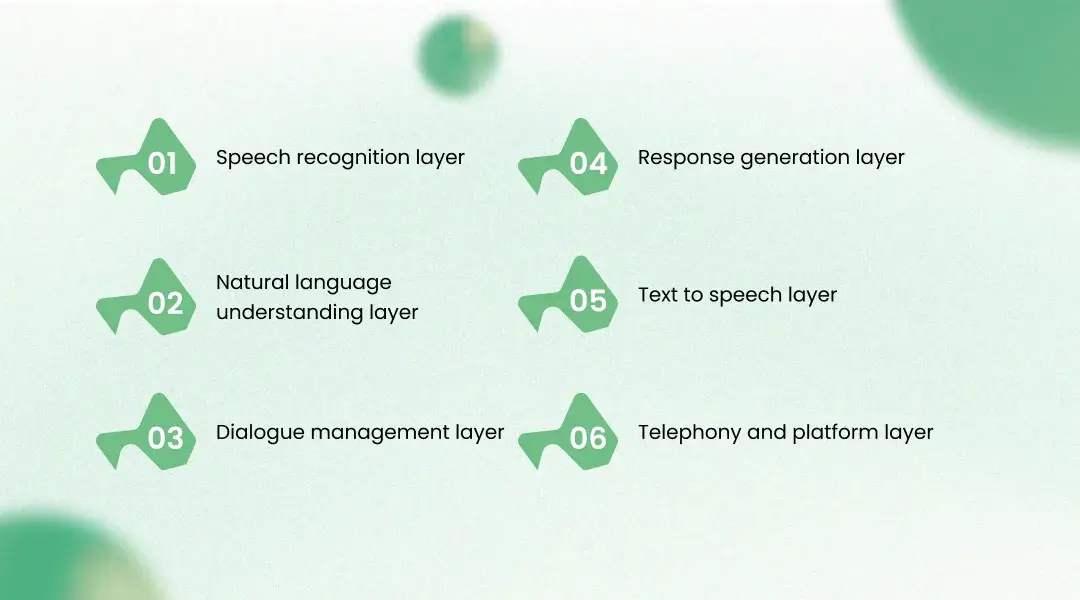
The AI call assistant architecture is a real-time pipeline of specialized layers. Each layer runs in milliseconds and feeds the next. A weakness in any single stage shows up as a slow, awkward, or wrong response. Understanding these layers is essential before any team commits to building or buying.
The full stack moves from audio in to audio out on every turn. Speech becomes text, text becomes intent, intent becomes action, and action becomes spoken language again. The hard part is doing all of this fast enough to feel like a conversation.
Speech recognition layer
The assistant first converts the caller audio into text in real time. This layer must run in streaming mode, not batch. Streaming models such as RNN-T and streaming CTC emit partial transcripts as the caller speaks. That early output is what keeps the whole pipeline responsive.
Conformer-based ASR offers strong accuracy on noisy phone audio. Whisper variants are excellent offline but heavier for true streaming use. On clean telephony audio, a well-tuned system reaches a word error rate of 5 to 10 percent. Domain adaptation matters here. Feeding product names, drug names, or local place names into the model lifts accuracy on the words that decide task success.
Natural language understanding layer
The NLU layer turns transcripts into intent and structured data. Two approaches dominate today. A fine-tuned classifier such as BERT or RoBERTa gives fast, cheap, and stable intent detection. A zero-shot or few-shot LLM classifier handles open-ended and unseen phrasing with more flexibility.
Most production assistants use a hybrid. A lightweight classifier handles the common, high-frequency intents at low latency. An LLM handles the long tail and ambiguous utterances. The layer also extracts entities and fills slots, such as a date, an order number, or an account ID. Robust slot filling across partial and corrected speech is what separates a usable assistant from a frustrating one.
Dialogue management layer
Dialogue management decides what the assistant does next on each turn. The classic choice is a finite state machine, which is predictable and easy to audit. A frame-based manager is more flexible and tracks multiple slots without rigid ordering. A retrieval augmented LLM approach handles open conversation with grounded knowledge.
For most call assistants, a frame-based core with LLM-assisted understanding works best. It keeps control and compliance tight while allowing natural phrasing. Pure generative dialogue is powerful but risky on regulated calls. It can drift, hallucinate steps, or skip required disclosures. Strong assistants constrain generation with explicit business rules and guardrails.
Response generation layer
This layer produces the words the assistant will say. Template-based responses are fast, predictable, and safe for confirmations. LLM generation is better for explanation, empathy, and varied phrasing. Retrieval grounding pulls live facts so the model speaks from real data, not guesses.
Latency and accuracy compete directly here. A large model gives richer answers but adds delay. Grounding every factual claim in retrieved data prevents hallucination on the phone. On a voice call, a confident wrong answer is far worse than a short pause. Good design caps response length so the assistant stays crisp and to the point.
Text-to-speech layer
The TTS layer converts the response text into natural speech. Neural systems such as VITS and YourTTS produce fluid, human-sounding output. Streaming TTS is the key requirement, not just voice quality. It must emit the first audio chunk in under 200 milliseconds.
Streaming lets the caller hear the start of a sentence while the rest is still synthesizing. That single technique removes most of the awkward gaps in voice AI. Custom voice design and prosody control shape the persona and tone. A calm, clear voice raises trust on billing and healthcare calls.
Telephony and platform layer
This layer connects the assistant to the actual phone network. Calls arrive over SIP trunks and the PSTN, or through WebRTC for web calling. RTP carries the live audio packets in both directions. Platforms such as Twilio, Vonage, Amazon Connect, and Genesys provide this connectivity.
The integration pattern bridges media streams into the AI pipeline with minimal added delay. High concurrency, clean barge in handling, and reliable failover are mandatory at scale. A dropped or stuttering call erases any benefit from clever NLU. This is the layer where reliability engineering matters as much as model quality. KriraAI treats this layer as a first-class concern, since most production failures originate here rather than in the models.
Key Design Decisions That Decide Success
The single largest driver of perceived quality is latency. A natural conversation needs end-to-end response latency under about 800 milliseconds. Beyond roughly one second, callers start talking over the assistant. The budget is split across ASR, NLU, generation, and TTS. Every layer must hold its share, with ASR partials arriving in under 300 milliseconds.
Barge-in handling is the second decisive factor. Callers interrupt, and the assistant must stop speaking instantly. The system should detect a barge within about 200 milliseconds and yield the floor. Without this, the assistant feels robotic, and people hang up.
Escalation and fallback logic
An honest assistant knows its limits. It must escalate cleanly when confidence drops or the task falls outside scope. A good fallback design protects both the customer and the brand.
Escalate when intent confidence falls below a defined threshold across two attempts.
Escalate immediately on detected distress, anger, or explicit requests for a human.
Pass the full call context and collected slots to the human agent on handoff.
Log every escalation reason to improve coverage in later iterations.
The aim is not to contain every call. The aim is to contain the right calls and route the rest with context intact.
How to Build an AI Call Assistant
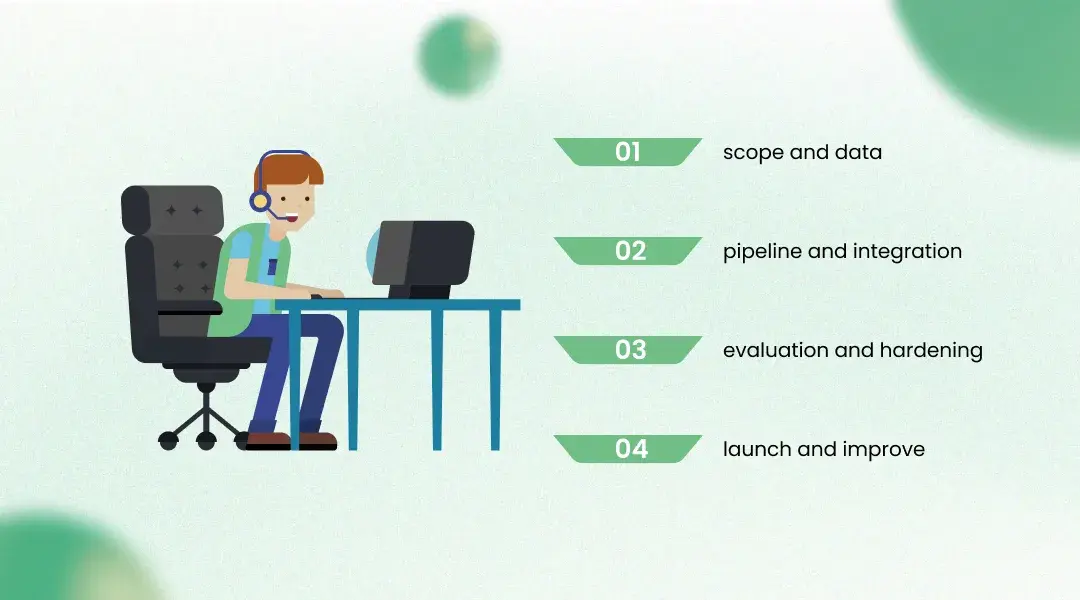
To build an AI call assistant that survives production, teams follow a staged path. Skipping stages is the most common reason deployments stall. A realistic full deployment runs roughly 8 to 12 weeks for a focused use case. The phases below reflect how KriraAI structures real delivery for enterprise voice automation.
Phase one, scope and data
The first phase defines a narrow, high-value use case. The team pulls call recordings and transcripts to map real intents. This grounds the design in how customers actually speak. A vague scope at this stage guarantees disappointment later.
Phase two, pipeline and integration
The second phase assembles the voice pipeline and wires the backends. Engineers select ASR, NLU, dialogue, and TTS components for the use case. They integrate CRM, order systems, and authentication into the call flow. Latency budgets are set and measured from day one, not at the end.
Phase three, evaluation and hardening
The third phase tests the assistant against a real call variety. This is where most quality gains are found. Teams evaluate against clear, measurable criteria before any live traffic.
Intent recognition accuracy across common and rare phrasing.
Task completion rate, also called containment, for in-scope calls.
End-to-end latency at the ninetieth percentile under load.
Escalation precision, meaning escalations that truly needed a human.
Authentication and compliance adherence on every regulated path.
Phase four: launch and improve.
The final phase rolls out to a small share of traffic first. Real calls reveal gaps that test sets miss. The team monitors quality, fixes failure clusters, and expands coverage. A call assistant is a living system, not a one-time delivery.
AI Call Assistant vs IVR and Human Agents
An AI call assistant differs from an IVR in one fundamental way. An IVR forces callers down rigid menus with keypad presses. An assistant holds an open conversation and adapts to natural speech. In an AI call assistant vs IVR comparison, the assistant resolves intent directly instead of routing through layers of options.
The contrast with human agents is about economics and consistency. A human agent typically handles 6 to 8 calls per hour. An assistant handles thousands of concurrent calls with no queue. It never tires, never varies its script, and works every hour of the day.
The honest view is that this is not a full replacement. Humans remain better at nuance, empathy, and messy edge cases. The right model is a blend, where the AI call assistant for call centers absorbs repetitive volume. Agents then focus on complex, high-value, and emotional conversations. This split is where the strongest business outcomes appear.
The Business Case and ROI
The ROI of an AI call assistant comes from cost per call and capacity. A human-handled call costs roughly 3 to 8 dollars in fully loaded terms. A well-scoped automated call costs closer to 10 to 30 cents. That gap compounds quickly across high-volume queues.
A well-designed assistant achieves a containment rate of 60 to 80 percent on suitable workflows. Containment means the call resolves without a human ever joining. Even at the lower end, the savings on repetitive calls are significant. The freed agent capacity also cuts hold times and abandonment.
Where the numbers come from
Realistic ROI modeling avoids inflated promises. It accounts for build cost, platform fees, and ongoing tuning. It also accounts for calls the assistant should not attempt. A credible model only counts containment on genuinely in scope traffic.
The second benefit is elasticity during demand spikes. Seasonal peaks no longer require frantic hiring and training. The assistant scales instantly and shrinks back with no overhead. For many operations, this resilience matters as much as the per-call savings. KriraAI builds these models with conservative assumptions so the business case holds under audit.
Common Mistakes and What Good Looks Like
Most failed deployments share a small set of root causes. Knowing them in advance saves months of rework. The pattern is consistent across industries and call types.
Choosing a scope that is too broad, which dilutes accuracy on every intent.
Ignoring latency until launch, when conversations already feel sluggish.
Skipping streaming ASR and TTS, which creates long, unnatural silences.
Allowing unconstrained LLM generation on regulated or transactional calls.
Treating escalation as failure rather than a designed, context-rich handoff.
A production-grade assistant looks different in practice. It feels fast, with replies that begin before the caller finishes a thought. It admits uncertainty and routes cleanly when needed. It logs everything, so each week of traffic makes it measurably better.
Good systems also instrument quality continuously. They score conversations, track intent accuracy, and watch escalation trends. They run A/B tests on dialogue strategies to lift containment safely. This monitoring discipline is what keeps performance stable as call patterns shift over time.
Conclusion
Three points matter most for any team evaluating an AI call assistant. First, it is a real-time engineered pipeline, where latency under 800 milliseconds and streaming at every stage decide whether it feels human. Second, the strongest returns come from narrow, high-volume workflows, where containment of 60 to 80 percent turns dollars per call into cents. Third, success depends on honest escalation and continuous tuning, not on automating every call type.
KriraAI designs and deploys production-grade AI voice agent systems for real enterprise environments. We bring serious engineering depth across ASR, dialogue management, telephony, and backend integration. We build assistants that stay fast, stay grounded, and improve with every week of live traffic. Our focus is voice automation that works reliably at scale, not demos that fail under load.
If you are weighing whether to build or buy a call assistant, we would welcome the conversation. Talk to KriraAI about your call volumes, your workflows, and your constraints, and we will help you design a voice agent that performs in production.
FAQs
An AI call assistant is a voice agent that handles full phone conversations from greeting to resolution. It works through a real-time pipeline of layers that each run in milliseconds. Speech recognition converts caller audio to text, natural language understanding extracts intent and key details, and a dialogue manager decides the next step. The system then retrieves data, generates a grounded response, and speaks it back through neural text-to-speech. It connects to the phone network over SIP or WebRTC. The assistant completes tasks like booking appointments or checking orders, and escalates to a human when needed.
An AI call assistant has two cost components: the initial build and the ongoing per-call cost. A focused deployment typically takes 8 to 12 weeks of engineering, integration, and hardening. Once live, a well-scoped automated call usually costs between 10 and 30 cents to handle. That compares with roughly 3 to 8 dollars for a human-handled call in fully loaded terms. Ongoing costs include telephony, model usage, and continuous tuning. The strongest returns come from high volume, repetitive workflows where containment stays high. Realistic ROI modeling should count savings only on genuinely in-scope traffic, not every call.
An AI call assistant handles structured and bounded tasks extremely well, but complex emotional calls remain a shared responsibility. It excels at order status, scheduling, balance checks, and qualification, where intents are predictable. For ambiguous, sensitive, or highly nuanced situations, the right design escalates to a human with full context. The best architectures use confidence thresholds and distress detection to decide when to hand off. They passed the collected details and the conversation summary to the agent on transfer. This blended model keeps containment high on routine volume while preserving quality on hard calls. Trying to automate every call type usually reduces accuracy across the board.
The core difference is conversation versus menus. A traditional IVR routes callers through fixed options selected by keypad presses or rigid voice prompts. An AI call assistant understands natural speech and responds to what the caller actually means. In an AI call assistant vs IVR comparison, the assistant resolves intent directly instead of forcing navigation through nested layers. It handles interruptions, corrections, and varied phrasing that break a standard IVR. It also takes real action through backend systems during the call. The result is shorter calls, less caller frustration, and higher first contact resolution. An IVR routes, while an assistant resolves.
An AI call assistant reaches strong accuracy on well-scoped tasks, often matching humans on routine intents. On clean telephony audio, modern speech recognition achieves a word error rate near 5 to 10 percent. Intent recognition and slot filling can be highly reliable when the use case is narrow and well trained. Humans still outperform on ambiguity, empathy, and unusual edge cases. The accurate comparison is not all calls, but the specific subset the assistant is built for. On that subset, a tuned assistant delivers consistent quality without fatigue or variation. Continuous monitoring and retraining keep its accuracy improving as call patterns evolve.
Ridham Chovatiya is the COO at KriraAI, driving operational excellence and scalable AI solutions. He specialises in building high-performance teams and delivering impactful, customer-centric technology strategies.