Most teams that buy AI calling software learn the same lesson within a week. The demo sounded flawless, but live calls felt slow and awkward. The gap between a scripted demo and a real phone call is enormous. AI calling software has to recognize speech, understand intent, fetch data, and speak back. It must do all of that on a noisy phone line in under one second. That budget is what separates software that feels human from software that feels like an old IVR menu.
This guide explains how AI calling software actually works in production. It walks through the full voice pipeline and the telephony layer underneath it. It covers the latency problem that breaks most deployments and the real numbers behind cost and ROI. It also explains why inbound and outbound are different engineering problems. By the end you will know what to ask vendors, what to budget, and where these systems fail.
AI calling software is a system that places or answers phone calls and holds a natural spoken conversation without a human agent. It listens, reasons, takes actions in your backend systems, and responds in a synthetic voice. The goal is to automate calls that previously required a person on the line. This includes support queries, lead qualification, appointment booking, reminders, and collections follow ups.
The problem it solves is structural, not cosmetic. Phone support and outbound calling are expensive, hard to staff, and impossible to scale instantly. A human team can only handle calls one at a time, and hiring lags demand by weeks. Call centres lose customers to long hold times and missed callbacks. AI calling software removes that ceiling by handling thousands of concurrent calls at once.
The distinction that matters is between scripted IVR and conversational AI. Traditional IVR forces callers through rigid menus and breaks the moment someone speaks freely. Modern AI calling software understands open speech and adapts to how people actually talk. KriraAI designs and deploys production AI calling systems that replace brittle IVR trees with conversations that resolve the caller's actual intent.
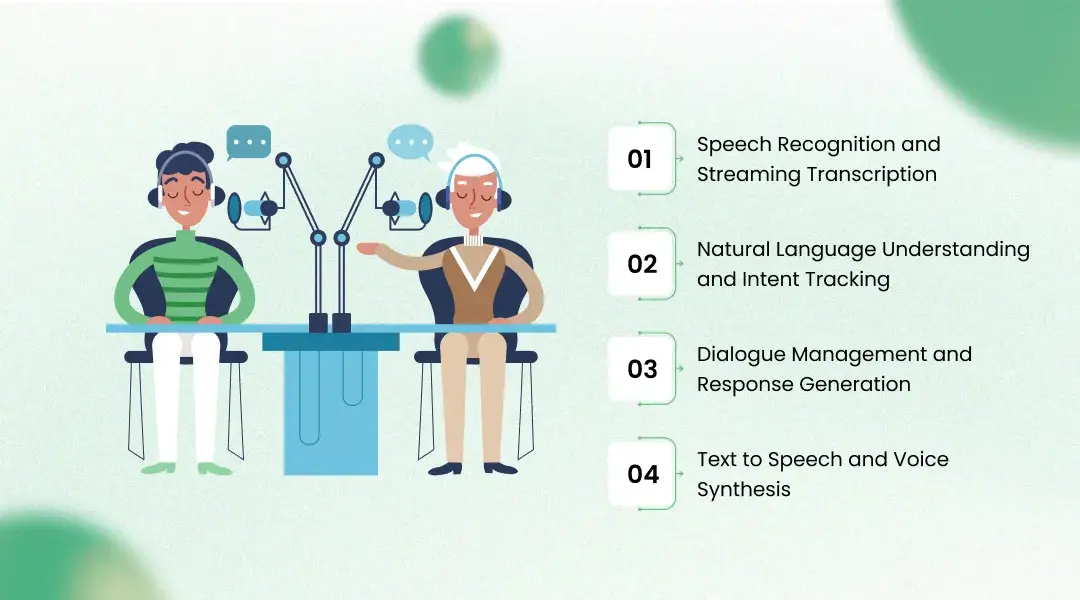
Understanding how AI calling software works means understanding the AI voice calling pipeline as a real time loop. Every caller turn passes through several stages in sequence. Audio comes in, gets transcribed, gets understood, drives a decision, and gets spoken back. Each stage adds latency, and the total must stay low enough to feel like a conversation.
The pipeline is not a single model. It is a chain of specialised components that must be tuned together. A weak link anywhere produces calls that lag, mishear, or talk over the caller. The sections below break down each layer and the engineering decisions that matter.
The first layer is automatic speech recognition, which converts the caller's audio into text. Telephony audio is narrowband and sampled at 8kHz using codecs like G.711. That low fidelity hurts accuracy compared to clean studio audio. Streaming ASR word error rates on real phone calls typically land between 7 and 12 percent.
For live calls you cannot use a batch model that waits for the full utterance. Whisper large variants are highly accurate but were built for batch transcription, which adds latency. Production systems lean on streaming architectures instead, such as RNN-T or streaming Conformer models. Providers like Deepgram and AssemblyAI expose these as low latency streaming endpoints.
Endpointing is as important as raw accuracy in AI calling software. The system must decide when the caller has finished speaking before it responds. Voice activity detection and smart endpointing prevent the agent from interrupting or waiting too long. Domain adaptation also matters, because product names, account numbers, and local names break generic models.
The next layer turns the transcript into structured meaning. Older systems used fine tuned BERT or RoBERTa classifiers for intent detection. These are fast and cheap but require labelled data and break on phrasing they never saw. Modern AI calling software increasingly uses large language models for understanding instead.
A hybrid approach works best in production environments. A fast classifier or router handles common, well defined intents at low cost. An LLM with function calling handles open ended or ambiguous turns where flexibility matters. This keeps costs down while preserving the ability to handle messy real speech.
Entity extraction and slot filling run alongside intent detection. The system pulls out dates, amounts, names, and reference numbers from the transcript. It must track context across many turns, since callers correct themselves and change topics. State tracking is what lets the agent remember what was already said earlier in the call.
Dialogue management decides what the agent does next on each turn. The three common designs are finite state machines, frame based managers, and LLM driven control. A finite state machine is predictable and auditable but brittle when callers go off script. A fully generative LLM is flexible but risks hallucination and wandering off task.
Most production AI calling software uses a constrained, guardrailed LLM with tool calling. The model can converse freely but is restricted to approved actions and grounded data. Retrieval augmented generation pulls real answers from your knowledge base instead of inventing them. This combination keeps conversations natural while preventing the agent from making things up.
Response generation has a hard latency constraint that text chatbots never face. The first words must begin streaming before the full answer is composed. Systems optimise for time to first token rather than total generation time. Grounding and guardrails prevent confident wrong answers, which damage trust faster on a live call than in chat.
The final layer converts the chosen response into spoken audio. Neural TTS systems such as VITS based models produce natural prosody and clear speech. Fast hosted engines like Cartesia and ElevenLabs Turbo deliver low latency synthesis suited to calls. First audio chunk latency from these fast models typically sits around 90 to 150 milliseconds.
Streaming TTS is non-negotiable for AI calling software at scale. The audio must start playing before the full sentence is synthesised. Waiting for a complete sentence adds dead air that callers immediately notice. The agent should also support barge in, so callers can interrupt and the agent stops talking.
Voice persona design is a real product decision, not an afterthought. The voice sets the caller's expectation for the brand within the first second. KriraAI tunes voice, pacing, and turn taking so the agent matches the use case and the audience. A collections call and a clinic reminder call need very different vocal personas.
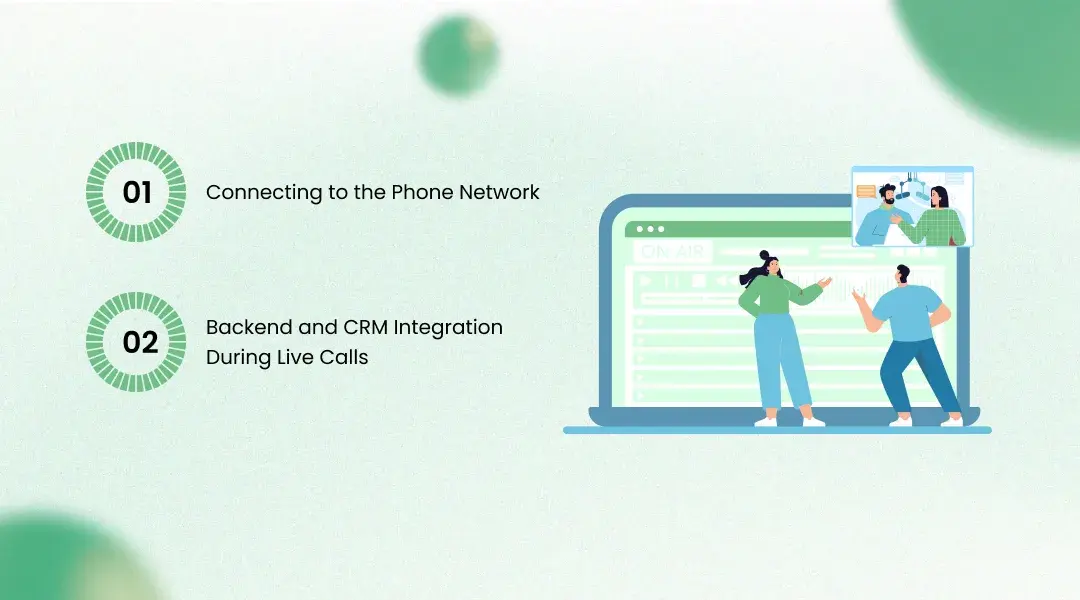
The voice pipeline is only half the system. The other half connects that pipeline to the actual phone network and your business data. This layer is where most reliability problems live in production. A great conversation model is useless if calls drop or data lookups fail mid call.
AI calling software reaches callers through telephony infrastructure built on standard protocols. SIP handles call signalling, while RTP carries the actual audio packets. WebRTC connects browser and app based voice without a phone number. Platforms like Twilio, Plivo, Vonage, Telnyx, Amazon Connect, and Genesys provide this connectivity.
Media streaming is how the pipeline gets live audio from the call. Providers expose real time media streams over WebSockets that pipe audio to your ASR. Concurrency planning matters here, because a campaign can spike to thousands of simultaneous calls. Codec handling, jitter buffering, and packet loss recovery all affect how clean the audio arrives.
The agent must act on real data while the caller waits on the line. This means live lookups into a CRM, order system, or scheduling database mid conversation. The agent might verify an identity, check an order status, or book a slot in real time. Every one of those calls must return fast enough to fit inside the response budget.
Integration also covers handoff and post call work, which decide overall quality. Clean escalation to a human agent with full context prevents frustrated callers. After the call, the system stores transcripts, updates records, and feeds analytics. KriraAI builds these integrations against real enterprise stacks so the agent acts on live data, not stale copies.
Latency is the single hardest engineering problem in AI calling software. Human conversation has a natural turn taking rhythm with gaps of a few hundred milliseconds. To feel natural, total response latency should stay under roughly 800 milliseconds. Once the gap passes about 1.2 seconds, the conversation starts to feel robotic and people talk over the agent.
That budget has to cover the entire AI voice calling pipeline, not one stage. Endpointing might consume 100 to 300 milliseconds before processing even begins. The LLM adds time to first token, often 300 to 500 milliseconds under load. TTS adds its first chunk latency, and network round trips add more on top.
The way to win is parallelism and streaming, not faster components alone. Stages overlap instead of running strictly one after another wherever possible. The LLM starts generating before the caller fully stops, then corrects if needed. Streaming TTS begins speaking the first words while the rest is still being produced.
Buyers often assume one product handles both inbound and outbound calls equally well. In practice they are different engineering and compliance problems. Inbound calling means a caller chose to reach you and expects an immediate, helpful response. Outbound calling means you are initiating contact, which raises consent and timing concerns.
Inbound AI calling software optimises for fast pickup, intent detection, and resolution. The hard parts are understanding unscripted speech and routing correctly on the first turn. Outbound systems instead optimise for reaching the right person and respecting regulation. Pacing, retry logic, and time of day rules become central design concerns.
Compliance is where outbound gets serious, especially in markets like India. Outbound campaigns must respect TRAI DLT registration and consent rules for commercial calls. Data handling must align with the DPDP framework for personal information. A serious vendor builds these controls in rather than treating them as an afterthought.
The AI calling software ROI case rests on three levers that compound together. The first is cost per call, the second is scale, and the third is availability. A clear eyed model looks honestly at all three rather than promising magic. The numbers below reflect realistic production economics, not best case demos.
On cost, AI calling software typically runs around 0.06 to 0.12 US dollars per minute. That covers telephony, ASR, the language model, and TTS combined. A fully loaded human agent costs far more per minute once wages, management, and idle time are counted. The gap widens further because the AI handles peaks without overtime or new hires.
Scale and availability are where the AI calling software ROI gets decisive. The system handles thousands of concurrent calls and runs every hour of every day. Well scoped use cases reach 60 to 80 percent automation, meaning most calls resolve without a human. A realistic production rollout usually takes 4 to 8 weeks rather than several months.
The honest tradeoff is that AI calling software is not free to run and not perfect. It excels at high volume, well defined calls and struggles with rare, emotional, or complex ones. The right model routes the long tail to humans and automates the predictable bulk. KriraAI builds business cases on these real numbers so leaders fund projects that actually pay back.
Choosing the best AI calling software comes down to a few decisive criteria. Vendors all demo well, so you have to test the conditions that break systems. Evaluate against your real audio, your real intents, and your real integrations. The following criteria separate production grade systems from impressive demos.
Measure live end to end latency on real phone lines, not the latency quoted in a scripted demo.
Test speech recognition accuracy on your actual accents, background noise, and domain vocabulary.
Confirm the dialogue layer is grounded and guarded so it cannot invent answers on a live call.
Verify real time integration with your CRM and core systems, including identity verification flows.
Check escalation quality, since clean handoff to a human with full context defines caller trust.
Review compliance support for outbound rules such as TRAI DLT and data handling under DPDP.
Inspect monitoring, including intent accuracy tracking, escalation rate, and conversation quality scoring.
The build versus buy decision depends on volume and control needs. Buying a platform is faster and fine for standard support or reminder flows. Building gives you control over latency, voice, and deep integration, but demands real voice engineering. Many teams choose a middle path where a partner builds a custom system on proven components.
If you build, treat the AI voice calling pipeline as a system to be tuned together. Optimise endpointing and streaming first, because latency wins or loses the experience. Instrument everything from day one so you can see where calls fail. KriraAI brings serious engineering depth to exactly this work, delivering voice automation that performs reliably in real enterprise environments.
The most common mistake is buying on demo quality instead of production behaviour. A demo runs on clean audio, narrow scripts, and no backend load. Real calls bring accents, noise, interruptions, and live data lookups. Teams that skip realistic testing discover the gap only after launch.
A second frequent mistake is ignoring the latency budget until it is too late. Adding a slow integration or a heavy model quietly pushes responses past one second. By then the conversation already feels mechanical to callers. Latency must be a design constraint from the first architecture decision.
The third mistake is treating escalation and compliance as edge cases. Poor handoff leaves callers repeating themselves to a confused human agent. Weak consent and data controls create legal exposure on outbound campaigns. Good AI calling software treats these as core features, not afterthoughts bolted on later.
Three points decide whether AI calling software succeeds in production. First, the system is a tuned voice pipeline, and latency under roughly 800 milliseconds is what makes it feel human. Second, the economics are real, with per minute costs near 0.06 to 0.12 dollars and automation of 60 to 80 percent on well scoped calls. Third, reliability lives in the telephony, integration, escalation, and compliance layers, not in the demo.
KriraAI designs and deploys production grade AI voice agent systems that turn those principles into working software. The team brings the voice engineering depth to control latency, the integration experience to act on live enterprise data, and the domain knowledge to handle compliance from the first design decision. KriraAI builds AI calling software that performs reliably at scale, not just in a demo. If you are evaluating or building a voice agent, talk to KriraAI about your specific calling requirements and where automation will actually pay back.
AI calling software works as a real time loop that connects a phone call to an AI voice pipeline. Incoming audio is transcribed by streaming speech recognition, then interpreted by an understanding layer that detects intent and extracts details. A dialogue manager, usually a guarded large language model with tool calling, decides the response and pulls grounded data from your systems. A text to speech engine streams the spoken reply back to the caller. The whole loop must complete in well under one second to feel natural, which is why production systems stream and overlap stages rather than running them strictly in sequence.
AI calling software typically costs around 0.06 to 0.12 US dollars per minute of call in production, covering telephony, speech recognition, the language model, and text to speech together. Pricing varies with call complexity, the models chosen, and your call volume, since heavier models and richer integrations raise the per minute figure. Compared with a fully loaded human agent, the cost per minute is far lower, and the gap widens during demand spikes because the AI scales instantly without overtime or new hiring. The AI calling software ROI usually comes from combining lower per call cost, unlimited concurrency, and round the clock availability.
AI calling software can make outbound calls legally, but only when it respects consent and regulatory rules for your market. In India, outbound commercial calling must comply with TRAI DLT registration and consent requirements, and personal data must be handled under the DPDP framework. This means honouring do not call preferences, calling within permitted hours, and keeping auditable consent records. The legality depends on configuration and governance, not the technology alone, so a responsible vendor builds these controls into the platform. Treat compliance as a core design requirement, because penalties and reputational damage from non compliant outbound campaigns are severe.
AI calling software is better than human agents for high volume, well defined calls, while humans remain better for rare, complex, or emotionally charged conversations. The software handles thousands of concurrent calls instantly, runs every hour of every day, and never tires or varies in quality. Well scoped deployments automate roughly 60 to 80 percent of calls without a human. The strongest results come from a hybrid model where the AI handles predictable bulk volume and escalates the difficult long tail to people with full context. The goal is not full replacement but removing repetitive load so human agents focus on cases that genuinely need them.
The best AI calling software stands out on real call performance rather than scripted demo quality. It holds end to end response latency under roughly 800 milliseconds on live phone lines so conversations feel natural. It maintains high speech recognition accuracy on real accents, noise, and domain vocabulary, and its dialogue layer is grounded so it cannot fabricate answers. It integrates with live CRM and core systems mid call, escalates cleanly to humans with full context, and supports outbound compliance such as TRAI DLT and DPDP. Strong monitoring of intent accuracy, escalation rate, and conversation quality lets the system improve continuously after launch.
Founder & CEO
Divyang Mandani is the CEO of KriraAI, driving innovative AI and IT solutions with a focus on transformative technology, ethical AI, and impactful digital strategies for businesses worldwide.
