Let me guess.
You’ve heard AI Agents. You’ve heard Deep Learning. Maybe even AI Agents vs Machine Learning 2026.
And now you’re stuck wondering Are these competing technologies… or parts of the same system?
I’ve been in rooms where CTOs argued over this for hours. Not because they weren’t smart but because the industry loves blurry definitions.
So let’s fix that.
No jargon. No fluff. Just clarity.
At its core, AI agents are systems that decide and act.
Not just predict. Not just analyze. They do things.
Think of them as digital employees ones that observe, decide, and execute tasks without constant human input.
Reactive Agents – Respond to inputs (like chatbots)
Autonomous Agents – Plan, decide, and execute tasks independently
Multi-Agent Systems – Multiple agents collaborating (or competing)
I’ve built systems where AI agents:
Handle customer support end-to-end
Automate internal workflows
Optimize pricing in real time
This is why AI Agents in business 2026 is exploding.
Because businesses don’t just want insights anymore. They want action.
Deep learning is a subset of machine learning that uses neural networks to learn patterns from data.
That’s it.
No decision-making layer. No autonomy. Just learning.
Imagine a system that learns like a human brain layer by layer.
Input → Hidden Layers → Output
Each layer refines the signal.
Simple in theory. Brutal in execution.
CNNs (for images)
RNNs/LSTMs (for sequences)
Transformers (for language yes, the kind behind ChatGPT)
These power most deep learning applications 2026, from voice recognition to fraud detection.
Let’s cut through the noise.
Factor | AI Agents | Deep Learning |
Purpose | Decision + Action | Pattern Recognition |
Autonomy | High | None |
Learning | Optional | Core function |
Real-Time Action | Yes | No |
Role | System-level | Component-level |
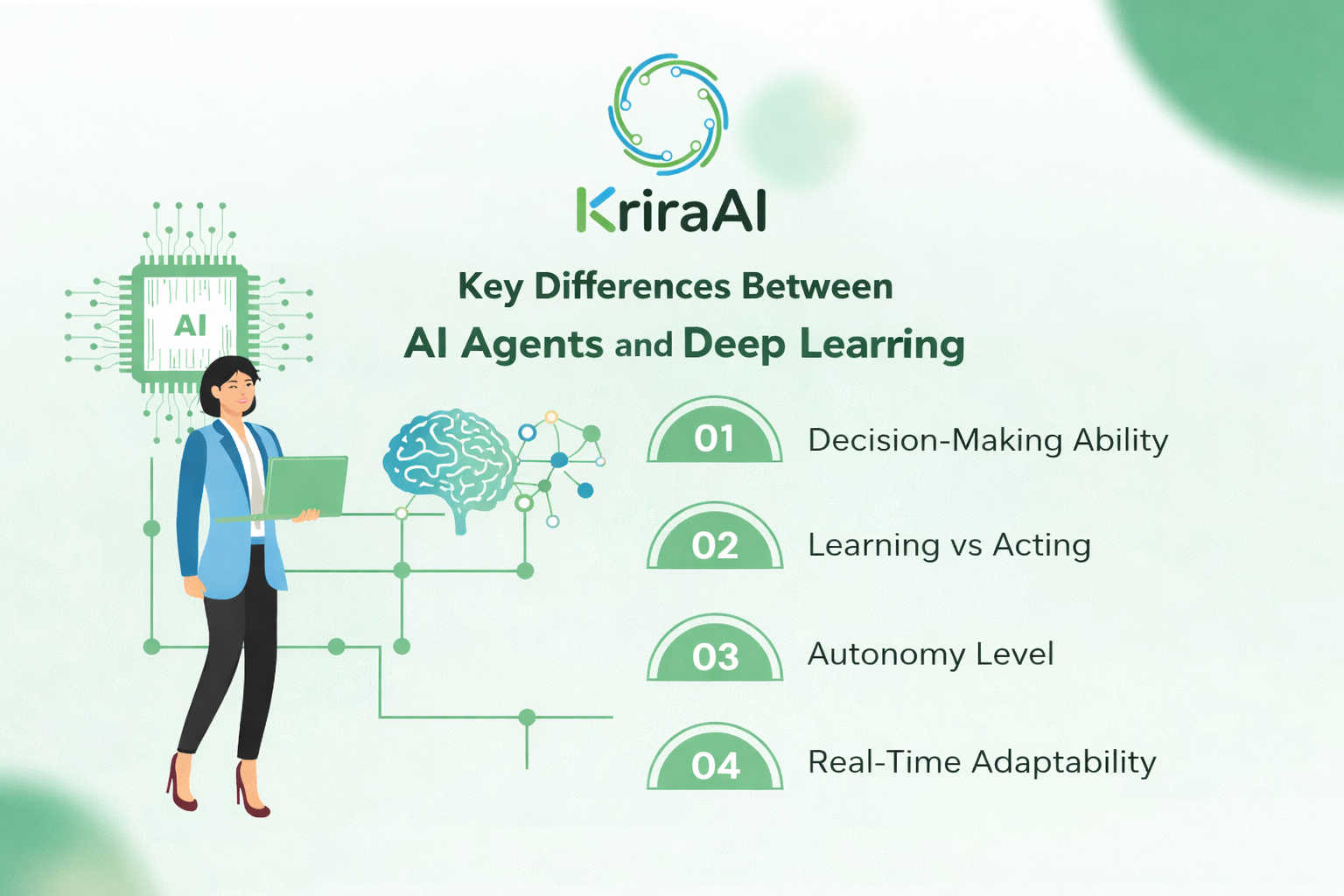
AI agents are AI decision making systems. Deep learning models? They just provide predictions.
Deep learning = learning AI agents = acting
Simple.
Agents can run entire workflows. Deep learning cannot.
Agents adapt dynamically. Deep learning models need retraining.
Here’s where people get it wrong.
They think it’s AI Agents vs Deep Learning as a competition.
It’s not.
It’s a relationship.
AI agents often use deep learning models internally.
Example architecture:
Deep learning model → predicts customer intent
AI agent → decides response + executes action
So when you compare intelligent AI agents vs neural networks, you’re comparing a system vs a component.
Big difference.
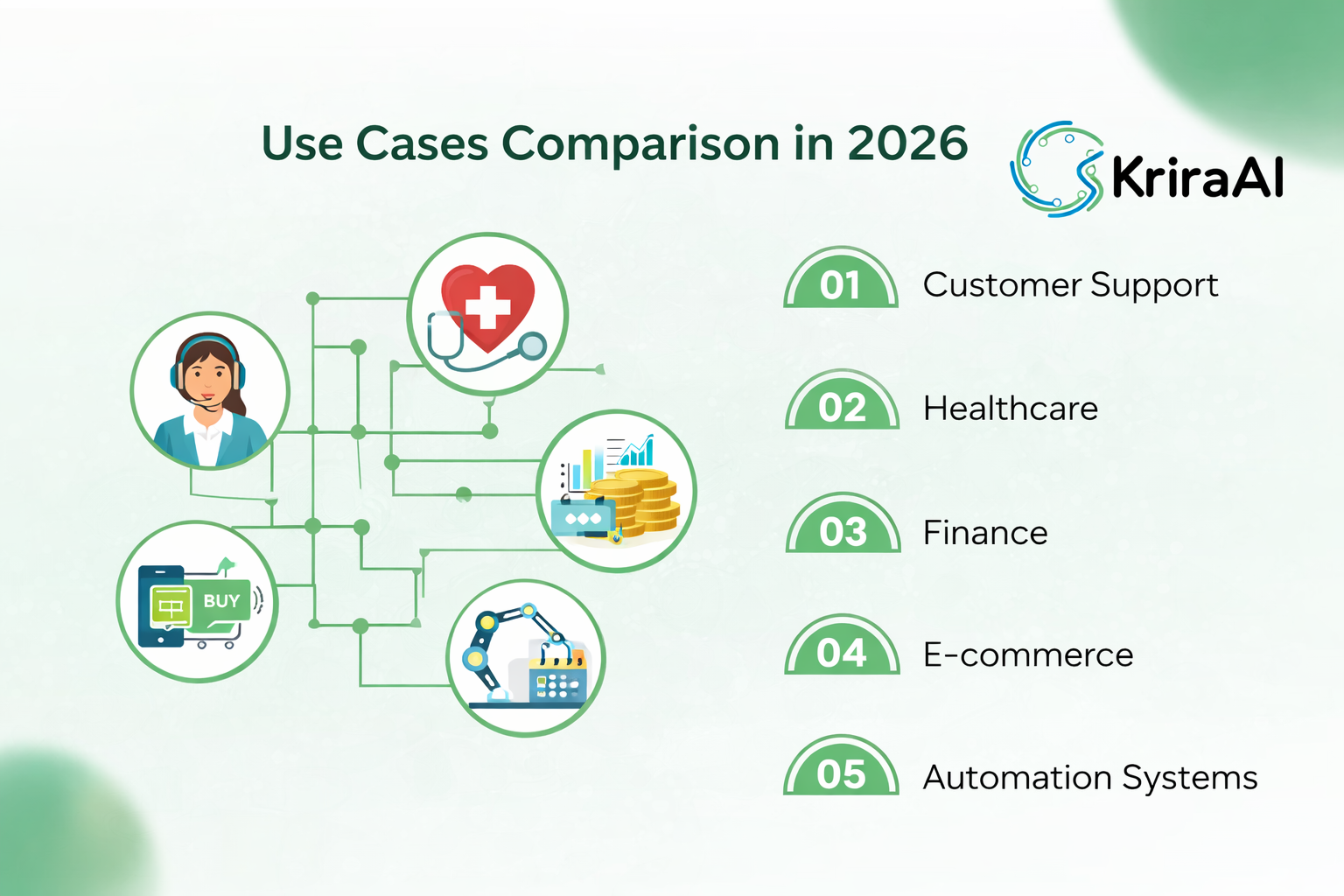
Let’s make this practical.
Deep Learning: sentiment analysis
AI Agents: full conversation handling + resolution
Deep Learning: disease detection
AI Agents: patient workflow automation
Deep Learning: fraud detection
AI Agents: real-time transaction blocking
Deep Learning: recommendations
AI Agents: dynamic pricing + inventory control
This is where AI automation vs deep learning becomes obvious.
One analyzes. The other executes.
Advantages:
End-to-end automation
Real-time decision-making
Scalable operations
Limitations:
Complex to design
Requires orchestration
Higher upfront cost
Advantages:
High accuracy in predictions
Strong pattern recognition
Proven across industries
Limitations:
No autonomy
Data-heavy
Requires constant tuning
Short answer?
It depends.
Long answer?
Let me be blunt.
If your goal is insights, go with deep learning. If your goal is execution, go with AI agents.
But most modern businesses need both.
At KriraAI, I’ve seen companies waste months building models… …and then realize they still need a system to use those predictions.
That’s where agents come in.
Deep learning → cheaper initially
AI agents → better ROI long-term
If your focus is AI to Save Time and Cut Costs, agents win.
Every time.
Let’s zoom out.
Companies running on AI agents, not humans.
Sounds extreme?
It’s already happening.
This is the real shift.
Not generative AI vs deep learning… But how everything connects.
Soon, you won’t need engineers to build agents.
(And yes, that should make you slightly uncomfortable.)
Here’s the truth most blogs won’t tell you.
Deep learning is the brain. AI agents are the body.
One thinks. The other acts.
And businesses that combine both? They move faster. Operate smarter. And frankly win.
So next time someone asks you about Deep Learning vs AI Agents…
You won’t just answer.
You’ll explain it better than most experts.
The core difference lies in function. Deep learning focuses on learning patterns and generating predictions from data, while AI agents use those predictions to make decisions and take actions. In modern systems, deep learning acts as a component, while AI agents operate as complete systems.
AI agents operate by combining data inputs, decision logic, and execution layers. For example, in customer support, an AI agent can understand a query, decide the best response, and resolve the issue without human intervention, making them highly effective in automation.
Absolutely. Deep learning remains a foundational technology for tasks like image recognition, NLP, and predictions. However, it is increasingly being embedded inside AI agents rather than used independently.
Deep learning models are generally cheaper to start with but require ongoing data and maintenance costs. AI agents have higher initial development costs but deliver stronger ROI over time through automation and operational efficiency.
AI agents are better suited for automation because they can act on decisions. Deep learning can support automation by providing insights, but it cannot execute tasks independently.
Founder & CEO
Divyang Mandani is the CEO of KriraAI, driving innovative AI and IT solutions with a focus on transformative technology, ethical AI, and impactful digital strategies for businesses worldwide.