Gartner forecasts that 80% of enterprise applications shipped or updated in Q1 2026 now embed at least one AI agent, a dramatic surge from just 33% in 2024. This is not a projection buried in a speculative white paper. It is a measured observation of what has already happened. Enterprises deploying agentic AI systems report average returns of 171%, with U.S. companies achieving closer to 192%, roughly three times the ROI of traditional automation. The experimental phase for operations is over, and the companies still debating whether to adopt are already losing ground to competitors who deployed six months ago.
The shift toward autonomous AI workflows marks the most significant change in how businesses operate since the adoption of cloud computing in the early 2010s. AI agents are not chatbots with better prompts. They are systems that plan, reason, use tools, retain memory, and take goal oriented action across complex business processes. They read contracts, schedule meetings, qualify sales leads, reconcile invoices, triage support tickets, and monitor compliance, all without waiting for a human to tell them what to do next. The difference between an AI agent and a traditional automation script is the difference between a GPS that recalculates your route and a paper map that sits in the glove compartment.
This blog will examine why AI agents have become essential for enterprise competitiveness, how the technology actually works in production environments, what measurable results companies are achieving, and how organizations can build a practical AI agent implementation strategy that avoids the most common and expensive mistakes. Whether you are a CTO evaluating your first pilot or a founder looking to understand the agentic AI landscape, this analysis offers the specifics you need to make informed decisions.
Before examining the technology itself, it is worth understanding why enterprises are so desperate for it. Modern enterprise operations suffer from a compounding set of inefficiencies that have resisted decades of software investment. Companies have spent trillions of dollars on ERP systems, CRM platforms, project management tools, and business intelligence dashboards, yet the average knowledge worker still spends 60% of their time on coordination, context switching, and manual data transfer between systems rather than on the high value work they were hired to do.
The problem is structural, not superficial. Enterprise software was built to store and display data, not to act on it. A CRM can show you that a lead has gone cold, but it cannot draft the follow up email, check the lead's latest LinkedIn activity, pull relevant case studies, and schedule a meeting. A finance platform can flag an invoice discrepancy, but it cannot cross reference the purchase order, email the vendor, and update the general ledger. Each of these tasks requires a human to serve as the connective tissue between systems, and that connective tissue is the most expensive and least scalable resource in any organization.
Cost pressures have made this status quo unsustainable. Labour costs in knowledge work have risen steadily, while the complexity of regulatory compliance, customer expectations, and competitive dynamics has increased even faster. Companies are being asked to do more with less, a phrase that has become a boardroom cliche precisely because no existing technology has delivered on its promise. Hiring more people does not solve a process problem. Adding more software tools often makes coordination worse, not better, because each new tool creates another silo that requires human attention to bridge.
The competitive dynamics are equally punishing. In industries from financial services to healthcare to logistics, the speed of decision making has become a primary competitive advantage. Companies that can respond to market signals, customer inquiries, and operational disruptions faster than their competitors capture disproportionate value. But speed cannot be achieved through human effort alone when the underlying processes require traversing multiple systems, checking multiple data sources, and coordinating multiple stakeholders. This is the gap that AI agents are designed to fill, not by replacing human judgment, but by handling the repetitive, cross system coordination work that consumes most of the workday.
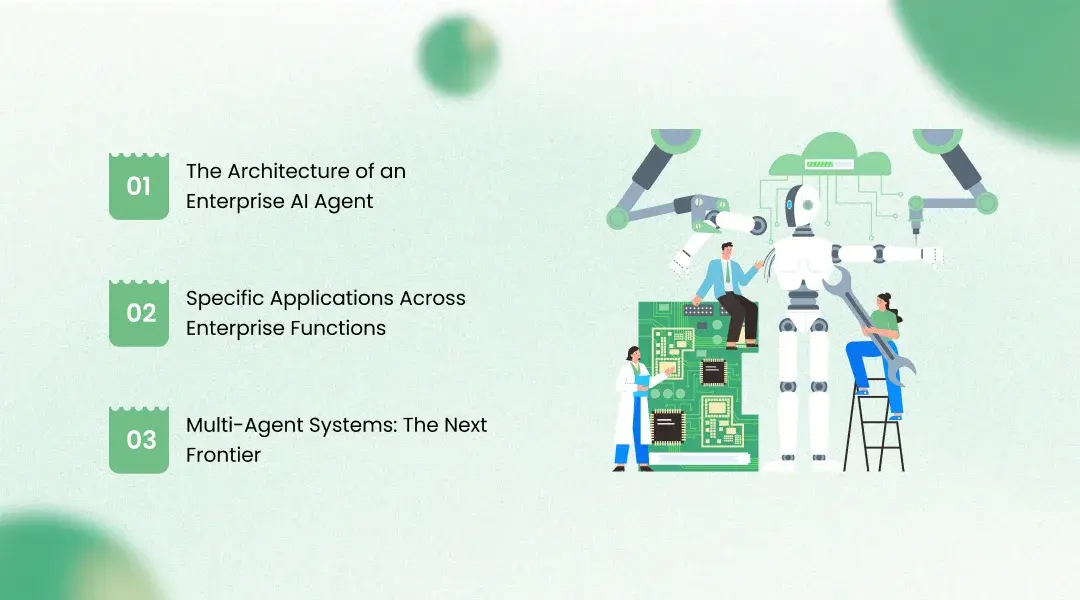
An AI agent is fundamentally different from the AI tools that most enterprises have used to date. Traditional AI applications, such as recommendation engines, fraud detection models, or sentiment analysis tools, perform a single function on a single data source and return a single output. An AI agent, by contrast, operates as an autonomous system that can reason about goals, break complex objectives into sub tasks, select and use tools, interact with external systems through APIs, maintain context across multi step workflows, and adjust its approach based on intermediate results.
The core technical components that make this possible include large language models for reasoning and natural language understanding, tool use protocols such as the Model Context Protocol (MCP) that standardize how agents connect to enterprise data and services, memory systems that allow agents to retain context across sessions, and orchestration frameworks that coordinate multiple agents working on related tasks. KriraAI has been at the forefront of integrating these components into production grade systems that enterprises can deploy without rebuilding their existing technology infrastructure, focusing on practical architectures that deliver measurable outcomes rather than impressive demos.
The most mature deployments of agentic AI for business fall into several well defined categories, each solving a specific operational bottleneck.
In customer service and support, AI agents now handle initial ticket triage, gather relevant customer history from CRM and billing systems, attempt resolution for common issues, and escalate complex cases with full context summaries to human agents. Companies running these systems report that agents can deflect 30% to 50% of incoming support tickets entirely, while reducing average resolution time for escalated tickets by 40% because the human agent receives a complete briefing rather than starting from scratch.
In sales and revenue operations, agents qualify inbound leads by researching prospects across multiple data sources, scoring fit against ideal customer profiles, drafting personalized outreach, and scheduling meetings. The autonomous AI workflows in this category are particularly compelling because they eliminate the most tedious parts of the sales development representative role while improving response times from hours to minutes. Enterprise clients using sales automation agents report three to five times improvement in response rates compared to generic outreach.
In finance and accounting, agents reconcile invoices against purchase orders, flag discrepancies, route approvals, and update general ledger entries. They process expense reports by cross referencing receipts against corporate policies, checking for duplicates, and routing exceptions for human review. In legal and compliance, agents review contracts against standard templates, flag non standard clauses, and generate risk summaries. Salesforce reportedly cut $5 million in legal costs through contract automation using agentic AI.
In IT operations, agents monitor system health, diagnose alerts, attempt automated remediation for known issues, and generate incident reports. They handle password resets, provision access, and manage software license allocation. These tasks are individually small but collectively consume enormous amounts of IT team bandwidth.
The evolution from single agent deployments to multi-agent systems enterprise architectures represents the next major leap in capability. Rather than deploying one agent to handle one function, organizations are now building teams of specialized agents that collaborate on complex, cross functional workflows. Gartner documented a 1,445% surge in multi-agent system inquiries from Q1 2024 to Q2 2025, signaling that this shift is production critical, not experimental.
A multi-agent architecture might include a research agent that gathers and synthesizes information, an analysis agent that evaluates options against defined criteria, a communication agent that drafts messages and documents, and a coordination agent that manages handoffs and ensures nothing falls through the cracks. These agents operate with different access permissions, different tool sets, and different optimization goals, but they share context through orchestration layers that manage state synchronization and conflict resolution. Multi-agent AI systems deliver approximately three times faster task completion and 60% better accuracy compared to single agent implementations, according to recent enterprise benchmarks.
The business case for AI agents has moved beyond theoretical projections into verified, production level results. Organizations deploying agentic AI report average returns of 171%, with the median payback period across all enterprise functions sitting at just 5.1 months. Sales development agents pay back the fastest, with a median time to value of 3.4 months, while finance and operations agents take longer at approximately 8.9 months but deliver larger absolute returns due to the volume of transactions they process.
Cost savings are the most immediately visible impact. A mid-sized business automating 70% of customer service queries through AI agents can save between $80,000 and $100,000 annually against an agent platform cost of $5,000 to $25,000 per year. The Klarna case study remains one of the most cited examples in the industry: a single AI customer service agent handled the equivalent workload of 853 employees by Q3 2025, saving the company approximately $60 million. While not every company operates at Klarna's scale, the underlying economics apply across business sizes and sectors.
Productivity improvements compound over time in ways that initial ROI calculations often underestimate. McKinsey estimates that companies implementing AI agents see revenue increases of 3% to 15%, a 10% to 20% boost in sales ROI, and marketing cost reductions of up to 37%. These gains are not one time savings. AI agents continuously improve through feedback loops, with fraud detection systems becoming 15% to 25% more accurate each year as they process more data. This creates a compounding ROI curve where $1 invested in year one might yield $3.60, growing to $6.50 by year three and over $12 by year five.
Speed improvements also carry significant economic value, even though they are harder to measure on a balance sheet. When a sales agent can respond to an inbound lead in two minutes instead of two hours, the probability of conversion increases dramatically. When a finance agent can close the monthly books in three days instead of ten, the management team gains a week of decision making time. When an IT agent resolves a system alert in seconds instead of waiting for a human to notice it, the company avoids cascading downstream failures. These time based advantages translate directly into competitive positioning, customer satisfaction, and employee retention, because nobody wants to spend their career doing work that a machine can handle more reliably.
KriraAI works with enterprises to model these impacts before deployment, building custom ROI frameworks that account for both direct cost savings and the harder to quantify but equally important gains in speed, accuracy, and employee satisfaction. This pre deployment modelling is critical because it establishes realistic expectations and ensures that pilot programs are measured against the right benchmarks.
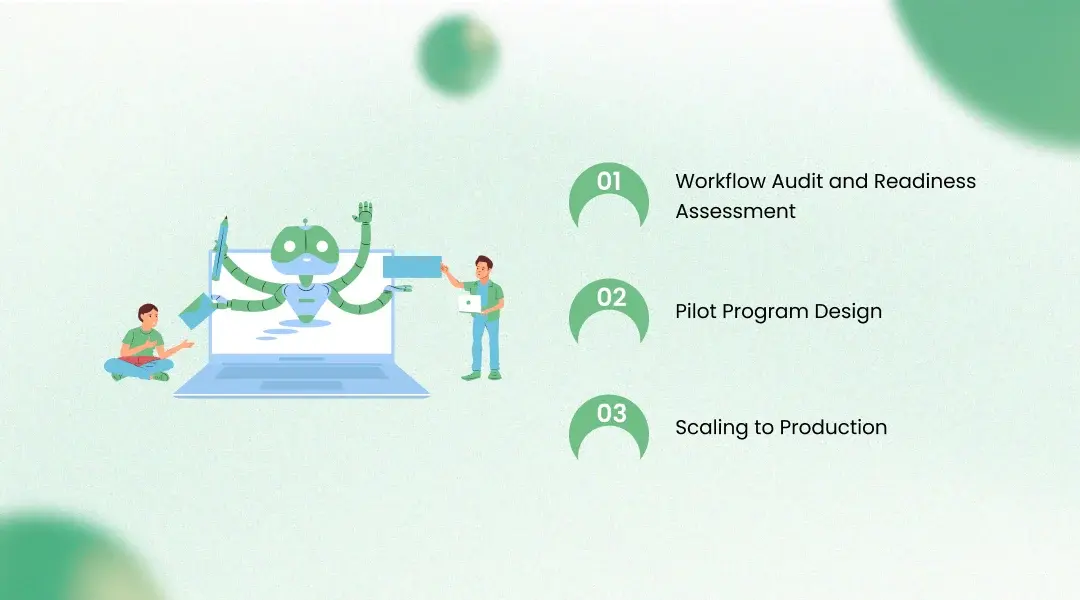
The most common reason AI agent projects fail is not technology limitations but poor scoping. Organizations that skip the workflow audit phase typically end up building agents for the wrong processes, automating workflows that are already broken rather than ones that are well defined but labour intensive. A proper audit involves mapping every step in a candidate workflow, identifying which steps require human judgment versus which are rule based or pattern based, measuring the current time and cost of each step, and assessing the quality and accessibility of the data that the agent would need.
The readiness assessment also covers data infrastructure. According to industry surveys, 52% of businesses cite data quality and availability as the biggest barrier to AI adoption, and 37% of organizations face data quality problems specifically when preparing for AI deployment. IDC projects a 15% productivity loss for companies that fail to establish AI ready data foundations by 2027. An agent that cannot access clean, structured, timely data will produce poor results regardless of how sophisticated its reasoning capabilities are.
The pilot phase should target a single, well bounded workflow with clear success metrics. The most successful pilots share several characteristics.
They automate workflows that are high volume, low variance, and currently performed by humans following documented procedures.
They operate in domains where errors are easily detected and corrected, reducing the risk of undetected failures.
They have a clear baseline measurement, so the team can objectively compare pre and post deployment performance.
They include human in the loop oversight for the first 30 to 60 days, with graduated autonomy based on performance data.
They have executive sponsorship and a defined decision point for scaling or stopping.
A phased approach typically spans three to four months: deploy, measure, refine, then decide on scaling. Investing $5,000 to $10,000 upfront in agent operations tooling, including monitoring, logging, and observability, can save $30,000 or more in debugging and rework cycles during the pilot.
Scaling an AI agent from pilot to production involves challenges that are fundamentally different from the pilot phase. Governance becomes critical, because an agent operating at scale across thousands of transactions per day requires robust audit trails, error handling, and compliance monitoring. Integration complexity increases as the agent needs to connect with more systems, each with its own authentication model, data format, and rate limits. Cost management requires attention because API calls to language models accumulate quickly at scale, and a single bug in an agent's reasoning loop can generate thousands of dollars in unexpected charges within hours.
The following mistakes account for the majority of failed AI agent deployments and should be addressed explicitly in your AI agent implementation strategy.
Automating broken processes rather than fixing them first. If a workflow has unclear ownership, inconsistent data inputs, or contradictory business rules, adding an AI agent will not fix the underlying dysfunction. It will automate the dysfunction at higher speed.
Skipping the human in the loop phase. The instinct to deploy fully autonomous agents from day one is understandable but dangerous. Every agent needs a calibration period during which humans review its outputs, catch errors, and provide feedback that improves performance.
Treating the agent as a standalone product rather than an integrated system. An AI agent's value comes from its ability to connect with and act across enterprise systems. Organisations that deploy agents without investing in proper API integrations, data pipelines, and orchestration layers end up with expensive chatbots rather than autonomous workflows.
Ignoring change management. The human side of AI deployment is consistently underestimated. Teams that feel threatened by automation will resist it, withhold data, and find ways to route work around the agent. Successful deployments involve affected teams from the design phase, demonstrate how agents eliminate tedious work rather than jobs, and provide clear career development pathways for employees whose roles evolve.
Honest assessment of the challenges facing AI agent adoption requires moving beyond the optimistic statistics. Despite the high adoption numbers, approximately two thirds of organisations say they are still in experiment or pilot mode, and only about a third have genuinely scaled AI agent deployments. Gartner projects that more than 40% of agentic AI projects will fail or be cancelled by the end of 2027 due to escalating costs, unclear business value, or insufficient risk controls.
Data readiness remains the single largest obstacle. Building AI agents on top of poor data infrastructure is like constructing a skyscraper on sand. Agents need access to clean, well structured, real time data across multiple systems, and most enterprises do not have this. Data silos, inconsistent formatting, missing records, and inadequate access controls all undermine agent performance. Organisations that rush past the data readiness stage consistently report lower ROI and higher failure rates than those that invest in data quality before deploying agents.
Talent gaps present another serious constraint. Building, deploying, and maintaining AI agents requires skills that most enterprise IT teams do not currently possess. Prompt engineering, agent architecture design, orchestration framework selection, and model evaluation are all relatively new disciplines without established training pipelines. Companies that rely solely on vendor provided solutions without building internal capability often find themselves unable to customize, troubleshoot, or evolve their agent deployments as business needs change.
Regulatory and compliance risks are particularly acute in industries such as financial services, healthcare, and legal services, where AI driven decisions can have significant consequences for individuals. Agent actions need to be auditable, explainable, and compliant with industry specific regulations that were written long before autonomous AI systems existed. The regulatory landscape is evolving rapidly, and companies that deploy agents without establishing robust governance frameworks risk both compliance violations and reputational damage.
Finally, the problem of cascading failures in multi-agent systems enterprise deployments deserves attention. When multiple agents operate simultaneously with interdependencies, a failure in one agent can propagate through the entire system. Most observed agent failures are actually orchestration and context transfer issues at handoff points between agents, not failures of model capability. Building resilient multi-agent architectures requires investment in monitoring, fallback mechanisms, and circuit breaker patterns that add complexity and cost to the deployment.
The trajectory of autonomous AI workflows over the next three to five years points toward a fundamental reorganisation of enterprise work. By 2028, Gartner projects that 33% of enterprise software applications will contain agentic AI capabilities, up from less than 1% in 2024, and 15% of day to day work decisions will be accomplished autonomously. By 2027, agent specialisation will lead to 70% of multi-agent systems containing agents with narrow, focused roles, improving accuracy but creating increasingly complex orchestration requirements.
The companies that will benefit most from this shift are those building their AI infrastructure now, even if their initial deployments are modest. The compounding nature of AI agent performance means that early adopters gain a widening advantage over time, because their agents are learning from production data that late adopters will not have access to for years. A fraud detection agent with two years of production data will consistently outperform a newly deployed competitor, not because of better technology, but because of better training data accumulated through actual operations.
Companies that delay AI agent adoption beyond 2027 will face a structural competitive disadvantage that becomes increasingly difficult to close. Their competitors will have optimised processes, accumulated proprietary training data, built internal expertise, and achieved cost structures that late adopters cannot match in the short term. This is not speculation. It is the same pattern observed in previous technology shifts, from ERP adoption in the 1990s to cloud migration in the 2010s. The companies that moved early captured disproportionate value, and the laggards spent years and enormous sums trying to catch up.
KriraAI is positioning its enterprise clients for this future by building agent architectures that are modular, extensible, and designed to evolve as foundation model capabilities improve. Rather than locking companies into rigid implementations tied to today's technology, KriraAI designs systems that can incorporate new models, new tools, and new orchestration patterns as they emerge, ensuring that the initial investment continues to deliver returns as the technology landscape shifts.
Three insights stand out from this analysis. First, AI agents in enterprise operations are no longer experimental technology. They are production grade systems delivering verified, compounding returns across every major business function. Second, the gap between early adopters and laggards is widening rapidly, and the compounding nature of AI agent performance means that delayed adoption creates a structural disadvantage that becomes harder to close with each passing quarter. Third, success depends not on the sophistication of the AI technology itself, but on the quality of the implementation: workflow selection, data readiness, governance frameworks, and change management determine whether an agent deployment becomes a competitive advantage or an expensive lesson.
The organisations that will thrive in the agentic AI era are those acting now, not with reckless speed, but with disciplined urgency. KriraAI partners with enterprises to build AI agent systems that are practical, measurable, and designed for scale, helping companies move from pilot to production without the costly missteps that derail so many deployments. From initial workflow audits through multi-agent architecture design and ongoing optimization, KriraAI provides the technical depth and strategic clarity that enterprise AI adoption demands.
If your organisation is evaluating AI agents or looking to scale an existing deployment, explore how KriraAI's enterprise AI solutions can accelerate your path to measurable results.
AI agents are autonomous software systems that use large language models and tool use protocols to plan, reason, and take multi step actions toward defined goals without requiring explicit step by step programming. Unlike traditional automation tools such as robotic process automation (RPA), which follow rigid, pre defined scripts and break when encountering unexpected inputs, AI agents can interpret context, make decisions, adapt to new situations, and interact with multiple enterprise systems dynamically. Traditional automation excels at highly repetitive, perfectly structured tasks, while AI agents handle complex workflows that involve unstructured data, judgment calls, and coordination across multiple systems. The practical difference is that an RPA bot can copy data from one spreadsheet to another, but an AI agent can read a customer complaint email, research the customer's history, determine the appropriate resolution based on company policy, draft a response, and update the relevant internal systems, all without human intervention.
The cost of implementing AI agents varies significantly based on complexity, scale, and whether an organisation builds custom solutions or uses existing platforms. Entry level deployments using pre built agent platforms typically range from $5,000 to $25,000 per year for mid-sized businesses, while custom enterprise implementations involving multi-agent architectures, proprietary data integrations, and advanced orchestration can require initial investments of $50,000 to $200,000 or more. However, these costs must be evaluated against the returns: well implemented AI agents typically deliver 200% to 500% ROI in the first year through labour cost savings, faster response times, and increased conversion rates. The median payback period across enterprise functions is 5.1 months, meaning most deployments become cost positive within the first two quarters. Hidden costs that organisations frequently underestimate include integration fees, data preparation, monitoring and observability tooling, and ongoing model costs at scale. Budgeting an additional 20% to 40% above the platform subscription for these expenses is a widely recommended practice.
Financial services and insurance lead AI agent adoption at 47% production deployment rates, followed by technology and professional services. These industries benefit disproportionately because they have high volumes of document intensive, rule based processes that are expensive when performed by humans but well suited to agentic automation. Banking institutions like JPMorgan now run over 450 AI use cases in production daily. Retail and e-commerce see strong returns from customer service agents, inventory management, and personalised marketing, with typical ROI of four to nine times the initial investment in year one. Healthcare and government agencies trail at 18% and 14% adoption respectively, primarily due to regulatory complexity and data sensitivity requirements. Professional services firms, including law, accounting, and consulting, report some of the highest per dollar returns, with ROI of eight to fifteen times in year one, because their core work involves document drafting, research, and client communication, all of which are well suited to AI agent capabilities.
The most significant risks fall into five categories: data quality failures, governance gaps, integration brittleness, cost overruns, and change management resistance. Data quality issues are the most common root cause of poor agent performance, with 52% of businesses citing data quality as their biggest barrier to AI adoption. Governance risks are particularly serious because agents operating at scale can make thousands of decisions per day, and without proper audit trails and oversight mechanisms, errors can compound rapidly before detection. Integration risks emerge when agents interact with legacy systems that lack modern APIs or have inconsistent data formats. Cost overruns typically result from uncontrolled API usage in agent reasoning loops, where a single logical error can trigger thousands of unnecessary model calls. Change management remains the most underestimated risk, as employees who feel threatened by automation will actively or passively resist deployment. Organisations that address all five risk categories during the planning phase, rather than reacting to problems post deployment, report significantly higher success rates.
The timeline to positive ROI from AI agent implementation depends heavily on the use case, deployment approach, and organisational readiness. Sales development and customer service agents deliver the fastest returns, with median payback periods of 3.4 months and 4.2 months respectively, because they immediately reduce labour costs while improving response times and conversion rates. Finance and operations agents take longer, with median payback at approximately 8.9 months, because they require more extensive integration with existing systems and a longer calibration period to achieve acceptable accuracy. Across all enterprise functions, 74% of executives report achieving positive ROI within the first year of deployment, and 39% report that productivity at least doubled. The key accelerant is proper scoping during the planning phase: organisations that spend adequate time on workflow audits and data readiness assessments before deployment consistently reach positive ROI two to three months faster than those that rush to production. A phased deployment approach, starting with a focused three to four month pilot and scaling based on measured results, is the most reliable path to sustained returns.
Ridham Chovatiya is the COO at KriraAI, driving operational excellence and scalable AI solutions. He specialises in building high-performance teams and delivering impactful, customer-centric technology strategies.