
AI Agent Development Cost in 2027: Pricing by Agent Type and How to Choose a Partner
Picture a 60-person freight forwarder near Mundra port whose staff spend roughly 420 desk hours a month keying 1,800 booking emails into a transport management system (TMS). It wants software that reads each email, fills the booking and waits for a coordinator to approve it, and agencies that offer AI Agent Development will quote that job anywhere from about $20,000 to well over $100,000. The ai agent development cost for a project like this depends less on the AI model than on the systems the agent has to touch, the mistakes it must never make, and who maintains it after launch.
The Mundra forwarder is an illustrative example that runs through every section, so each number tied to it is a worked assumption rather than survey data. Figures drawn from published research carry the publisher's name beside them, from Gartner to the US Bureau of Labor Statistics. Planning estimates are labelled as illustrative, so you can replace them with the figures on your own vendor's quote.
What does ai agent development cost in 2027?
A production AI agent in 2027 usually costs between about $7,500 and $280,000 to build, depending on whether it only answers questions or also takes actions across several business systems, plus a recurring monthly bill for model usage, hosting and upkeep. That range is wide because the label covers very different software. A bot that tells Mundra coordinators which ports need a fumigation certificate and a set of cooperating agents that negotiate freight rates are both sold as agents.
The fairest way to think about price is hours multiplied by a blended hourly rate. A blended rate is the average a vendor charges across everyone on the project, from the solution architect to the QA tester. Every tier below is shown at two illustrative blended rates, $30 an hour and $100 an hour, which roughly bracket offshore and onshore agency pricing; your actual quotes will differ.
How a custom agent works, traced through one booking email
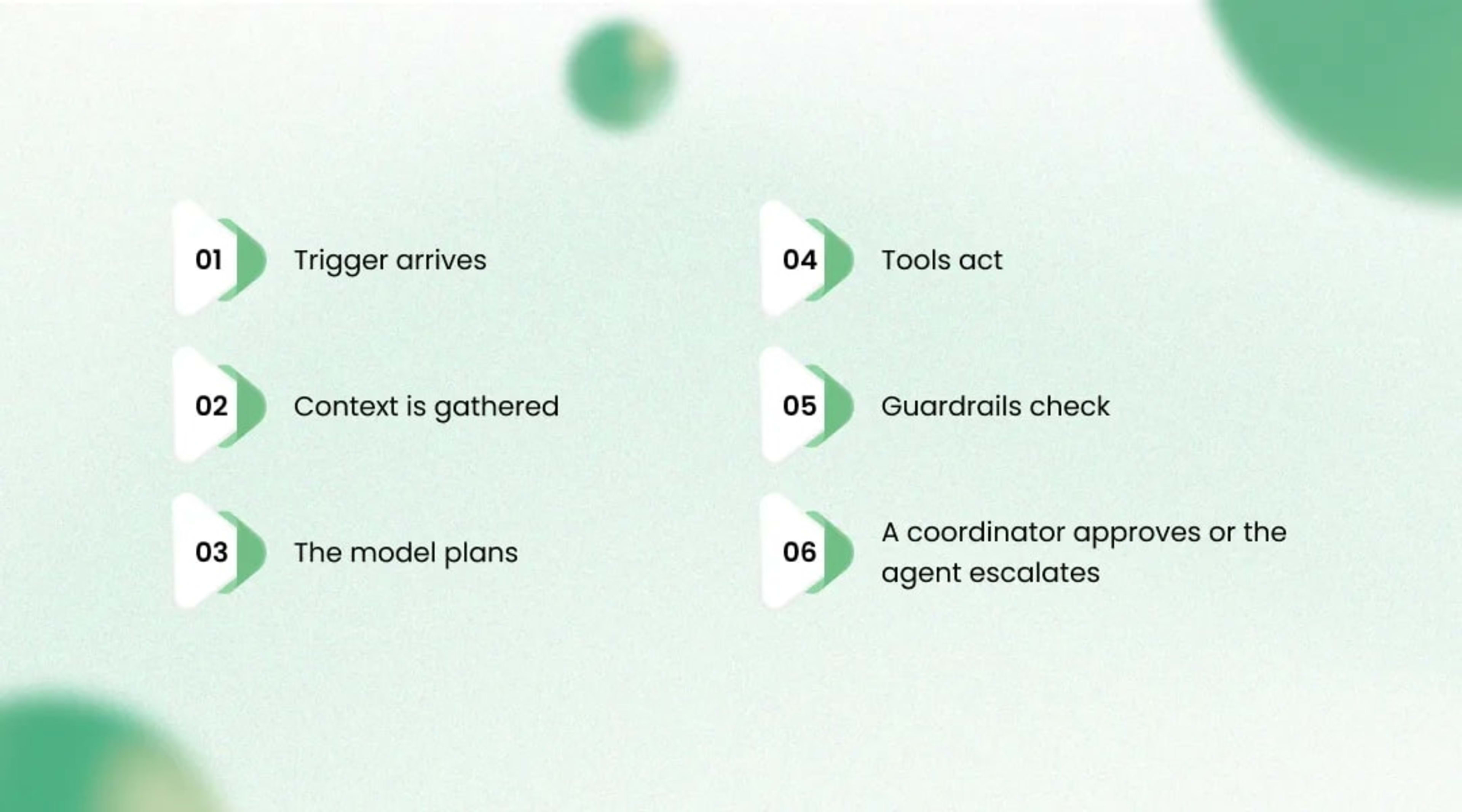
Every custom agent runs a loop of trigger, context, plan, action, check and handoff, and following one booking email at the Mundra forwarder shows where each part costs money. Component names vary from one vendor to the next, but the order of the loop rarely does. Here is that loop for a single 2 a.m. booking:
Trigger arrives. A shipper's email lands in the shared bookings inbox at 2 a.m. with a PDF of cargo details attached.
Context is gathered. The agent pulls the shipper's account, its last five bookings and the current sailing schedule from the TMS.
The model plans. A large language model (LLM), the text engine behind tools like ChatGPT, reads everything and decides which booking fields to fill and whether anything looks unusual.
Tools act. The agent writes a draft booking into the TMS through its API, the connection point that lets two programs exchange data.
Guardrails check. Rules confirm the container count matches the PDF and that no customs hold sits on the consignee.
A coordinator approves or the agent escalates. Clean drafts get a one-click approval at 9 a.m., while a flagged booking lands in the review queue with the reason attached.
Steps 2, 4 and 5 eat most of the budget. Connecting to an old TMS, cleaning messy shipper records and writing checks for customs edge cases take far longer than writing prompts. That is why two custom ai agents with similar screens can carry very different price tags.
Pricing by agent type
Agent pricing falls into four broad tiers, set mainly by how many systems the agent writes into and how much freedom it has to act before a coordinator or supervisor signs off. The table uses illustrative effort bands for budgeting, not market survey figures, so treat them as a starting point for comparing quotes. Timelines climb with each tier too, from a few weeks for a knowledge agent to several months for a multi-agent build.
Agent type
Knowledge agent
What it would do at the forwarder or the lab
Tells coordinators which ports need fumigation papers, using only the forwarder's own files
Illustrative effort
250 to 450 hours
At $30 per hour
$7,500 to $13,500
At $100 per hour
$25,000 to $45,000
Agent type
Workflow agent
What it would do at the forwarder or the lab
Turns a booking email into a TMS draft, checks the customs feed and waits for approval
Illustrative effort
600 to 1,100 hours
At $30 per hour
$18,000 to $33,000
At $100 per hour
$60,000 to $110,000
Agent type
Voice agent
What it would do at the forwarder or the lab
Answers a Pune lab caller asking about a blood report, finds the record and reads out its status
Illustrative effort
700 to 1,300 hours
At $30 per hour
$21,000 to $39,000
At $100 per hour
$70,000 to $130,000
Agent type
Multi-agent system
What it would do at the forwarder or the lab
Splits a rate quote across a pricing agent, a compliance agent and a reply-drafting agent
Illustrative effort
1,400 to 2,800 hours
At $30 per hour
$42,000 to $84,000
At $100 per hour
$140,000 to $280,000
Knowledge agents
A knowledge agent is the cheapest tier because it reads the forwarder's files and never writes into the TMS. Most of its hours go into retrieval, which means splitting documents into searchable pieces and making sure the agent quotes the current fumigation rule rather than last year's. If the forwarder only wanted coordinators to ask that kind of question, this tier would cover it.
Workflow agents
The Mundra booking agent belongs here, and we estimate it at about 820 hours. At the two illustrative rates, that works out to roughly $24,600 or $82,000. The jump from the knowledge tier comes from write access, since an agent that can change a booking needs permission controls, audit logs and rollback paths.
Voice agents
A voice agent for a nine-branch diagnostic lab chain in Pune stacks a speech pipeline on top of the workflow logic: speech-to-text, the LLM, text-to-speech and a telephony connection. The lab fields report-status calls all day, and its agent must respond in well under two seconds or callers talk over it. That latency tuning pushes voice above a text workflow of similar scope.
Voice also carries more recurring lines than text. The lab would pay per minute for transcription, per character or minute for the synthetic voice, and per minute again for the phone carrier, on top of model tokens. Call recording consent, Hindi and Marathi language support and a clean transfer to the lab's front desk each add build hours that a text agent never needs.
Multi-agent systems
A multi-agent version of the forwarder's work would give one agent the rate quote, a second the compliance check and a third the customer reply. Coordination is the expensive part, because each handoff between those three agents is a new place for errors to compound. Most buyers do not need this tier on day one, and a good partner will tell you so.
Seven factors that move a quote from $21,500 to $87,000

Integrations, data quality and the autonomy you allow drive most of the gap between a $21,500 quote and an $87,000 quote for the same booking agent. The remaining factors shift the price by smaller but still meaningful amounts. Knowing which of the seven applies to your project is the quickest way to predict where your ai agent development cost will land inside its tier.
Number and age of integrations
Each system the Mundra agent touches adds hours, and older ones add the most. A modern CRM with a documented API might take 30 hours to wire up, while an on-premise ERP that only exports nightly CSV files can take 120. Ask every vendor to list integrations by name with hours against each one.
Data readiness
If the forwarder's shipper master data has the same company spelled four ways, the agent will match bookings to the wrong account. Cleaning and deduplicating that data is real work that someone must pay for. Vendors who skip it in the quote usually bill it later as a change request.
Autonomy and guardrails
A booking agent that drafts and waits for a coordinator costs less to build safely than one that writes straight into the TMS. Every step you let it take unsupervised needs tests, limits and a recovery plan. Starting with approval on all writes, then loosening it as accuracy is proven, is the cheaper path for most teams.
Channel
A shared bookings inbox fed by 1,800 monthly emails is the simplest channel an agent can work in. Chat widgets, WhatsApp, Microsoft Teams and phone lines each bring their own setup, message formats and testing. Voice is the costliest of these for the latency reasons the Pune lab example shows.
Model choice and hosting
Calling a hosted model through an API is the fastest route for a first booking agent. Running an open-weight model inside your own cloud account costs more upfront for setup and GPUs but can make sense when shipper data cannot leave your network. Switching between the two later is easier if the vendor builds a thin model layer from the start.
Compliance and privacy
Regulated data raises the bill through extra logging, access reviews and documentation, and 2027 brings a specific deadline in India. The Digital Personal Data Protection Rules, 2025, notified by the government in November 2025, phase in most substantive duties by about May 2027. An agent handling personal data of people in India that goes live that year should budget for consent notices, retention limits and breach procedures rather than adding them after launch.
Evaluation
Evaluation means testing the agent against a fixed set of real past cases, often called a golden set, and scoring its answers. For the forwarder, that might be 300 historical booking emails with known correct outcomes. Quotes that leave this out are cheaper on paper and far riskier in production.
Where the 820 build hours go
Roughly a third of the forwarder's illustrative 820-hour budget goes into data and integration work, while prompts and agent logic take less than a quarter. Your own split will differ, but a quote that inverts this pattern deserves a pointed question. Here is how those hours might divide across phases:
Phase
Discovery and process mapping
What happens for the forwarder
Shadowing two coordinators and listing every booking exception they handle
Hours
60
Phase
Data and integrations
What happens for the forwarder
Connecting the inbox, TMS and customs feed, and cleaning shipper records
Hours
260
Phase
Agent logic and tools
What happens for the forwarder
Writing the prompts that tell the agent when a booking needs a customs check
Hours
200
Phase
Evaluation and testing
What happens for the forwarder
Building the 300-email golden set and fixing failures until accuracy targets hold
Hours
140
Phase
Deployment and monitoring
What happens for the forwarder
Locking down who can approve bookings and alerting on failed TMS writes
Hours
100
Phase
Hypercare
What happens for the forwarder
Thirty days of close support after go-live while real shipper traffic exposes new cases
Hours
60
Hypercare is the line buyers most often cut and most often regret. Real traffic surfaces edge cases that no golden set captured, like a shipper who starts sending bookings as phone photos. Keeping a funded month of support after launch is cheaper than an emergency fix in month two.
Running costs after launch
Once the Mundra agent is live, its monthly bill covers model tokens, hosting, monitoring and maintenance, and for a workflow like this the token bill is usually the smallest of the four. Each token is a fragment of a word, so a 200-word booking email with its PDF text runs to a few thousand tokens, and providers bill per million. Buyers who budget only the build miss part of the real ai agent development cost, because these lines continue for as long as the agent runs.
Run the forwarder's numbers. If each booking email consumes about 9,000 tokens across reading, extraction, tool calls and an occasional retry, 1,800 emails use around 16.2 million tokens a month. At an illustrative blended price of $4 per million tokens, that is about $65 a month; even at five times that price, the token bill stays near $325.
The larger recurring items are hosting and observability, which we would plan at an illustrative $150 to $400 a month for an agent this size, and ongoing maintenance. Maintenance covers prompt updates when the TMS changes a field, model upgrades and fixes for new shipper quirks. For planning, assume a yearly upkeep share of 15 to 20 percent on top of the build, which comes to about $12,300 to $16,400 a year on the $82,000 version.
Costs can spike in one situation buyers rarely ask about. A badly bounded agent that retries a failed TMS write dozens of times can multiply its token use overnight. Ask vendors how they cap retries and alert on unusual spend.
Run costs beyond the token bill
Several monthly items sit outside the token bill and rarely appear on a first quote. None of them is large alone, yet together they can outgrow the model spend. For the forwarder, the full list would look like this:
Vector database. The store that lets the agent search past bookings and shipper notes by meaning grows with every month of email history it indexes.
Tracing and observability. A step-by-step record of each booking the agent drafted is what lets an engineer explain a wrong draft the next morning.
Evaluation reruns. Replaying the 300-email golden set after every prompt change or model upgrade costs tokens and engineer time each release.
Log storage and retention. Keeping a record of what the agent wrote into the TMS, and for how long, matters for audits and for privacy rules.
Platform or seat fees. A framework or monitoring tool billed per coordinator seat grows each time the forwarder adds a desk.
Two levers keep these lines in check. Model routing sends simple tasks, like reading a clean booking form, to a smaller and cheaper model while saving the large model for messy emails. Prompt caching, offered by several model providers, discounts repeated text such as the long instruction block the agent reads before every booking, so check your provider's current price sheet for the exact saving.
Should the forwarder buy, configure or build?
Buying an off-the-shelf agent product is cheapest when your process looks like everyone else's, and a custom build tends to win over two or three years when your systems, data or exceptions are unusual, as the Mundra forwarder's customs-heavy bookings are. Most buyers sit between the two and configure a platform with some custom code around it. The deciding question is how much of your work is genuinely unusual.
The forwarder could, in theory, use a general email assistant that summarises messages. None of those products would know its TMS fields, its customs feed or the shipper who always sends container counts in the subject line. That specific knowledge is what a custom build pays for, and it is also what a vendor's per-seat subscription cannot supply.
A useful test is to list the five exceptions your staff handle most often and ask each product vendor to show those exact cases working. If three of the five need workarounds, the subscription will likely cost more in staff time than it saves. If all five work out of the box, buying is probably the smarter spend.
Fixed price, hourly or a dedicated team for an 820-hour build
For a $24,600 booking agent with well-mapped inputs, fixed price is usually safest, while hourly billing suits a first agent whose design discovery will reshape, and a dedicated team suits a company planning several agents in a year. The engagement model decides who carries the risk of scope surprises, and that risk is priced into the quote either way. Settle on the model before comparing prices, because one scope priced two ways will never look alike.
Model
Fixed price
Where it fits
A booking agent whose inbox, TMS fields and exception list are already written down
What to watch
A padded margin, plus steep change-request fees once a reefer booking in an odd format turns up
Model
Time and materials
Where it fits
A first agent where shadowing Mundra coordinators will change the design
What to watch
Thin weekly reports that let hours drift with no link to golden-set progress
Model
Dedicated team
Where it fits
A firm that wants a booking agent now and a quoting agent within the year
What to watch
Paying for idle engineers between the booking agent and a rate quote agent if that second project stalls
Companies that choose the dedicated route often want to hire ai agent developers who sit inside their own planning cycle rather than an agency's. For the forwarder, that would mean engineers who join the Monday operations call and hear about a new shipper format the day it appears. The model trades a higher monthly commitment for faster iteration, and it works best when someone on your side sets priorities every week.
Tie payments to golden set accuracy, not calendar dates
Whatever the model, link each payment to a result you can check against the golden set. For the forwarder, a sensible schedule might release one payment when discovery maps every booking exception, another when the agent drafts 85 percent of golden-set emails correctly, and the last after 30 days of live traffic without a missed customs hold. Milestones written this way turn a vague promise into a test the vendor has to pass.
Support terms after launch deserve the same precision. Agree on uptime expectations, how fast the vendor responds when the agent stops drafting bookings, and who is on call over weekends when vessels still arrive. An agent that handles real operations needs an incident plan just like any other production system.
Does the vendor's location change the $30 or $100 rate?
Location shifts the blended rate more than any other single factor, but it does not change the 820 hours a well-scoped booking agent needs. For context on onshore pricing, the US Bureau of Labor Statistics put the median hourly wage for software developers at $63.98 in May 2024, and agency rates sit above wages because they also cover overhead, management and margin. That makes the rate the one part of ai agent development cost you can shop around on without changing what gets built.
Teams in India often quote lower blended rates for the same effort, which is why many US, UK and Middle East buyers shortlist Indian partners. Gujarat, home to Mundra port and to IT parks in cities such as Surat and Ahmedabad, has its own pool of AI engineering firms. Buyers comparing regional options can review what AI agent development in Gujarat involves, including how those teams handle work across time zones.
A lower rate only saves money when the hours stay honest. Check that an offshore quote includes the same evaluation, hypercare and security work as an onshore one. For a wider view of how to shortlist vendors nationally, see this overview of the Best AI agent development company in India and the criteria it weighs.
How to compare AI agent development quotes for the same 820-hour scope
The most reliable way to compare quotes is to hand every vendor the same scope document, such as the forwarder's list of 1,800 monthly emails, three systems and 300 golden-set cases, and ask for hours by phase. Differences then point to real choices instead of hidden assumptions. The exercise also exposes any vendor who has not read your brief closely, so check each quote against these points before you sign:
Named integrations with hours. The TMS, inbox and customs feed each appear as separate lines rather than one integration bucket.
An evaluation plan. The quote states how many past cases make up the golden set and what accuracy must be reached before launch.
A token and hosting estimate. The run-cost section is worked out from your 1,800 monthly emails, not a generic per-month figure.
Ownership terms. Code, prompts, tool definitions and the golden set transfer to you when the contract ends.
Hypercare length. The first 30 days after go-live have a named support contact and a promised response time for a failed TMS write.
A change-request rate. The hourly price for adding, say, a fourth shipper format is agreed before that shipper ever writes in.
A model price clause. If a provider changes token prices mid-contract, the contract names who absorbs the shift on the $65 monthly token line.
Currency and tax. A Gujarat vendor and a London vendor both state whether totals are in rupees or dollars and whether GST applies, so the numbers compare fairly.
Watch for one red flag in particular. Gartner estimated in June 2025 that only about 130 of the thousands of vendors marketing agentic AI offered genuine agent capabilities, with many simply rebranding chatbots or RPA tools. If a demo cannot show the agent calling a real tool and recovering from a failed step, you may be paying agent prices for a chatbot.
What AI agents still cannot do well, even with a golden set
Even a well-built booking agent will sometimes misread an email, pick the wrong tool or state a false container count with confidence, because AI agents remain probabilistic software. Good builds reduce these failures and catch them, but no vendor can honestly promise zero errors. What you are really paying for is how rarely errors happen and how quickly they get caught.
Several limits matter for budgeting. Agents struggle with inputs far outside their training cases, such as a booking scrawled on a phone photo, and they do not repair a broken process; automating a messy approval chain just makes the mess faster. Voice agents like the Pune lab's can mishear dates and report numbers when a caller phones from a noisy bus stand.
Agents also depend on model providers that change over time. A model update can shift behaviour in ways your golden set catches only if you rerun it, which is part of why maintenance is a recurring cost. For regulated decisions such as credit approval or clinical advice, most teams keep a person signing off, and the agent prepares rather than decides.
Is a custom agent worth it at 1,800 monthly tasks?
A custom agent tends to pay off when a task arrives in volume, follows recognisable patterns and eats skilled staff time, as the forwarder's 1,800 monthly bookings do, and it rarely pays off for low-volume or constantly changing work. A ten-person firm handling 40 bookings a month probably would not recover the build. The difference is how many hours the agent can actually lift off someone's desk.
Run the forwarder's payback. If the agent drafts 70 percent of bookings well enough that each needs a two-minute review, desk time drops from about 420 hours to about 168 a month. At an illustrative loaded desk cost of $12 an hour, that saves around $3,000 a month and repays a $24,600 build in about eight months, while the $82,000 version takes over two years unless the savings are valued at higher wages.
Industry data supports caution. McKinsey's State of AI 2025 survey found 23 percent of respondents scaling an agentic system somewhere in their organisation and another 39 percent still experimenting. Gartner went further in June 2025, predicting that more than 40 percent of agentic AI projects will be cancelled by the end of 2027 because of rising costs, unclear value or weak risk controls.
How to start without overspending
The safest start is a narrow paid pilot on one high-volume task, with a fixed golden set and a go or no-go accuracy target agreed before any code is written. For the forwarder, that means booking emails from its three largest shippers only, with every write held for approval. A pilot like this caps your ai agent development cost at a known figure before you commit to a full rollout.
Time the task today. Clock how long a coordinator spends on one booking email and count the monthly volume, so the 420-hour baseline can be checked later.
Collect 200 to 300 past cases. These become the golden set that every vendor's pilot is scored against.
Request phase-level quotes. Send the same three-shipper scope to each shortlisted vendor and line up their hours phase by phase.
Run a six-week pilot on three Mundra shippers. Hold every TMS write for a coordinator's approval and record golden-set accuracy each Friday.
Decide with numbers. Widen the pilot to all shippers only if accuracy and saved desk hours beat the 420-hour baseline from step one.
Budget planning deserves its own worksheet before step three. Our AI agent development budget guide walks through how to set a ceiling and a contingency line for a first agent. With that ceiling fixed, vendor conversations get shorter and more honest.
Getting a quote you can check against a golden set
Pricing gets clearer once one scoped task, a golden set and phase-level hours are on the table. If you want engineers who will price your agent that way and then build it, you can Hire AI developers from KriraAI for a pilot or a dedicated team. Send your task volume and system list first, and the first quote will reflect real hours.
FAQs
A knowledge agent like the forwarder's fumigation helper can reach production on an illustrative $7,500 to $13,500 with an offshore team at $30 an hour. That figure assumes clean documents, one channel such as the shared inbox and no write access to the TMS. Adding even one write into the TMS usually moves the project into the $18,000-plus workflow tier.
A gap that wide between a $21,500 and an $87,000 quote usually reflects different assumptions about integrations, evaluation and post-launch support rather than the AI model. Ask both vendors to break their numbers into the six phases shown for the 820-hour booking agent, then compare line by line. Often the cheaper quote has no golden set and no hypercare, while the expensive one includes both.
In many cases, yes, by reading the ERP's nightly CSV export, querying a database view or, as a last resort, clicking through the screens like a coordinator would. Each workaround adds build hours and tends to break when the ERP vendor changes the nightly CSV layout. Budget extra testing time, and ask whether a small API layer would cost less over three years than patching the nightly CSV reader.
A fumigation-style knowledge agent can often go live in four to eight weeks, while a workflow agent like the forwarder's booking agent usually needs eight to fourteen weeks including evaluation. A three-agent rate quote system can take several months. Shipper data cleanup and internal access approvals are the most common causes of delay.
Switching is manageable if the vendor routes every model call through one thin layer instead of scattering provider-specific code through the booking agent. You will still need to rerun the full 300-email golden set, since a new model can behave differently on the same prompt. Ask for that layer in writing during scoping, before the first TMS integration is built.
Whoever the contract names owns them, so settle ownership of the code, prompts and golden set in writing before discovery starts. Ask for code, prompts, tool definitions, the golden set and deployment scripts to transfer on final payment. Without the golden set in particular, a new vendor cannot safely maintain the agent.
In a well-designed build, a low-confidence booking goes to the review queue with the reason attached, and no risky TMS write happens without a coordinator's approval. Each error should be logged and added to the golden set so the next release is tested against it. Ask vendors to demo a failed booking being caught, not only a clean one going through.
At 10,000 bookings a day, more than 160 times the forwarder's current daily volume, the agent would run many copies in parallel, so provider rate limits and token spend become the real constraints. Trimming even 2,000 tokens per booking changes the monthly bill noticeably at that scale. Load testing with realistic shipper traffic should be a line item in the quote.
It can if the build includes a memory layer that stores past exchanges and pulls the relevant ones back when the same shipper writes again. For the forwarder, remembering that one shipper always books reefer containers would save a coordinator a lookup on every email. That memory adds storage, retrieval work and decisions about how long shipper history is kept under privacy rules.
For a fumigation-style knowledge agent, a no-code platform is often cheaper to start and perfectly adequate. Per-seat or per-task fees climb as more coordinators and bookings flow through it, and an older on-premise TMS can hit the platform's integration limits. Many teams prototype on a platform and move to custom code once the booking volume justifies it.
Krushang Mandani is the CTO at KriraAI, driving innovation in AI-powered voice and automation solutions. He shares practical insights on conversational AI, business automation, and scalable tech strategies.