AI Adoption for Mid-Size Government Agencies: The 2026 Playbook
Forty-three percent of mid-size government agencies report that they are actively evaluating AI tools, yet fewer than nine percent have moved beyond a single pilot program into any form of scaled deployment. That gap is not a story about reluctance. It is a story about a segment of the public sector that has been systematically ignored by both the vendors selling enterprise AI platforms worth millions of dollars and the startup tools designed for a two-person team with a credit card. If your agency employs between fifty and five hundred people, serves a defined jurisdiction or mission area, and operates under real budget and compliance constraints, virtually every piece of AI advice you have encountered was written for someone else.
This blog is written specifically for directors, operations leads, IT managers, and department heads at mid-size public sector organizations: county agencies, regional authorities, mid-tier federal sub-agencies, municipal departments, and government-adjacent organizations that carry real administrative load, answer to oversight bodies, and face growing citizen demand without proportional budget growth. AI adoption for mid-size government agencies in 2026 is not the same conversation as AI for a Fortune 500 or a scrappy civic tech startup, and treating it as such has already cost agencies months of misdirected effort.
What follows is a complete and honest guide to where the real opportunity lies, what AI actually costs and delivers at this scale, which applications produce returns within a budget cycle, and how partnering with an expert AI consulting services company can help move your team from initial awareness to deployment without stalling in a committee. KriraAI, which builds practical AI systems designed specifically for organizations operating under real-world budget and compliance constraints, has worked with agencies in exactly this position, and the patterns are consistent enough to produce a clear roadmap.
The Operational Reality of a Mid-Size Government Agency
To understand why AI adoption at this scale requires a separate conversation, you first need to understand the actual operating environment that mid-size agencies inhabit. This is not a generalization. These are the structural conditions that define nearly every organization of this type.
A mid-size government agency typically runs with between six and twenty functional teams, each carrying its own caseload, reporting structure, and software environment. The agency is large enough that informal coordination has broken down and formal processes are required, but not large enough to have a dedicated enterprise architecture team or a CIO with a strategic technology budget. IT support is usually either a small internal team of two to five people handling infrastructure, helpdesk, and procurement simultaneously, or a managed services provider contracted at the lowest defensible cost.
Budget cycles are twelve months long and unforgiving. Capital expenditure requests require justification six to eighteen months before funds are available. Any technology investment must survive at least one budget review cycle and frequently two before money actually moves. This means that the timeline between "we should explore AI" and "we have budget to deploy AI" is structurally longer than in the private sector, even when the political will exists at the leadership level.
The technology stack at most agencies of this size is a layered archaeology. A core system of record, often a legacy case management or financial platform deployed in the early 2010s, sits at the foundation. On top of it sit departmental tools added over successive budget cycles, Microsoft 365 environments that are partially licensed and inconsistently adopted, a document management system that staff use inconsistently, and shadow workflows in shared drives and personal email. Data is fragmented, partially duplicated, and inconsistently formatted.
Compliance is not optional, and it is not abstract. HIPAA, CJIS, FedRAMP, state-specific data residency laws, open records obligations, and procurement regulations all constrain what technology can be deployed, how it is hosted, and who can access it. The compliance overhead at a mid-size agency is disproportionately large relative to the team size, because the same regulations that apply to a large federal agency apply here, but with a fraction of the legal and compliance staff to navigate them.
The workforce profile matters too. Staff tenure tends to be high, with average tenures of seven to twelve years common in administrative and case management roles. This produces institutional knowledge that is deep but undocumented, and change management challenges that are real and must be planned for. Leadership is typically willing to innovate but accountable to elected officials, oversight boards, or grant funders who require demonstrated value before additional investment.
Why AI Adoption Looks Fundamentally Different at This Scale
AI adoption for mid-size government agencies does not scale down from what a large federal department does, and it does not scale up from what a small municipal office does with an off-the-shelf chatbot. The differences are structural,l and they determine which strategies actually work.
A large federal department implementing AI has a dedicated transformation office, a multi-year budget commitment measured in tens of millions of dollars, multiple in-house data scientists, and vendors competing aggressively for a contract worth enough to justify deep customization. The agency can afford to run parallel systems, absorb integration failures, and iterate across a two-year timeline without operational disruption. This is not your situation.
A solo operator or very small office implements AI by subscribing to a SaaS tool with a credit card, using a pre-built template, and testing it over a weekend. There is no compliance review, no procurement process, no integration requirement. This is also not your situation.
The mid-size government agency sits in a uniquely constrained middle ground. The budget is real but limited, typically between fifty thousand and three hundred thousand dollars annually available for technology transformation when you account for the full procurement and implementation cycle. The compliance requirements are full-weight, meaning any AI system touching citizen data must be FedRAMP authorized or meet an equivalent state-level certification. Vendor options narrow sharply once you apply those filters. Custom enterprise solutions are priced out of reach. Most startup AI tools are not certified for government use.
The implementation complexity is also different. At this scale, you almost certainly cannot hire a data scientist internally. You need a vendor or partner who brings that expertise. But you also cannot absorb a multi-year implementation engagement. You need a partner who can deploy within a single budget cycle and demonstrate value before the next review. KriraAI, which builds modular AI systems designed to integrate with the existing technology stacks of mid-size public sector organizations, has found that the agencies succeeding in this space are those who prioritize narrow, high-volume processes over broad transformation goals in their first deployment.
The internal skill requirement at this scale is also specific. You do not need a machine learning engineer. You need one or two staff members who can serve as AI coordinators: people who understand your workflows well enough to validate AI outputs, manage exceptions, and communicate what the system is doing to the rest of the team. This is a training and role-definition challenge, not a hiring challenge, and it is fundamentally different from what both larger and smaller organizations require.
Return timelines are also governed by the budget cycle. A mid-size agency that cannot show measurable impact within twelve to eighteen months will not survive the next budget review with the AI line item intact. This means that ROI must be visible, documented, and expressed in terms that non-technical oversight bodies understand, such as hours saved per staff member, cases processed per week, or cost per service interaction.
The Right AI Applications for Mid-Size Government Agencies
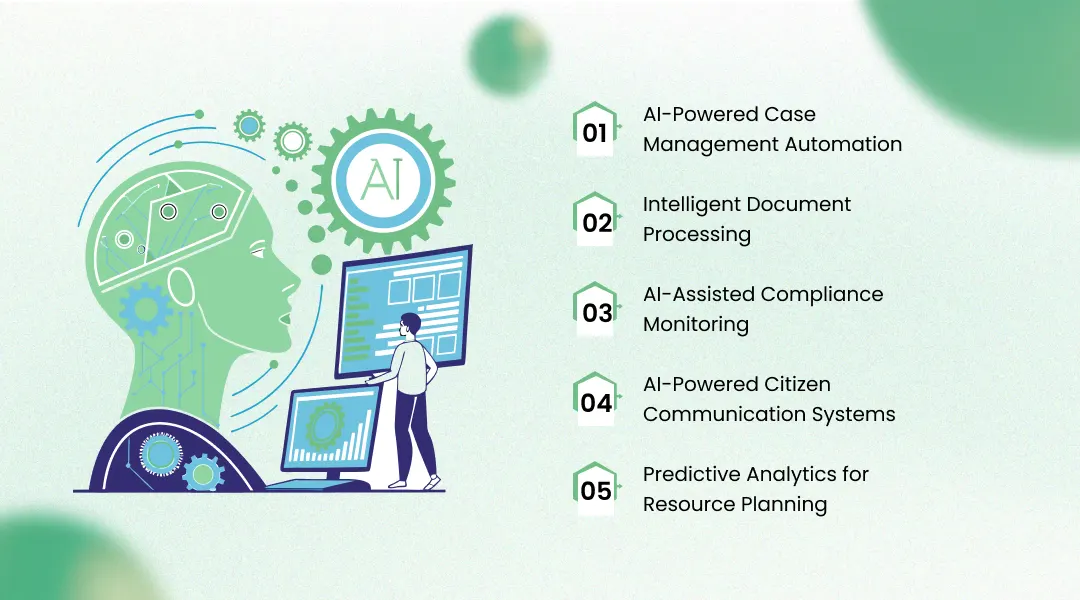
Not every AI application makes sense at this scale. The right question is not "what is the most impressive AI technology available" but "which AI application produces the best return given this budget, this compliance environment, and this team." Here are the applications that consistently deliver at this scale.
AI-Powered Case Management Automation
AI-powered case management for government agencies in the mid-market segment is the single highest-return application available today. Most mid-size agencies process between two hundred and five thousand cases per month across intake, eligibility determination, document verification, routing, and status updates. Each step involves repetitive judgment tasks that follow documented rules but consume significant staff time. AI systems trained on agency-specific decision trees can handle first-pass triage, flag incomplete applications, route cases to the correct department, and streamline operations through structured AI automation in business workflows without human intervention.
The cost at this scale runs between fifteen thousand and sixty thousand dollars for initial deployment when using a modular platform rather than custom development. The time to deployment is typically sixty to ninety days. Agencies implementing this application report reducing case processing time by thirty to fifty percent within the first quarter of deployment.
Intelligent Document Processing
Government agencies at this size receive thousands of documents monthly: forms, supporting evidence, correspondence, contracts, and reports. Extracting structured data from unstructured documents is one of the most labor-intensive and error-prone tasks in public administration. AI-powered document processing systems can extract, classify, and route document content with accuracy rates above ninety-five percent on standardized forms and above eighty-five percent on mixed or handwritten submissions.
The practical benefit at this scale is that you can redeploy two to four full-time equivalent staff hours per day per hundred documents processed. For an agency handling five hundred documents per day, that represents twenty to forty hours of daily staff time freed for higher-value work.
AI-Assisted Compliance Monitoring
Compliance is a constant and growing burden for mid-size agencies, requiring strict data security protocols similar to regulatory compliance software and financial IT solutions that safeguard sensitive records. Monitoring regulatory changes, updating internal procedures, auditing case records for compliance gaps, and generating reports for oversight bodies all require staff time that is poorly matched to the task. AI systems can monitor regulatory sources, flag changes relevant to the agency's mission area, cross-reference existing procedures against updated requirements, and generate preliminary audit reports for human review.
The cost for a compliance monitoring AI integration is typically between eight thousand and twenty-five thousand dollars annually at this scale. The benefit is measured in audit preparation time, which agencies report reducing by forty to sixty percent.
AI-Powered Citizen Communication Systems
Mid-size agencies receive high volumes of citizen inquiries through phone, email, and increasingly through web portals. AI-powered communication systems, configured to reflect the agency's actual policies and connected to live case status data, leverage modern production AI voice agent architecture to handle between sixty and eighty percent of routine citizen inquiries without human involvement. This is not a generic chatbot. It is a system trained on your specific programs, your specific eligibility rules, and your specific service geography.
Implementation at this scale requires careful content preparation, approximately four to eight weeks of workflow mapping and policy documentation, and a clear escalation protocol. Agencies that invest in this preparation phase consistently outperform those that deploy with minimal configuration.
Predictive Analytics for Resource Planning
Mid-size agencies consistently underinvest in forecasting because the analytical capacity required has historically been expensive. AI-powered predictive analytics, applied to historical caseload data, seasonal patterns, and demographic trends, can enable agencies to anticipate demand spikes four to eight weeks in advance. This allows staffing and resource decisions to be proactive rather than reactive. The cost of a predictive analytics module at this scale is between ten thousand and thirty thousand dollars, and the value is measurable in overtime reduction and service continuity during peak periods.
Quantified Business Impact at the Mid-Market Government Scale
The measurable results that mid-size government agencies are achieving through AI adoption are specific enough to inform investment decisions and significant enough to survive the scrutiny of an oversight board. Here is what the data shows at this scale.
Mid-size agencies deploying AI-powered case management automation report an average reduction of forty-two percent in average case processing time within six months of full deployment. For an agency with ten case managers, each handling one hundred cases per month, this translates to freeing approximately eighty to one hundred hours of staff time per month, equivalent to one full-time position, redirectable to complex cases that require genuine human judgment.
AI-assisted document processing implementations at this scale deliver an average accuracy rate of ninety-six percent on structured forms and eighty-seven percent on mixed submissions, compared to a human error rate of three to seven percent on high-volume repetitive document review. The cost per document processed drops by sixty to seventy percent within the first year.
Citizen communication AI systems deployed at mid-size agencies reduce inbound call volume by an average of fifty-five percent for routine inquiry types within ninety days of deployment. When staff time is costed at loaded rates including benefits, this produces annualized savings of sixty thousand to one hundred and twenty thousand dollars for an agency receiving five hundred routine inquiries per week.
Compliance monitoring AI reduces the time required to prepare quarterly oversight reports by an average of forty-seven percent. For agencies spending two hundred staff hours per quarter on compliance reporting, this represents a savings of nearly four hundred hours annually, valued at thirty thousand to fifty thousand dollars depending on the staff level involved.
Perhaps most importantly for the mid-market segment, these results are achievable within a single budget cycle. The combination of relatively focused scope, faster deployment timelines, and measurable high-volume processes means that a mid-size agency can demonstrate positive ROI within twelve months of implementation, which is the threshold required to sustain political and budgetary support for continued investment.
KriraAI has developed deployment frameworks specifically calibrated to deliver these measurable outcomes within the budget cycle constraints of mid-size public sector organizations, ensuring that initial implementations produce documented results rather than proof-of-concept outcomes that do not survive budget reviews.
Implementation Roadmap for Mid-Size Government Agencies
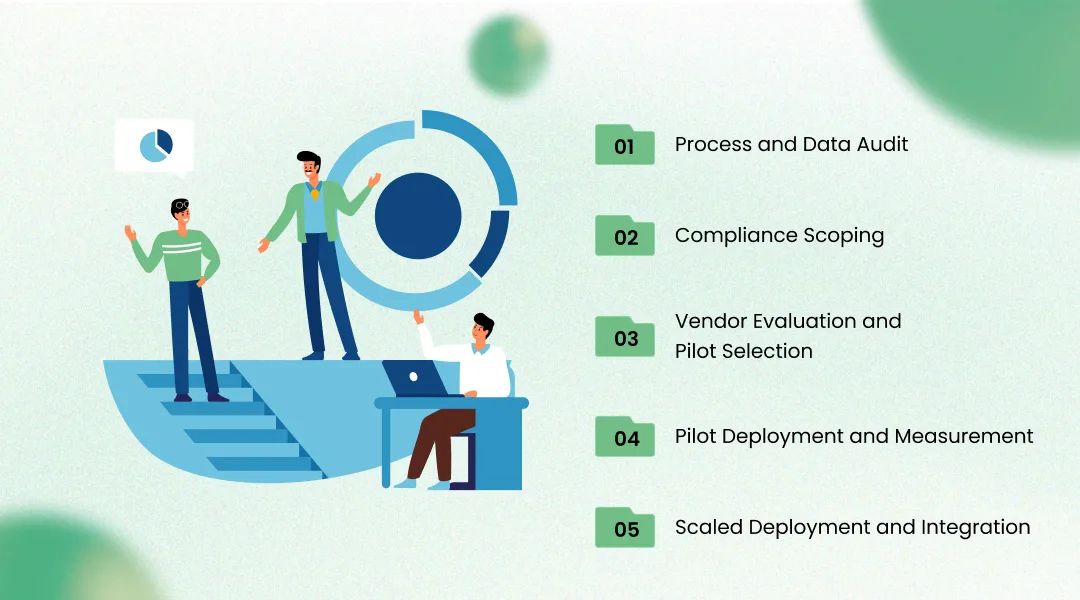
AI adoption for mid-size government agencies that succeeds follows a consistent sequence. Agencies that skip steps in this sequence spend more money and achieve less than those that follow it deliberately.
Phase One: Process and Data Audit (Weeks One through Four)
Before any vendor is engaged, map the three to five highest-volume repetitive processes in the agency. Document the current workflow, the staff time consumed, the error rate, and the output. Identify where data is stored, in what format, and under what access controls. This audit is internal work and costs nothing except staff time. Its output is a priority list of AI candidates ranked by volume, compliance tractability, and data readiness.
Phase Two: Compliance Scoping (Weeks Three through Six, overlapping with Phase One)
Before shortlisting vendors, determine the applicable compliance certifications required for your agency's data environment. FedRAMP authorization is the federal baseline. State agencies often have additional requirements. Any vendor who cannot meet these requirements is ineligible regardless of their product quality. Reduce the vendor universe to compliant options before investing time in evaluation.
Phase Three: Vendor Evaluation and Pilot Selection (Weeks Five through Ten)
Evaluate three to five compliant vendors against the specific use case identified in Phase One. Require a paid pilot or a structured proof of concept scoped to your actual data and workflow. A vendor demonstration on sample data tells you almost nothing about performance in our specific environment. Negotiate a ninety-day pilot with defined success criteria before committing to a full contract.
Phase Four: Pilot Deployment and Measurement (Weeks Ten through Twenty-Two)
Deploy the pilot with one identified process owner, one IT liaison, and one designated AI coordinator who will monitor outputs daily. Measure against the baseline established in Phase One. Document everything. The measurement output of the pilot is the justification document for the full deployment budget.
Phase Five: Scaled Deployment and Integration (Months Six through Twelve)
Expand from the pilot process to adjacent processes, integrating the AI system with existing data sources and workflows. This phase requires change management planning, staff training, and communication from leadership about what the AI system is doing and why.
Challenges Specific to the Mid-Market Government Segment
Honest guidance requires naming the real difficulties, not just the opportunities. Mid-size government agencies face specific challenges in AI adoption that are not shared by larger or smaller organizations, and ignoring them in a planning process produces implementations that fail.
The procurement timeline is structurally hostile to agile AI deployment. A full competitive procurement process for a technology contract above a threshold that varies by jurisdiction, often twenty-five thousand to one hundred thousand dollars, can take six to eighteen months from solicitation to contract execution. This means that an agency that identifies the right AI application in January may not have a signed contract with a vendor until the following October. Planning must account for this timeline, and leadership must be prepared to initiate procurement before the technology decision is fully finalized.
The compliance certification gap among AI vendors is real and frustrating. Many of the most capable AI tools available in the commercial market are not FedRAMP authorized or otherwise certified for government use. The certified vendor universe is smaller, sometimes less innovative, and sometimes more expensive than the uncertified market. Mid-size agencies must work within this constraint rather than trying to create workarounds, because workarounds create audit exposure.
Internal data governance is often underdeveloped at this scale. The agency has enough data to make AI valuable, but the data is stored in ways that reflect years of operational improvisation rather than strategic architecture. Preparing data for AI use is a real investment, often underestimated in initial budget planning, and it must be included in any honest cost projection.
Staff capacity for change is finite. A mid-size agency cannot simultaneously implement AI in multiple departments without degrading the quality of implementation in each. A phased approach that concentrates implementation resources on one area at a time produces better outcomes than a broad rollout that leaves every department partially supported.
The Future Competitive Landscape: What Happens to Agencies That Wait
Three to five years from now, the gap between mid-size government agencies that adopted AI in the 2024 to 2026 window and those that did not will be visible, measurable, and difficult to close. The compounding nature of AI adoption means that early movers do not just have a head start. They accumulate advantages that grow over time.
Agencies that deployed AI-powered case management in 2026 will have, by 2028, trained their systems on three to four years of agency-specific data, producing accuracy rates and decision-support quality that a newly deployed system cannot replicate for at least eighteen months. The learning curve advantage is real, and it compounds with time.
Staff capabilities will diverge. Agencies that have integrated AI into their workflows for three years will have staff who are fluent in working alongside AI systems, validating AI outputs, and identifying where human judgment adds the most value. Agencies beginning AI deployment in 2028 will face a longer staff learning curve, higher training costs, and a competitive disadvantage in recruiting staff who now expect AI-enabled environments.
Citizen expectations are rising faster than most agency leaders acknowledge. By 2028, the majority of citizens under forty-five will expect real-time case status information, rapid response to inquiries, and digital-first service delivery as a baseline, not a premium. Agencies that have built the infrastructure to deliver this will retain public trust. Those that have not will face growing political pressure and potential consolidation or mandate-driven transformation that removes agency control over the implementation process.
Budget dynamics will also shift. Agencies that can demonstrate AI-driven efficiency gains will be better positioned in competitive budget environments. Those that cannot document productivity improvements will face harder trade-offs between service levels and staffing costs as government budgets remain constrained across most jurisdictions.
The window to implement AI on the agency's own terms, at the agency's own pace, with vendor and process choices made strategically rather than reactively, is approximately two to three years wide. After that, implementation will increasingly be driven by mandate, interoperability requirements, or crisis rather than strategic choice.
Three points from this analysis are worth carrying forward. AI adoption for mid-size government agencies is a distinct challenge that requires distinct solutions, not scaled versions of enterprise implementations or startup tools. The applications with the best return at this scale are narrow, high-volume, and compliance-tractable: case management automation, intelligent document processing, citizen communication systems, and compliance monitoring. And the window to implement strategically, on the agency's own terms, is approximately two to three years wide before mandates and citizen pressure accelerate the timeline beyond comfortable planning horizons.
The agencies that will lead their jurisdictions in service delivery quality, operational efficiency, and staff capacity five years from now are not the ones waiting for a perfect moment or a universal technology standard. They are the ones implementing disciplined, well-scoped AI deployments in 2025 and 2026, learning from those implementations, and building on them sequentially.
KriraAI works specifically with mid-size government and public sector organizations that are ready to implement AI within real budget, compliance, and timeline constraints. KriraAI's approach is not to propose enterprise transformation frameworks scaled down or to recommend off-the-shelf tools that have not been evaluated for government compliance. The work is a s practical implementation design built for agencies with fifty to five hundred staff, genuine procurement constraints, and oversight bodies that require documented results rather than pilot promises. If your agency is in the evaluation or early planning stage of AI adoption, the right next step is a structured conversation about which applications fit your specific environment, what they will cost, and what they will deliver within your budget cycle. Reach out to KriraAI to begin that conversation.
FAQs
AI adoption for mid-size government agencies in the first year of implementation typically costs between seventy-five thousand and two hundred and fifty thousand dollars when you account for software licensing, implementation services, data preparation, staff training, and change management. This range reflects the difference between a single focused deployment on one high-volume process versus a multi-process initial rollout. Agencies that attempt to minimize cost by skipping data preparation or change management consistently spend more in the second year correcting problems that result from those shortcuts. The most cost-effective approach for an agency in this size range is to budget realistically for a single well-executed implementation rather than attempting a broad deployment at minimum cost. Federal and state grant programs for technology modernization, including several established under recent infrastructure and digitalization legislation, can offset between twenty and fifty percent of these costs for qualifying agencies, and any agency not actively evaluating grant eligibility before procurement is leaving money on the table.
A mid-size government agency implementing AI on a well-scoped, high-volume process should see measurable and documentable return on investment within nine to twelve months of deployment. The first three months typically show productivity improvements in the specific process targeted. Months four through six produce the data needed to calculate cost savings per transaction. By month nine, an agency with a disciplined measurement approach has enough documented evidence to justify the next investment phase to an oversight body. Agencies that see ROI within twelve months consistently share three characteristics: they started with a process that had high volume and clear existing metrics, they invested in data preparation before deployment rather than during it, and they assigned a dedicated internal point person to monitor AI outputs and flag anomalies in the first six months of operation.
AI applications compliant with government data regulations for mid-size agencies must meet specific certification requirements that vary by data type and jurisdiction. For federal data environments, FedRAMP authorization is the baseline requirement, and as of 2026 there are approximately four hundred FedRAMP-authorized cloud services with AI capabilities. For state agencies, equivalent state-level certifications apply, and requirements vary significantly. AI systems touching protected health information must comply with HIPAA. Systems in the criminal justice environment must meet CJIS Security Policy requirements. The practical implication for a mid-size agency is that vendor evaluation must begin with compliance certification, not product capability. An AI tool that is not certified for your data environment is not available to you regardless of its functional quality. Working with an implementation partner who understands the certified vendor landscape for your specific regulatory environment, as KriraAI's public sector practice does, significantly reduces the time spent evaluating ineligible options.
A mid-size government agency evaluating AI vendors should structure the evaluation around four sequential criteria applied in order. First, compliance certification: the vendor must be certified for the agency's data environment. Second, reference validation: the vendor must be able to provide references from agencies of comparable size and mission complexity, not only from large federal deployments that required resources the mid-size agency does not have. Third, implementation model: the vendor must be able to deploy within a single budget cycle and demonstrate measurable results within twelve months. Fourth, total cost of ownership: the vendor's pricing must include implementation, integration, training, and first-year support in a transparent structure, not a base license with large services fees discovered during contracting. Agencies that evaluate in this order consistently avoid the situation where a technically excellent product fails because it is not certified, not affordable at scale, or not deployable within the agency's operational constraints.
A mid-size government agency does not need to hire data scientists or AI engineers before deploying AI, but it does need three internal capabilities in place before deployment begins. First, a designated AI coordinator, typically an existing staff member with strong process knowledge and analytical aptitude who is given dedicated time to manage the AI deployment, validate outputs, and communicate with the vendor. Second, an IT liaison with sufficient infrastructure access and vendor management experience to handle data connections, security configurations, and system integrations without escalating every decision. Third, documented process workflows for the target deployment area: if the agency cannot describe the current process in a step-by-step format with defined inputs, decision points, and outputs, the AI system cannot be configured to replicate or improve it. These three capabilities are achievable through role redefinition and targeted training rather than new hiring, which is a critical consideration for mid-size agencies operating under hiring freezes or position controls.
Ridham Chovatiya is the COO at KriraAI, driving operational excellence and scalable AI solutions. He specialises in building high-performance teams and delivering impactful, customer-centric technology strategies.