
AI Adoption for Mid-Market Logistics Companies: A Practical 2026 Guide
Mid-market logistics companies, those operating between 50 and 500 employees, handle an estimated 34 percent of domestic freight volume in the United States yet control less than 12 percent of the technology investment flowing into the logistics sector. That gap is not an accident. It is the product of a years-long assumption that AI belongs either to the giants who can afford custom platforms or to the scrappy startups building lean SaaS tools for owner-operators. The company running 80 trucks, managing a regional distribution center, and billing between $15 million and $120 million per year has been largely left out of the AI conversation, and that exclusion is beginning to cost them at a measurable rate.
This blog is written specifically for mid-market logistics operators. It is not written for freight brokers with three employees and a TMS subscription, and it is not written for global 3PLs with dedicated AI engineering teams. It is written for the regional carrier, the growing warehouse operator, the mid-size freight forwarder, and the distribution company that has outgrown simple tools but cannot justify seven-figure enterprise software contracts. If that describes your company, the next 3,000 words will be the most operationally useful AI content you have read this year. This guide covers which AI applications deliver the strongest return at your scale, how to structure an implementation that your existing team can absorb, and what the competitive landscape will look like in three years for companies that move now versus companies that wait.
The Operational Reality of a Mid-Market Logistics Company in 2026
Running a mid-market logistics company is a uniquely pressured position in the industry. You are large enough that your customers, often mid-size manufacturers, regional retailers, or e-commerce brands, expect the service reliability and reporting visibility of a large carrier. You are small enough that your technology budget is measured in hundreds of thousands of dollars per year, not millions, and your IT department is typically one to four people whose primary job is keeping existing systems running rather than evaluating new ones.
The typical mid-market logistics operator runs a technology stack that includes a Transportation Management System (TMS), either a legacy on-premise installation or a mid-tier SaaS product like McLeod, TMW, or Rose Rocket, a Warehouse Management System if they operate a DC, a basic ERP or accounting platform, and a collection of spreadsheets that have accumulated over years to fill the gaps between those systems. The integration between these systems is often partial, manual reconciliation still happens weekly if not daily, and data quality across platforms is inconsistent because no one has owned a data governance initiative that was not also fighting fires at the same time.
Decision-making at this scale moves faster than at an enterprise but slower than at a small business. A new software platform requires sign-off from operations leadership and finance. Pilots typically run three to six months before a commitment is made. The person evaluating AI solutions is often the VP of Operations or the COO, not a dedicated Chief Digital Officer, and that person is simultaneously managing customer escalations, driver retention issues, compliance requirements, and margin pressure from fuel and labor costs.
The specific pressures mid-market logistics companies face in 2026 include three dynamics that are structurally different from what smaller or larger competitors experience. First, enterprise carriers have invested in predictive analytics platforms that allow them to dynamically price lanes and optimize networks in near real time, which means mid-market companies are increasingly losing bids on high-volume lanes where they used to compete purely on service. Second, the driver shortage is hitting mid-market fleets disproportionately because large carriers can offer signing bonuses and benefits packages that a 120-truck fleet cannot match. Third, e-commerce volume patterns have made demand forecasting more erratic, and mid-market warehouses operating without AI-assisted slotting and labor planning are chronically over- or understaffed relative to actual throughput.
Why AI Adoption Looks Different at This Scale
The most damaging mistake a mid-market logistics company can make when approaching AI is treating enterprise AI playbooks as a starting point and then trying to scale them down. Enterprise AI adoption in logistics typically involves 12 to 18 months of data infrastructure work before a single AI model is deployed in production. It involves dedicated data engineering teams, API integrations built by internal developers, and custom model training on proprietary operational datasets. That approach requires between $2 million and $8 million in Year 1 investment and a 24-to-36-month runway before measurable ROI appears at the operational level. This is not a scaled-down version of what a mid-market company should do. It is a fundamentally different category of project.
At the same time, the assumption that a mid-market logistics company can simply subscribe to the same tools as a solo freight broker and achieve meaningful results is equally wrong. Lightweight AI tools designed for micro-businesses, things like single-lane route suggestion apps or simple chatbot-based dispatch assistants, are built for operators whose complexity ceiling is low. A company managing 50 drivers, 3 warehouse shifts, multiple customer SLAs, and intermodal coordination has data volumes and integration requirements that these tools hit the wall on within months of deployment.
The mid-market sweet spot for AI adoption in logistics sits in a specific product category that has matured significantly between 2023 and 2026: mid-tier AI platforms built explicitly for regional and growing logistics operators. These platforms, which KriraAI helps companies identify, configure, and integrate, are designed to work with the messy, partially integrated data environments that mid-market companies actually have, not the clean data lakes that enterprise implementations assume. They offer pre-built connectors for common TMS and WMS platforms, they deploy in weeks rather than months, and they are priced in the range of $60,000 to $300,000 per year depending on fleet size and complexity, which is within the budget range of a company billing $20 million or more annually.
The internal skill requirement for AI adoption at this scale is also different. Enterprise AI requires data scientists. Micro-business AI tools require no technical skill at all. Mid-market AI adoption requires one person, typically an operations analyst or a tech-forward operations manager, who can own the configuration, data mapping, and ongoing model feedback loops. This role does not need to write code. It needs to understand the business logic well enough to translate operational rules into system parameters and to evaluate AI outputs critically enough to catch errors before they become customer problems.
The timeline to ROI for a well-selected and properly implemented AI application in a mid-market logistics company is four to nine months for applications like route optimization, demand forecasting, and automated freight matching. That timeline assumes a clean implementation with proper data mapping from the start, which is where the majority of mid-market implementations lose time.
The Right AI Applications for Mid-Market Logistics Companies
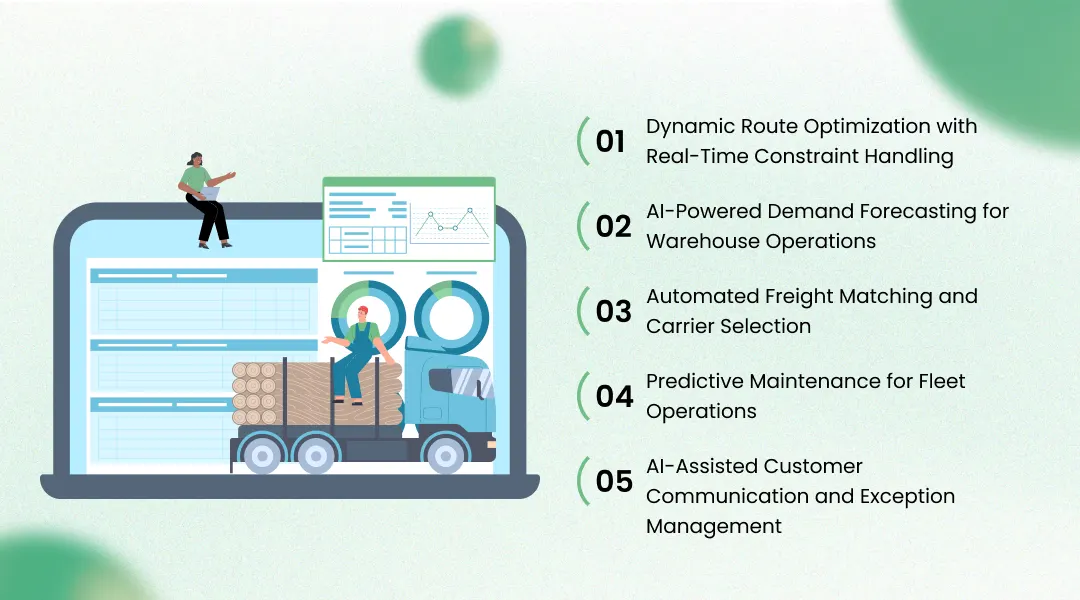
Not every AI application that generates press coverage makes sense for a 150-person logistics company. The following applications represent the highest return-to-effort ratio specifically for this segment, based on the operational complexity, data availability, and budget realities of a mid-market operator.
Dynamic Route Optimization with Real-Time Constraint Handling
Route optimization software has existed for decades, but AI-powered route optimization is meaningfully different from the static routing tools that most mid-market companies already own. Traditional routing software optimizes a route based on fixed inputs like distance, time windows, and vehicle capacity. AI route optimization continuously re-optimizes based on real-time inputs including traffic conditions, driver hours of service status, weather, customer availability changes, and fuel price fluctuations across stop locations. For a fleet of 40 to 200 vehicles, this kind of dynamic optimization typically reduces total miles driven by 8 to 14 percent, which at current diesel prices translates to $180,000 to $620,000 in annual fuel savings for a fleet of that size. Implementation typically requires connecting the AI platform to your TMS for order data and to your EHD system for HOS data, a project that takes four to eight weeks with a vendor that offers pre-built connectors.
AI-Powered Demand Forecasting for Warehouse Operations
Mid-market 3PLs and warehouse operators consistently cite labor planning as one of their highest variable cost challenges. Demand arrives in patterns that are partially predictable, such as seasonal peaks and customer promotional calendars, and partially erratic, driven by supply chain disruptions and short-notice order changes. AI demand forecasting models trained on 18 to 24 months of inbound order data, historical throughput by SKU category, and external signals like customer sell-through data can produce 72-hour labor demand forecasts that are 30 to 40 percent more accurate than manual planning. For a warehouse running 80 to 200 associates across multiple shifts, a 30 percent improvement in forecast accuracy typically eliminates between $400,000 and $1.2 million per year in overtime costs and temp agency premiums.
Automated Freight Matching and Carrier Selection
Mid-market freight brokers and shippers operating in spot and contract markets spend significant dispatcher time manually matching loads to carriers and negotiating rates. AI freight matching tools analyze historical lane performance, carrier reliability scores, current capacity signals from load boards, and rate trend data to recommend optimal carrier-load matches automatically. These tools do not replace the relationship-based carrier management that mid-market companies do well. They eliminate the low-value search and comparison work that consumes 40 to 60 percent of a dispatcher's day, allowing those employees to focus on exception management and carrier relationship development.
Predictive Maintenance for Fleet Operations
For mid-market carriers owning between 30 and 200 tractors, unplanned breakdowns are disproportionately costly because they lack the reserve fleet depth of large carriers. A breakdown on a 120-truck fleet might mean refusing a load or paying a spot premium to cover the shipment. AI predictive maintenance platforms connect to ELD telematics data and engine diagnostic feeds to identify failure probability patterns for specific components. Companies implementing predictive maintenance at this scale typically see a 20 to 35 percent reduction in unplanned breakdown events and a 15 to 25 percent reduction in maintenance costs through better parts inventory management and more efficient shop scheduling.
AI-Assisted Customer Communication and Exception Management
Shipment exception handling, the calls, emails, and status updates generated by delayed, damaged, or mis-routed freight, consumes between 15 and 25 percent of customer service labor in a typical mid-market logistics company. AI communication tools can now handle a large share of this volume autonomously, sending proactive delay notifications, generating automated status updates, and flagging exceptions that require human intervention based on customer tier, SLA thresholds, and resolution complexity. The customer experience impact is measurable: companies implementing AI exception management report a 22 to 31 percent improvement in customer satisfaction scores within the first six months, driven primarily by the shift from reactive to proactive communication.
Quantified Business Impact at Mid-Market Scale
The business case for AI adoption in mid-market logistics is not theoretical. Companies in the 50 to 500 employee range that have implemented the applications described above are reporting results that are meaningful at their operational scale, not just impressive as percentage figures.
A regional carrier operating 95 trucks and billing approximately $38 million annually implemented AI route optimization in Q1 2024 and reduced fuel costs by 11 percent within the first four months of full deployment. At that company's fuel spend level, the annual saving represented $890,000, against a platform cost of $145,000 per year, producing a 514 percent first-year ROI after accounting for implementation costs. The carrier's on-time delivery performance also improved from 91.2 percent to 96.7 percent over the same period, which directly contributed to two new customer contract wins that the sales team attributed to improved scorecard performance.
A mid-market 3PL managing approximately 280,000 square feet across two distribution centers implemented AI demand forecasting in early 2024 and reduced overtime expenditure by 34 percent in the first year. That reduction represented $1.1 million in direct labor cost savings against a total AI implementation investment of $210,000 including platform licensing and integration work. The forecasting accuracy improvement also allowed the company to reduce its reliance on temp agency workers, cutting agency fee expenditure by 28 percent.
Mid-market logistics companies implementing AI freight matching tools are reporting dispatcher productivity improvements of 40 to 55 percent in terms of loads processed per dispatcher per day. For a company employing 12 dispatchers at an average fully loaded cost of $75,000 per year, a 45 percent productivity improvement represents the equivalent of 5.4 additional dispatcher positions worth of capacity without additional headcount, valued at approximately $405,000 per year. This capacity gain is typically reinvested in handling higher load volumes during peak periods rather than in headcount reduction, which means the business impact compounds through revenue growth rather than cost reduction alone.
KriraAI works specifically with mid-market logistics operators to identify which of these applications fits their current data maturity and operational complexity, and to build an implementation sequence that produces measurable returns within the first business quarter of deployment rather than the 18-month enterprise timelines that most AI vendors quote.
Implementation Roadmap for Mid-Market Logistics Companies
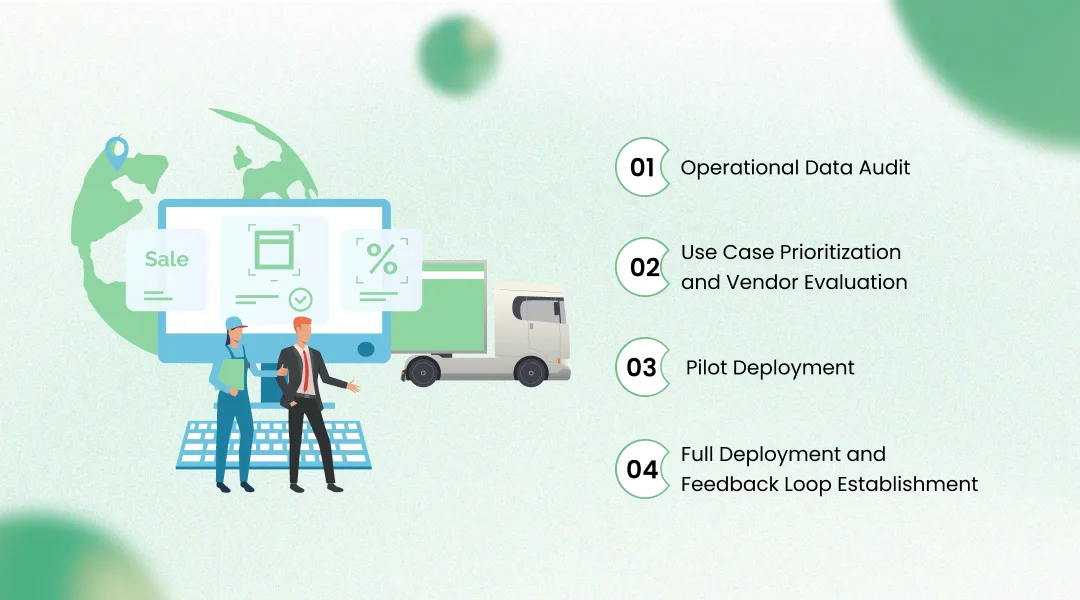
Implementing AI in a mid-market logistics company is a structured process with specific stages. The following roadmap reflects the actual implementation path that companies of this size follow when they approach it correctly.
Stage 1: Operational Data Audit (Weeks 1 to 4)
Before selecting any AI platform, conduct an audit of the data that the AI will need to function. For route optimization, this means evaluating the quality and completeness of order data, vehicle data, and telematics feeds in your TMS and ELD systems. For demand forecasting, it means assessing 18 to 24 months of inbound order history, SKU-level throughput data, and any available customer forecast inputs. The audit does not need to find perfect data. It needs to identify which data gaps would prevent a model from producing useful outputs and which gaps can be tolerated or filled with proxy data. Most mid-market companies find that their data is 60 to 80 percent ready for AI use with targeted cleaning, not wholesale reconstruction.
Stage 2: Use Case Prioritization and Vendor Evaluation (Weeks 3 to 8)
Based on the data audit, prioritize the one or two AI applications where your data is strongest and your operational pain is highest. A company with good telematics data and a fuel cost problem should start with route optimization. A company with clean WMS data and a labor cost problem should start with demand forecasting. Evaluate three to five vendors for the chosen use case, focusing specifically on their integration capabilities with your existing TMS or WMS, their implementation timeline for companies of your size, and their pricing model at your scale. Request references from customers of similar size in similar logistics segments, not from enterprise customers whose implementations look nothing like yours.
Stage 3: Pilot Deployment (Weeks 6 to 16)
Run a structured pilot on a defined subset of your operations. For route optimization, pilot on one geographic region or one customer account. For demand forecasting, pilot on one facility or one product category. Define your success metrics before the pilot begins, including the specific percentage improvement in the target metric that would justify full deployment. Run the AI system in parallel with your existing process for the first four weeks to build operational confidence before transitioning to AI-led decision making.
Stage 4: Full Deployment and Feedback Loop Establishment (Months 4 to 9)
Scale the pilot to full operations and establish a weekly review cadence where your operations analyst examines AI output quality, flags anomalies, and feeds corrections back into the model. This feedback loop is the difference between an AI system that improves over time and one that plateaus. Most mid-market companies underinvest in this stage, which is why results often fall short of the pilot performance.
The Three Most Common Mistakes Mid-Market Logistics Companies Make with AI
Mistake 1: Selecting a platform built for enterprise scale
Enterprise AI logistics platforms are often the most visible in the market because they have the largest marketing budgets. They are also designed for data environments, integration teams, and implementation timelines that mid-market companies cannot support. Companies that select enterprise platforms typically spend 60 to 80 percent of their budget on customization and integration work rather than on the AI functionality itself.
Mistake 2: Underestimating the data preparation requirement
The most common reason AI pilots in mid-market logistics fail to reach full deployment is not the AI technology. It is the discovery, mid-pilot, of data quality problems that were not identified before the project began. A four-week data audit before vendor selection would have prevented most of these failures and is a non-negotiable first step.
Mistake 3: Assigning AI ownership to IT rather than operations
In mid-market logistics, the person who owns an AI implementation should be an operations leader, not an IT manager. The system requires business logic decisions, not code decisions. IT should support the integration, but the operational owner who understands dispatch logic, customer SLA structures, and lane economics must drive the configuration and ongoing management.
Challenges Specific to Mid-Market Logistics AI Adoption
Mid-market logistics companies face a specific set of AI adoption challenges that are neither the resource limitations of a small operator nor the organizational inertia of a large enterprise. Understanding these challenges precisely is the prerequisite for navigating them.
The first challenge is integration complexity without integration resources. A mid-market logistics company typically has four to seven core software systems, each with its own data model and API capability, ranging from well-documented modern APIs to legacy systems with no API layer at all. Connecting an AI platform to this environment requires integration work that exceeds what a one or two person IT team can deliver without vendor support. Companies that do not budget explicitly for integration services, typically 20 to 40 percent of the total AI implementation cost, consistently find that their projects stall at the data connection stage.
The second challenge is change management at a middle-management layer that feels directly threatened by AI. Dispatchers, planners, and operations supervisors in mid-market logistics companies often interpret AI adoption as a signal that their judgment and experience are being replaced rather than augmented. This resistance is not irrational. It requires direct communication from leadership about the role that AI is playing, visible examples of how the technology is making those employees' jobs easier rather than replacing them, and involvement of those employees in the pilot evaluation process.
The third challenge is vendor selection in a market where mid-market products are genuinely difficult to identify. The logistics AI vendor landscape in 2026is polarized between enterprise solutions priced above $500,000 annually and lightweight SMB tools that cap out in functionality below what a mid-market company needs. The genuine mid-market tier exists but requires deliberate research to find, which is part of the consulting value that companies like KriraAI provide when helping mid-market logistics operators evaluate and select AI technology that is actually sized for their operational reality.
The Future Competitive Landscape: What 2028 Looks Like for Mid-Market Logistics
Three years from now, the logistics industry will be divided in a way that is already predictable based on current adoption patterns. Companies that began AI adoption in 2024 and 2026 will have accumulated 36 to 48 months of model learning on their operational data. That learning is not easily replicated by a company that starts in 2028. A route optimization model trained on three years of your specific lane history, customer behavior patterns, and driver performance data produces meaningfully better outputs than a model deployed on the same platform today. The competitive advantage is not just in having AI. It is in having AI that has learned your business.
By 2028, mid-market logistics companies with mature AI implementations will operate with 15 to 20 percent lower cost structures than their non-AI competitors of the same size. That cost advantage will flow directly into pricing flexibility, allowing AI-adopting companies to undercut competitors on price while maintaining superior margins, or to maintain price parity while delivering measurably better service performance. Customer loyalty in logistics correlates strongly with on-time delivery consistency and proactive communication, both of which AI systems directly improve. Companies delivering 97 percent on-time performance through AI-optimized operations will retain customers that competitors running at 91 percent will lose, regardless of price.
The talent dynamic will also shift. The best operations talent will increasingly prefer employers whose technology infrastructure makes their jobs more effective and less reactive. Mid-market companies that have invested in AI will find it easier to attract and retain the operations analysts, fleet managers, and account managers who are choosing employers partly based on the quality of the tools they will work with.
The companies that wait until 2027 or 2028 to begin AI adoption will face a compounding disadvantage. They will pay implementation costs that have risen as demand for AI integration services grows. They will deploy models that start with no operational history on their data. They will compete for talent with companies that already have mature AI environments. And they will attempt to close a technology gap while simultaneously competing on price against companies whose AI-driven cost structures are already two to three years more efficient.
Conclusion
Three points from this guide deserve to be carried forward as action items. First, AI adoption for mid-market logistics companies requires a purpose-built approach, not a scaled-down enterprise playbook or a scaled-up SMB tool. The applications, vendors, timelines, and internal resources needed at this scale are specific, and selecting the wrong path costs both time and budget that mid-market operators cannot easily absorb. Second, the quantified returns from well-implemented AI in route optimization, demand forecasting, and automated freight matching are substantial at the mid-market scale, with first-year ROI cases ranging from 300 to 600 percent when implementations are properly structured. Third, the compounding advantage that early AI adopters are building in terms of model learning, cost structure efficiency, and customer retention means that the cost of waiting in 2025 is materially higher than the cost of waiting was in 2023.
KriraAI builds practical, scalable AI solutions specifically designed for mid-market logistics companies that are navigating exactly this challenge. KriraAI does not offer enterprise platforms scaled down with features removed, and does not offer lightweight SMB tools stretched past their design ceiling. The company's implementations are built around the actual data environments, integration constraints, and internal team capabilities of logistics operators in the 50 to 500 employee range, and are structured to produce measurable operational results within a single business quarter. If you are a mid-market logistics operator evaluating AI adoption and want guidance on which applications fit your specific operational profile, your existing systems, and your current data maturity, contact KriraAI to explore a fit assessment designed specifically for companies at your stage of growth.
FAQs
For a mid-market logistics company with 50 to 500 employees, a realistic AI implementation budget for a single use case such as route optimization or demand forecasting ranges from $80,000 to $350,000 in Year 1, including platform licensing, integration services, and internal staff time. This range reflects the actual cost structure of mid-tier AI platforms built for this segment, not enterprise platforms that require separate data infrastructure investments before the AI work even begins. In Year 2 and beyond, costs typically drop to the annual licensing fee alone, between $60,000 and $200,000, as integration work is already complete. Companies should budget 20 to 40 percent of their total first-year cost specifically for integration and data preparation work, as underestimating this component is the most common reason mid-market AI implementations go over budget.
Mid-market logistics companies implementing well-matched AI applications in route optimization, demand forecasting, or freight matching typically see measurable ROI within four to nine months of full deployment. This timeline assumes that the data audit and integration work were completed properly before the pilot began, and that the pilot ran for six to ten weeks before full deployment. Companies that rush the implementation without completing data preparation work typically see their ROI timeline extend to 12 to 18 months as data quality issues are resolved mid-implementation. The fastest ROI cases in this segment are route optimization deployments where telematics data quality is strong, where fuel costs represent a significant share of operating expense, and where the AI platform offers pre-built connectors to the company's existing TMS.
A mid-market logistics company does not need a data scientist or an AI engineer to operate an AI system effectively after deployment. What it needs is one dedicated operations analyst or operations manager who has strong analytical skills, solid understanding of the company's operational logic and data, and the time allocation to own the AI system's ongoing performance. This person should spend four to eight hours per week reviewing AI outputs, flagging anomalies, and providing feedback to the vendor or directly into the system's correction interface. Most mid-tier AI vendors designed for this segment have built their platforms to be managed without coding skills, with configuration interfaces that translate business rules into model parameters. The critical internal capability is business judgment, not technical engineering.
Yes. The majority of AI applications that deliver the strongest ROI for mid-market logistics companies are designed to work alongside existing TMS and WMS systems rather than replace them. AI route optimization tools connect to the TMS to pull order and vehicle data, then push optimized route assignments back, all without the TMS changing. AI demand forecasting tools pull historical order data from the WMS and deliver forecasts that planners consume in the same scheduling workflows they already use. The key requirement is that the AI platform supports API connections or flat-file data exchange with the specific TMS and WMS versions the company runs. This is why mid-market logistics companies should ask vendors specifically about connector availability for their exact system version before committing to a platform.
The biggest risk is not that the AI will make poor decisions, it is that the company will over-rely on AI outputs before the model has been validated sufficiently on their specific data and operations. A route optimization model that was not properly trained on a company's specific customer time windows and driver break patterns may produce routes that look efficient on paper but are operationally infeasible. This risk is mitigated by running a parallel operation period of four to six weeks during the pilot, where AI recommendations are compared against human dispatcher decisions before the AI system takes operational control. Companies should also establish clear exception flags so that AI outputs that fall outside defined operational bounds are automatically escalated to a human reviewer rather than executed. The parallel operation phase is not optional for mid-market companies that cannot absorb the customer impact of operational errors during the AI learning period.
Ridham Chovatiya is the COO at KriraAI, driving operational excellence and scalable AI solutions. He specialises in building high-performance teams and delivering impactful, customer-centric technology strategies.