A recent finding from the U.S. Census Bureau's Business Trends and Outlook Survey puts the current AI adoption rate among U.S. businesses at approximately 18% as of late 2025, with over 20% expecting to use AI in the first half of 2026. Yet within small data science consulting firms with ten to fifty employees, adoption of AI to optimize internal operations remains strikingly low. Most of these firms are busy building AI solutions for their clients while running their own businesses on spreadsheets and manual processes. The companies best positioned to benefit from artificial intelligence are often the last to apply it to themselves.
If you run or manage a data science services firm with a team of ten to fifty people, this blog is written specifically for your operational reality. Not for the solo freelancer juggling three clients on a laptop, and not for Accenture or Deloitte with thousands of consultants and dedicated R&D divisions. Your firm occupies a uniquely challenging middle ground where you have enough complexity to benefit from AI-driven workflows, but not enough budget or headcount to justify enterprise-grade platforms. This guide covers the specific AI tools, realistic costs, implementation timelines, and measurable outcomes that firms of your exact size are achieving in 2026, drawing on the kind of hands-on AI consultancy services that help firms like yours pick the right starting point.
Small data science firms in this size range operate with a lean but highly skilled workforce. The team usually includes senior data scientists, machine learning engineers, analysts, a small project management function, and a founder who wears multiple hats across sales, delivery, and strategy. Revenue commonly falls between $1.5 million and $12 million annually. Technology budgets for internal operations rarely exceed 5% to 8% of revenue.
The technology stack for internal operations at these firms is often surprisingly unsophisticated relative to what they build for clients. Client relationship management might live in a basic CRM or a shared spreadsheet. Project scoping relies on the experience of senior team members rather than historical data analysis. Knowledge management is informal, with insights from past projects locked in Slack channels or the memories of long-tenured employees.
Decision-making in these firms moves quickly compared to large enterprises. The founder or a small leadership team can approve a new tool purchase within days rather than months. However, there is rarely a dedicated operations or IT team to evaluate and maintain new technologies. Every internal improvement competes directly with billable client work for attention. The pressure to maintain utilization rates above 70% means internal projects get deprioritized in favor of revenue-generating work, a dynamic that is especially pronounced for firms serving fast-moving, data-intensive sectors like finance.
The AI adoption conversation in mainstream business media is dominated by two extremes. On one end, enterprise transformation stories feature companies spending $5 million to $50 million on custom AI platforms with teams of 20 or more managing the rollout. On the other end, solo operators adopt plug-and-play AI tools for individual productivity. A small data science firm with ten to fifty employees fits neither narrative.
Enterprise AI strategies assume resources that simply do not exist at this scale. A Fortune 500 company implementing AI has a Chief Data Officer, a dedicated AI governance committee, a multi-million-dollar annual budget for experimentation, and the ability to absorb a failed pilot without financial consequences. A 25-person data science consultancy has none of these. Attempting to replicate enterprise approaches typically results in overspending on platforms that require dedicated administrators, which the firm cannot hire.
The solo operator approach fails for different reasons. Individual AI tools deliver value when one person uses them for personal productivity, but a firm with 15 to 40 data scientists needs AI that works across workflows and delivers organizational rather than individual benefits. KriraAI has observed this pattern repeatedly when working with small data science firms: the companies that succeed with AI adoption treat it as an operational infrastructure investment rather than a collection of individual tool subscriptions.
Budget realities further differentiate this segment. A realistic internal AI budget for a firm of this size ranges from $500 to $3,000 per month for tooling, with an additional 40 to 80 hours of internal team time for initial setup spread across the first quarter. The timeline to see measurable returns at this scale is typically 60 to 120 days for the first workflow, compared to 12 to 18 months for an enterprise deployment, as explored in our guide to Custom AI Solutions for Business Growth. This faster feedback loop is an advantage, but only if the firm selects the right starting point — a challenge we've also mapped out in our practical adoption guide for mid-size security companies navigating a similar budget squeeze.
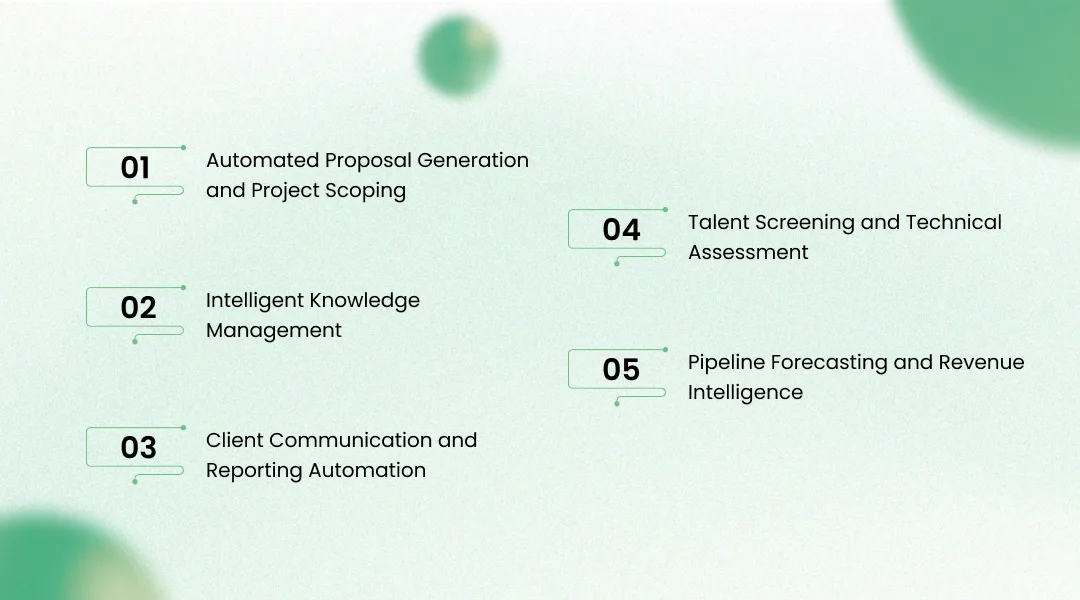
Not every AI application makes sense for a firm of this size. The most practical applications for small data science firms in 2026 fall into five categories, each addressing a specific operational bottleneck.
The average small data science firm spends 15 to 25 hours per month on proposal writing and project scoping. AI tools that combine large language models with retrieval-augmented generation can pull from a firm's library of past proposals, project outcomes, and pricing history to generate first drafts in minutes. These tools can reduce proposal creation time by 60% to 70% at a cost of $50 to $200 per month. For a firm where senior data scientists bill at $200 to $350 per hour, saving 10 hours per month on proposals translates to $2,000 to $3,500 in recovered billable capacity.
Knowledge loss is one of the most expensive hidden costs in small data science firms. When a senior data scientist leaves, the insights from every project they led walk out the door. AI-powered knowledge management tools can index a firm's entire corpus of project documentation, code repositories, and client communications to create a searchable institutional memory. These tools cost between $8 and $25 per user per month. For a 30-person firm, that is $240 to $750 monthly, a fraction of the cost of losing even one week of productivity when a key team member departs.
Small data science firms often underestimate how much time goes into client communication that is not directly analytical work. Weekly status updates, monthly reports, executive summaries, and meeting follow-ups consume significant hours. AI tools that integrate with project management platforms can auto-generate status reports, summarize meeting transcripts, and draft client-facing communications. These typically cost $100 to $400 per month and save 20 to 30 hours of team time monthly.
Hiring is a persistent challenge for small data science firms. Every open position requires senior technical staff to screen resumes, design assessments, and conduct interviews. AI-driven applicant tracking systems with built-in technical assessment capabilities can pre-screen candidates against technical requirements and surface the top 10% of applicants before a human reviews a single resume. The cost ranges from $200 to $500 per month. Firms that implement these tools report reducing time to hire by 35% to 45% and senior staff hours spent on recruitment by approximately 50%.
Most small data science firms manage their sales pipeline with gut instinct supplemented by a basic CRM. AI-powered revenue intelligence tools analyze deal patterns, communication sentiment, and historical conversion rates to predict which opportunities will close, when, and at what value. For a firm where a single new engagement might be worth $50,000 to $500,000, even a modest improvement in forecast accuracy translates to better resource planning. These tools range from $75 to $300 per user per month for the sales team, typically two to five users at this firm's size.
The business impact of AI automation for data science consulting firms in this size range must be understood in context. A 30-person data science firm billing at an average of $175 per hour with a 72% utilization rate generates approximately $5.6 million in annual revenue. At these numbers, small efficiency gains have an outsized impact because the firm operates at thin margins where every recovered hour matters.
Firms that have implemented AI-driven proposal automation and knowledge management in 2026 report a 12% to 18% increase in effective utilization rates. For the hypothetical 30-person firm above, an increase from 72% to 80% utilization represents approximately $560,000 in additional annual revenue capacity without hiring a single new employee. The cost of the AI tools enabling this shift is typically $2,000 to $4,000 per month, representing an annual ROI exceeding 1,000%.
Time savings compound in specific ways at this scale. A firm that reduces proposal turnaround from five days to two days wins more competitive bids because speed differentiates it when clients evaluate multiple firms. Companies using AI for small analytics operations report a 25% improvement in proposal win rates. KriraAI's analysis of small services firms shows that the revenue impact of faster proposals alone typically exceeds $200,000 annually for firms in the $3 million to $8 million revenue range.
Employee retention also improves measurably when AI handles tedious operational work. Data scientists who spend less time on status reports and administrative documentation report 20% to 30% higher job satisfaction scores. In a market where replacing a senior data scientist costs 1.5 to 2 times their annual salary, reducing attrition by even one person per year at a 30-person firm saves $150,000 to $300,000 in replacement costs.
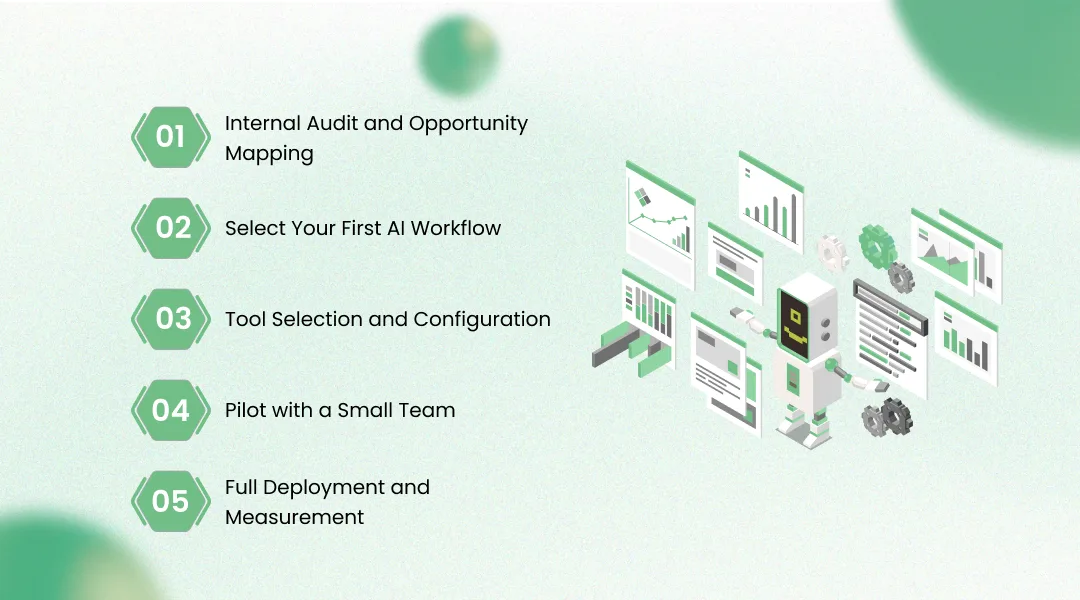
Implementing AI in a small data science firm requires a phased approach that respects the reality that every hour spent on internal improvement is an hour not spent on client work. The following roadmap is designed for firms with ten to fifty employees.
Before purchasing any tool, spend two weeks documenting where your team's non-billable hours actually go. Have each team member track their time across categories like proposal writing, internal meetings, knowledge searching, client reporting, and administrative tasks for two weeks. Most firms discover that 25% to 35% of total capacity goes to non-billable activities, with proposal writing, reporting, and knowledge management consistently ranking as the top three time consumers. Total investment: 15 to 20 hours across the firm.
Choose exactly one workflow to automate first. Prioritize based on three factors: hours consumed weekly, repetitiveness of the task, and quality of existing data to configure the AI tool. For most small data science firms, proposal generation or client reporting scores highest on all three. Resist automating multiple workflows simultaneously. A single successful implementation builds organizational confidence. Total investment: 4 to 6 hours of leadership time.
Evaluate two to three tools for your chosen workflow using free trials, following the same disciplined evaluation criteria outlined in our AI Agents Complete Guide for business automation. Configure the selected tool with your firm's actual data: past proposals, project templates, or client communication samples. This configuration phase is where most small firms underinvest. A generative AI tool producing generic output is not useful, but the same tool configured with your firm's historical data produces output that requires minimal editing. Budget 20 to 30 hours of a mid-level team member's time for configuration. KriraAI recommends that firms allocate a dedicated "AI sprint" where one team member spends 50% of their time for two weeks on setup rather than spreading the effort in fragmented increments.
Roll the tool out to three to five team members, not the entire firm. Collect structured feedback weekly: time saved per task, quality of output on a 1-to-5 scale, and specific friction points. Common issues that surface during pilots include output quality inconsistency, integration gaps with existing tools, and team members reverting to old habits. Address each issue during the pilot rather than after a full rollout.
Deploy the tool across the entire relevant team. Establish simple metrics: hours saved per week, quality scores from client feedback, and utilization rate changes. After 30 days, calculate the actual ROI and present results to the team. This data becomes the business case for your next AI workflow implementation.
The first mistake is buying enterprise tools at startup pricing. Many AI platforms offer attractive introductory rates that double or triple after the first year. Always evaluate the Year 2 cost and the feature set at the tier you will actually need. The second mistake is expecting AI to work without configuration. Every AI tool requires customization with your firm's data and workflows to produce professional-quality output. The third mistake is trying to automate everything at once. Firms that attempt to roll out AI across five workflows simultaneously end up with five half-configured tools that nobody uses.
Small data science firms face challenges that neither enterprises nor solo operators encounter. The most significant is the expertise paradox: your team members are AI experts who build sophisticated systems for clients, yet they may resist applying simpler AI tools to their own workflows. A senior data scientist who builds custom neural networks may dismiss an AI proposal generator without evaluating whether it saves 10 hours per month. Overcoming this resistance requires framing internal AI adoption as an operational efficiency initiative rather than a technical achievement.
Data privacy presents another challenge specific to this company's size. Small data science firms handle sensitive client data and proprietary methodologies. Any AI tool processing internal documents must meet strict data handling requirements. Unlike enterprises that negotiate custom data processing agreements, small firms must work within standard terms of service and evaluate whether those terms are compatible with their client contracts.
Resource allocation creates ongoing tension even after initial implementation. In a firm where every person's utilization rate is tracked, spending time on internal AI projects feels like a direct hit to the bottom line. The firms that succeed treat AI implementation time as an investment with a measurable return period. Establishing a small recurring budget of 4 to 8 hours per month per team lead for AI workflow refinement prevents the pattern where tools get configured once and then degrade as the firm's processes evolve.
The data science services industry is entering a period of rapid differentiation. Between 2028 and 2030, the dividing line among small firms will be operational AI maturity. Firms that implementAI-drivenn operations in 2025 and 2026 will operate at 15% to 25% higher margins than competitors who rely on manual processes. This margin advantage compounds because it funds better talent acquisition, more competitive pricing, and investment in proprietary methodologies.
The client expectation shift is already underway. Enterprise buyers who hire data science consulting firms increasingly expect those firms to demonstrate AI fluency not just in deliverables but in their own operations. A prospective client evaluating two firms of similar size will choose the one that uses AI to deliver proposals faster and manage projects more transparently. Implementing AI in data science services is becoming a credibility signal that demonstrates the firm practices what it sells.
Three specific capabilities will separate market leaders from laggards among small data science firms by 2028. First, the ability to scope and price projects with AI-assisted estimation reduces variance in project profitability. Second, the ability to retain and surface institutional knowledge so that client engagements benefit from the firm's entire history. Third, the ability to scale delivery without proportionally scaling headcount, using AI to handle the administrative overhead that currently limits growth.
Three insights from this guide deserve emphasis. First, the right AI tools for a small data science firm are not scaled-down enterprise platforms or scaled-up individual apps. They are purpose-selected solutions configured with your firm's own data. Second, a phased rollout starting with one high-impact workflow consistently outperforms attempts to transform everything at once. Third, the competitive advantage of early adoption compounds because it is built on accumulated data and organizational habits, not just software licenses.
KriraAI works with small data science firms to identify, implement, and optimize the specific AI tools that match their team size, budget, and growth objectives. Rather than recommending enterprise solutions that require dedicated administrators or consumer tools that do not scale, KriraAI focuses on practical AI implementations designed for firms with ten to fifty employees. If your data science firm is ready to apply the same analytical rigor to its own operations that it brings to client engagements, exploring what KriraAI offers for firms at your growth stage is a worthwhile next step.
The realistic monthly cost for a small data science firm implementing affordable AI tools across two to three core workflows ranges from $1,500 to $5,000 per month, depending on the specific tools selected and the number of users. This breaks down to approximately $500 to $1,500 for proposal and document automation, $240 to $750 for knowledge management platforms, $100 to $400 for meeting intelligence and reporting automation, and $200 to $500 for recruitment screening. Firms should budget an additional 40 to 80 hours of team time in the first quarter for setup, which represents a one time investment that pays back within the first 90 days through recovered billable hours.
Small data science firms typically see measurable ROI from their first AI workflow within 60 to 90 days of full deployment, including configuration and pilot phases. The fastest returns come from proposal automation and client reporting workflows, where time savings translate directly to recovered billable capacity. A firm billing senior data scientists at $200 to $350 per hour that saves 40 hours per month recovers $8,000 to $14,000 monthly against a tool cost of $1,500 to $3,000. The compounding benefits of AI ROI for small analytics companies become more significant after six months, when tools have accumulated enough firm specific data to improve output quality and team members have fully integrated AI assisted workflows into daily habits.
Data science consulting firms handling sensitive client data should prioritize AI tools that offer enterprise grade data handling even at small business pricing tiers. Look for tools that provide SOC 2 Type II compliance, data processing agreements that specify no training on customer data, and options for data residency in specific regions if clients require it. Self hosted LLM options using frameworks like Ollama give small firms control over their data without requiring enterprise budgets. The key evaluation criterion is whether the vendor's terms of service explicitly state that customer data is not used to train models, as this commonly conflicts with client contracts governing data handling and confidentiality.
Yes, a small data science firm can implement AI tools without a dedicated operations team, but it requires a deliberate approach. The most effective model at this firm size is to designate an "AI champion," a mid level team member who is curious about operational efficiency and willing to spend 4 to 8 hours per week on implementation during the initial three month rollout period. This person does not need to be a senior data scientist. A technically capable project manager or analyst often makes a better AI champion because they experience operational friction daily and are motivated to solve it. After initial setup, maintenance typically requires only 2 to 4 hours per week. The AI champion model works because it concentrates knowledge and accountability in one person rather than distributing responsibility across a team where it becomes nobody's priority.
The biggest risk of delaying data science business AI integration is falling behind the operational efficiency curve that compounds over time. Firms that adopt AI for internal operations in 2025 and 2026 are building datasets of project histories, refined prompts, and organizational habits that become increasingly difficult for late adopters to replicate. By 2028, industry benchmarks suggest that AI enabled data science firms will operate at 15% to 25% higher margins than comparable firms using manual processes. Late adopters will face a dual challenge: catching up on implementation while competing against firms with two to three years of accumulated operational data powering their AI systems.
Ridham Chovatiya is the COO at KriraAI, driving operational excellence and scalable AI solutions. He specialises in building high-performance teams and delivering impactful, customer-centric technology strategies.