A mid-size security company running 80 to 400 guards across 15 to 60 client sites spends an estimated 20 or more hours per week just on scheduling alone. That figure comes from operational surveys of contract guard firms in the 50-to-500-employee range, where a single scheduling coordinator juggles shift fills, callout replacements, overtime caps, and site-specific certification requirements using spreadsheets and group texts. When you factor in the 2026 reality that the global physical security services market is valued at approximately 378 billion dollars and growing at 6 percent annually, the question is no longer whether AI matters in this industry. The question is whether your company can afford to keep running on manual processes while your competitors automate.
This blog is not written for Allied Universal or GardaWorld, and it is not written for the solo security consultant with three part-time guards. It is written specifically for the mid-size contract security company running between 50 and 500 employees, managing multiple client contracts, dealing with thin margins, high turnover, and the constant operational chaos of scaling a people-heavy business. What follows is a practical guide to adopting AI in a way that matches your actual budget, team, and operational reality, covering the applications that deliver the fastest returns, realistic cost savings, implementation without disruption, and mistakes to avoid.
Mid-size security companies occupy a uniquely challenging position in the physical security industry. You are too large to manage with informal systems and too small to afford the enterprise infrastructure that firms like Securitas or Allied Universal deploy. Understanding this operational reality is the foundation for making smart AI decisions.
A typical mid-size security firm in this range operates with a lean leadership team: an owner or general manager, one or two operations managers, a scheduling coordinator who doubles as a dispatcher, and a field supervisor for every 25 to 40 guards. Decision-making is fast because the owner is usually directly involved, but resources for technology evaluation are thin. There is no IT department, and technology decisions are made by the same person who resolves payroll disputes and meets with prospective clients.
The guard workforce presents its own challenges. Turnover in contract security ranges between 100 and 300 percent annually for firms in this segment, meaning a company with 150 guards may need to hire and train 150 to 450 replacements every year. The administrative burden of workforce churn consumes a disproportionate share of management time.
Budget constraints are real but often misunderstood. A mid-size security company in this range typically generates between 3 million and 30 million dollars in annual revenue, with net margins between 3 and 8 percent. Technology spending is usually reactive rather than strategic, with investments triggered by client demands or competitive pressure rather than long-term planning. Monthly technology budgets of 2,000 to 8,000 dollars are common, which means any AI solution must demonstrate clear ROI within 60 to 90 days or it will not survive the next budget review.
The AI advice that dominates industry conferences and vendor marketing materials is overwhelmingly designed for two audiences: Fortune 500 enterprises deploying global security operations centers with million-dollar budgets, or small businesses looking for a single camera with basic motion alerts. Neither model works for the mid-size security company, and applying either one will waste money and create frustration.
Enterprise physical security AI typically involves multi-year contracts starting at 100,000 dollars or more annually, custom integrations with proprietary hardware ecosystems, and training programs that span months. A deployment designed for a Fortune 500 campus cannot simply be scaled down for a company managing 35 client sites with a two-person operations team.
Enterprise solutions also assume a level of data infrastructure that most mid-size security companies do not possess, including unified data lakes, API-connected systems, and standardized reporting frameworks. The typical mid-size firm runs scheduling on spreadsheets, incident reporting on paper, and client communication through text messages. Jumping directly to enterprise-grade AI without first building a basic digital foundation is like trying to run machine learning on data you have not yet collected.
On the other end, the simple AI tools marketed to small businesses lack the multi-site coordination, compliance tracking, and operational depth that a company managing 50 to 500 guards requires. A scheduling app designed for a restaurant with 12 employees cannot handle the complexity of armed versus unarmed guard assignments, overtime threshold management across multiple jurisdictions, or site-specific post orders that change weekly.
KriraAI has observed this gap repeatedly when working with mid-size security companies: the available solutions either demand resources these companies do not have or deliver capabilities they have already outgrown. The right approach for this segment is modular AI adoption, starting with the highest-pain, highest-return operational processes and expanding systematically as each layer proves its value.
At enterprise scale, AI implementation timelines of 12 to 18 months are considered normal. At the mid-size scale, the window for proving value is 30 to 90 days. If a new system does not show measurable improvement within a single billing cycle, it gets abandoned. This means mid-size security companies need AI solutions that deploy in days or weeks, integrate with existing workflows rather than replacing them, and deliver visible results before the next quarterly client review.
Not every AI application makes sense for a company of this size. What follows are the specific applications that consistently deliver the best return for the resources available at the 50- to 500-employee scale.
This is the single highest-impact AI application for mid-size security companies. Manual scheduling for a company managing 100 or more guards across 30 or more client sites consumes an estimated 15 to 20 hours of management time per week. AI-powered scheduling systems such as TrackTik, Deputy, and Celayix analyze guard certifications, overtime thresholds, travel distance between sites, client contract requirements, and historical no-show patterns to generate optimized schedules automatically.
When a guard calls out at midnight, an AI scheduling system identifies the three best replacement options based on proximity, cost, and qualification match, contacts them in priority order, and confirms the fill without a manager picking up the phone. For a mid-size company, this capability alone can recover 15 to 20 hours per week of management time, which at loaded labor rates of 35 dollars per hour translates to 27,000 to 36,000 dollars in annual savings. Cloud-based scheduling platforms in this category typically cost between 3 and 8 dollars per user per month, placing total costs at 1,800 to 48,000 dollars annually, depending on guard count and feature tier.
AI video analytics transforms existing security cameras from passive recording devices into active threat detection systems. For mid-size security companies, this capability is less about operating analytics internally and more about offering AI-enhanced monitoring as a value-added service to clients. Platforms like Spot AI, Eagle Eye Networks, and Coram AI work with the cameras clients already have installed. Businesses deploying computer vision development services can detect unusual activity, monitor restricted areas, and improve incident response without replacing existing camera infrastructure.
The business case is straightforward. Adding AI video analytics to the service offering can reduce guard hours required per site by 20 to 40 percent while improving incident detection rates. A site that currently requires around-the-clock manned coverage might shift to 16 hours of guarding supplemented by AI-monitored remote surveillance during off-peak hours. The cost per camera ranges from 10 to 50 dollars per month, making it economically viable at this scale.
Security companies in the 50-to-500-employee range frequently lose billable incidents and struggle with reporting consistency because guards fill out paper forms or skip reports entirely. AI-powered incident reporting tools now use natural language processing to allow guards to dictate incident reports by voice, which the system transcribes, structures, and tags automatically. The system flags incomplete reports, prompts for missing details, and generates client-ready summaries without supervisor intervention. These capabilities are powered by advanced Natural Language Processing (NLP) services, allowing spoken reports to be converted into structured compliance-ready documentation.
For compliance-sensitive contracts in healthcare, education, or critical infrastructure, this capability is essential. KriraAI has helped security companies in this segment implement AI-assisted documentation workflows that reduced report completion time by 60 percent while increasing the completeness and consistency of incident records.
Mid-size security companies often lose contracts not because of poor service delivery but because of poor visibility. Clients do not see the value their security team provides because the reporting is manual, delayed, and inconsistent. AI-powered client portals now generate automated shift summaries, patrol verification reports, incident timelines, and performance dashboards that clients can access in real time. This transforms the client relationship from a trust-based arrangement to a data-verified partnership, which directly impacts retention rates and contract renewal negotiations.
The numbers matter, but they need to make sense for a company of this size. A five-thousand-person enterprise saving forty hours per week barely notices the change. A mid-size security company saving the same forty hours frees up an entire management position.
For a mid-size security company with 100 guards and 30 client sites, the following benchmarks represent realistic outcomes based on industry data from 2025 and 2026 implementations. AI-powered scheduling reduces management scheduling time by 70 to 80 percent, recovering approximately 15 to 20 hours per week. At loaded labor rates, this translates to 27,000 to 36,000 dollars in annual savings from scheduling alone. Guard callout replacement that previously took 45 to 60 minutes of phone calls now resolves in under 5 minutes through automated smart matching.
AI video analytics applied across 15 client sites reduces false alarm dispatches by 80 to 90 percent. For a company where each false alarm dispatch costs 25 to 75 dollars in guard travel and response time, eliminating hundreds of false alarms per month generates savings of 30,000 to 60,000 dollars annually. The reduction in false alarms also improves guard morale, because officers respond to verified threats rather than chasing triggered motion sensors and stray animals.
Automated incident reporting reduces report completion time from an average of 20 minutes per report to approximately 5 minutes through voice dictation and AI structuring. Across a company generating 200 incident reports per month, this saves approximately 50 hours of guard time monthly. Client retention improvements are harder to quantify directly, but security companies that deploy AI-powered client portals report contract renewal rates 15 to 25 percentage points higher than industry averages.
The total addressable savings for a mid-size security company implementing AI across scheduling, monitoring, and reporting typically range between 80,000 and 200,000 dollars annually. Against a technology investment of 25,000 to 60,000 dollars per year, the ROI timeline is typically 3 to 6 months.
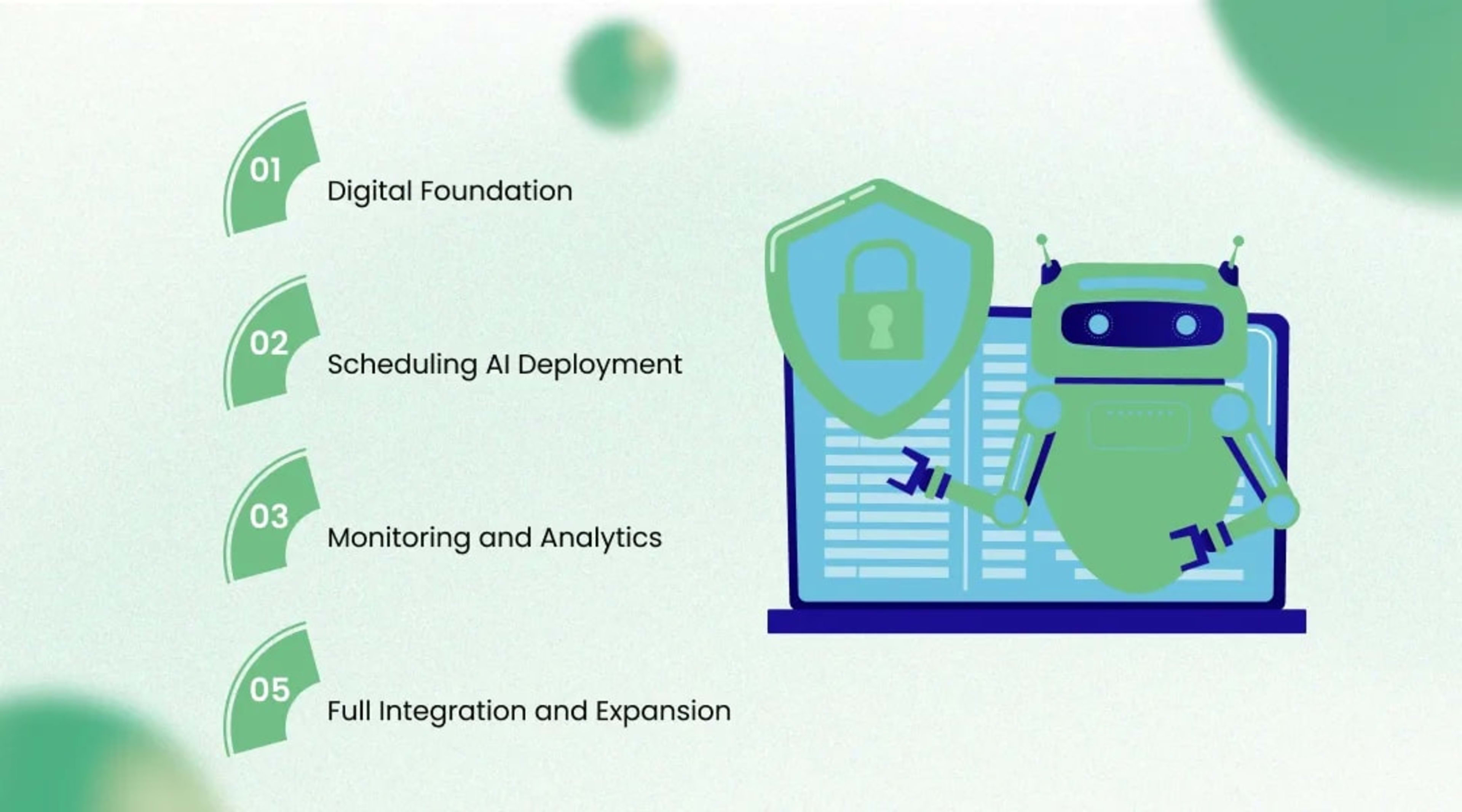
Implementing AI at this scale requires a disciplined, phased approach that respects both the operational constraints and the financial reality of a mid-size security business.
Before any AI deployment, ensure your core operational data is digitized. Migrate scheduling from spreadsheets to a cloud-based workforce management platform, standardize incident report formats, and centralize client contract details. This phase does not require AI. It requires discipline, ensuring that when AI tools are layered on top, they have structured data to work with.
Deploy AI-powered scheduling as the first AI application, starting with a pilot on your five highest-volume client sites. Configure the system with guard certifications, overtime rules, and site-specific requirements. Run it in parallel with manual scheduling for two weeks to validate accuracy, then transition fully.
Add AI video analytics to three to five client sites where you currently provide manned guarding during low-activity periods. Start with sites that have existing camera infrastructure and predictable traffic patterns, such as commercial office buildings or warehouses. Measure the reduction in false alarms and guard dispatches over a 30-day baseline period. Manufacturing facilities with large production areas also benefit from AI solutions for the manufacturing industry, where computer vision and intelligent monitoring improve workplace safety, asset protection, and operational visibility.
Connect your scheduling, reporting, and monitoring systems to a unified operational dashboard. Add AI-powered client portals for your top ten accounts and begin using AI-generated analytics to support contract renewal conversations with data-driven proof of service quality.
The first mistake is deploying too many tools at once. Mid-size companies with limited management bandwidth cannot absorb three or four new platforms simultaneously. Each deployment should stabilize before the next one begins. Sequential adoption with 30-day stabilization periods between each phase prevents the operational chaos that leads to abandonment.
The second mistake is choosing enterprise-grade solutions that require dedicated IT support. If a platform needs a full-time administrator or a systems integrator to maintain it, it is not designed for your company size. Prioritize cloud-based, self-service platforms with mobile-first interfaces that your operations team can manage without external help.
The third mistake is failing to involve field supervisors in the selection process. AI tools that operations managers love but field supervisors ignore will fail. Guard adoption is the single biggest determinant of success. Include at least two field supervisors in the evaluation and pilot process for every AI tool you consider.
Mid-size security companies face a specific set of AI adoption challenges that neither larger nor smaller companies experience. The most persistent challenge is the integration gap. At this scale, you likely run four to six disconnected systems: scheduling in one platform, payroll in another, incident reporting in a third, client invoicing in a fourth, and guard communication through text messages. Most AI tools solve one problem well but do not integrate with the others, creating data silos that reduce the overall effectiveness of each tool.
Workforce resistance is another significant friction point. Guards are overwhelmingly hourly workers who view new technology with skepticism, particularly GPS tracking and AI-monitored patrol routes. Deploying AI without transparent communication about its purpose and impact on daily work breeds resentment. The most successful mid-size implementations invest as much time in change management communication as they do in technical configuration.
Cash flow timing creates a practical barrier that vendors rarely acknowledge. Most AI platforms charge monthly per-user fees, but the ROI takes 60 to 90 days to materialize in the financial statements. For a company operating on 3 to 8 percent net margins, funding a 3,000 to 6,000 dollar monthly technology expense before the savings arrive requires careful cash flow planning and sometimes a phased site rollout.
The physical security industry is undergoing a structural transformation driven by AI-enabled service models. The security guard management software market alone is projected to reach 4.33 billion dollars by 2030, growing at a 14.4 percent CAGR. Companies that adopt AI now are not just saving money today. They are building a fundamentally different competitive position for 2028 and beyond.
Within three to five years, the mid-size security companies that will win contracts will be the ones offering clients real-time dashboards showing guard patrol verification, incident response times, and site-specific analytics. Companies that can demonstrate AI-verified service delivery will command higher billing rates because they can prove what they provide. The ones still relying on paper reports and manual scheduling will find themselves competing exclusively on price, which in a thin-margin industry is a path to insolvency.
The compounding advantage is significant. Companies that deploy AI scheduling in 2026 will have two full years of optimized operational data by 2028, enabling predictive staffing models and automated bid pricing based on actual cost data. Competitors starting their AI journey in 2028 will need those same two years to build that data foundation, during which time early movers will have already locked in the key client relationships.
According to Genetec's 2026 physical security trend research, 45 percent of end users are now prioritizing AI adoption, up from 21 percent in 2025. For the first time, AI ranked alongside access control and video surveillance as a core priority. Mid-size security companies that treat AI as a future consideration are already falling behind an industry moving faster than any previous technology cycle.
Three points stand above everything else for mid-size security companies considering AI adoption in 2026. First, AI scheduling automation is the single fastest path to measurable ROI, recovering 15 to 20 hours of management time per week and generating 27,000 to 36,000 dollars in annual savings for a company with 100 guards. Second, AI video analytics is not a replacement for guards but a service enhancement that allows you to offer clients better coverage at lower cost, strengthening both margins and contract retention. Third, phased implementation over 16 to 24 weeks is the only sustainable path for companies at this scale, because deploying too fast overwhelms limited management bandwidth and leads to abandonment.
KriraAI works specifically with mid-size security companies to design and implement AI solutions that match the real constraints of the 50- to 500-employee segment. Rather than offering enterprise platforms scaled down to fit a smaller budget or startup tools stretched beyond their capabilities, KriraAI builds practical AI implementations around the actual workflows, systems, and growth goals of companies at this scale. From AI-powered scheduling and workforce management to intelligent video analytics integration and automated client reporting, every solution is designed to deliver measurable results within 90 days, because that is the timeline a mid-size company operates on.
If your security company has between 50 and 500 employees and you want a concrete assessment of where AI can deliver the fastest return, reach out to KriraAI for a consultation built around your actual numbers.
Total AI technology costs for a mid-size security company typically range between 25,000 and 60,000 dollars annually, covering cloud-based scheduling platforms at 3 to 8 dollars per user per month, AI video analytics at 10 to 50 dollars per camera per month, and automated reporting tools. The exact cost depends on guard count, number of client sites, and which specific capabilities you deploy, but most companies in this segment achieve full ROI within 3 to 6 months through reduced management hours, fewer false alarm dispatches, and improved client retention.
AI does not replace security guards at mid-size companies. Instead, it augments their capabilities and reduces the number of hours required for low-activity coverage periods. A site that currently needs a guard present around the clock might shift to 16 hours of manned coverage supplemented by 8 hours of AI-monitored remote surveillance, reducing guard labor costs by 20 to 35 percent while maintaining or improving incident detection rates. The guard's role evolves from passive monitoring to responding to AI-verified, high-priority events.
A mid-size security company with approximately 100 guards and 30 client sites can realistically expect annual savings of 80,000 to 200,000 dollars from AI adoption across scheduling automation, false alarm reduction, and operational efficiency gains. These savings come from recovering 15 to 20 hours per week of management scheduling time, eliminating 80 to 90 percent of false alarm dispatches, and reducing incident report completion time by approximately 60 percent. The investment typically pays for itself within the first two billing quarters.
A phased AI implementation for a mid-size security company typically takes 16 to 24 weeks from initial digital foundation work through full integration. The first phase, digitizing core operational data, takes about 4 weeks. AI-powered scheduling can be deployed and validated in 4 additional weeks. Video analytics and monitoring capabilities require another 8 weeks for pilot testing and baseline measurement. Full integration with client-facing dashboards completes the process at the 16-to 24-week mark.
The first AI tool a mid-size security company should adopt is an AI-powered scheduling and workforce management platform because scheduling is the highest-pain, highest-frequency operational process that consumes the most management time. Platforms like TrackTik, Deputy, or Celayix are designed for this exact use case and can demonstrate measurable time savings within the first two weeks of deployment. After scheduling stabilizes, AI video analytics for client site monitoring should follow as the second priority because it directly supports the business case for reduced guard hours and enhanced service offerings.
Ridham Chovatiya is the COO at KriraAI, driving operational excellence and scalable AI solutions. He specialises in building high-performance teams and delivering impactful, customer-centric technology strategies.