LLMs
- OpenAI GPT models
- Claude
- Gemini
- Mistral and open-source models
Your company already has the answers. They sit in PDFs, wikis, tickets and databases that nobody has time to search. KriraAI offers RAG development services that connect a large language model to your own business data, so every answer comes from your documents and shows its source. We build enterprise RAG solutions that stay secure, scale with your team and keep working after launch.
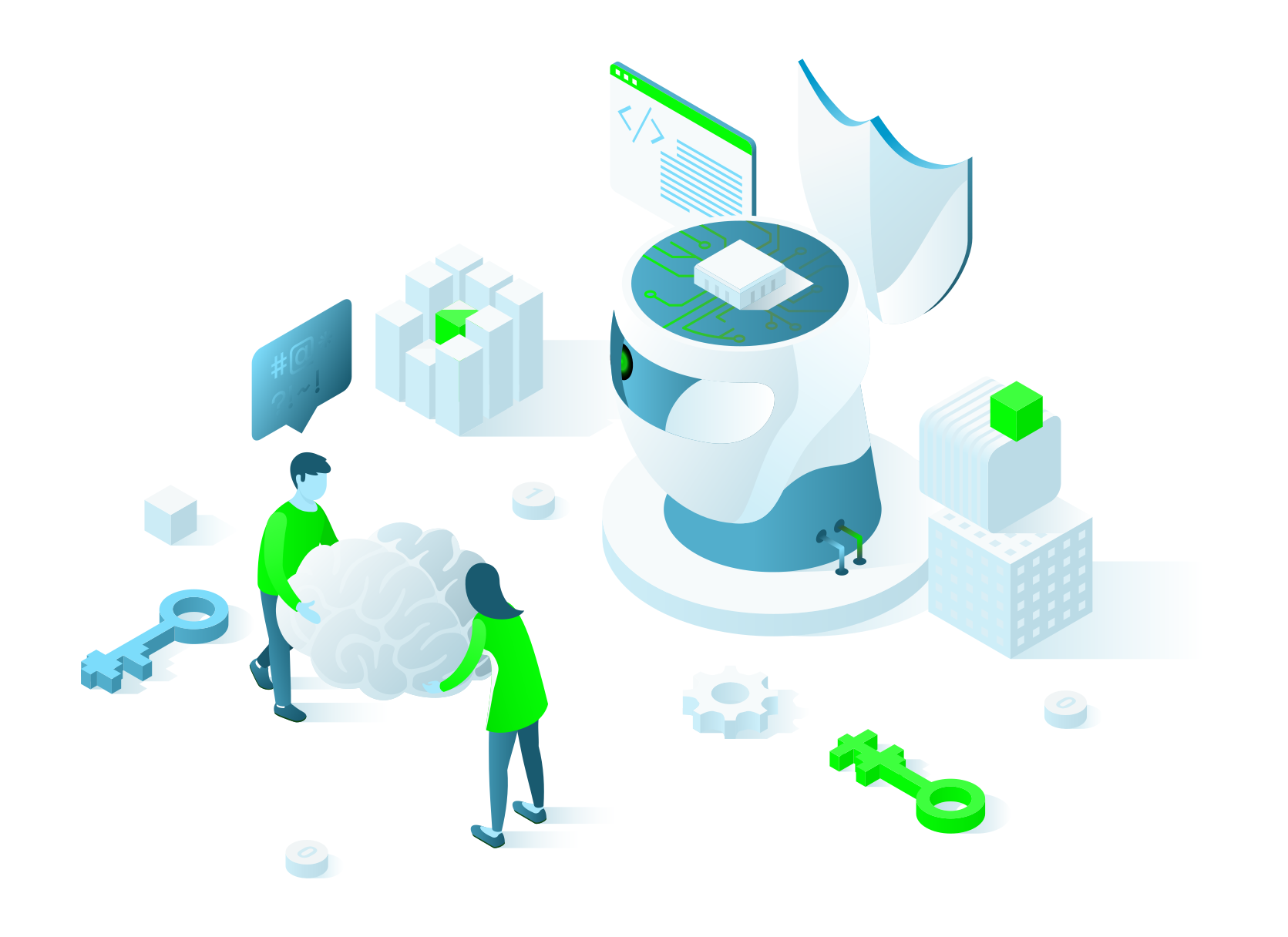
RAG development services cover everything needed to build AI that reads your data before it answers. That means data setup, search design, model integration, testing and support. The goal is correct answers from your own knowledge, not guesses.
Retrieval-augmented generation (RAG) gives an LLM the right facts at the moment a question is asked. The system finds the most relevant passages in your data and passes them to the model. The model then writes its answer from those passages, not from memory.
A normal LLM does not know your pricing, policies or last week's update. RAG works with private knowledge that changes often, and answers can cite their sources. You get more control over what the AI sees, with no costly retraining every time your data changes.
Search by meaning across drives and wikis, with existing access rights respected.
Pull facts from large report sets in minutes, with every point traced back to its source.
Quick, current answers on specs, pricing rules and competitor questions for sales teams.
One chat window for policies, processes and past decisions, with links to every source.
Ask plain questions across contracts, reports and manuals and get the exact clause or table.
Instant answers from help articles and past tickets, with hard cases handed to a human.
Search by meaning across drives and wikis, with existing access rights respected.
Pull facts from large report sets in minutes, with every point traced back to its source.
Quick, current answers on specs, pricing rules and competitor questions for sales teams.
One chat window for policies, processes and past decisions, with links to every source.
Ask plain questions across contracts, reports and manuals and get the exact clause or table.
Instant answers from help articles and past tickets, with hard cases handed to a human.
Our RAG Architecture
Data Sources → Data Ingestion → Parsing, Chunking and Metadata → Embeddings and Indexing → Vector or Hybrid Search → Reranking → LLM and Context Generation → Citations and Grounded Response → Evaluation and Monitoring
In our projects, most weak RAG systems fail at the early steps, not at the model. Poor parsing and bad chunk sizes cause more wrong answers than the choice of LLM. So we fix the data before we write a single prompt.
We pick tools based on your data, budget and security needs:
Security is built into the retrieval layer, not added at the end.
results filtered by document-level access
different roles see different knowledge
sensitive fields masked or removed
every query and source recorded for review
run inside your own cloud or servers
policies and controls mapped to your industry rules
Requirement
RAG
Fine-Tuning
Changing or private knowledge
Strong fit
Less direct
Source citations
Yes, when built in
Not built in
Updating knowledge
Update or re-index data
New training cycle
Style and behavior
Limited
Stronger fit
Retrieval permissions
Supported
Not built in
RAG, fine-tuning or a mix of both should be chosen based on data freshness, behavior needs, security and business goals.
What Affects RAG Development Cost? Cost depends on your data sources, document complexity, retrieval design, integrations, security, deployment model, scale and evaluation needs. Engagement Models
Most clients start with a small proof of concept on one use case, then scale once it proves its value.
One team owns data, retrieval, models, testing and support, so nothing gets lost in handovers.
Built for real traffic and real users from day one, with monitoring planned in.
Every change is measured against test scores, so you always know how accurate the system is.
Private cloud or on-premise, with access rules that follow your existing permissions.
One team owns data, retrieval, models, testing and support, so nothing gets lost in handovers.
Connect your business data with reliable, context-aware AI. Talk to our RAG development experts about your use case, data sources and deployment needs.
They help you build AI that answers questions from your own business data, with sources.
A partner builds, hosts and runs your RAG system, including re-indexing, monitoring and updates.
The model answers from retrieved documents, not memory, and can refuse when nothing relevant is found.
Yes. It can run in your own cloud or on-premise, with access controls on every document.
RAG adds fresh facts at query time, while fine-tuning changes the model's style and behavior.
It depends on data sources, document complexity, integrations, security and scale. We share a clear estimate after a short discovery call.