AI Model Monitoring and Drift Detection Services
A model that scored well in testing can lose accuracy within weeks of going live, and most teams only find out when a customer, an auditor, or a revenue report tells them. KriraAI provides AI model monitoring and drift detection services that watch your production models continuously, flag data drift and concept drift as they begin, and trigger retraining before performance slips. We build monitoring for classical machine learning models, deep learning systems, and LLM applications, and we fit it into the MLOps stack you already run.
Why AI Models Degrade in Production
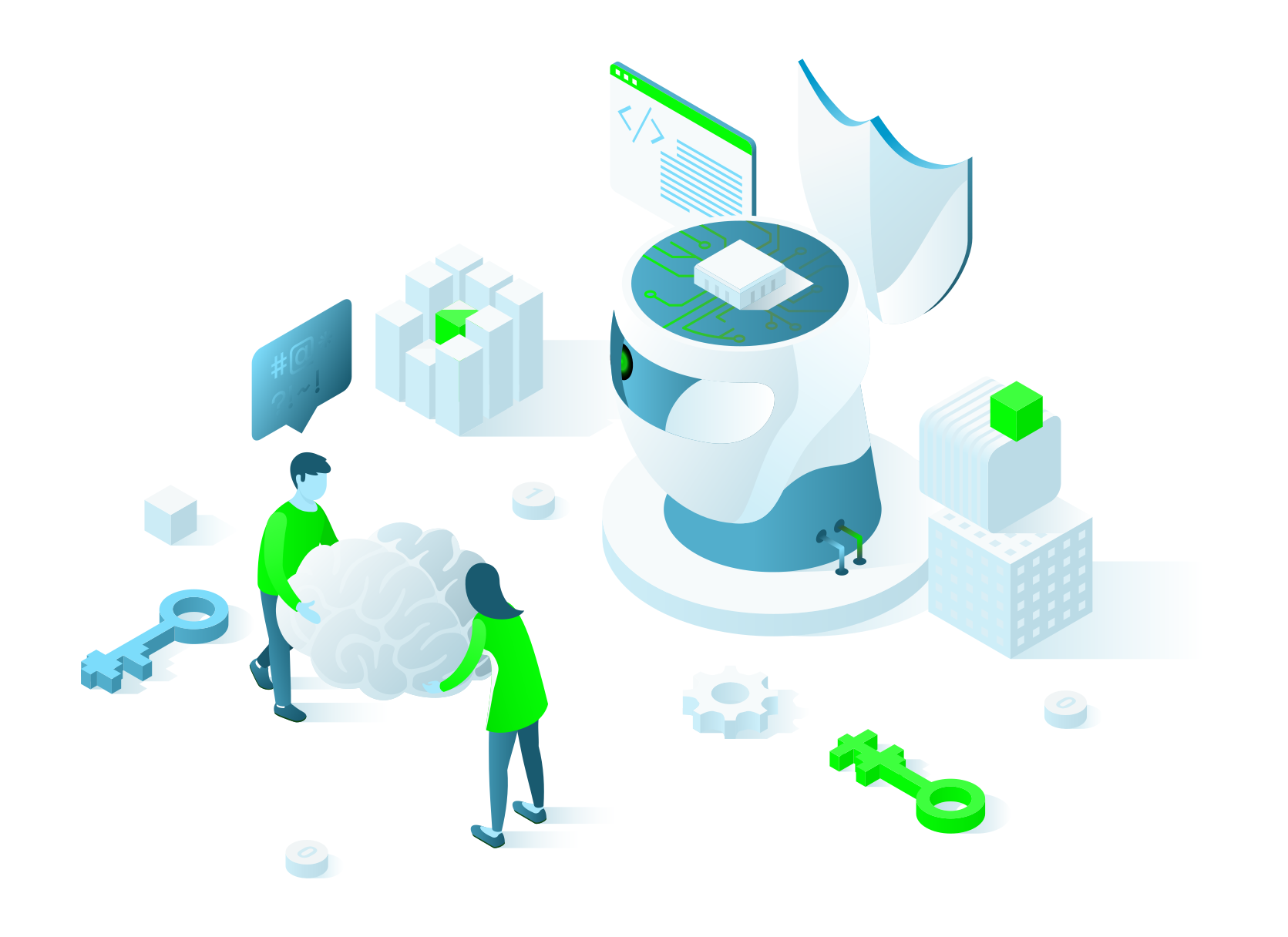
Every machine learning model is trained on a snapshot of the past, but it makes decisions about a present that keeps changing. Customer behavior shifts, data formats change, and sensors age, so live data slowly stops resembling the training data. Without ML model monitoring in place, this decay is silent because the model keeps returning confident predictions long after those predictions stop being right.
What Is Data Drift?
Data drift is a change in the statistical distribution of a model's input features compared with its training data. A fraud model trained mostly on desktop transactions that suddenly receives mostly mobile traffic is a typical example. The model is now operating in regions of the feature space it rarely saw during training, and its predictions become less reliable.
What Is Concept Drift?
Concept drift happens when the relationship between inputs and the target changes, so the same input should now produce a different prediction. Demand forecasting models experienced this at scale when buying patterns changed abruptly during global supply disruptions. Concept drift is harder to catch than data drift because the input distribution can look normal while accuracy collapses underneath it.
What Is Model Drift?
Model drift is the umbrella term for the measurable decline in a model's predictive performance over time, caused by data drift, concept drift, or upstream data quality failures. It usually appears first as a shift in the distribution of predictions, well before ground truth labels arrive to confirm the drop. Model drift detection therefore depends on tracking early signals such as prediction drift and confidence, not accuracy alone.
Our AI Model Monitoring Services
Our model monitoring services cover a production model from first deployment to retirement. Each engagement starts with the models that carry the most business risk. You can take the complete service or only the components your team is missing.
How Our Drift Detection Works
Drift detection is only useful when the method fits the data, so we select tests per feature instead of applying one metric everywhere. Numerical features are commonly evaluated with the Kolmogorov Smirnov test, Wasserstein distance, and Population Stability Index, while categorical features use chi square tests and Jensen Shannon divergence. Streaming concept drift is tracked with detectors such as ADWIN, Page Hinkley, and DDM, and LLM systems are monitored through distances between embedding distributions.
Thresholds are calibrated on historical data so seasonal variation does not trigger false alarms. Every alert shows which features drifted, by how much, and which segments are affected. That turns a vague warning into a clear next step.
Technology Stack for Model Monitoring
We are tool agnostic and build on what fits your environment. For drift detection and AI observability we use Evidently AI, Arize, WhyLabs, Fiddler, and NannyML. For MLOps monitoring we integrate with MLflow, Kubeflow, SageMaker Model Monitor, Azure Machine Learning, and Vertex AI, using Prometheus and Grafana for metrics and Langfuse or LangSmith for LLM tracing.
Who Needs AI Model Monitoring
Any organization running models that influence money, safety, or customer experience needs AI model monitoring. Finance teams rely on it for credit scoring and fraud detection, while healthcare, retail, manufacturing, and SaaS companies use it for forecasting, predictive maintenance, and recommendations. Teams running chatbots or RAG systems need it too, because without LLM observability quality issues surface through customer complaints first.
Why Choose KriraAI
KriraAI builds production AI systems for enterprise clients across more than 22 industries, so we design monitoring as teams that keep models running. Our engineers work across classical ML, deep learning, and LLM systems, which means one team can cover your entire model portfolio. We focus on actionable alerts, clear ownership, and integration with your current stack instead of adding another tool to maintain.
Start Monitoring Your Production Models
If your models have been live for several months without drift detection, there is a good chance their performance has already shifted. Book a model monitoring assessment and we will review your highest risk models, find drift and data quality gaps, and outline a plan for your stack. You will leave with a clear view of where your models stand and what to fix first.