
Manufacturing
Predictive maintenance, quality inspection and demand forecasting.
AI is now a board-level priority, yet many organizations struggle to prove its value. Projects are launched with excitement but without a clear financial model, and months later leadership asks a simple question: "What did we actually get from this investment?"
The most common reasons AI initiatives fail to show ROI are:
Unclear business value
AI is adopted because competitors are doing it, not because a specific problem was quantified.
Hidden AI implementation costs
Data preparation, integration, cloud usage, model monitoring and change management are often underestimated.
No measurement framework
Without baseline metrics, measuring the ROI of AI projects becomes guesswork.
Weak leadership buy-in
Decision-makers need numbers, risks and timelines, not just technical demos.
A structured AI business case solves all four problems before a single rupee is spent.
AI business case and ROI modelling is the process of estimating the costs, benefits, risks and payback period of an AI initiative before investing in it. It turns an idea such as "let's automate customer support with generative AI" into a clear financial model that shows expected savings, revenue impact, total cost of ownership and return on investment over time.
Our AI value assessment combines business analysis, financial modelling and AI technical expertise. The result is an executive-ready business case that helps you decide which AI projects to fund, how much to invest, and when to expect returns.
Every engagement includes practical, ready-to-use deliverables:
Detailed ROI model (Excel) with editable assumptions and scenarios
AI business case document built on a proven AI business case template
Executive presentation for leadership and board meetings
Use case priority matrix ranking opportunities by value and effort
Implementation roadmap with timelines, milestones and KPIs to track AI investment ROI
Whether you are a large enterprise planning AI adoption at scale or a growing business testing your first AI tool, a clear business case for AI adoption reduces risk and speeds up decisions.
Predictive maintenance, quality inspection and demand forecasting.
Fraud detection, document processing and customer service automation.
Clinical documentation, patient engagement and operational efficiency.
Personalization, inventory optimization and AI-powered support.
Code assistance, knowledge management and process automation.
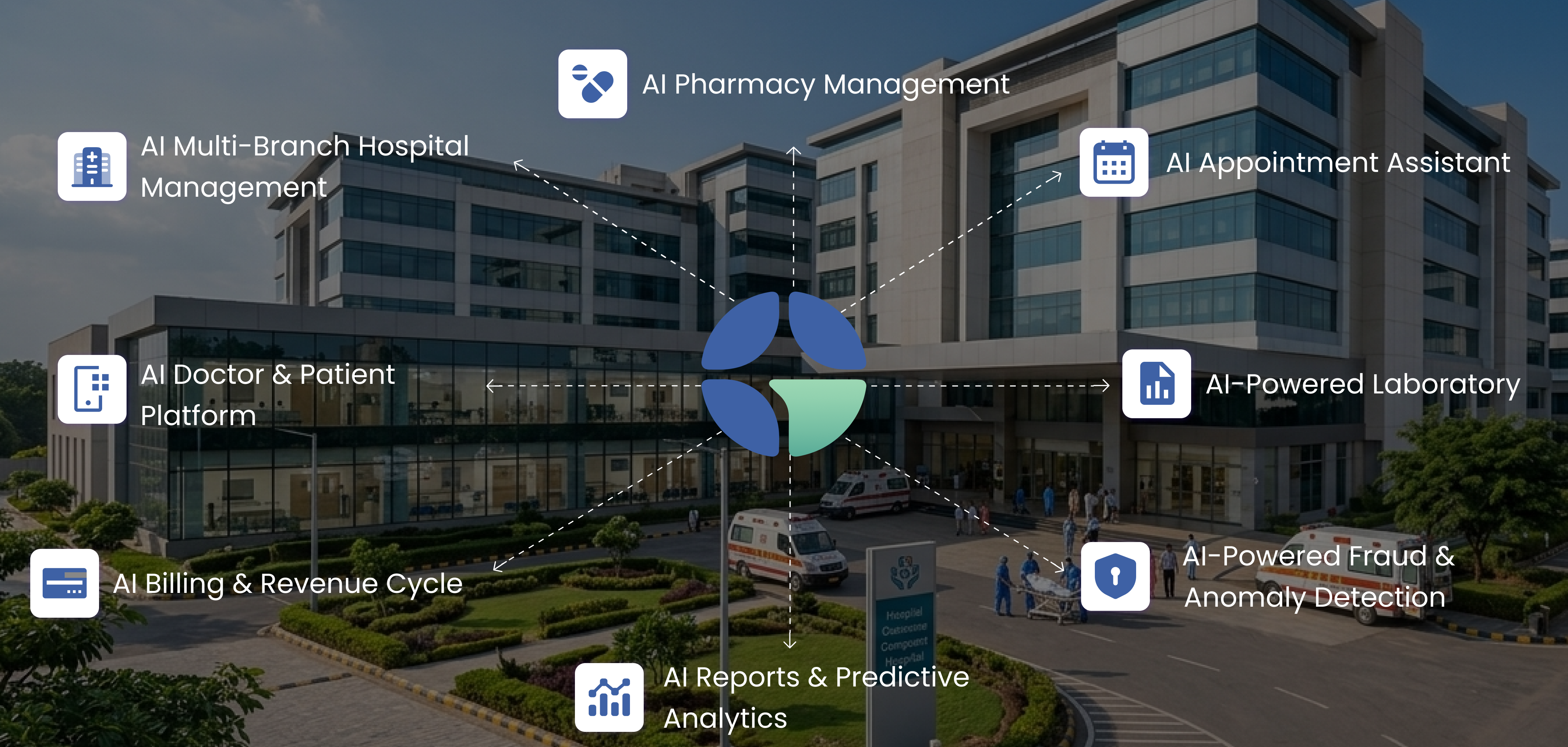
One system for multi-branch hospitals, from AI-assisted front desk and consultation to pharmacy, lab and final bill.
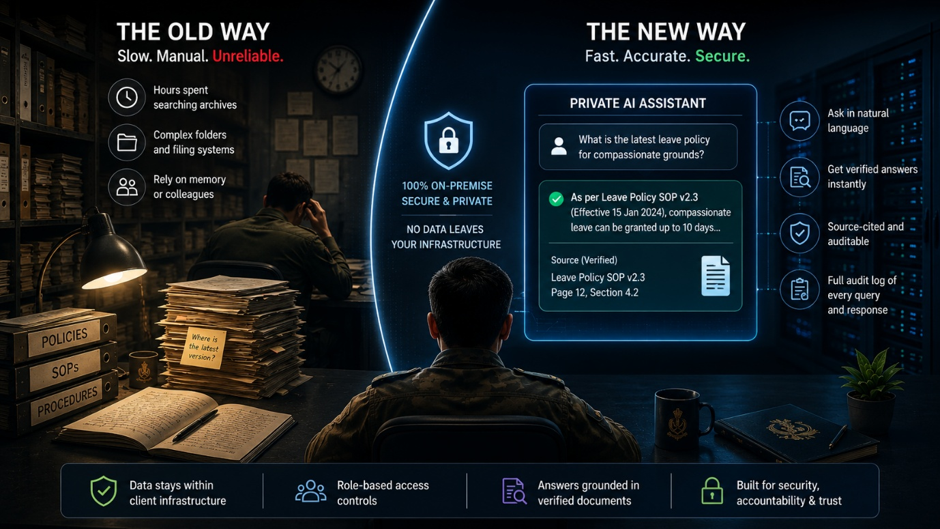
Built entirely inside the client's own infrastructure, the system grounds every answer in verified internal documents instead of open internet knowledge.
As one of the trusted providers of AI consulting services in India, we help organizations move from AI experimentation to measurable business impact.
We start with your goals and numbers, not with technology.
We recommend what is right for you, not what a vendor wants to sell.
Every assumption is visible and editable, so your finance team can trust the results.
Our team brings together AI specialists, business analysts and financial modellers.
Get a complete AI business case in weeks, not months.
We start with your goals and numbers, not with technology.
Our proven five-step AI ROI framework brings structure to every engagement. The core formula is simple: AI ROI = (Total Benefits − Total Costs) ÷ Total Costs × 100. The real value lies in measuring each input accurately, and that is where our expertise makes the difference.





An AI business case is a document that justifies an AI investment by outlining the problem, proposed solution, expected costs, projected benefits, risks and ROI. It helps leadership decide whether to fund an AI project and sets measurable goals for tracking success.
AI ROI is calculated as (Total Benefits − Total Costs) ÷ Total Costs × 100. Benefits include cost savings, productivity gains and revenue growth. Costs include licences, infrastructure, data preparation, integration, training and ongoing maintenance, measured over a defined period of usually 1 to 3 years.
Measure ROI by comparing post-implementation KPIs against baseline metrics recorded before the AI rollout. Common KPIs include time saved per task, cost per transaction, error rates, customer satisfaction and revenue per employee. Track them monthly to confirm actual returns match forecasts.
An AI cost-benefit analysis includes all direct costs (software, infrastructure, talent), indirect costs (training, change management, governance) and benefits (efficiency, revenue uplift, risk reduction, better customer experience). It compares them over time to determine whether the AI investment is financially worthwhile.
AI TCO is the full lifetime cost of an AI solution. It covers initial setup, data preparation, integration, cloud or API usage, model monitoring, retraining, security, compliance and staff training. TCO is often much higher than the tool's licence price, so it is essential for accurate ROI.
Many organizations see early generative AI ROI within 3 to 6 months for focused use cases like content creation, customer support or internal knowledge search. Larger, enterprise-wide initiatives typically take 12 to 24 months to deliver full returns, depending on adoption and integration.
AI use cases are prioritized by scoring each one on business value, technical feasibility, data readiness, implementation cost and risk. High-value, high-feasibility use cases are selected first because they deliver quick wins and build momentum for broader AI adoption.
Yes. A standard AI business case template includes an executive summary, problem statement, proposed AI solution, cost breakdown, benefit analysis, ROI forecast, risks and mitigation, and an implementation roadmap. We provide a customized template as part of every engagement.
AI projects usually fail to deliver ROI because of unclear business goals, underestimated costs, poor data quality, low user adoption and no measurement framework. Building a business case before investing addresses these risks early and keeps projects tied to measurable outcomes.
A focused AI business case for one or two use cases typically takes 2 to 4 weeks. A broader AI strategy covering multiple departments and use cases may take 4 to 8 weeks, depending on data availability and the number of stakeholders involved.