Forty-three percent of customers hang up on an IVR before completing a task. The technology businesses have relied on for three decades to handle inbound calls was never designed to actually understand people. It was designed to route them. The AI voice agent changes that at a fundamental level, not by adding better menus, but by replacing the entire interaction model with one that listens, understands, reasons, and responds in natural conversation.
An AI voice agent is a software system capable of conducting spoken dialogue with a human caller autonomously, handling the full arc of a conversation, including understanding the caller's intent, asking clarifying questions, retrieving relevant data from backend systems, making decisions, and completing tasks or escalating to a human when needed. It does this in real time, over a phone line or voice interface, with response latency typically under 800 milliseconds in a well-engineered production system.
This blog covers the complete picture of what an AI voice agent is, how every technical layer works, what the architecture of a production system looks like, what the business case is for deploying one, and what it actually takes to go from concept to a reliable voice agent running at scale. Whether you are evaluating your first deployment, exploring custom AI development services, or looking to go deeper on the engineering, this guide is written for the level of detail your decision requires.
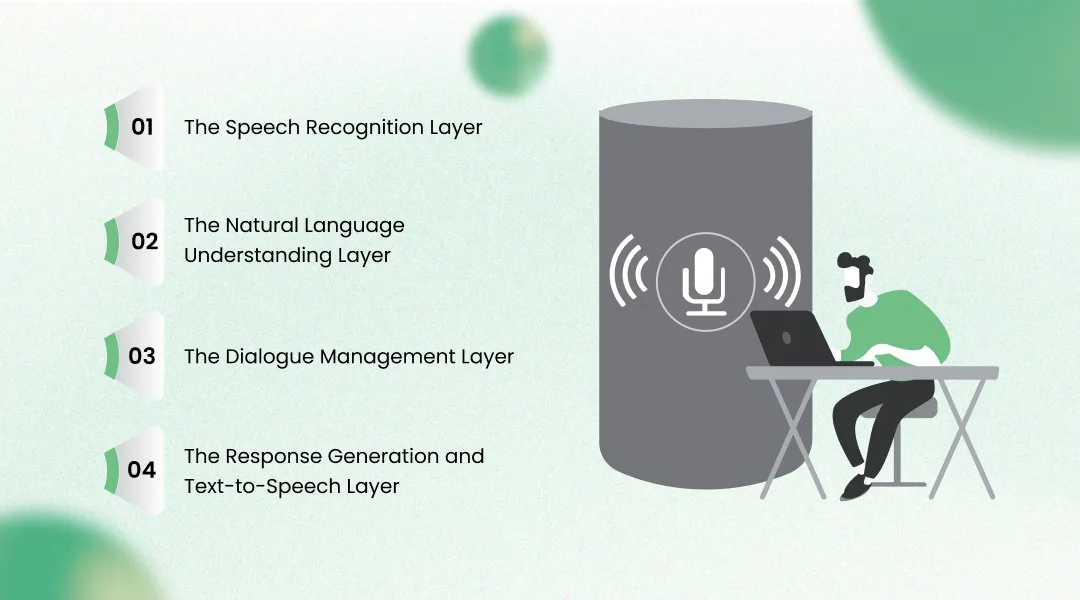
Understanding an AI voice agent requires understanding it as a stack of distinct, interdependent layers, each with its own engineering trade-offs. A failure or bottleneck at any single layer degrades the entire conversation. Most deployments that underperform in production fail at the integration between layers, not within a single layer in isolation.
The first layer is automatic speech recognition, commonly called ASR. This is the component that converts the caller's spoken audio into text that the rest of the system can process. In 2024, the dominant ASR architectures in production voice AI systems are Conformer-based encoder models with streaming capability and RNN-T (Recurrent Neural Network Transducer) architectures, both of which support token-by-token transcription as audio arrives rather than waiting for a complete utterance.
OpenAI Whisper large-v3 has become a common reference model for offline transcription quality, achieving word error rates below 3 percent on clean English audio. However, Whisper in its standard form is not streaming-capable, making it unsuitable for real-time voice agent applications where end-of-utterance detection and rapid response are critical. Production systems instead use streaming-capable models such as NVIDIA NeMo's Conformer-CTC, AssemblyAI's Universal-2, or Deepgram's Nova-2, which deliver word error rates between 4 and 8 percent on telephony-grade audio while maintaining per-token latency under 200 milliseconds.
Domain adaptation is a non-negotiable requirement for any enterprise deployment. A general-purpose ASR model trained on broadcast audio will misrecognise industry-specific terminology at rates that make NLU downstream unreliable. Adapting an ASR model to a domain, whether that is medical terminology, financial product names, or logistics jargon, reduces domain-specific word error rates by 30 to 60 percent and is typically achieved through n-gram language model interpolation, custom vocabulary injection, or fine-tuning on domain audio.
Once transcription arrives, the NLU layer must determine what the caller actually means. This involves intent classification, entity extraction, and slot filling, and the architectural choice here has major downstream consequences.
Fine-tuned BERT or RoBERTa classifiers remain the most reliable approach for closed-domain intent classification where the intent set is well-defined and training data is available. These models achieve classification accuracy above 95 percent for in-domain intents with as few as 200 training examples per class. Their latency footprint is low, typically under 50 milliseconds for inference, and they are deterministic and auditable.
LLM-based zero-shot intent understanding using models such as GPT-4o or Claude Sonnet is increasingly viable for open-domain or highly variable conversations where the intent space cannot be fully enumerated in advance. The tradeoff is higher latency, typically 300 to 800 milliseconds for a single classification call, and higher cost per conversation. A hybrid architecture, where a fine-tuned classifier handles the high-frequency predictable intents and an LLM handles the long tail and ambiguous cases, is what teams building serious production AI voice agent systems choose when they need both reliability and flexibility.
Entity extraction in voice contexts introduces challenges that text-based NLU does not face. Dates, account numbers, and names are frequently misrecognised by ASR, which means the NLU layer must apply spoken-form normalisation, homophone disambiguation, and confidence-threshold logic before treating an extracted entity as reliable. Production systems typically maintain a confirmation dialogue strategy for entities above a certain value threshold, which keeps error rates at acceptable levels without over-confirming routine information.
Dialogue management is where the conversation logic lives, and it is the layer that separates a voice agent that sounds good in a demo from one that handles the full range of real-world conversation complexity.
Three architectural approaches exist. Finite state machine dialogue managers define all possible conversation paths explicitly and execute transitions based on intent and entity values. They are completely predictable, easy to debug, and appropriate for strictly bounded use cases such as appointment booking or payment collection. Their failure mode is brittleness: a caller who deviates from the expected path triggers undefined behaviour unless fallback states are engineered exhaustively.
Frame-based dialogue managers represent the conversation as a set of slots to fill across one or more frames and allow the caller to provide information in any order. They handle mixed-initiative conversation more gracefully than FSMs and are appropriate for multi-intent dialogues. The complexity of maintaining and debugging frame state across long conversations grows quickly.
Retrieval-augmented LLM dialogue management, where a large language model manages conversation state, generates responses, and calls tools through a structured function-calling interface, is now the architecture of choice for enterprise AI voice agent deployments requiring natural conversation, complex reasoning, and high adaptability. The LLM maintains context across the full conversation history within its context window, calls backend functions to retrieve data or complete transactions, and generates responses grounded in retrieved information. The critical engineering constraint is that context window management must be explicit: conversation histories must be pruned, summarised, or compressed as calls extend in duration to prevent latency degradation and cost escalation.
Response generation in a voice-first system must be constrained in ways that differ from text generation. Responses must be concise because listeners cannot skim. They must avoid visual formatting because lists and headers do not translate to audio. And they must be generated fast enough that the caller does not experience an uncomfortable silence.
For RAG-based dialogue managers, response generation is handled by the LLM with a carefully designed system prompt that enforces spoken language conventions, limits response length, and grounds outputs in retrieved data to prevent hallucination. Generation latency using a fast inference endpoint for a model such as GPT-4o mini or Claude Haiku is typically 200 to 400 milliseconds for a response of appropriate spoken length.
The text-to-speech layer converts generated text into audio. Neural TTS systems have advanced to the point where voice quality is no longer a primary differentiator. VITS-based architectures, such as those underlying ElevenLabs, PlayHT, and Azure Neural TTS, produce speech that is indistinguishable from human recordings for most listeners. YourTTS and Coqui TTS offer open-source alternatives deployable on-premise for organisations with data residency requirements. The critical TTS performance metric in production is not quality but streaming synthesis latency: a well-configured neural TTS endpoint can begin streaming audio back to the caller within 150 to 300 milliseconds of receiving the first sentence, which means the caller begins hearing the response before generation is complete.
An AI voice agent does not exist in isolation. It must integrate with the telephony infrastructure that carries calls, and in most enterprise deployments, it must also connect to the contact centre platform, the CRM, and the backend systems that hold the data the agent needs to be useful.
The two dominant protocols for connecting an AI voice agent to telephony infrastructure are SIP (Session Initiation Protocol) and WebRTC. SIP is the standard for PSTN connectivity through carriers and is the integration path required for phone number-based deployments,s whether using providers such as Twilio, Vonage, Bandwidth, or direct SIP trunking from a telecom. WebRTC enables browser-based and application-based voice interfaces and is appropriate for embedded voice agents within web or mobile products.
Audio handling at the telephony layer introduces the most overlooked source of quality degradation in production deployments. PSTN audio is G.711 encoded at 8 kHz, which is significantly narrower than the 16 kHz or higher sampling rate that modern ASR models perform best on. Upsampling at ingestion, combined with real-time noise suppression, is a required pre-processing step in any production voice pipeline. Failing to address this can increase the ASR word error rate by 4 to 12 percentage points depending on the call environment.
Most enterprise deployments integrate the AI voice agent with an existing contact centre platform rather than replacing it entirely. Integration with Amazon Connect, Genesys Cloud, Avaya, or Cisco Contact Centre is achieved through a combination of REST APIs, Lambda functions (in the case of Connect), and CTI connectors. The AI voice agent typically runs as a bot endpoint registered with the platform, receives audio streams, and returns synthesised audio or DTMF signals.
Human escalation is a mandatory architectural requirement, not an optional feature. When the AI voice agent cannot resolve a caller's issue, a warm handoff to a live agent must pass the full conversation transcript, extracted entities, and any resolved context to the agent's desktop so the caller does not need to repeat themselves. This handoff capability, designed correctly, is what allows organisations to achieve 70 to 80 percent autonomous resolution rates while maintaining the safety valve of human support.
The difference between an AI voice agent that feels intelligent and one that feels generic is almost always data access. An agent that can look up an account, check an order status, confirm an appointment, or process a transaction in real time is genuinely useful. One that can only answer static FAQ questions is not.
Backend integration in a production AI voice agent is implemented through a function-calling or tool-use interface exposed to the dialogue management LLM. The LLM is given a set of callable tools, each with a defined schema, and invokes them during conversation when it determines that data retrieval or an action is needed. Each tool call round-trip adds approximately 200 to 600 milliseconds to response latency, depending on the backend system's response time, which makes backend API performance a first-class concern in voice agent engineering.
Common integrations in enterprise deployments include:
CRM lookup via Salesforce, HubSpot, or Microsoft Dynamics APIs to retrieve customer history and account status during the opening turns of a call.
Scheduling system integration with Google Calendar, Calendly, or proprietary platforms for appointment booking and modification use cases.
Order management system access for fulfilment status checks, modification requests, and returns initiation in e-commerce and logistics deployments.
Knowledge base retrieval using vector search over product documentation, policy documents, or FAQ content to ground responses in accurate company-specific information.
Authentication flows using DTMF-based PIN entry or voice biometric verification to confirm caller identity before allowing access to sensitive account data.
KriraAI, which designs and deploys production-grade AI voice agent systems for enterprise clients, consistently identifies backend integration latency and error handling as the most underestimated engineering challenge in voice agent deployment. A backend API that takes 3 seconds to respond in a web context is tolerable. In a voice conversation, it creates a silence that callers interpret as a system failure.
End-to-end response latency is the single most important technical metric for a production AI voice agent. Human conversation operates on a natural rhythm in which response latency above 1,200 milliseconds registers as an awkward pause, and latency above 2,000 milliseconds causes callers to speak again, triggering barge-in handling and conversation disruption. The target for a well-engineered production system is end-to-end latency under 800 milliseconds from the end of the caller's utterance to the first audible response audio.
Achieving the 800-millisecond target requires disciplined budget allocation across all layers:
ASR end-of-utterance detection and transcription: 150 to 250 milliseconds.
NLU intent classification (fine-tuned model path): 30 to 80 milliseconds.
Dialogue management and LLM inference (first token): 200 to 400 milliseconds.
Tool call round-trip (if required): 200 to 500 milliseconds.
TTS synthesis to first audio chunk: 150 to 250 milliseconds.
When all layers perform at the lower end of these ranges, total latency lands around 730 milliseconds without a tool call. When a tool call is required, the budget is exceeded unless the dialogue manager begins generating and streaming the first sentence of the response while the tool call is in flight, a pattern called speculative response generation that reduces perceived latency by 300 to 400 milliseconds in cases where the response preamble does not depend on the tool result.
Deploying all inference components in the same cloud region as the telephony endpoint is the highest-leverage single infrastructure decision in a voice agent deployment. Cross-region network round-trips add 40 to 120 milliseconds per hop and compound across multiple service calls. Co-location of ASR, NLU, LLM, and TTS services in a single region, with the telephony media server in the same or an adjacent availability zone, is the baseline requirement for hitting sub-800-millisecond targets consistently.
GPU-accelerated inference for both ASR and TTS is standard in any production deployment expecting more than approximately 20 concurrent calls. CPU-based inference at scale produces latency spikes under load that cannot be addressed through code optimisation alone.
The business case for an AI voice agent is built on three measurable value drivers: cost reduction, availability extension, and conversation quality improvement. Each is real, each has a specific quantification methodology, and each has limitations that an honest evaluation must address.
A fully loaded human call centre agent in North America or Western Europe costs between 28 and 45 USD per hour, including salary, benefits, training, management overhead, and facility costs. The average cost per handled call at a resolution rate of six calls per hour is therefore 5 to 7.50 USD. An AI voice agent handling the same call, including inference costs, telephony, monitoring, and platform amortisation, costs between 0.08 and 0.35 USD per call at current API pricing, depending on call duration and the LLM tier used.
For a contact centre handling 50,000 calls per month with an achievable AI autonomous resolution rate of 65 percent, the AI voice agent handles 32,500 calls at a total cost of approximately 5,000 to 11,375 USD, compared to the equivalent human cost of 162,500 to 243,750 USD. The net monthly saving is in the range of 151,000 to 232,000 USD, which typically produces ROI payback on the implementation investment within three to five months.
These numbers require honest qualification. The 65 percent autonomous resolution rate applies to well-bounded use cases such as account enquiries, appointment scheduling, order status, and standard complaint workflows. Complex, multi-issue calls, emotionally elevated callers, and novel scenarios all require escalation. Building the business case on over-optimistic resolution rate assumptions is the most common reason AI voice agent deployments disappoint on ROI.
An AI voice agent operates twenty-four hours a day, seven days a week, without staffing premiums, sick days, or shift handover quality degradation. For organisations whose customers contact them outside business hours, after-hours call handling alone can justify the deployment. In sectors such as utilities, healthcare, and financial services, the proportion of calls arriving outside staffed hours is typically between 25 and 40 percent. Handling this volume with a voice agent at near-zero marginal cost delivers immediate and measurable ROI independent of in-hours performance.
Scale is the other dimension of the availability argument. A human contact centre takes weeks to scale capacity. An AI voice agent scales to handle 10x normal call volume in minutes by adding compute capacity, with no degradation in response quality and no queuing. For seasonal businesses, event-driven demand spikes, or organisations with unpredictable call patterns, this elasticity has direct operational value.
A voice agent that handles a clean, cooperative, on-script call is not a hard engineering problem. The hard problem is handling the full population of real calls: callers who interrupt mid-sentence, callers who provide information out of order, callers who change their mind halfway through a transaction, callers who speak with heavy accents or in noisy environments, and callers who are angry or distressed.
Barge-in, the ability for a caller to interrupt the agent's response mid-sentence, is a required feature in any production AI voice agent. Implementations that force callers to listen to a complete response before speaking feel robotic and frustrating. Technically, barge-in requires voice activity detection (VAD) running in parallel with TTS playback, capable of detecting speech onset within 100 to 200 milliseconds and triggering response cancellation and new transcription immediately. The engineering complexity is in the state management: the dialogue context must reflect how much of the cancelled response the system considers the caller heard before interrupting, as this affects the continuation logic.
Every production AI voice agent requires a multi-tier fallback architecture. When the agent does not understand an utterance, the first tier is a clarification request using a strategy that does not reveal the specific nature of the failure. When two consecutive turns fail to resolve ambiguity, the second tier is a graceful reformulation that offers the caller explicit options. When the fallback strategy itself fails, or the caller requests a human, the third tier is warm escalation with full context transfer.
Teams designing practical AI voice agent implementations at KriraAI treat the escalation path not as an edge case but as a first-class conversation pathway with its own dialogue design, handoff data schema, and quality monitoring. The escalation rate is a primary KPI for every deployment, and a well-designed system monitors escalation reasons at a granular level to drive continuous dialogue improvement.
Global enterprises deploying a single AI voice agent across multiple geographies face significant ASR performance variation across accents and dialects. Whisper large-v3 handles a wide range of accents reasonably well at 8 to 15 percent word error rate across major English dialects, but PSTN-quality audio combined with regional accents can push word error rates above 20 percent on models not specifically adapted. The solution is either a multi-model routing architecture that selects an ASR model by detected locale, or a single model with broad multilingual training,g such as Whisper or MMS,S that handles accent variation inherently.
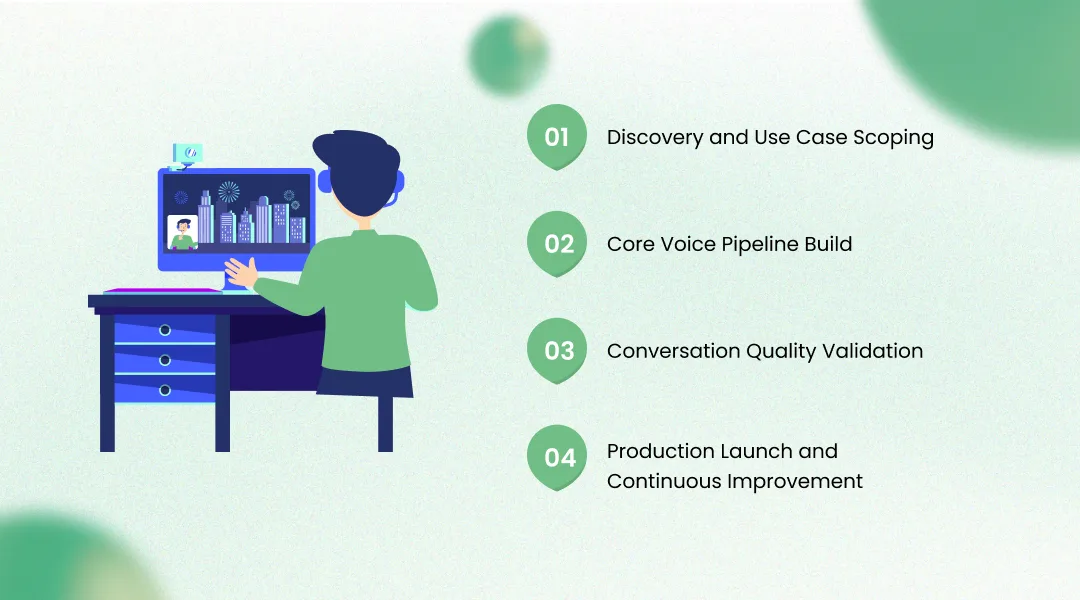
The implementation journey for a production AI voice agent has four distinct phases, each with specific deliverables, decision points, and risk factors.
The first phase defines the specific conversation types the agent will handle, the data systems it must access, the telephony environment it will integrate with, and the acceptance criteria for production readiness. Use case scoping must be ruthlessly specific. "Handle customer service calls" is not a use case. "Handle inbound calls from existing customers requesting account balance information, payment due date, and payment processing, with escalation to a human agent for disputes and complaints" is a use case that can be built, tested, and measured.
This phase typically takes two to four weeks and produces a conversation design document, an integration architecture diagram, an ASR domain adaptation requirements list, and a deployment readiness checklist.
The second phase involves standing up the full technical stack: ASR with domain adaptation, NLU models or LLM configuration, dialogue manager build, TTS voice selection and configuration, and telephony integration. For a greenfield deployment using cloud-based components, this phase takes four to eight weeks,s depending on the number of integrations and the complexity of the dialogue.
End-to-end latency testing must begin in this phase, not after launch. Latency is an emergent property of the full stack under load, and it is far cheaper to address latency issues during build than post-deployment.
The third phase subjects the built agent to a structured test programme covering:
Happy path testing covering all primary use cases against defined accuracy and completion rate targets.
Adversarial testing covering out-of-domain inputs, ambiguous utterances, barge-in sequences, and long pauses.
Accent and noise robustness testing using synthetic audio samples representing the actual caller population.
Load testing to validate latency profiles at 2x, 5x, and 10x expected peak concurrent call volume.
Escalation path testing verifies that handoff data completeness and agent desktop population work correctly in all scenarios.
KriraAI uses a combination of automated test harnesses and human evaluation panels drawn from the target caller demographic to validate conversation quality before any production deployment. Automated test pass rates above 93 percent on the primary use case set, combined with human evaluator satisfaction scores above 4.0 out of 5.0, are the thresholds the team uses before recommending a production launch.
Production launch should begin with a controlled rollout routing a defined percentage of live calls to the AI voice agent while the majority of traffic continues to human agents. This shadow period, typically two to four weeks, surfaces call types and caller behaviours that test cases did not cover and allows dialogue refinement before full deployment.
The continuous improvement infrastructure is as important as the initial build. Every production AI voice agent deployment requires a monitoring pipeline that captures call transcripts, tags intent recognition failures, measures task completion rates by call category, and feeds a weekly improvement cycle. Without this infrastructure, voice agent performance plateaus or degrades as the real-world call distribution shifts from the conditions under which the agent was designed.
A production AI voice agent is not a finished product at launch. It is a system that improves continuously or degrades slowly depending on whether the operator has invested in the monitoring and improvement infrastructure. The monitoring layer is therefore not an optional post-launch addition but a core architectural component.
The key metrics a production monitoring system must track include:
Intent recognition accuracy by intent category is tracked weekly to detect drift.
Task completion rate, defined as the proportion of calls in which the caller's primary goal was achieved without escalation.
Escalation rate by escalation reason, broken down into requested escalation versus agent-initiated escalation versus system-initiated escalation.
End-to-end latency percentiles at P50, P90, and P99, measured per call and per session to detect infrastructure degradation.
ASR confidence distribution, which, when it shifts toward lower confidence, indicates a change in caller population or call environment that may require ASR re-adaptation.
Post-call survey scores or inferred satisfaction from call completion and callback rate signals.
The continuous improvement cycle processes this monitoring data weekly, identifies the highest-impact failure categories, generates additional training data or dialogue revision candidates for those categories, and deploys updates through a staging and shadow testing process before production promotion. This cycle, maintained consistently, typically produces 2 to 5 percentage points of improvement in task completion rate per quarter in the first year of operation.
Three facts from this guide are worth holding onto when evaluating or building an AI voice agent for production. First, the performance of a production AI voice agent is an emergent property of the entire stack, and optimising individual layers in isolation does not produce a system that callers experience as natural and reliable. The speech recognition, NLU, dialogue management, response generation, TTS, and telephony layers must each be engineered to the right standard and integrated with explicit latency budgets and fallback contracts between them. Second, the business case is real and measurable, but it depends on honest resolution rate assumptions tied to well-scoped use cases, not aspirational figures applied to the full call volume. Third, the monitoring and continuous improvement infrastructure is not optional post-launch infrastructure. It is a core system component that determines whether the agent improves over time or gradually loses performance as call patterns evolve.
KriraAI designs and deploys production-grade AI voice agent systems built on this level of engineering rigour. The team brings serious depth across the full technology stack, from ASR domain adaptation and dialogue architecture to telephony integration and the monitoring infrastructure that drives continuous improvement. KriraAI has delivered voice automation systems that perform reliably at enterprise scale across multiple industries and approaches every engagement with the conviction that a voice agent either works well enough for a real caller on a real call or it is not ready for production. If your organisation is evaluating, designing, or scaling an AI voice agent deployment, we invite you to bring your requirements to a conversation with the KriraAI team.
A traditional IVR (Interactive Voice Response) system presents callers with a fixed menu of numbered options and routes them based on DTMF key presses or very limited keyword detection. It does not understand natural speech, cannot handle multi-turn dialogue, and cannot execute complex tasks. An AI voice agent understands spoken natural language, maintains context across a full conversation, retrieves data from backend systems in real time, handles interruptions and topic changes, and can complete transactional tasks without human involvement. The difference is not incremental. An IVR forces the caller to conform to the system's structure. An AI voice agent adapts to the caller's natural way of speaking. This distinction is why organisations replacing IVR with a properly built AI voice agent typically see caller satisfaction scores increase by 20 to 40 percentage points on automated interaction metrics, alongside the cost reduction that drives the business case.
A production-ready AI voice agent for a well-scoped use case, such as appointment scheduling, account inquiry handling, or payment processing, typically requires eight to sixteen weeks from kick-off to production launch when built by an experienced team. This timeline assumes the scope is clearly defined, backend APIs are accessible and documented, and telephony integration requirements are confirmed early. Deployments that extend beyond sixteen weeks are almost always the result of scope creep, undocumented backend systems, or insufficient test infrastructure rather than inherent platform complexity. Organisations that attempt to build comprehensive multi-use-case agents as a single deployment frequently underestimate both timeline and complexity and achieve better outcomes by launching a focused first use case and expanding iteratively.
Intent recognition accuracy for a well-trained AI voice agent operating on its defined use case set typically reaches 92 to 97 percent on in-domain calls. Entity extraction accuracy, which includes dates, account numbers, and names spoken over telephony audio, is lower and typically falls between 85 and 94 percent depending on the entity type and the quality of the spoken audio. Both accuracy figures depend heavily on the quality of the ASR layer, the breadth and quality of the NLU training data, and the degree of domain adaptation applied. Accuracy figures cited by vendors in sandbox or clean-audio conditions often do not reflect real telephony performance, which is why pre-production testing on representative call recordings from the actual deployment environment is an essential validation step that cannot be skipped.
Yes, but multilingual capability requires deliberate architecture decisions rather than assumption. A single ASR model trained primarily on one language will produce significantly degraded transcription on others, with word error rates for a non-primary language often three to five times higher than for the primary language. Production multilingual deployments either use a language-identification layer that routes audio to the appropriate language-specific ASR model, or a single multilingual ASR model such as Whisper large-v3, which supports 99 languages with varying performance levels. NLU and dialogue management must also be multilingual, either through separate language-specific models or through a multilingual LLM. Organisations handling more than 10 percent of their call volume in a second language should treat that language as a first-class citizen in their architecture from the outset rather than attempting to add it as an afterthought post-deployment.
Emotion detection and handling is a design dimension of production AI voice agent systems that is frequently underdeveloped. A well-designed voice agent detects signals of emotional escalation through a combination of acoustic features (pitch variation, speech rate, amplitude) and linguistic content analysis, and adjusts its conversation strategy accordingly. For mildly frustrated callers, the agent modifies its response tone and prioritises rapid resolution over completeness. For callers who are clearly distressed or who express high-frustration signals, the agent should execute a graceful warm transfer to a human agent with full context, rather than continuing to attempt autonomous resolution. The worst outcome is an agent that rigidly continues its task-completion logic while a caller becomes increasingly upset, which happens in systems that lack explicit emotion-aware escalation logic. Properly designed escalation based on detected emotional state typically reduces post-call complaint rates by 30 to 50 percent compared to pure intent-based escalation rules.
Ridham Chovatiya is the COO at KriraAI, driving operational excellence and scalable AI solutions. He specialises in building high-performance teams and delivering impactful, customer-centric technology strategies.