Let me guess.
You’ve read five blogs already. Each one claims to explain AI Agents vs Machine Learning… and somehow you’re more confused than when you started.
Yeah. I’ve seen that happen a lot.
Here’s the problem: most people explaining this don’t actually build these systems. I do. Every week.
And here’s the truth simple, slightly uncomfortable, but necessary:
Machine Learning predicts. AI Agents act.
That’s it. That’s the core difference.
But if you stop there, you’ll make bad decisions. Expensive ones.
So let’s break this down properly.
Machine Learning is a method where systems learn patterns from data to make predictions or decisions.
Not magic. Just math + data.
It’s a pipeline:
Data → Training → Model → Prediction
You feed historical data. The model learns patterns. It predicts outcomes.
That’s the loop.
Supervised Learning – learns from labeled data
Unsupervised Learning – finds hidden patterns
Reinforcement Learning – learns via trial and error
ML doesn’t “think.” It doesn’t “decide.” It doesn’t “act.”
It predicts.
That’s why most Machine Learning Services still require humans or systems to take action after prediction.
Now things get interesting.
AI Agents are autonomous systems that perceive, decide, and act toward a goal.
Not just prediction. Execution.
Think of it as a loop:
Perception → Decision → Action → Learning
They observe. They decide. They act.
Then they repeat.
Reactive agents
Goal-based agents
Learning agents
Autonomous AI agents
What if your system didn’t just tell you what might happen… …but actually did something about it?
That’s the shift.
That’s why AI Agents in Machine Learning ecosystems are becoming dominant.
Let’s cut through the noise.
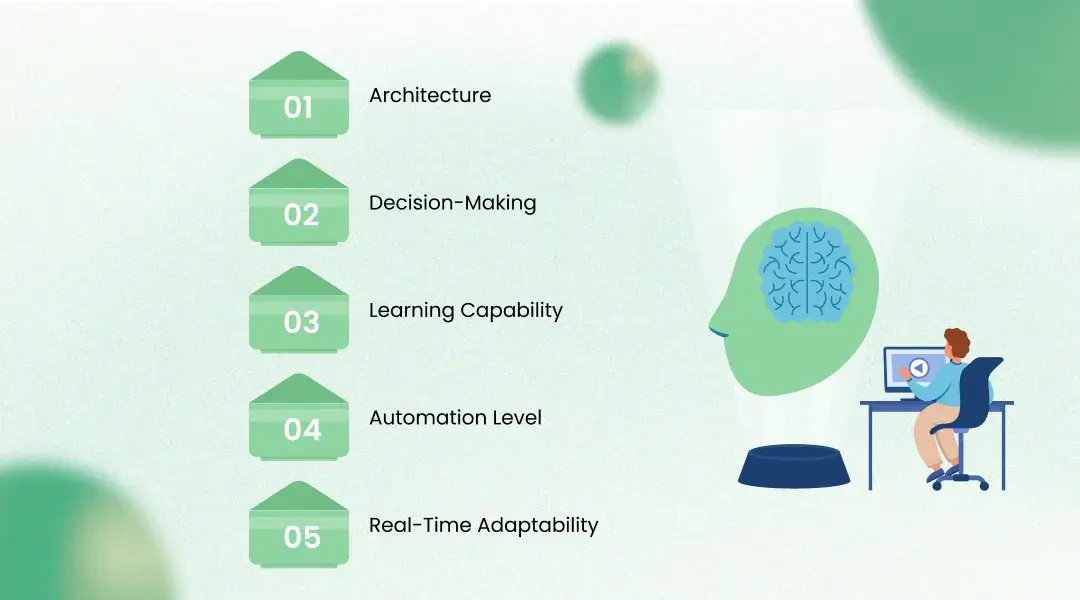
ML = Model AI Agents = System of models + logic + actions
ML → Suggests Agents → Decides
ML → Static after training Agents → Continuous
ML → Partial Agents → End-to-end
ML → Limited Agents → High
Short version?
AI Agents vs Traditional ML is like GPS vs self-driving car.
One guides. The other drives.
Recommendation systems (Netflix, Amazon)
Fraud detection
Predictive analytics
Classic machine learning examples 2026 still dominate data-heavy industries.
AI voice assistants
Autonomous customer support
AI sales agents
I worked on a support automation system last year. Initially ML-based.
It predicted customer intent well. But it couldn’t resolve tickets.
We replaced it with an AI agent system.
Resolution rate jumped 63%.
Same data. Different approach.
Let that sink in.
Feature | Machine Learning | AI Agents |
Learning | Data-based | Continuous + autonomous |
Action | Predictive | Action-oriented |
Adaptability | Limited | High |
Human Intervention | Required | Minimal |
Let’s be honest.
Businesses don’t care about models. They care about outcomes.
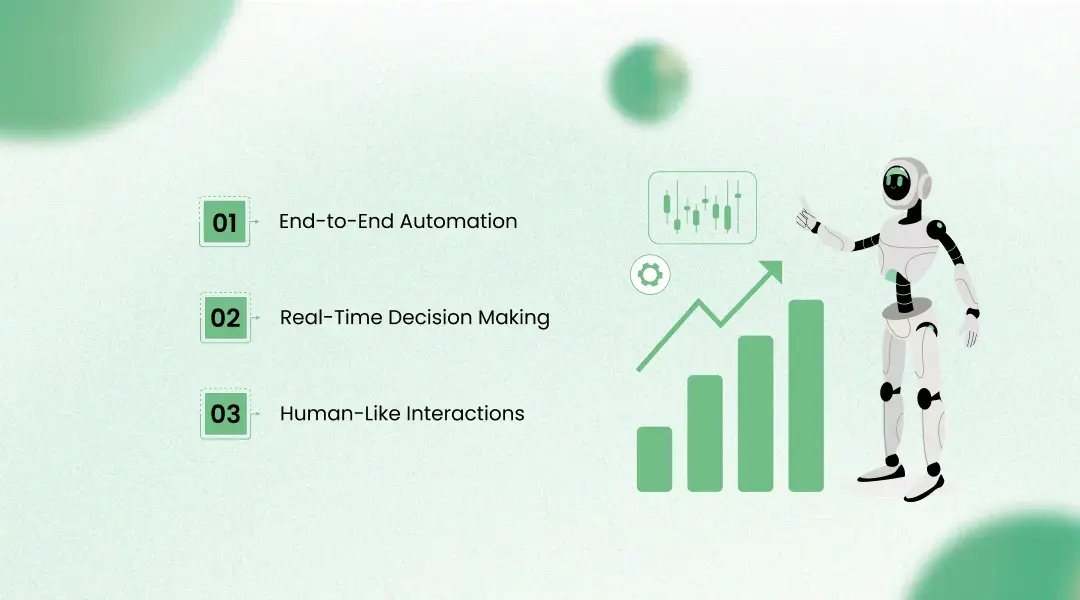
No handoffs. No delays.
Agents don’t wait for dashboards.
Especially in voice and chat systems.
This is why AI agents for business automation are exploding right now.
Now the uncomfortable part.
They age. Fast.
And that costs time and money.
ML doesn’t act. It suggests.
Which is fine…
Unless you need automation.
This is where most people mess up.
You need predictions
Data analysis is the goal
Human decision-makers are involved
You need automation
Decisions must happen instantly
Systems need to act independently
Still unsure?
Ask yourself one question:
Do I need insights… or outcomes?
That answer decides everything.
Quick clarity:
Machine Learning → Broad concept
Deep Learning → Subset using neural networks
AI Agents → Systems that use ML/DL to act
So when people compare ML vs AI vs Deep Learning difference, they’re often mixing layers of the same stack.
It’s not competition.
It’s evolution.
I’ll say this bluntly.
We’re moving toward autonomous businesses.
Not fully. Not yet.
But close.
AI replacing manual workflows
Voice + agent ecosystems
Self-operating customer journeys
The future of AI agents 2026 isn’t theoretical anymore.
I’m already deploying them.
And the gap between companies using agents… and those still stuck with static ML models?
It’s widening. Fast.
Let’s bring this home.
AI Agents vs Machine Learning isn’t a battle. It’s a progression.
Machine Learning gave us intelligence. AI Agents give us action.
And businesses don’t win with insights alone.
They win with execution.
Machine Learning predicts outcomes, while AI Agents take actions based on those predictions.
Not always. It depends on whether you need predictions or automation.
Yes. AI Agents often use ML models as part of their decision-making system.
Voice assistants, AI customer support bots, and autonomous sales systems.
Absolutely. It remains the foundation for many AI systems, including agents.
Founder & CEO
Divyang Mandani is the CEO of KriraAI, driving innovative AI and IT solutions with a focus on transformative technology, ethical AI, and impactful digital strategies for businesses worldwide.