On March 25, 2026, Google Research published a paper that crashed memory chip stocks, sent independent developers racing to ship working implementations overnight, and prompted Cloudflare CEO Matthew Prince to call it Google's DeepSeek moment. The paper unveiled TurboQuant, a training-free, data-oblivious vector quantization algorithm that compresses the KV cache of large language models to 3 bits per value, achieving a 6x reduction in KV cache memory and up to 8x speedup on NVIDIA H100 GPUs for attention computation, all without measurable accuracy degradation. That combination, near-lossless compression at 6x with no retraining, hardware speedup, and mathematically provable bounds, is genuinely rare in applied ML research and genuinely uncommon in the trajectory of inference engineering.
The reason the announcement landed with unusual force is that it strikes directly at the central economic constraint of production LLM deployment in 2026. Training large models is expensive but it happens once. Inference runs on every request, forever. Over 90% of total LLM operational cost is inference, not training, and a 10x improvement in inference efficiency compounds across every API call, every user session, and every agentic loop.TurboQuant does not move that needle by 10x, but it targets the specific component, the KV cache, that has become the dominant VRAM bottleneck as context windows have expanded past 100,000 tokens. For teams running document analysis, multi-turn agentic workflows, or RAG pipelines at scale, this is no longer a research footnote. It is a line item on the infrastructure cost sheet.
Understanding whether TurboQuant belongs in your inference stack requires understanding exactly what it does, what it does not do, how the two-stage algorithm actually works at the level of vector geometry, where existing implementations stand as of April 2026, and what the honest limitations are. This blog covers all of that, including the benchmark claims, the community debate around the QJL residual stage, the practical deployment picture, and what enterprise teams should be evaluating right now. At KriraAI, where we build and deploy production AI systems for enterprise clients, we have been tracking this technique closely since the arXiv preprint, and its trajectory is worth taking seriously.
To understand why TurboQuant matters, you need to hold the full VRAM accounting in your head simultaneously. A 70B-parameter model loaded in FP16 consumes approximately 140 GB of GPU memory. That number is fixed regardless of what you do at inference time. The KV cache is a completely separate and dynamic memory pool that grows with every token in the active context window and with every concurrent user request you are serving.
Running a Llama 70B model with a 1 million token context window may require approximately 328 GB of VRAM just for the KV cache, dwarfing the 140 GB needed for the model weights themselves.Even at more modest context lengths, the arithmetic is uncomfortable. At 128,000 tokens, a 70B model's KV cache alone consumes around 40 GB, nearly double the headroom available on two H100 SXM5s after loading the model weights.This forces engineers into multi-GPU configurations not because the model needs more compute but because the inference memory footprint overflows what a single accelerator holds.
The KV cache exists because autoregressive generation would otherwise be catastrophically inefficient. When a transformer model generates the nth token, every attention layer must compute similarity scores between the new query vector and the key vectors of all n-1 preceding tokens. Without caching, every generation step recomputes the full attention matrix over the entire context from scratch. With caching, each attention layer stores its key and value tensors after they are computed so they can be retrieved rather than recomputed on subsequent steps. The trade-off is straightforward: cache growth in exchange for linear attention cost per step rather than quadratic. The engineering problem is that cache growth has become the binding constraint as context windows have expanded.
The standard approaches to KV cache compression prior to TurboQuant fall into two categories: quantization and token pruning. Quantization methods like FP8 cache compression in vLLM or KIVI reduce the bit-width of stored key and value vectors, but they introduce a structural problem at low bit-widths. In LLaMA-2-7B, the top 1% of KV cache values may have magnitudes that are 10 to 100 times larger than the median value, and this massive distribution skew makes linear 4-bit quantization impossible without specialized techniques, as the outliers stretch the quantization grid and crush the precision of normal tokens.
KIVI, the most cited prior method, addressed this with asymmetric per-channel and per-token quantization and achieved approximately 2.6x compression. Token pruning approaches like SnapKV and PyramidKV discarded less important cached tokens rather than compressing them, which introduces the risk of irreversible information loss in tasks where long-range context dependencies matter. Neither approach closed the gap between FP16 baseline quality and aggressive memory reduction simultaneously. TurboQuant approaches the problem from a completely different geometric direction, which is what makes it worth studying carefully.
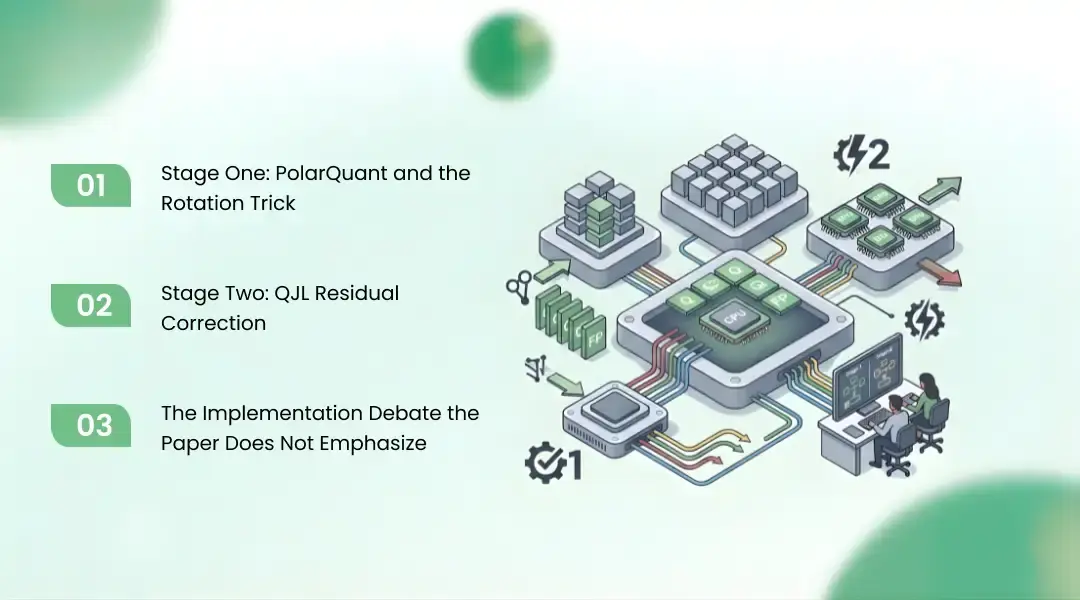
TurboQuant is not a single quantization scheme. It is a pipeline of two independently developed and peer-reviewed algorithms, PolarQuant and Quantized Johnson-Lindenstrauss (QJL), combined to achieve what neither accomplishes alone. The core architectural insight is geometric: the reason KV cache vectors are hard to quantize efficiently is that their value distributions are non-uniform and correlated across dimensions. TurboQuant removes both problems before quantization begins, rather than working around them after the fact.
The core problem with naive quantization of KV cache vectors is that different dimensions have different value distributions. Some dimensions cluster tightly around zero while others spread across a wide range. Traditional quantizers handle this by computing per-block normalization constants that rescale each block of values before quantization, but these normalization constants themselves consume memory, eroding the compression benefit at low bit-widths.
PolarQuant eliminates this overhead through a geometric transformation. A random orthogonal rotation matrix is applied to each key and value vector before any compression occurs. The rotation matrix is drawn from the Hadamard transform family, which provides O(d log d) computation rather than the O(d squared) cost of a full dense rotation. The crucial property of a random orthogonal rotation is that it is norm-preserving: it does not change the length of the vector or any inner product between pairs of vectors. What it does change is the distribution of energy across dimensions. After rotation, each coordinate of the vector independently follows an approximately Beta distribution regardless of what the original vector looked like. This is the key theoretical guarantee: the rotation induces a known, predictable, uniform statistical distribution on every coordinate.
Once the distribution is predictable, you can compute a mathematically optimal set of quantization buckets ahead of time using the Lloyd-Max algorithm applied to the Beta distribution. These codebooks are computed once and embedded as compile-time constants, requiring no per-model calibration, no dataset passes, and no warm-up. PolarQuant then quantizes each coordinate independently using these pre-computed codebooks, achieving close to the information-theoretic minimum distortion for the given bit budget. The conversion to polar coordinates further eliminates the per-block scaling factors that methods like INT4 quantization must carry alongside compressed values. Those scaling factors, though small per entry, consume a non-trivial fraction of the total memory at scale and partially defeat the compression at low bit-widths.
After PolarQuant, there remains a small systematic bias in the inner product estimates that attention uses to compute relevance scores. The query-key dot product that drives attention weighting is computed between compressed key vectors and full-precision query vectors. Quantization introduces a bounded but non-zero distortion in this inner product, and over many layers that distortion can compound.
QJL, or Quantized Johnson-Lindenstrauss, adds a 1-bit error-correction step that reduces each residual vector to a single sign bit, correcting bias in inner product estimates. It functions as a mathematical error-correction layer, removing the systematic bias introduced during the PolarQuant step and improving the accuracy of attention score calculations.The QJL transform projects the residual error onto a random sign matrix, producing a single bit per element with zero memory overhead, as the sign bits pack directly into the existing memory layout.
The open-source community has surfaced an important nuance that practitioners need to understand. Multiple independent implementation teams found that QJL actually hurts performance in practice for LLM attention, despite being theoretically correct. QJL is unbiased for raw inner products, but attention runs those scores through softmax, which exponentially amplifies variance. QJL's random noise gets magnified by softmax, while MSE-only quantization has biased but lower-variance inner products, and lower variance wins after softmax.The practical implication is that production implementations should use PolarQuant with MSE-only quantization for the residual rather than the full two-stage QJL pipeline, particularly for models with attention head dimensions of 64 or below. At head dimension 128 and above, with the full PolarQuant plus outlier-channel handling, QJL performs closer to the paper's theoretical claims.
This is not a fundamental flaw in the research. QJL works correctly for its other stated application, vector search, where no softmax amplification occurs. The community discovery is that the two use cases, KV cache and vector search, benefit from different configurations of the same underlying mathematics.
At 3.5 bits per value, TurboQuant achieves a LongBench average score of 50.06 and a Needle-in-Haystack score of 0.997, identical to full FP16 precision. At 2.5 bits, the LongBench average drops marginally to 49.44 while the Needle score holds at 0.997. By comparison, KIVI at 3 bits scores 48.50 on LongBench and 0.981 on Needle-in-Haystack, and SnapKV scores 44.57 on LongBench and 0.858 on Needle, a significant degradation on long-range retrieval tasks.
On NVIDIA H100 GPUs, 4-bit TurboQuant delivers an 8x speedup for attention logit computations compared to 32-bit precision.This acceleration comes from two sources: reduced memory bandwidth pressure as smaller cache vectors transit the HBM-SRAM bus, and alignment of the compressed format with H100 tensor core memory access patterns. The compression format is specifically designed to align with how H100 tensor cores read memory, ensuring that decompression during inference does not introduce significant latency overhead.
The compression ratio figures require careful reading. On a pure dense transformer, TurboQuant at 3.5-bit achieves 4.9x compression versus FP16, with freed VRAM supporting 3 additional concurrent 131,000-context requests on the same hardware.The headline 6x figure refers to more aggressive 3-bit or asymmetric configurations. For production deployments, 3.5 bits is the operating point that preserves full benchmark quality on 8B and larger models. At 3 bits, quality starts degrading noticeably on models smaller than 8B parameters. Models below approximately 1 billion parameters show significant output degradation and are not good candidates for TurboQuant.
Understanding TurboQuant requires being precise about what part of the inference stack it touches. TurboQuant is a post-training quantization algorithm specifically targeting the KV cache. The model weights for a 70B model still require 140 GB of VRAM at FP16 regardless of TurboQuant. What changes is the memory footprint of the attention key-value cache generated during inference.This is a critical distinction because it defines where TurboQuant complements other techniques rather than replacing them.
Weight quantization methods, including GPTQ, AWQ, and GGUF formats used in llama.cpp, compress the model's learned parameters and reduce the fixed cost of loading the model. KV cache quantization, which is what TurboQuant does, reduces the dynamic cost of running a workload. Both address different memory pools and are fully complementary. An 8B model quantized to 4-bit weights via AWQ and running with 3.5-bit TurboQuant KV cache compression can achieve meaningful long-context inference on hardware that would previously have required a much larger GPU cluster.
TurboQuant interacts cleanly with speculative decoding because the draft model maintains its own KV cache and the verification step reads from the main model's compressed cache without requiring any format conversion in the hot path. The compressed vectors are decompressed at attention-read time using the pre-computed codebooks, which are fast enough that they do not materially affect the latency advantage that speculative decoding provides.
Continuous batching, the technique pioneered by vLLM's PagedAttention, allocates KV cache in page-sized blocks and recycles them as sequences complete. TurboQuant's compression directly multiplies the effective capacity of each memory page. A 16-token KV cache page that consumed 2 MB of HBM in FP16 consumes approximately 330 KB in 3.5-bit TurboQuant. The practical implication is that the same GPU can hold significantly more concurrent requests before exhausting its KV cache budget, which directly improves throughput and lowers the per-token serving cost.
TurboQuant was designed as a unified algorithm for two distinct compression problems: LLM KV cache and vector search index compression. For retrieval-augmented generation pipelines, this dual applicability is particularly interesting. For vector search applications, indexing time with TurboQuant drops to virtually zero, at 0.0013 seconds for 1,536-dimensional vectors compared to 239.75 seconds for product quantization, while recall numbers on GloVe outperform both product quantization and RaBitQ baselines.An organization running a RAG system could, in principle, apply TurboQuant at both layers: the retrieval index and the LLM inference cache. The same mathematical framework governs both.
This dual applicability is one reason that teams at KriraAI, which builds enterprise AI systems including production RAG architectures, have been evaluating TurboQuant across the full inference pipeline rather than treating it as narrowly relevant to chat applications. The opportunity to apply a single, theoretically grounded compression primitive across both retrieval and generation memory pools without retraining is architecturally significant.
The honest answer as of April 2026 is that TurboQuant is a research breakthrough with active community adoption but without a production-grade official implementation. As of April 2026, TurboQuant has not been merged into major inference frameworks. Production integration requires custom CUDA kernels for the PolarQuant transform. Google's official implementation is expected in Q2 2026.There is a feature request open on the vLLM project (Issue #38171) for native TurboQuant support, and a community fork of llama.cpp has demonstrated working builds with promising initial benchmark parity.
What does exist is a substantial body of validated community implementations. The turboquant-pytorch repository provides a from-scratch PyTorch reference implementation that has been validated against the paper's theoretical bounds with MSE matching within 1%. The turboquant_plus fork of llama.cpp from contributor TheTom has demonstrated Apple Silicon support with near-q8_0 prefill speed and approximately 0.9x decode throughput at long context in turbo3 format. Independent community experiments confirm turbo4, which is 4-bit PolarQuant, achieves closer quality to q8_0 than to q4_0, at better compression than either.
For engineering teams evaluating TurboQuant for production, the pragmatic path right now is a two-track approach. First, deploy vLLM's production-ready FP8 KV cache quantization today, as it delivers approximately 2x compression with no accuracy risk and full framework support. Second, track the vLLM feature request and Google's Q2 2026 official code release, run TurboQuant against your specific workload including your model family, context length distribution, and batch size using community implementations, and treat Q3 to Q4 2026 as the realistic production-ready window for major inference frameworks.
The economic case for TurboQuant, assuming it achieves production-framework integration in the second half of 2026, is straightforward. Inference now accounts for 85% of enterprise AI spend, and TurboQuant's training-free deployment could cut those costs by more than 50%, directly improving the unit economics of every scaled AI product.That claim requires scrutiny. The 50% figure assumes workloads where the KV cache is the dominant VRAM constraint, which is true for long-context and high-concurrency serving but not for all inference workloads. Short-context, low-throughput deployments see minimal benefit.
The clearest scenario is long-context serving. Without compression, a 40 GB KV cache on hardware with only 20 GB of headroom means a single 128,000-context request cannot be served alongside the model weights. With TurboQuant, the 6.7 GB footprint fits comfortably, with room to serve multiple concurrent requests.The dollar consequence of that shift is substantial. At $5.80 per hour for a 70B model on two H100 SXM5 nodes, the ability to serve six concurrent long-context requests instead of one or two changes the per-query cost by a factor of three to six, not by a marginal percentage. That is the kind of infrastructure efficiency that changes product pricing decisions and market access for mid-sized enterprises.
Morgan Stanley analysts noted after the initial announcement that TurboQuant does not reduce total HBM demand for training workloads, and therefore does not represent the existential threat to memory chip manufacturers that some headlines suggested. The technique allows systems to handle 4 to 8 times longer context windows or significantly larger batch sizes on the same hardware without running out of memory, improving efficiency rather than eliminating total memory requirements.For enterprise AI buyers, the distinction matters: TurboQuant is an efficiency multiplier on existing hardware investments, not a reason to delay hardware procurement.
No technique this new enters production without honest limitations, and practitioners need to hold these alongside the benchmark numbers. The most material limitation for enterprise use is model size sensitivity. At 3 bits, quality starts degrading noticeably on models smaller than 8B parameters. On 0.5B to 1.6B parameter models, quantization noise can produce repetitive or degraded output, especially at 3-bit.Teams running smaller models for edge deployment or cost-sensitive applications should evaluate carefully rather than assuming the 3.5-bit claims transfer from 70B benchmarks to their specific model.
Key-value asymmetry is a second practical constraint. Community experiments across multiple independent implementations have confirmed that key vectors and value vectors respond differently to compression. Value quantization at 2 bits causes cosine similarity degradation to approximately 0.94, which manifests as detectable output quality degradation on generative tasks. Four-bit values maintain cosine similarity of 0.997, indistinguishable from full precision on 3B and larger models.The practical recommendation is asymmetric allocation: use 4-bit quantization for values and more aggressive 3-bit quantization for keys, where 3-bit keys maintain high inner product fidelity after PolarQuant rotation.
The absence of official production code is the third and most operationally significant limitation. Without official CUDA kernels optimized for H100 and H200 tensor core memory access patterns, integrating TurboQuant into a production vLLM deployment today requires custom kernel development. That engineering investment is non-trivial and carries maintenance risk until official framework support lands. Teams without dedicated inference engineering capacity should wait for the official release rather than building on community implementations for production workloads.
Three things stand out from a careful technical reading of TurboQuant. The first is what the algorithm actually does: it solves the KV cache quantization problem through a geometric transformation that eliminates the root cause of quantization error, non-uniform coordinate distributions, rather than working around it with per-block calibration constants. The PolarQuant rotation induces a predictable Beta distribution on every coordinate of every key and value vector, enabling near-optimal scalar quantization with pre-computed codebooks and no calibration data. At 3.5 bits per channel, the resulting compression is provably within 2.7 times the information-theoretic optimal and matches full FP16 quality across every standard long-context benchmark on models 8B and larger.
The second is where TurboQuant KV cache compression matters most: long-context inference, high-concurrency serving, and any enterprise workload where the KV cache has become the binding GPU memory constraint. A Llama 70B model serving 128,000-token contexts drops from a 40 GB KV cache footprint to approximately 6.7 GB at 3.5-bit TurboQuant. That is the difference between a hardware configuration that works and one that does not, and at the inference cost structure of 2026, where inference accounts for 85% of enterprise AI spend, the downstream economic consequence is substantial.
The third is what organizations should do in response: the algorithm is ready to evaluate, but the official production implementation is not yet available. Teams running models above 8B parameters at context lengths above 32,000 tokens should benchmark community implementations against their workloads now, particularly the turboquant-pytorch reference and the turboquant_plus llama.cpp fork, which has validated results on both CUDA and Apple Silicon. All teams should track the vLLM feature request and Google's Q2 2026 official code release as the starting point for production evaluation.
At KriraAI, we build production AI systems for enterprises across document intelligence, agentic automation, and retrieval-augmented generation, which are precisely the workloads where long-context KV cache pressure is highest and where TurboQuant's compression ratio translates most directly into infrastructure cost reduction. Our approach to emerging techniques like TurboQuant is not to adopt at announcement but to evaluate carefully, track the gap between research claims and community implementation findings, and integrate when production-grade framework support makes the deployment risk manageable. TurboQuant is at that threshold. If you want to understand what this technique could mean for your organisation's inference costs and long-context AI capabilities, we invite you to explore it further with KriraAI.
TurboQuant is not model quantization and should not be confused with weight quantization methods like AWQ, GPTQ, or GGUF formats. It exclusively targets the KV cache, the dynamic memory buffer of attention key and value vectors that a transformer model writes and reads during inference. Model weights are fixed at 140 GB for a 70B FP16 model regardless of whether TurboQuant is applied. What TurboQuant changes is the memory footprint of inference activations, specifically the key-value tensors stored across all attention layers for each active context window. The two techniques address separate memory pools and are fully complementary: you can apply 4-bit AWQ to the model weights and 3.5-bit TurboQuant to the KV cache simultaneously. This combination enables meaningful long-context inference on hardware that would previously have required substantially larger or more numerous GPUs.
TurboQuant requires no retraining, fine-tuning, or calibration data of any kind. It is entirely data-oblivious: the PolarQuant rotation matrix is derived from mathematical properties of high-dimensional random orthogonal transforms, and the Lloyd-Max quantization codebooks are pre-computed from the known Beta distribution that random rotation induces, not from empirical statistics of a specific model or dataset. This means TurboQuant applies identically to any transformer architecture using standard multi-head attention, grouped-query attention, or multi-query attention, across the Llama, Mistral, Gemma, and Qwen model families, without any per-model calibration step. The algorithm operates fully online, processing each KV vector as it is written to the cache without requiring access to historical context. This is a significant practical advantage over calibration-dependent quantization methods, which require representative inference workloads to run before deployment.
At comparable compression ratios, TurboQuant consistently outperforms KIVI on long-context benchmarks, with the quality gap widening at lower bit-widths. At 3 bits, TurboQuant achieves a LongBench average score of approximately 50.06 while KIVI scores 48.50, and the Needle-in-Haystack score difference is more pronounced, at 0.997 for TurboQuant versus 0.981 for KIVI. The architectural difference explains the quality gap. KIVI applies asymmetric per-channel and per-token quantization directly to raw KV vectors without rotation, which means its quantization grid must accommodate the irregular, outlier-dominated distribution of raw transformer activations. TurboQuant eliminates this irregularity before quantization begins by applying a random orthogonal rotation that induces a uniform Beta distribution across all coordinates, enabling near-optimal scalar quantization with pre-computed codebooks rather than per-sample adaptation. TurboQuant also provides a formal mathematical proof that its distortion rate is within 2.7 times the information-theoretic optimal, a theoretical guarantee that KIVI does not offer.
Several material limitations exist that practitioners should evaluate independently. First, small models below approximately 3 billion parameters exhibit noticeable quality degradation at 3-bit compression, particularly on tasks sensitive to token-level precision such as structured data generation and code completion. Second, the QJL residual stage, which the paper describes as bias-correcting inner product estimates, has been shown by at least six independent community implementations to hurt rather than help attention quality in practice, because softmax amplifies the variance that QJL introduces. The robust finding from community testing is that PolarQuant alone with MSE-only residual quantization outperforms the full two-stage pipeline for autoregressive generation tasks. Third, as of April 2026, TurboQuant is absent from all major inference frameworks including vLLM, TensorRT-LLM, and SGLang. Production deployment requires custom CUDA kernel development or reliance on experimental community forks.
Google's official implementation is targeted for Q2 2026, with the formal ICLR 2026 presentation scheduled for April 23 to 25 in Rio de Janeiro. Following the official release, integration into major serving frameworks typically takes two to four months for initial support and three to six months for production-grade, optimized kernel integration. This suggests that enterprises running vLLM or TensorRT-LLM can reasonably target Q3 to Q4 2026 for production evaluation and Q1 2027 for broad deployment. Teams with dedicated inference engineering capacity who are running workloads where the KV cache is currently the dominant VRAM constraint may find it worthwhile to evaluate community implementations against their specific model family and context length distribution now, particularly for models in the 8B to 70B range at context lengths above 32,000 tokens. For all other teams, the appropriate posture is to monitor the vLLM feature request and Google's GitHub release, run benchmark validation against your own workloads when official code drops, and treat the second half of 2026 as the evaluation window.
Founder & CEO
Divyang Mandani is the CEO of KriraAI, driving innovative AI and IT solutions with a focus on transformative technology, ethical AI, and impactful digital strategies for businesses worldwide.