The static forward pass is ending as the dominant paradigm for extracting capability from large language models. What replaces it is already visible in the research literature: a family of architectures and training objectives that allow a model to spend variable amounts of compute at inference time, searching, verifying, backtracking, and self-correcting before committing to an answer. The results from the first serious deployments of this approach, most legibly in OpenAI's o-series models and DeepMind's Gemini thinking variants, reveal a capability curve that does not plateau at the same point as standard chain-of-thought prompting. Models that allocate more tokens to reasoning at inference time keep improving on hard benchmarks well past the point where scaling training compute produces diminishing returns.
The deeper implication, which mainstream AI coverage has not yet fully processed, is that test-time compute scaling represents a structural decoupling of a model's deployed capability from its training-time parameter count. A 7B model with a well-trained process reward model and a competent search procedure can, in principle, outperform a 70B model doing single-pass inference on sufficiently difficult tasks. This changes the economics of AI deployment, the architecture of inference infrastructure, the design of training pipelines, and the way practitioners should think about the capability ceiling of any given model checkpoint.
This is not a speculative direction. The research infrastructure for test-time compute scaling is converging rapidly across several independent threads: outcome-supervised reward models, process reward models trained on step-level annotations, Monte Carlo tree search adapted to token sequences, best-of-N sampling with learned verifiers, self-consistency decoding, and most recently, models trained end-to-end with reinforcement learning to produce extended internal reasoning traces. Each of these threads is maturing, and the convergence of all of them into a unified inference-time reasoning architecture is the central technical development practitioners need to understand over the next two years.
This blog will cover the mechanistic foundations of test-time compute scaling, the architectural trajectories along which current research is evolving, the role of verifiers and process reward models as the critical bottleneck, the hardware and infrastructure implications of variable-compute inference, the training paradigm shifts that this development demands, the capability thresholds that become accessible as inference budgets grow, and the engineering decisions that teams deploying AI systems should be making now to position themselves for this shift.
The standard transformer forward pass applies a fixed sequence of operations to an input and produces an output in a single directed sweep. Every token in the output is generated through the same depth of computation regardless of how hard the underlying problem is. A model asked to convert Fahrenheit to Celsius applies the same 96 layers of attention and feedforward operations as a model asked to find the proof of a new mathematical identity. This is architecturally inelegant and empirically limiting.
The ceiling becomes apparent when you examine performance curves on tasks requiring multi-step deductive reasoning. On competition mathematics, formal logic, and complex code synthesis, scaling training compute beyond a certain point produces measurably smaller gains per doubling than the early scaling regime. This is not because the models lack knowledge. It is because single-pass inference cannot perform the kind of hypothesis generation, intermediate verification, and path correction that these problems structurally require. The architecture does not permit going back.
The key insight motivating test-time compute scaling is that verification is almost always easier than generation. Checking whether a proposed proof step is valid is cheaper than generating it. Checking whether a program satisfies a test suite is cheaper than writing the program. Checking whether a mathematical identity holds is cheaper than discovering it. This asymmetry is not incidental. It is what makes search over a space of candidate solutions tractable when direct generation is not.
When models are given the ability to generate many candidate solutions and evaluate them with a trained verifier, the effective problem-solving capability of a fixed model checkpoint increases substantially as the number of samples grows. The seminal result in this direction, demonstrating that best-of-N sampling with an outcome reward model scales log-linearly in reasoning accuracy with N over a very wide range of N values, established that inference-time compute and training-time compute are, at least partially, substitutable. The slope of this scaling curve, and the conditions under which it holds, are among the most important empirical questions in AI research right now.
There is a qualitative shift in what models can solve when they are allowed to reason for extended token budgets rather than being forced into a fixed output length. This shift is most clearly visible on tasks that require more than roughly five sequential deductive steps, which is approximately where single-pass chain-of-thought reasoning starts to degrade in reliability. Beyond this threshold, the benefits of iterative self-correction, hypothesis revision, and intermediate verification are substantial enough that models with access to them appear to be a different class of reasoner than models without.
The implication for practitioners is that the capability boundary of any deployed model is not a fixed property of its weights. It is a function of the inference procedure applied to those weights. Teams that are benchmarking model performance using single-pass inference are measuring a lower bound, not the actual capability of the model.
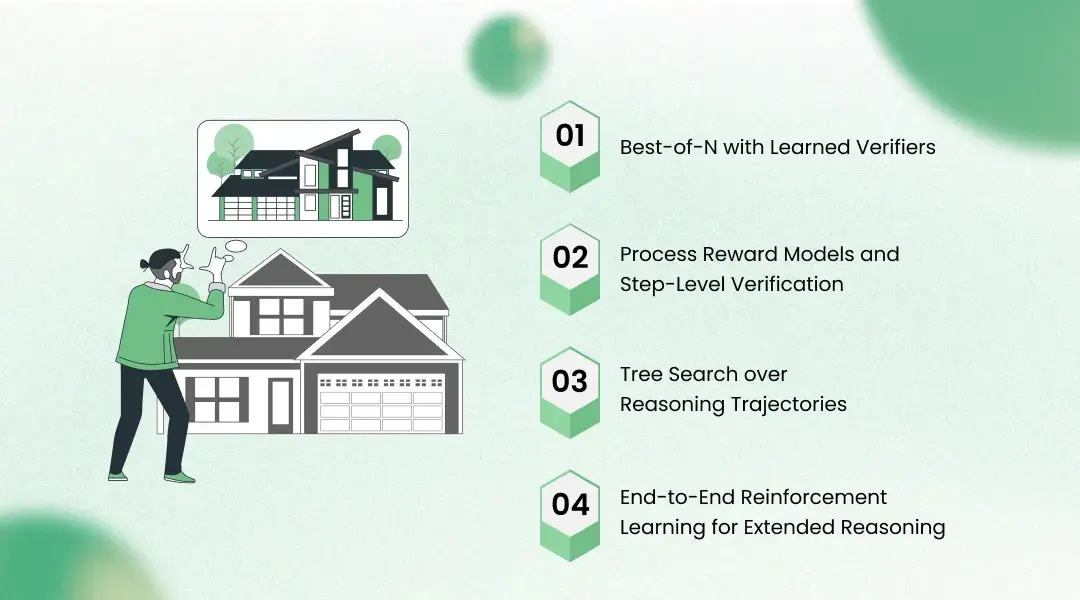
The research community has not converged on a single architecture for test-time compute scaling. Instead, four distinct approaches are maturing in parallel, each with different strengths, computational profiles, and infrastructure requirements. Understanding the trajectory of each is necessary for making informed architectural decisions.
The simplest approach samples N independent solutions from the policy model and scores each with a separately trained reward model. The highest-scoring solution is returned. The compute cost scales linearly with N. The quality of the result depends almost entirely on the quality of the verifier, which is why outcome reward models trained on correctness labels were the first viable implementation of this idea and also why they fail in domains where correctness is hard to determine automatically.
The architectural trajectory for this approach points toward more granular verifiers that can score partial solutions rather than completed ones. This is the transition from outcome reward models to process reward models.
Process reward models assign scalar scores to individual reasoning steps rather than to completed solutions. This matters architecturally because it enables a much richer search procedure: instead of generating complete solutions and ranking them, a search algorithm can use step-level scores to prune unproductive reasoning branches early, before the compute cost of completing them is incurred.
The training data challenge for process reward models is significant. Correct step-level annotations require either expensive human labelers who understand the domain deeply, or automated annotation pipelines that can determine step correctness programmatically. For mathematics, automated annotation is feasible using symbolic verification tools. For code, test suites serve as step-level verifiers for intermediate assertions. For natural language reasoning, this remains an open problem and represents one of the primary bottlenecks limiting the extension of test-time compute scaling to general-purpose tasks.
The research trajectory here is toward synthetic annotation pipelines where a powerful model generates reasoning traces, a symbolic verifier labels individual steps, and these labels are used to train process reward models at scale. This pipeline is already operational for mathematical reasoning and will extend to formal verification tasks within the next 12 to 18 months as formal language tooling matures.
Monte Carlo tree search adapted to token-level reasoning was demonstrated to improve over both best-of-N and greedy decoding on competition-level mathematical problems. The architecture treats the space of partial reasoning traces as a tree, uses the policy model to propose expansions at each node, uses a value function to estimate the expected outcome from each node, and applies UCB-style exploration to balance breadth and depth.
The compute profile of tree search is fundamentally different from best-of-N. Tree search achieves better sample efficiency in difficult problems because it concentrates compute on promising reasoning paths rather than completing all N branches fully. However, it requires a trained value function over partial traces, which is harder to train than an outcome reward model and requires infrastructure for managing the branching tree of partial sequences during inference.
The near-term architectural prediction is that tree search will become the dominant approach for high-stakes, high-latency-tolerant reasoning tasks. The value function training pipeline will become a standard component of the post-training stack alongside supervised fine-tuning and RLHF. Teams should expect to see open-source frameworks for reasoning tree search emerge and stabilize over the next 12 months.
The most architecturally significant development in test-time compute scaling is training models end-to-end with reinforcement learning to produce extended internal reasoning traces before outputting a final answer. Rather than using a separate verifier as an external oracle during inference, these models internalize the verification loop. The reasoning trace is a sequence of tokens that the model generates as part of its output, and the reinforcement learning objective trains the model to produce traces that lead to correct final answers.
The critical observation about this approach is that it produces emergent reasoning behaviors that were not explicitly supervised. Models trained this way develop behaviors like hypothesis generation, contradiction detection, subproblem decomposition, and self-correction that appear spontaneously as a consequence of optimizing for final answer correctness over extended token budgets. This is one of the clearest examples of capability emergence from a well-specified training objective rather than explicit instruction.
The architectural implication is that the reasoning trace length becomes a hyperparameter of the deployed system that can be adjusted at inference time. Longer traces generally produce better answers on harder problems, up to a task-specific saturation point. This means that latency and answer quality become explicitly tradeable quantities in deployed systems, which has profound implications for inference infrastructure design.
If test-time compute scaling has a single most important unsolved engineering problem, it is the quality and generality of process reward models. An outcome reward model tells you whether the final answer is correct. A process reward model tells you whether each intermediate step is a valid move toward a correct answer. The difference between these is the difference between evaluating a completed chess game and evaluating individual moves in real time.
Outcome reward models are effective when correct answers are abundant, verifiable, and diverse. For problems where correct answers are rare, outcome supervision provides a very sparse training signal. A model that generates 1000 reasoning traces and receives a positive reward only on the three that reach the correct answer learns very slowly about which specific reasoning patterns led to success. Process reward models address this by providing dense supervision throughout the reasoning trace, which accelerates learning and allows the model to generalize more effectively to problem types where it has not seen the specific final answer before.
The current bottleneck for process reward model training is annotation. Human annotators with sufficient domain expertise to judge whether a mathematical reasoning step is valid are expensive and slow. The research community is addressing this through several parallel approaches.
The first is automated annotation using symbolic verification, which works in domains with well-defined formal semantics. For mathematical reasoning, a step is valid if it follows from the preceding steps by a rule of the relevant formal system. This can be checked automatically using proof assistants or symbolic math systems. For code reasoning, assertions can be verified programmatically.
The second approach uses a powerful frontier model as an automatic annotator for weaker models. A large model generates annotations for reasoning steps, and these pseudo-labels are used to train process reward models for deployment at smaller scale. This approach has known limitations including label noise and the distributional gap between the annotator model and the policy model, but it is already producing usable results in mathematical domains.
The third and most promising long-term approach is training models to generate their own correctness signals through self-play and consistency checking. If a model can reliably identify when two independently generated reasoning paths lead to contradictory conclusions, it can use these contradictions to label individual steps without requiring external annotation. This is architecturally related to debate-based training approaches and will likely mature into a practical pipeline within the next 24 months.
Test-time compute scaling changes the hardware requirements for AI inference in ways that most infrastructure teams have not yet internalized. The standard inference optimization stack, which optimizes for throughput at fixed output length and minimizes per-token latency, is not the right stack for inference-time reasoning workloads.
Extended reasoning traces are long. A model generating a 10,000-token internal reasoning trace before producing a 200-token final answer has a very different operational profile from a model generating a single 500-token response. The key difference is that the KV cache for the reasoning trace must be stored and accessed throughout the generation process, and the memory bandwidth required to serve this cache becomes the dominant bottleneck rather than compute throughput.
At current hardware capabilities, serving a 70B parameter model with a 10,000-token KV cache at reasonable latency requires approximately 4x the HBM bandwidth utilization compared to the same model with a 1,000-token cache. This is a fundamental hardware constraint that inference-time reasoning systems must work around, and the engineering solutions for doing so are not yet mature.
The infrastructure trajectory points toward two complementary approaches. The first is speculative decoding adapted for reasoning traces, where a smaller model generates candidate reasoning steps and a larger verifier accepts or rejects them, reducing the number of large-model forward passes required per reasoning token. The second is hierarchical KV cache architectures that compress early portions of long reasoning traces into lower-resolution representations as the generation proceeds, trading precision in early reasoning steps for memory bandwidth efficiency.
A key property of inference-time reasoning architectures is that they allocate different amounts of compute to different queries based on query difficulty. Easy queries exit early, with short reasoning traces. Hard queries receive larger token budgets and potentially more complex search procedures. This is computationally efficient in aggregate but creates significant routing and load-balancing challenges for multi-tenant serving infrastructure.
Standard autoscaling policies based on requests per second are not appropriate for inference-time reasoning workloads, because request latency variance is very high and correlated with problem difficulty. A practical serving system for these workloads needs difficulty estimation at request ingestion time to route queries to appropriately provisioned backends, and this difficulty estimation is itself a non-trivial problem.
At KriraAI, the team working on production inference infrastructure has identified this routing problem as one of the primary engineering challenges in deploying reasoning-capable models at scale. The solution will likely involve lightweight classifier models that estimate expected token budget requirements from query characteristics, enabling dynamic provisioning before the expensive reasoning computation begins. This classifier layer will become a standard component of production reasoning system architecture within the next 18 months.

Test-time compute scaling is not just an inference-time change. It requires substantial changes to how models are trained after pretraining, and these changes are not incremental adjustments to the existing RLHF pipeline. They represent a new post-training paradigm with different data requirements, training objectives, and evaluation protocols.
Standard RLHF operates over relatively short sequences, typically hundreds of tokens, where the reward signal can be densely applied. Reinforcement learning for extended reasoning operates over sequences of thousands of tokens where the reward is sparse at the outcome level and requires process-level supervision for dense training. The RL algorithms appropriate for this regime are different from those used in standard RLHF.
The emerging consensus is that variants of GRPO and PPO with group-relative baselines are more stable for extended reasoning training than standard PPO with a value network, because the variance in reward estimates over long horizons makes value network training difficult. The specific algorithmic choices here are still being actively worked out, and practitioners should expect rapid iteration in this space over the next 12 months.
Training a model to reason effectively with extended token budgets requires demonstration data showing what good extended reasoning looks like. This creates a bootstrapping problem: to generate good extended reasoning traces for training, you need a model that already reasons well. The current solution is to use frontier models to generate training data for smaller models, but this introduces a capability ceiling where the trained model cannot exceed the reasoning quality of its teacher model.
The research direction that breaks this ceiling is using verifiable domains like mathematics and formal logic to construct training data where correctness can be checked without a teacher model. A model that learns to generate and verify its own solutions in domains with automatic correctness signals can bootstrap reasoning capability that exceeds what any individual training example demonstrates, because the RL objective rewards finding correct solutions through any sequence of reasoning steps, not just the specific sequences present in the training data.
The difficulty distribution of training problems has a large effect on the reasoning capabilities that emerge from RL training. Problems that are too easy do not require extended reasoning and do not train the model to use its extended token budget productively. Problems that are too hard produce essentially zero reward signal and also do not improve the model. The optimal curriculum presents problems slightly beyond the model's current capabilities, where extended reasoning provides genuine benefit.
Constructing such curricula at scale is a significant data engineering challenge. KriraAI's research team has been developing automated difficulty estimation pipelines that can construct dynamically adaptive curricula for reasoning model training. The key insight from this work is that difficulty relative to a specific model checkpoint is not the same as absolute problem difficulty, and the most effective curricula update the difficulty distribution continuously during training as model capability improves.
The most important technical question for practitioners is what specific capabilities become accessible as inference-time compute budgets increase. Based on current research trajectories, several capability thresholds are approaching that will matter significantly for deployed AI systems.
Models with access to extended reasoning and iterative self-correction will cross the threshold for reliable multi-step planning in open-ended environments within the next 12 to 18 months. Current models fail on planning tasks primarily because they cannot maintain a consistent world model over many sequential decisions and cannot recover from early errors without backtracking. Test-time compute scaling provides exactly the mechanism needed for backtracking and revision.
The specific architectural prediction is that planning-capable systems will use a hierarchical reasoning structure where a high-level reasoning pass sketches a plan, a verification pass checks plan feasibility, and a low-level execution pass implements the plan step by step with continuous monitoring against the high-level specification. Each layer of this hierarchy will use different compute budgets, with the verification layer being the most computationally intensive.
Within 24 months, inference-time reasoning models will be capable of generating formally verified proofs for non-trivial software properties as part of standard code generation workflows. The current gap between neural code generation and formal verification is primarily a reasoning depth gap, not a knowledge gap. Models already know the relevant formal methods. What they lack is the ability to reason through sufficiently long proof search trajectories.
As test-time compute scaling matures, the formal verification threshold will be crossed first for restricted problem classes including algorithmic correctness proofs for standard data structures and safety properties of finite-state systems. The tooling integration required to connect model-generated proofs to existing proof assistants like Lean and Coq is already being built by multiple research groups.
The capability threshold most relevant to AI researchers themselves is reliable hypothesis generation and experimental design in novel research domains. This requires a combination of deep domain knowledge, creative analogical reasoning, and rigorous logical deduction that current single-pass models cannot reliably deliver. Models trained with extended reasoning budgets and verified on mathematical and scientific reasoning benchmarks are approaching this threshold.
The specific capability prediction is that by late 2026, reasoning models with access to external tools including literature search and symbolic computation will be capable of generating valid experimental hypotheses in narrow subfields of mathematics and theoretical computer science, where correctness criteria are well-defined and can be checked. The extension to empirical sciences where correctness is noisier will lag by 12 to 18 additional months.
Test-time compute scaling implies a fundamental shift in how engineers think about the compute budget of a model call. In the current paradigm, calling a model has essentially fixed cost per output token, and the primary engineering decision is which model to call. In the inference-time reasoning paradigm, the primary engineering decision is how much compute to allocate to reasoning for this specific query, and the answer should be different for every query.
The engineering pattern that will become standard for deployed reasoning systems is a cascade architecture with difficulty routing. An initial lightweight model or classifier assesses the difficulty of the incoming query and routes it to an inference backend with an appropriate compute budget. Easy queries are served with short reasoning budgets or no reasoning at all. Hard queries receive large budgets and potentially activate tree search procedures.
This cascade architecture reduces average serving cost substantially compared to applying maximum reasoning budgets to all queries, while preserving the capability benefits of extended reasoning for queries that require it. The savings in practice depend heavily on the difficulty distribution of the query workload, and estimating this distribution accurately is important for capacity planning.
Adaptive compute allocation requires models that are well-calibrated about their own uncertainty. A model that does not know when it is uncertain about an answer cannot appropriately request more reasoning compute. Confidence calibration in inference-time reasoning systems is therefore not just an evaluation metric but a system design requirement.
The research trajectory for calibration in reasoning models points toward training objectives that explicitly reward the model for requesting additional compute when it is uncertain and for providing confident answers when it is certain. This is related to selective prediction and learning-to-defer frameworks, and these connections will be more explicitly exploited in next-generation training pipelines.
At KriraAI, the approach to confidence-adaptive serving has been to separate the uncertainty estimation function from the reasoning function entirely, using a lightweight verifier to evaluate the top-K candidate answers before deciding whether to expand the search. This verifier-in-the-loop architecture reduces false confidence significantly on out-of-distribution queries while adding relatively modest latency overhead.
Inference-time reasoning architecture and the verifier-guided search methodology it depends on face several open technical problems. Understanding these problems is important both for evaluating the realistic timeline for capability improvements and for identifying where research investment will produce the most leverage.
Process reward models trained on finite datasets can be overexploited by search procedures that optimize heavily against them. When a search algorithm generates enough candidate reasoning steps, it will eventually produce steps that score highly according to the verifier but are semantically invalid or circular. This is the verifier overoptimization problem, analogous to reward hacking in standard RL settings.
The current mitigation approaches include training verifiers with diverse data augmentation, using ensembles of verifiers to reduce the attack surface, and applying entropy-based diversity bonuses during search to discourage the collapse toward narrow high-reward regions. None of these approaches fully solves the problem, and it remains a significant source of reliability failures in deployed reasoning systems.
Models trained on reasoning chains in specific domains do not reliably generalize to novel domains that require composing reasoning skills from multiple training domains. A model that has learned to reason about number theory and about combinatorics may not be able to reason about a problem that requires both simultaneously, even if the individual skills are well-established. This compositional generalization failure is one of the primary limitations of current reasoning models and is not clearly addressed by simply increasing the training data volume.
The most promising research direction for compositional generalization is training on explicitly compositional problem distributions, where training problems are constructed by combining sub-problems from different domains in structured ways. Researchers have shown that models trained on such distributions generalize to novel compositions more reliably than models trained on domain-specific collections of similar complexity.
From an engineering perspective, one of the most practical open problems in inference-time reasoning is determining the latency threshold below which extended reasoning becomes too slow for interactive use cases. Current reasoning models with large token budgets can take 30 to 120 seconds to produce a final answer on hard problems, which is acceptable for asynchronous tasks but not for interactive deployment.
The trajectory of hardware improvements in memory bandwidth, combined with advances in speculative decoding for long sequences, suggests that the latency of extended reasoning will decrease by roughly 3x to 5x within the next 18 months. This will bring many high-quality reasoning queries into the interactive latency range of under 10 seconds, substantially expanding the set of use cases where inference-time reasoning is practical.
The development of test-time compute scaling is not yet mature enough for most production teams to fully adopt, but it is mature enough that architectural decisions made today will determine how well positioned teams are when the technology stabilizes. Several specific preparation steps are relevant for engineering teams building AI systems.
Teams should start building evaluation infrastructure now that measures model capability across a range of inference compute budgets rather than at a single fixed budget. This means designing benchmarks with well-defined correct answers so that best-of-N sampling is evaluable, and it means building the tooling to run repeated inference calls and aggregate across them. Teams that have this infrastructure will be able to identify capability improvements from reasoning-enhanced models much faster than teams that do not.
Teams should invest in verifier development for their specific domains. If the domain has formally verifiable correctness criteria, building or integrating symbolic verification tools is high-leverage work that will compound significantly as reasoning models mature. If the domain does not have formal verifiability, investing in data collection for outcome supervision is the appropriate foundation.
Teams should design inference serving infrastructure for variable latency from the beginning rather than retrofitting it later. The request-response model for AI inference needs to accommodate long-running reasoning calls differently from fast response calls, and systems that conflate these two patterns will face significant operational problems as reasoning-capable models are deployed.
Teams should evaluate the process reward model training pipelines that are currently emerging from the research community for applicability to their specific domains. The timeline for open-source process reward model tooling to reach production quality is approximately 12 to 18 months, and teams that begin experimenting early will have significant advantage.
Three technical implications of test-time compute scaling stand above the rest in their significance for practitioners. First, model capability is no longer a fixed property of a checkpoint. It is a function of the inference procedure, the compute budget, and the quality of the trained verifier. Benchmarking, procurement, and architectural decisions based on single-pass evaluation are systematically underestimating what deployed systems can do and what the gap between different approaches actually is. Second, the post-training stack must expand to include process reward model training and RL over extended reasoning horizons as first-class components alongside supervised fine-tuning. Teams that do not build or adopt these pipelines will fall behind as reasoning-capable models become the standard for hard-task deployment. Third, the capability frontier accessible to AI systems is shifting toward tasks that require iterative reasoning, formal verification, and multi-step planning, which are precisely the tasks that have historically defined the boundary between AI-assisted and human-only workflows. This frontier is moving faster than most enterprise AI roadmaps have anticipated.
KriraAI operates at the intersection of AI research and production deployment, building systems that are designed for where the technology is heading rather than optimized for where it stands today. The team has been investing in adaptive inference infrastructure, process reward model tooling, and curriculum design for reasoning training because these are the foundational components that will determine production AI capability over the next two to three years. The reasoning revolution is not a future event to prepare for in the abstract. It is a set of concrete architectural decisions that teams are making right now, and the difference between making them early and making them late will compound significantly.
Technical teams who want to understand how KriraAI approaches these emerging capabilities in production are invited to explore the applied research and deployment frameworks the team has been developing. The most consequential AI architectural decisions of the next 24 months will be made by practitioners who understand test-time compute scaling deeply enough to build for it, not around it.
Chain-of-thought prompting elicits reasoning traces from a model by including demonstration examples or explicit instructions in the prompt. It does not change how the model allocates compute or how it searches the space of possible reasoning paths. Test-time compute scaling refers to inference procedures that actively use additional compute to generate multiple candidate reasoning trajectories, evaluate them with trained verifiers, and select or aggregate across them. The architectural distinction matters because chain-of-thought is a prompting technique applied to a standard auto-regressive model, while test-time compute scaling requires additional trained components including reward models or value functions, and requires inference infrastructure capable of managing multiple parallel generation streams. The capability improvements from the two approaches are also qualitatively different: chain-of-thought helps primarily with reasoning legibility and modest accuracy improvements on tasks the model can already solve, while test-time compute scaling unlocks reliable performance on tasks that are completely out of reach for single-pass inference.
Outcome reward models score completed solutions as correct or incorrect. Process reward models score individual reasoning steps for validity. The difference matters most for hard problems where correct solutions are rare in the sampling distribution, because outcome reward models provide zero training signal for all the near-correct reasoning paths that reached the wrong answer through a single error. Process reward models provide dense signal throughout these near-correct trajectories, which makes RL training much more sample-efficient in the hard-problem regime. For deployed systems, process reward models enable early termination of unproductive reasoning paths during tree search, reducing the compute cost of finding correct solutions. For most current production use cases, where problems are moderately difficult and outcome supervision is available, outcome reward models are sufficient. Process reward models become necessary when deploying on tasks with inherently rare correct answers, very long reasoning horizons, or formal verification requirements.
Several infrastructure changes are non-trivial. First, KV cache management must accommodate variable-length reasoning traces that can be 10x to 50x longer than typical response lengths. This affects memory allocation, cache eviction policy, and the choice of attention implementation. Second, serving systems must manage concurrent generation across multiple reasoning branches for tree search workloads, requiring batch management logic that is significantly more complex than standard static-batch inference. Third, autoscaling policies must account for the high variance in request latency caused by variable reasoning budgets, since a single difficult query can occupy a backend for orders of magnitude longer than an easy query. Fourth, cost attribution and monitoring must be redesigned around token budgets rather than request counts, because the cost difference between an easy and a hard query can be 100x in a reasoning-capable system. Teams deploying reasoning models without addressing these infrastructure changes will encounter significant operational surprises.
The primary heuristic is whether the task involves verifiable sequential reasoning steps where intermediate correctness matters, or whether it is primarily a pattern-matching or knowledge retrieval task. Tasks that benefit strongly from inference-time reasoning include formal verification, mathematical derivation, complex planning with constraints, and multi-step code synthesis where intermediate correctness can be checked. Tasks that do not benefit as strongly include factual retrieval, stylistic generation, and tasks where the answer quality is primarily determined by training data coverage rather than reasoning depth. A practical evaluation approach is to run best-of-N sampling with an automatic verifier on a representative task sample and measure the slope of performance improvement with N. If performance improves substantially as N increases from 1 to 32, the task is a good candidate for inference-time reasoning investment. If performance plateaus quickly, the bottleneck is likely training coverage rather than reasoning depth.
For constrained domains with automatic verifiability, including mathematical reasoning, formal code verification, and logical deduction, production-quality reliability is achievable within 12 to 18 months using systems being built today. The primary remaining work is stabilizing process reward model training pipelines and reducing inference latency through speculative decoding improvements. For more general enterprise use cases involving complex document analysis, multi-step research tasks, and domain-specific planning problems, the timeline is 24 to 36 months, gated primarily on the development of scalable annotation pipelines for process reward model training in domains without automatic correctness verification. Teams that invest in building verifiable evaluation infrastructure and domain-specific outcome supervision data now will be positioned to adopt reasoning-capable systems substantially earlier than teams that begin this work after the technology matures.
Founder & CEO
Divyang Mandani is the CEO of KriraAI, driving innovative AI and IT solutions with a focus on transformative technology, ethical AI, and impactful digital strategies for businesses worldwide.