How to Scale AI Solutions Without Losing Data Privacy
Three months into scaling an AI product, a founder once told me:
"We didn’t expect privacy to become the biggest problem."
Of course they didn’t.
Everyone focuses on performance. Speed. Accuracy. Growth curves. No one plans for what happens when your AI starts touching millions of data points instead of thousands.
Let me ask you something.
What breaks first when AI scales?
Not your model. Not your infrastructure.
Your trust layer.
And once that cracks… recovery is expensive. Sometimes impossible.
What Does It Mean to Scale AI Solutions?
Scaling AI isn’t just about handling more users. That’s the surface-level definition.
The real shift?
You move from automation → decision intelligence.
At small scale:
AI helps automate repetitive tasks
At large scale:
AI starts influencing decisions
Customer experiences depend on it
Business outcomes rely on it
Example?
A chatbot handling 100 queries/day is automation. The same system handling 100,000 queries and shaping customer sentiment, is decision infrastructure.
And here’s the catch (most teams miss this):
The more valuable your AI becomes, the more sensitive the data it touches.
Why Data Privacy Becomes a Bigger Problem at Scale
Scaling multiplies everything.
Including risk.
More Users = More Data Exposure
More users means:
More personal data
More behavioral data
More integration points
Each one is a potential vulnerability.
Real Risks You Can’t Ignore
Let’s not sugarcoat this.
Data breaches → Direct financial loss + legal chaos
Regulatory penalties → Fines that hurt, not just financially
Loss of customer trust → The silent killer
I’ve seen companies recover from bugs.
I’ve rarely seen them recover from broken trust.
Common Mistakes Businesses Make While Scaling AI
This is where things usually go wrong.
And it’s rarely because of bad intentions.
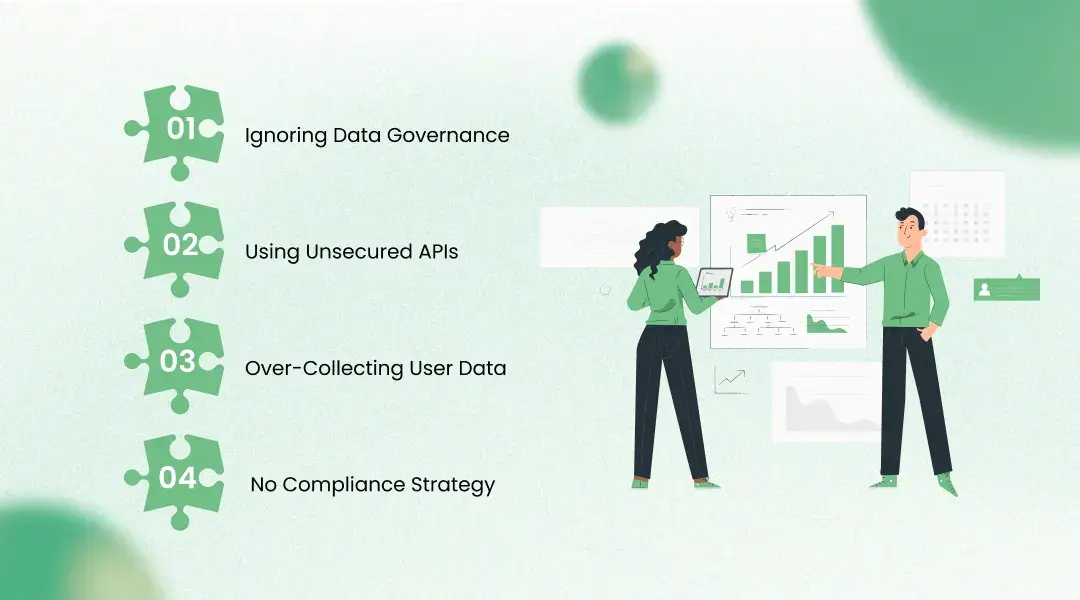
1. Ignoring Data Governance
No clear policies. No ownership. Just “we’ll fix it later.”
Later never comes.
2. Using Unsecured APIs
Quick integrations. Faster launches. Hidden risks.
(Yes, I’ve seen production systems leaking data through third-party APIs.)
3. Over-Collecting User Data
More data ≠ better AI.
Sometimes, it just means more liability.
4. No Compliance Strategy
“We’ll handle compliance once we scale.”
That’s like installing brakes after buying a car.
Core Principles of AI Data Privacy
If you remember nothing else from this article, remember this section.
Data Minimization
Collect only what you actually need. Nothing more.
Transparency
Users should know what data you collect—and why.
User Consent
Not buried in legal jargon. Clear. Explicit.
Security-First Architecture
Privacy isn’t a feature you add later. It’s a foundation.
Best Practices to Scale AI Without Losing Data Privacy
This is where theory meets reality.
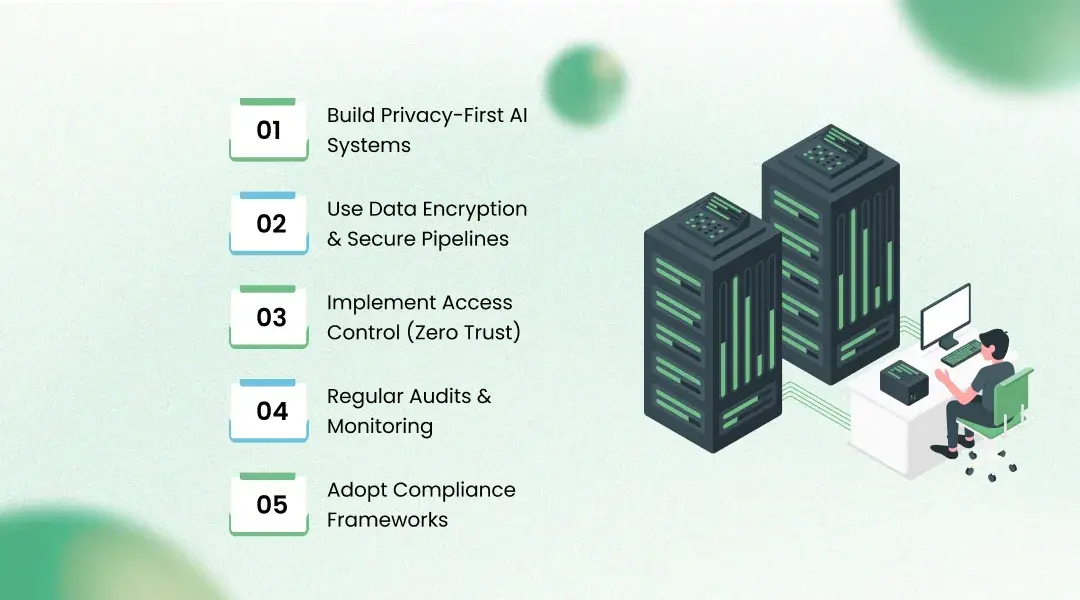
Build Privacy-First AI Systems
Design systems assuming data risk exists from day one.
Not after your first incident.
Use Data Encryption & Secure Pipelines
Encrypt data:
At rest
In transit
No exceptions.
Implement Access Control (Zero Trust)
Not everyone needs access to everything.
Simple idea. Rarely implemented well.
Regular Audits & Monitoring
You can’t protect what you don’t track.
Continuous monitoring > occasional checks.
Adopt Compliance Frameworks
Align with global and local regulations early.
It saves you from expensive rewrites later.
Advanced Privacy-Preserving AI Techniques
Now we get a bit technical—but stay with me.
This is where serious companies separate themselves.
Federated Learning
Data stays on user devices. Models learn without centralizing data.
Less exposure. More control.
Differential Privacy
Adds controlled noise to data.
Sounds counterintuitive. Works brilliantly.
Data Anonymization
Remove personally identifiable information.
Still useful. Much safer.
Edge AI Processing
Process data locally instead of sending everything to servers.
Faster. More private.
AI Compliance & Regulations You Must Know
Let’s address the elephant in the room.
Compliance.
GDPR (Europe)
Strict. Non-negotiable if you operate globally.
India DPDP Act
India is tightening data privacy laws.
Ignoring this? Risky.
HIPAA (Healthcare)
If you touch health data, this isn’t optional.
Here’s the part most companies misunderstand:
Compliance isn’t a burden. It’s positioning.
Customers trust companies that take privacy seriously.
That trust? It converts.
Real-World Example: Scaling AI Securely
Let me tell you about a SaaS client.
Before:
Rapid AI deployment
No clear data governance
Basic security measures
Result:
Growth plateaued
Enterprise clients hesitated
After:
We rebuilt their system with:
Encrypted pipelines
Role-based access control
Compliance-ready architecture
Result:
Enterprise deals closed faster
Customer trust increased
Revenue followed
Same AI.
Different foundation.
How AI Development Companies Ensure Data Privacy
This is where choosing the right partner matters.
Not all AI development services are equal.
Here’s what experienced teams actually do:
Secure Architecture Design
Privacy is baked into system design, not added later.
Compliance-Ready Solutions
Built to align with regulations from day one.
Ongoing Monitoring & Upgrades
Because threats evolve. Constantly.
At KriraAI, this is standard practice.
(Not because it sounds good, but because we’ve seen what happens when it’s ignored.)
If you’re evaluating a Best AI development Company, this should be your baseline—not a bonus.
Future of AI: Privacy-First Innovation
Let’s zoom out for a second.
Where is this heading?
AI Governance is Rising
Governments are paying attention.
So should you.
Ethical AI is Becoming Standard
Not optional. Expected.
Privacy as Competitive Advantage
Companies that protect data will win.
Simple.
Conclusion
Scaling AI is exciting.
But it comes with responsibility.
The companies that win won’t be the ones with the fastest models.
They’ll be the ones people trust.
Because at scale, AI data privacy isn’t technical, it’s reputational.
And reputations?
They’re hard to rebuild.
FAQs
Focus on privacy-first architecture, encryption, access control, and compliance frameworks from the beginning - not after scaling.
Because AI systems rely on sensitive data. Poor privacy can lead to breaches, legal issues, and loss of customer trust.
Data breaches, regulatory penalties, and trust loss are the biggest risks when scaling AI systems without proper safeguards.
Compliance ensures your AI systems follow legal standards, reducing risks and building credibility with customers.
Yes. Even small businesses can adopt basic practices like data minimization, encryption, and secure APIs to protect user data.
Founder & CEO
Divyang Mandani is the CEO of KriraAI, driving innovative AI and IT solutions with a focus on transformative technology, ethical AI, and impactful digital strategies for businesses worldwide.