Only 29% of small and medium enterprises using generative AI report deploying it in core business functions, according to a 2025 OECD survey covering G7 economies. For mid-market companies with 50 to 500 employees, this statistic reveals a paradox. These organizations generate enough unstructured text data to justify , yet most of them are barely scratching the surface of what natural language processing can do for their operations. If you lead a mid-market company, you sit in a uniquely uncomfortable position. You handle enough customer emails, support tickets, contracts, and internal documents to drown your teams in manual processing, but you lack the seven-figure AI budget and dedicated data science departments that enterprises rely on. This guide is written specifically for you. It walks through exactly how mid-market organizations can evaluate, adopt, and scale NLP services in a way that respects your actual budget, team structure, and growth trajectory. You will learn which NLP applications deliver the fastest returns at your scale, what realistic costs look like, how to avoid the three mistakes that derail most mid-market AI projects, and what the competitive landscape will look like for companies that act now versus those that wait.
A mid-market company with 50 to 500 employees typically operates with a lean but layered structure. You likely have functional departments for sales, customer support, operations, finance, and marketing, each with its own manager or director, but you do not have a dedicated AI team, a chief data officer, or an internal machine learning engineer on staff. Your IT department consists of three to fifteen people who maintain infrastructure, manage SaaS tools, and handle security. They are competent generalists, not AI specialists.
Your technology stack is a patchwork assembled over years. You run a CRM like Salesforce or HubSpot, an ERP system that may or may not be cloud-based, a customer support platform like Zendesk or Freshdesk, and a handful of industry-specific tools. These systems generate massive volumes of unstructured text: customer emails, chat transcripts, support tickets, contract documents, sales call notes, survey responses, and internal communications. According to industry estimates, approximately 80% of business data is unstructured, and mid-market companies produce enough of it to create real operational bottlenecks without having the workforce to process it efficiently.
Your annual technology budget for new initiatives typically ranges from $200,000 to $1.5 million, depending on your revenue. AI and NLP projects compete with cybersecurity upgrades, ERP migrations, and compliance requirements for this budget. Decision-making is faster than at enterprises because you have fewer approval layers, but it is also more cautious because each dollar spent carries more weight. A failed $300,000 AI project at a Fortune 500 company is a rounding error. The same failure at a 200-person company can freeze innovation spending for two years.
You also face a specific talent pressure. The companies large enough to hire full-time NLP engineers offer $180,000 to $250,000 salaries. Solo operators and small businesses bypass this entirely by using consumer-grade AI tools. Mid-market companies sit in between, needing professional-grade NLP capabilities without the ability to build or maintain them internally. This is the core constraint that shapes every decision in this guide.
Enterprise AI adoption and mid-market AI adoption are fundamentally different processes, and conflating them is one of the most expensive mistakes a mid-market leader can make. When a Fortune 500 company adopts NLP services, it typically engages a systems integrator, allocates a $2 million to $10 million annual budget, assigns a cross-functional team of 15 to 30 people, and plans for an 18-month rollout. The enterprise builds custom models trained on proprietary data, deploys them on dedicated infrastructure, and maintains them with a permanent AI operations team.
A mid-market company cannot and should not replicate this approach. Your path to NLP adoption relies on three different principles. First, you use pre-trained models and cloud APIs rather than building from scratch. The NLP market has matured to the point where cloud-based NLP platforms from providers like Google Cloud Natural Language, AWS Comprehend, and Azure AI Language offer production-ready capabilities at usage-based pricing that starts under $500 per month for moderate volumes. Second, you integrate NLP into existing workflows rather than creating new ones. Your support team does not need a new analytics dashboard; they need NLP-powered ticket routing and sentiment detection embedded directly into their existing Zendesk or Freshdesk environment. Third, you measure success in operational hours saved and error rates reduced, not in model accuracy benchmarks that only data scientists understand.
At the same time, mid-market NLP adoption differs from what solo operators and micro businesses do. A solo operator subscribes to ChatGPT or a similar consumer tool for $20 per month and uses it for ad-hoc text generation and summarization. That approach does not scale when 200 people need consistent, automated NLP capabilities integrated across multiple business systems. Mid-market companies need managed NLP services with proper data governance, consistent output quality, integration APIs, and usage controls. KriraAI works specifically in this space, designing NLP implementations that give mid-market companies enterprise-grade text processing without the enterprise price tag or complexity.
The timeline to see returns also differs by company size. Mid-market companies that focus on the right use cases typically see measurable ROI within three to six months of deployment, compared to 12 to 18 months for enterprise-scale transformations. This faster feedback loop is actually an advantage, because it allows mid-market teams to iterate and expand based on real results rather than speculative projections.
A realistic first-year budget for NLP services at a mid-market company breaks down into three components. Platform and API costs typically run $6,000 to $60,000 annually, depending on volume and complexity. Implementation and integration services, often provided by specialized partners like KriraAI, range from $30,000 to $150,000 for initial setup. Ongoing optimization and support add $2,000 to $10,000 per month. This puts the total first-year investment between $60,000 and $270,000 for most mid-market deployments, a fraction of enterprise spending but far more than consumer tool subscriptions.
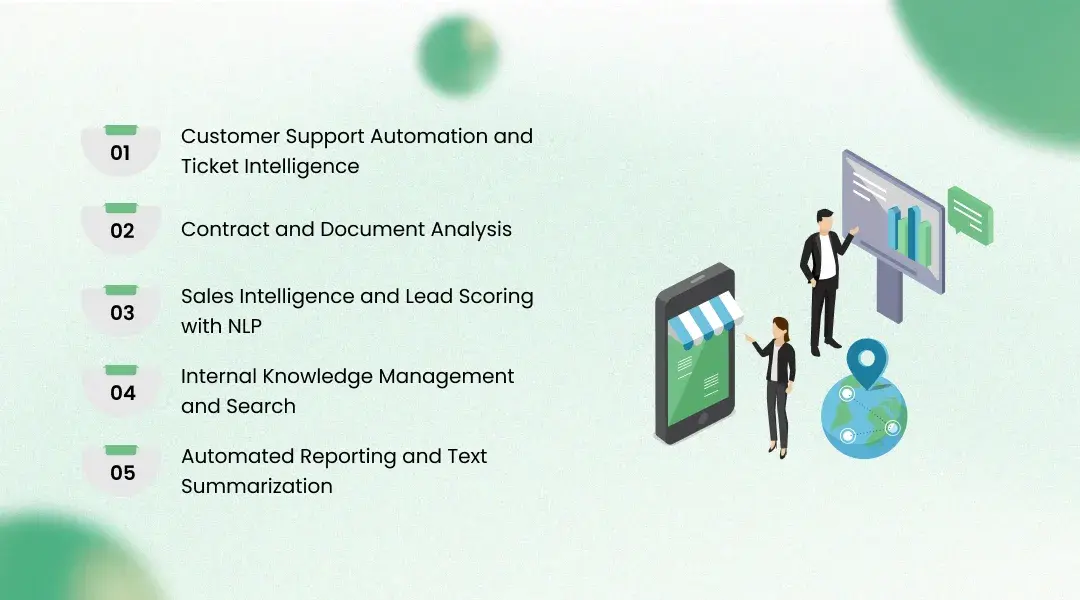
Not every NLP application is worth pursuing at mid-market scale. The best choices combine high frequency of use, clear cost savings, and low integration complexity. Here are the five NLP applications that consistently deliver the strongest returns for companies of this size.
This is the single highest-ROI NLP application for most mid-market companies. NLP-powered ticket classification automatically routes incoming support requests to the right team or agent based on topic, urgency, and sentiment. Intent detection identifies whether a customer needs billing help, technical support, a product return, or escalation to a manager. Sentiment analysis flags tickets from frustrated or angry customers for priority handling before they escalate.
For a mid-market company handling 2,000 to 20,000 support tickets per month, this technology typically reduces average response time by 35% to 50% and cuts misrouted tickets by 60% to 80%. The cost for cloud-based NLP ticket intelligence ranges from $500 to $3,000 per month at this volume, and integration with major helpdesk platforms takes two to four weeks. A 150-person B2B software company that implemented NLP ticket routing can realistically expect to save 30 to 40 hours of agent time per week within 90 days of deployment.
Mid-market companies review hundreds of contracts, proposals, and compliance documents annually, yet rarely have dedicated legal operations teams. NLP-powered document analysis can extract key terms, dates, obligations, and risk clauses from contracts in seconds rather than hours. It can compare new contracts against standard templates to highlight deviations, identify missing clauses, and flag unusual language.
For a company processing 50 to 300 contracts per month, this application saves an average of 15 to 25 hours per week in manual review time. Platforms offering this capability at mid-market pricing include tools that charge $1,000 to $5,000 per month based on document volume. The technology is particularly valuable for mid-market companies in professional services, manufacturing, and distribution where contract complexity is high but dedicated legal staff is limited to one or two people.
NLP can analyze email threads, call transcripts, and CRM notes to score leads based on language patterns, buying signals, and engagement sentiment. For a mid-market sales team of 15 to 80 people, this means less time chasing low-quality leads and more time on prospects showing genuine purchase intent.
The practical impact is significant. Mid-market SaaS companies implementing NLP-driven lead scoring have reported shortening their sales cycles by 10 to 15 days and improving conversion rates by 20% to 30%. The cost for integrating NLP lead intelligence with existing CRM systems runs $2,000 to $8,000 per month at mid-market scale, with setup taking four to eight weeks when working with experienced implementation partners.
As mid-market companies grow, institutional knowledge becomes scattered across email threads, shared drives, Slack channels, project management tools, and individual laptops. NLP-powered semantic search goes beyond keyword matching to understand the meaning behind queries. An employee asking "what is our refund policy for enterprise clients" gets the right answer even if the policy document never uses the word "refund" but instead says "reimbursement" or "credit."
This capability reduces the average time employees spend searching for internal information from 20 minutes per search to under 2 minutes. For a 200-person company where employees search for information an average of 5 times per day, the productivity recovery is substantial. Cloud-based knowledge management with NLP search costs $3 to $8 per user per month at mid-market scale, making it one of the most cost-effective NLP applications available.
NLP text summarization can condense lengthy reports, meeting transcripts, research documents, and regulatory filings into structured summaries. For mid-market executives and managers who receive 50 to 100 pages of reading material per week, automated summarization with key point extraction saves three to five hours weekly. This application integrates with document management systems and communication platforms with minimal technical complexity.
The numbers matter differently when you are a 200-person company rather than a 20,000-person enterprise. Here is what realistic NLP adoption looks like in measurable terms at mid-market scale.
A mid-market professional services firm with 120 employees that implemented NLP-powered document analysis and contract review can expect to reduce document processing time by 40% to 55%. In practical terms, this translates to recovering 200 to 350 hours of professional staff time per month, time that was previously spent reading, classifying, and extracting data from documents manually. At an average loaded cost of $45 to $75 per hour for professional staff, that represents $9,000 to $26,250 in monthly labor cost recovery against a typical NLP service cost of $3,000 to $8,000 per month.
For customer-facing operations, mid-market companies deploying NLP in their support workflows report 35% to 50% reduction in average ticket resolution time and a 25% to 40% improvement in first-contact resolution rates. A 2025 analysis of mid-market technology companies found that NLP-driven customer service automation reduced the cost per support interaction from approximately $12 to $15 down to $4 to $7, while simultaneously improving customer satisfaction scores by 15 to 22 percentage points.
The cumulative effect on revenue is also measurable. Mid-market companies using NLP for sales intelligence report 12% to 18% higher win rates on qualified opportunities and 15% to 25% faster pipeline velocity. For a company with $20 million in annual revenue and a 30% close rate, improving that close rate to 34% through better lead qualification and sentiment-based engagement timing adds $2.4 million in additional annual revenue. These are not theoretical projections; they reflect the typical range reported by mid-market companies that have deployed NLP services with proper implementation support from partners like KriraAI.
The implementation services segment of the NLP market is growing at 26% annually, which confirms that companies are moving beyond experimentation into production deployment. For mid-market companies specifically, the ROI timeline is compelling: most organizations achieve full payback on their NLP investment within four to eight months of production deployment, with ongoing returns compounding as the systems process more data and improve accuracy.
Adopting NLP services at a mid-market company requires a structured but lean process. Unlike enterprise deployments that take 12 to 18 months, mid-market implementations should move from initial assessment to production value in 10 to 16 weeks for the first use case. Here is the practical roadmap.
Phase 1: Internal Audit and Use Case Selection (Weeks 1 to 3). Start by mapping every process in your organization that involves reading, writing, classifying, or searching text. For each process, document the volume (how many documents, tickets, or emails per week), the labor hours consumed, and the error rate or inconsistency issues. Rank these processes by a simple formula: hours consumed multiplied by hourly labor cost, minus estimated NLP service cost. The process with the highest net value is your first use case. Do not try to solve everything at once. One well-executed NLP deployment builds internal confidence and organizational knowledge that accelerates every subsequent project.
Phase 2: Vendor Evaluation and Partner Selection (Weeks 3 to 5). Evaluate NLP solutions along five dimensions specific to mid-market needs:
Integration capability with your existing tech stack, not theoretical API availability but proven connectors for your specific CRM, helpdesk, or document management system.
Pricing transparency at your volume, because many enterprise NLP vendors publish impressive per-unit prices that balloon when you factor in minimum commitments, training data fees, and support tiers.
Time to production, which should be measured in weeks not months for a mid-market first deployment.
Data residency and security controls that meet your compliance requirements without requiring you to build custom infrastructure.
Scalability from your current volume to 3x to 5x growth without requiring re-architecture.
Phase 3: Pilot Deployment (Weeks 5 to 10). Deploy the NLP solution on a subset of your data or a single team. Run it in parallel with existing processes for two to four weeks so you can directly compare automated results against manual baselines. Track three metrics: accuracy (is the NLP output correct), speed (how much faster is the process), and adoption (are the people who need to use it actually using it). If accuracy exceeds 85% and speed improvement exceeds 30%, you have a viable production deployment.
Phase 4: Production Rollout and Optimization (Weeks 10 to 16). Expand the deployment to all relevant teams and data sources. Set up monitoring dashboards that track the same three metrics at scale. Schedule monthly reviews for the first quarter to fine-tune configurations, update classification categories, and address edge cases. After 90 days of production operation, begin planning your second NLP use case using the same framework.
Mistake 1: Starting with the most technically impressive use case instead of the most operationally impactful one. Mid-market companies often want to implement cutting-edge NLP capabilities like multi-document reasoning or real-time sentiment analysis across social media channels. These are complex projects that require significant tuning and data preparation. Instead, start with the use case that saves the most labor hours per dollar invested, even if it seems mundane. Automated ticket classification is less exciting than advanced conversational AI, but it delivers faster, more reliable returns.
Mistake 2: Treating NLP adoption as a technology project instead of a workflow change. The technology is the easy part. The hard part is getting your support team to trust automated ticket routing, getting your sales team to act on NLP-generated lead scores, and getting your legal reviewer to accept AI-flagged contract risks. Allocate 30% of your implementation budget to training, change management, and feedback loops. A technically perfect NLP deployment that nobody uses is a pure loss.
Mistake 3: Negotiating enterprise contracts when you need mid-market pricing. Many NLP vendors offer enterprise agreements with annual commitments, dedicated account managers, and custom SLAs. These contracts lock mid-market companies into spending levels that assume enterprise-scale usage. Instead, start with usage-based or monthly pricing. Accept slightly higher per-unit costs in exchange for the flexibility to scale up or down as you learn what actually works. Convert to annual agreements only after six months of stable production usage confirms your volume and needs.
Mid-market companies face a distinct set of friction points that neither enterprises nor small businesses encounter. The most significant is the integration complexity gap. Your technology stack is complex enough to require professional integration work, but your IT team is too small to manage it without external support. Enterprise companies assign dedicated integration engineers to NLP projects. Small businesses use plug-and-play tools that require no integration. Mid-market companies need NLP solutions that offer robust APIs and pre-built connectors, combined with implementation partners who understand mid-market system architectures.
Data readiness presents another unique challenge. Mid-market companies typically have enough data to train and run NLP models effectively, but that data is scattered across five to fifteen different systems with inconsistent formatting, incomplete fields, and duplicate records. An enterprise data team would spend six months cleaning and centralizing this data before deploying NLP. A mid-market company cannot afford that timeline. The practical solution is to start NLP deployment on your cleanest, most centralized data source, such as your support ticketing system, and expand to messier data sources only after your initial deployment proves value and justifies the cleanup investment.
Compliance and data governance also hit mid-market companies differently. You are large enough to be subject to data protection regulations like GDPR, CCPA, and industry-specific requirements, but small enough that you do not have a dedicated compliance team. Any NLP service you adopt must handle data residency, processing agreements, and audit trails as built-in features, not add-on consulting engagements. In 2025, 41% of companies that experienced AI implementation issues cited data quality as their top problem, and 39% of those who felt unprepared pointed to a lack of in-house expertise as their primary challenge. Both of these problems are amplified at mid-market scale where resources are constrained but requirements are not.
The NLP market is projected to grow from approximately $70 billion in 2026 to $250 billion by 2031, with the services segment growing at over 30% annually. This growth is not happening in a vacuum. It is being driven by companies that are embedding NLP into their core operations and gaining compounding advantages over competitors that are not.
For mid-market companies, the competitive implications are stark. Within three to five years, the gap between NLP-adopters and non-adopters at this company size will manifest in three specific ways. First, customer experience quality will diverge. Companies using NLP for support automation, sentiment monitoring, and personalized communication will handle 40% to 60% more customer interactions with the same team size, while maintaining higher satisfaction scores. Their competitors will either hire more staff at increasing cost or accept declining service quality.
Second, operational decision speed will separate winners from losers. Mid-market companies using NLP to automatically extract insights from contracts, market reports, customer feedback, and competitive intelligence will make strategic decisions in days rather than weeks. Speed of insight becomes speed of execution, which becomes market advantage.
Third, talent efficiency will become a decisive factor. KriraAI and similar focused providers are making it possible for mid-market companies to achieve NLP capabilities that previously required dedicated data science teams. The companies that leverage this shift early will operate with the analytical sophistication of much larger organizations while maintaining the agility and cost structure of a mid-market business. Companies that wait will find the gap increasingly expensive to close, as early adopters will have accumulated years of optimized NLP models trained on their proprietary data, workflow automations that compound in value, and organizational competency in using AI-powered insights.
The window for mid-market companies to adopt NLP services as a competitive differentiator is narrowing. As cloud NLP platforms become more accessible and implementation costs continue to decrease, early adoption advantage shifts from technology access to organizational readiness and accumulated learning.
Three points stand out from this analysis of NLP services for mid-market companies. First, the mid-market sweet spot for NLP adoption is not in building custom AI systems or subscribing to consumer tools. It is in deploying cloud-based, professionally integrated NLP services that match the operational reality of 50 to 500 person organizations. Second, the right first use case matters more than the most impressive technology. Start with the workflow that consumes the most labor hours per dollar, deploy NLP there, prove value in 90 days, and expand from strength. Third, the competitive window for early adoption advantage is narrowing as NLP services become more accessible, and the companies that build organizational NLP competency now will compound that advantage over the next three to five years.
KriraAI specializes in exactly this kind of mid-market NLP implementation, building practical, scalable natural language processing solutions that fit the actual budgets, team structures, and growth stages of companies with 50 to 500 employees. Rather than selling enterprise AI platforms that require six-figure customization or consumer tools that cannot scale across an organization, KriraAI designs NLP deployments that deliver measurable returns within 90 days while establishing a foundation for continued AI expansion. If your mid-market company is ready to move from reading about NLP to deploying it in your operations, exploring a conversation with KriraAI is a practical next step toward turning unstructured text into a competitive advantage.
The total cost of NLP services for a mid-market company depends on the specific applications deployed and the volume of data processed. For a typical first deployment focused on customer support automation or document analysis, mid-market companies should expect to spend between $60,000 and $270,000 in the first year, which includes platform licensing, implementation services, and ongoing optimization. This breaks down to approximately $500 to $5,000 per month in platform and API costs, $30,000 to $150,000 in one-time implementation fees, and $2,000 to $10,000 per month in managed support. After the first year, ongoing costs typically decrease by 20% to 30% as the initial implementation investment is absorbed and usage patterns stabilize. Mid-market companies that work with experienced NLP implementation partners achieve payback within four to eight months of production deployment on average.
The fastest NLP use case for mid-market deployment is typically customer support ticket classification and routing. This application can move from evaluation to production in six to ten weeks because it works with data that mid-market companies already have in structured, centralized systems like Zendesk, Freshdesk, or Salesforce Service Cloud. The NLP models required for ticket classification are well-established and available as cloud APIs, meaning there is no model training required for most scenarios. The integration points are limited to a single system, which reduces technical complexity. Most mid-market companies see measurable improvements in ticket routing accuracy and response time within the first two weeks of production deployment, making it an ideal first project to build organizational confidence in NLP services before expanding to more complex applications.
No, mid-market companies do not need to hire a full-time data scientist to adopt and benefit from NLP services. The NLP market has matured significantly, and cloud-based platforms now offer pre-trained models, intuitive configuration interfaces, and managed services that handle the technical complexity. What mid-market companies do need is a technically capable internal champion, typically someone in IT or operations, who understands your business processes and can serve as the liaison between your teams and your NLP implementation partner. This person does not need machine learning expertise. They need systems integration knowledge, project management skills, and enough curiosity about NLP capabilities to identify new use cases as they emerge. Many mid-market companies successfully run NLP implementations with their existing IT staff supplemented by external partners who handle model selection, tuning, and optimization.
Enterprise NLP solutions are designed for organizations with dedicated data science teams, custom infrastructure, and budgets exceeding $1 million annually for AI initiatives. These solutions often require extensive customization, proprietary model training, and complex multi-system integrations managed by internal engineering teams. NLP services designed for mid-market companies take a fundamentally different approach. They prioritize pre-built integrations with common mid-market software stacks, usage-based pricing that scales with actual consumption rather than requiring large upfront commitments, managed optimization that replaces the need for in-house ML expertise, and implementation timelines measured in weeks rather than quarters. The functional outcomes are comparable, including accurate text classification, sentiment analysis, entity extraction, and document processing, but the delivery model is built for organizations that need professional-grade capabilities without building and maintaining AI infrastructure internally.
A mid-market company implementing NLP services should expect first-year ROI between 150% and 350% when the deployment targets high-volume, labor-intensive text processing workflows. The primary ROI drivers are labor hour recovery, where employees redirected from manual text processing to higher-value work, error reduction in processes like ticket routing or contract review, and speed improvements that shorten cycle times for customer response, document review, or sales follow-up. For a concrete benchmark, a 200-person company deploying NLP for customer support automation typically recovers 120 to 200 hours of agent time per month, which at fully loaded labor costs translates to $5,400 to $15,000 in monthly savings against NLP service costs of $3,000 to $8,000 per month. The ROI compounds in the second year as the system processes more data, improves its accuracy, and expands to additional use cases.
Founder & CEO
Divyang Mandani is the CEO of KriraAI, driving innovative AI and IT solutions with a focus on transformative technology, ethical AI, and impactful digital strategies for businesses worldwide.