The market for natural language processing services is on track to more than double inside five years. Most analysts now place its value near 39 billion dollars in 2025, with Mordor Intelligence projecting growth toward 115 billion dollars by 2030 at a compound annual rate close to 24 percent. Some firms forecast far steeper curves, with Precedence Research modeling a 38 percent annual rate through 2034. Those numbers describe more than a healthy market. They describe a capability that has moved out of research labs and into the daily machinery of how companies read, write, and reason about language at scale.
That shift is why language technology is no longer a side project for forward looking firms. Roughly 88 to 89 percent of organizations now report using artificial intelligence in at least one business function, according to McKinsey survey data, and language tasks sit at the center of that adoption. The companies winning here are not the ones with the largest models. They are the ones who treat language as an operational asset rather than a cost. This article walks through the real state of the industry, the specific technologies reshaping it, the measurable results companies are seeing, a practical path to deployment, the honest limitations involved, and where the field is heading by the end of the decade.
Every enterprise runs on language, and almost none of it is structured. Contracts, support tickets, emails, clinical notes, call transcripts, regulatory filings, and product reviews all arrive as free text or speech. For decades that material sat in archives that humans could not realistically read in full. The cost of that backlog was invisible precisely because it was so large that no one tried to measure it.
The pressure has changed because the volume has changed. Global data creation is tracking toward roughly 175 zettabytes in 2025, and the majority of new business data is unstructured. A mid sized insurer might generate hundreds of thousands of claims documents a year. A bank produces millions of customer messages across channels. The people meant to process that material are expensive, slow relative to the inflow, and increasingly hard to hire for repetitive language work.
The hidden cost shows up in three places that finance teams rarely connect. The first is labor spent on tasks that are necessary but low in judgment, such as triaging tickets or extracting fields from forms. The second is risk, because important signals stay buried in text that no one reviews until something goes wrong. The third is opportunity, since insight that could shape pricing or retention never reaches a decision maker in time to act on it.
Competitive dynamics make this worse rather than better. When one competitor automates language heavy workflows, its response times fall and its margins improve, which resets customer expectations across the whole sector. Service desks that once measured response in hours now compete on minutes. Document review that once took days becomes an overnight expectation. The firms that treat this as a temporary efficiency race tend to underinvest, while the firms that treat language as infrastructure quietly pull ahead.
Suggested visual: a layered diagram showing the flow of unstructured text through an enterprise, from intake to archive, with labor cost points marked at each stage.
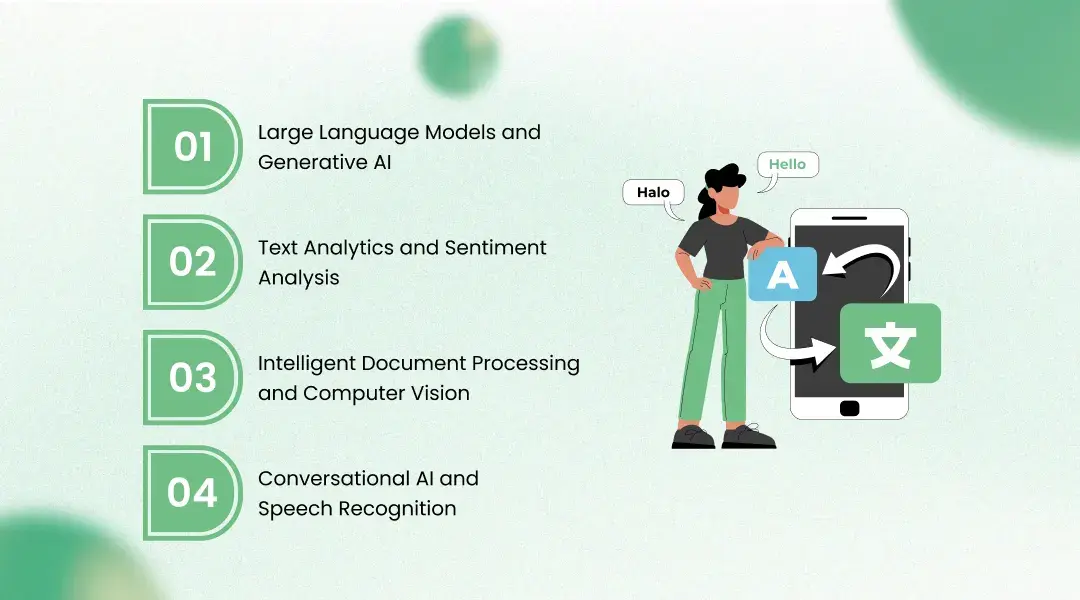
Modern natural language processing services no longer rely on the brittle rule sets that defined the field a decade ago. They combine several distinct technologies, each matched to a specific class of problem, and the difference between a good provider and a poor one is usually how precisely those technologies are mapped to real workflows. Below are the four technology families doing the heaviest lifting in enterprise NLP solutions today, with the concrete problems each one solves.
Large language models reshaped the industry by collapsing many separate tasks into one flexible engine. A single foundation model can summarize a contract, draft a reply, classify a complaint, and answer a policy question without a custom pipeline for each. Mordor Intelligence reports that machine learning and foundation models together made up close to 50 percent of enterprise artificial intelligence adoption in 2025, which reflects how central these models have become. In practice, providers wrap these models in retrieval systems so the answers stay grounded in a company's own documents rather than the open internet.
The most valuable generative applications are not chat for its own sake. They are knowledge tasks where a model reads a large body of internal text and produces a reliable, sourced answer. Contract analysis, clinical documentation, and policy lookups are common examples. The market concentration here is striking, with one widely cited Menlo Ventures analysis attributing about 88 percent of enterprise large language model spending to just three providers.
Text analytics services answer a different question than generative tools. Instead of producing new language, they measure existing language at scale. Sentiment analysis scores the emotional tone of reviews and support conversations. Topic modeling clusters thousands of messages into themes a human team would never finish reading. Entity extraction pulls names, amounts, and dates out of raw text and turns them into structured rows a database can use.
These capabilities matter because they convert opinion into evidence. A product team can see that complaints about delivery time rose 18 percent in a quarter rather than relying on anecdote. Risk teams can flag contracts that contain unusual indemnity language. The strongest text analytics services do not just label data, they connect those labels back to a business metric so the analysis drives a decision rather than ending in a dashboard.
Intelligent document processing is where language and vision meet. Many enterprise documents are scanned images, handwritten forms, or complex layouts that plain text extraction cannot read. Computer vision and optical character recognition convert those images into machine readable text, and language models then interpret the meaning. This combination is what lets a system read an invoice, locate the total, validate it against a purchase order, and route it for payment with little human touch.
The value of intelligent document processing rises with document complexity and volume. Industries drowning in paperwork, such as insurance, lending, healthcare, and logistics, see the clearest returns. A claims team that once keyed fields by hand can shift to reviewing only the exceptions the model flags. The goal is not to remove people from the process but to let them spend their attention on the small share of cases that genuinely need judgment.
Conversational AI development brings these capabilities into live interaction. Speech recognition turns calls into text, language understanding interprets intent, and generation produces a response, all fast enough to feel natural in conversation. This is the layer most customers experience directly through voice assistants, support bots, and automated agents that handle routine requests without a queue.
The economics here are blunt and well documented. NextPhone, citing IBM research, reports that an AI handled interaction costs between 25 and 50 cents while a human agent interaction costs 3 to 6 dollars. That gap is why conversational AI development has become one of the fastest moving segments of the field. The mature deployments keep a human in the loop for sensitive cases, since the failure mode of a confident wrong answer is far more costly in a live conversation than in a batch report.
[Visual suggestion: a comparison panel mapping each of the four technology families to the specific enterprise problem it solves and a representative use case.]
The returns from natural language processing services are now specific enough to model rather than promise. Contact centers that adopt artificial intelligence see roughly 30 percent operational cost reductions on average, according to industry roundups, and IBM research cited by NextPhone places customer service savings in the 30 to 50 percent range. For narrow routine tasks, the same research suggests labor cost reductions reaching as high as 90 percent. These are not uniform across every company, but the direction is consistent.
The broader picture matches the customer service numbers. Second Talent reports that organizations adopting enterprise artificial intelligence see around 34 percent operational efficiency gains and 27 percent cost reductions within 18 months of deployment. The return on spend is also becoming measurable. A widely shared analysis found that early generative adopters report 3.70 dollars of value for every dollar invested, with top performers reaching 10.30 dollars per dollar.
Scale is part of why the impact compounds. IBM disclosed that its Watson platform processed more than one billion enterprise customer interactions in 2024, a 40 percent increase over the prior year. That kind of volume is impossible to staff manually and impossible to ignore competitively. Once a system handles a billion interactions, even a small per interaction saving turns into a number that reaches the board.
Three impact patterns recur across well run deployments, and they are worth naming directly because they shape where a company should look first.
Cost displacement appears fastest in high volume, low judgment tasks such as ticket triage, invoice processing, and first line support, where text analytics services and intelligent document processing remove repetitive labor.
Speed gains show up in any process gated by reading, since a model that summarizes a hundred page document in seconds shortens cycle times that used to be measured in days.
Revenue effects arrive later but last longer, because better language understanding improves retention, personalization, and the quality of insight that feeds pricing and product decisions.
The firms that capture all three tend to start with cost, prove the model on a contained workflow, and reinvest the savings into the slower revenue plays. The firms that chase revenue first often stall, because they skip the operational base that funds everything else.
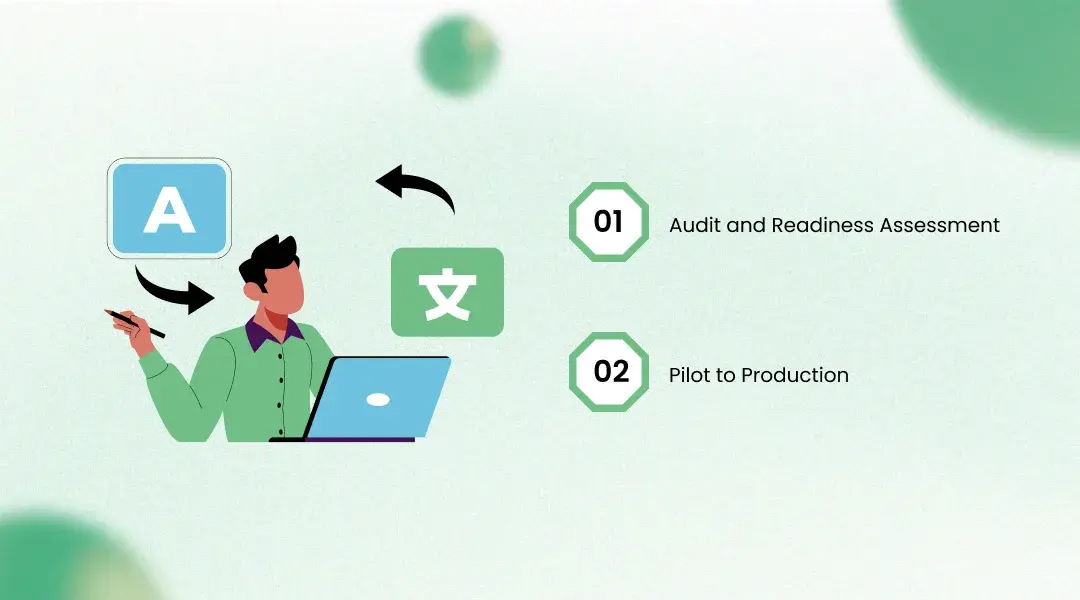
Adoption fails far more often from poor sequencing than from poor technology. A workable rollout of enterprise NLP solutions moves through clear stages, each with a defined exit before the next begins. Rushing the early stages is the single most common reason deployments stall after the demo.
The first stage answers a blunt question. Which language heavy workflows cost the most and depend least on rare human judgment. A readiness assessment inventories where text and speech enter the business, how much volume each channel carries, and what the current cost of handling it is. It also examines data quality honestly, because a model trained on messy or biased records will produce messy or biased output at speed.
This is the stage where partners like KriraAI add the most value. KriraAI builds practical artificial intelligence solutions for enterprises and starts engagements by mapping language workflows to measurable cost before any model is selected. That discipline matters because it ties the project to a financial baseline. Without a baseline, success becomes a matter of opinion rather than evidence.
The second stage proves value on one contained workflow. A good pilot is narrow enough to ship in weeks, high enough in volume to show real savings, and instrumented so the results are undeniable. The aim is not a perfect system but a credible signal that the approach works in the company's actual data, not a vendor's demo environment.
Moving from pilot to production is its own discipline rather than a flip of a switch. The stages below describe a sequence that consistently survives contact with reality.
Run the pilot in parallel with the existing process so you can compare output side by side without risking live operations.
Add a human in the loop for any decision with financial or compliance weight, then measure how often the model and the reviewer agree.
Expand scope only after accuracy holds steady across a full business cycle, since seasonal or edge case data often breaks early models.
Integrate with core systems through stable interfaces so the language layer feeds existing tools rather than forcing a parallel workflow.
Establish monitoring that tracks accuracy, cost per task, and drift, because a model that worked at launch can degrade silently as data shifts.
The most damaging mistake is buying technology before defining the problem. Teams that start with a model and look for a use case almost always overspend and underdeliver. The fix is to start from the audit and let the workflow choose the technology, which is the order strong providers enforce.
A second common error is skipping the human in the loop too early. The data is sobering here, since one industry roundup found that 39 percent of artificial intelligence customer service bots were pulled back or reworked due to errors in 2024. In response, about 76 percent of enterprises now build human review into their processes. A third mistake is treating deployment as the finish line rather than the start of monitoring, which is where quiet accuracy decay erodes the early gains.
[Visual suggestion: a horizontal roadmap graphic with four phases, audit, pilot, production, and monitoring, each annotated with its exit criteria.]
The honest reality is that natural language processing services are powerful and genuinely hard to do well. Data quality is the first and largest obstacle, and the data backs this up. Second Talent reports that 73 percent of enterprises name data quality as their biggest challenge in artificial intelligence adoption. A model is only as reliable as the records it learns from, and most enterprise text was never created with machine reading in mind.
Talent is the second constraint. Skilled practitioners who understand both the technology and the business context remain scarce, and the wage premium for those skills has climbed sharply. Many companies lack the internal expertise to evaluate vendors, which leaves them vulnerable to overpromised demos. This is part of why specialized partners exist, since few firms can build and retain a full language engineering team for a single line of work.
Regulation adds a third layer of difficulty that varies by region and industry. The European Union's artificial intelligence rules, healthcare privacy law, and financial compliance regimes all constrain what data can be used and how decisions must be explained. A system that cannot justify its output is unusable in regulated settings regardless of its accuracy. Several other limitations deserve plain statement rather than reassurance.
Integration complexity is real, because language systems must connect to legacy software that was never designed to consume model output.
Accuracy is probabilistic rather than guaranteed, so any process that demands certainty needs human review built in by design.
Change management often decides success more than the technology, since staff who distrust or bypass a new system will quietly undermine it.
Cost can creep upward as usage scales, especially with premium models, which makes ongoing cost monitoring a permanent rather than a one time task.
None of these challenges argue against adoption. They argue for adoption done carefully, with realistic scope and honest measurement. The companies that pretend these problems do not exist are the ones most likely to abandon a project after a disappointing first attempt.
The next three to five years will shift the field from assisting people to acting on their behalf. Today most language systems recommend an action and a human carries it out. Mordor Intelligence notes that as accuracy improves, leadership teams are increasingly authorizing systems to execute decisions rather than merely suggest them. By the end of the decade, agentic language systems that read, decide, and act inside defined limits will be common in well governed enterprises.
A second change is the move toward smaller, specialized models running closer to a company's own data. Cloud deployment already holds about 63 percent of the market, according to Mordor Intelligence, but the pull of privacy and cost will push more sensitive workloads onto tuned models that an enterprise controls directly. Conversational AI development will mature from scripted bots into agents that hold context across an entire customer relationship rather than a single session.
The competitive landscape will split along a clear line. The companies that built clean data foundations and treated language as infrastructure will compound their advantage, because their systems improve as their data grows. The companies that ran a single pilot and stopped will find the gap widening faster than they can close it. Language capability is becoming cumulative, which means late movers do not simply start behind, they start behind a rival whose system is already learning.
The firms most at risk are not the smallest ones. They are mid sized incumbents with large data backlogs and slow decision cycles, since their advantage was scale and that advantage erodes when a nimbler rival reads and acts on text faster. The protective move is to start now on a contained workflow and build the operational habit of measurement, rather than waiting for the technology to feel finished. It will not feel finished, because it will keep moving.
Three points carry the most weight for any leader weighing this decision. The first is that the returns are now specific and measurable, with operational cost reductions of roughly 30 percent in contact centers and 27 percent across broader deployments inside 18 months. The second is that sequencing matters more than technology, since a careful path from audit to pilot to monitored production succeeds where impressive demos stall. The third is that advantage in this field compounds, so the gap between early and late movers widens rather than closes over time.
This is where KriraAI fits into the picture as a practical partner rather than a generic vendor. KriraAI builds artificial intelligence solutions for enterprises that are designed to be measurable and built for scale, starting from a workflow audit that ties every project to a clear cost baseline before any model is chosen. That approach is what separates enterprise NLP solutions that deliver real savings from ones that produce a promising pilot and little else. KriraAI focuses on the unglamorous work of integration, human oversight, and ongoing monitoring that turns a model into a dependable part of the business.
If your organization is processing language at scale and wants a deployment grounded in evidence rather than hype, it is worth a conversation with KriraAI to map where natural language processing services would move your numbers first. The technology will keep advancing whether or not any single company acts, so the practical edge belongs to the firms that start now on a contained workflow and build the habit of measuring what works. Reach out to KriraAI to explore how a focused first project could prove the value in your own data within a single business cycle.
Natural language processing services are managed offerings that help organizations analyze, understand, and generate human language at scale using artificial intelligence. They combine technologies such as large language models, text analytics, optical character recognition, and speech recognition to read documents, interpret messages, classify sentiment, extract data, and power conversational agents. Companies use them to automate language heavy work that humans cannot realistically do in full, such as reviewing millions of support tickets or thousands of contracts. The services are typically delivered as cloud platforms or custom built solutions, and the market is estimated near 39 billion dollars in 2025 with strong projected growth through the rest of the decade.
The cost of natural language processing services varies widely based on volume, complexity, and whether you use a standard platform or a custom build. On a per interaction basis the savings are clear, since IBM research cited by NextPhone shows an artificial intelligence handled interaction costs between 25 and 50 cents compared with 3 to 6 dollars for a human agent. Platform subscriptions, model usage fees, integration work, and ongoing monitoring all factor into the total. Most enterprises find the relevant question is not the sticker price but the return, and early adopters report between 3.70 and 10.30 dollars of value for every dollar invested. A proper readiness assessment that ties the project to a cost baseline is the most reliable way to estimate true cost.
Natural language processing is the broad field concerned with how computers handle human language, while generative artificial intelligence is one powerful approach within that field. Traditional NLP includes tasks such as classification, entity extraction, and sentiment scoring, which measure or label existing text rather than create new text. Generative AI, powered mostly by large language models, produces new language such as summaries, drafts, and answers. Modern natural language processing services usually blend both, using generative models for open ended tasks and analytical methods for measurement and structured extraction. Thinking of generative AI as a recent and especially flexible tool inside the wider NLP toolkit is the most accurate way to understand the relationship.
Businesses use natural language processing services to automate any workflow that depends on reading, writing, or listening at scale. Common applications include customer support automation, where conversational agents handle routine requests, and intelligent document processing, where systems extract data from invoices, claims, and contracts. Text analytics services help companies measure sentiment across reviews and detect emerging issues in support conversations. Banks use them for compliance screening, insurers for claims triage, healthcare providers for clinical documentation, and retailers for personalization. IBM reported that its Watson platform processed more than one billion enterprise customer interactions in 2024, which shows the scale at which these services now operate in real organizations.
No, natural language processing and machine learning are related but not the same. Machine learning is a broad method in which systems learn patterns from data rather than following fixed rules, and it is used across many domains including images, fraud detection, and forecasting. Natural language processing is the specific application of these and other techniques to human language. Most modern NLP relies heavily on machine learning, and Mordor Intelligence reports that machine learning and foundation models together made up close to half of enterprise artificial intelligence adoption in 2025. So NLP frequently uses machine learning as its engine, but machine learning extends far beyond language and language work also draws on linguistic methods that are not purely statistical.
Founder & CEO
Divyang Mandani is the CEO of KriraAI, driving innovative AI and IT solutions with a focus on transformative technology, ethical AI, and impactful digital strategies for businesses worldwide.