Let me guess.
You’ve been hearing “multi-agent systems” everywhere lately. LinkedIn. Tech blogs. That one founder who suddenly thinks he’s an AI expert.
And now you’re wondering…
Is this actually important? Or just another buzzword wearing a lab coat?
So no fluff here. Just clarity.
A multi-agent system is a setup where multiple AI agents work together (or sometimes against each other) to solve a problem.
Not one brain.
A team of brains.
Each with a role.
Think of a restaurant.
One person takes orders
Another cooks
Another serves
Now imagine replacing each human with an AI agent.
That’s a multi-agent AI system.
Simple. But powerful.
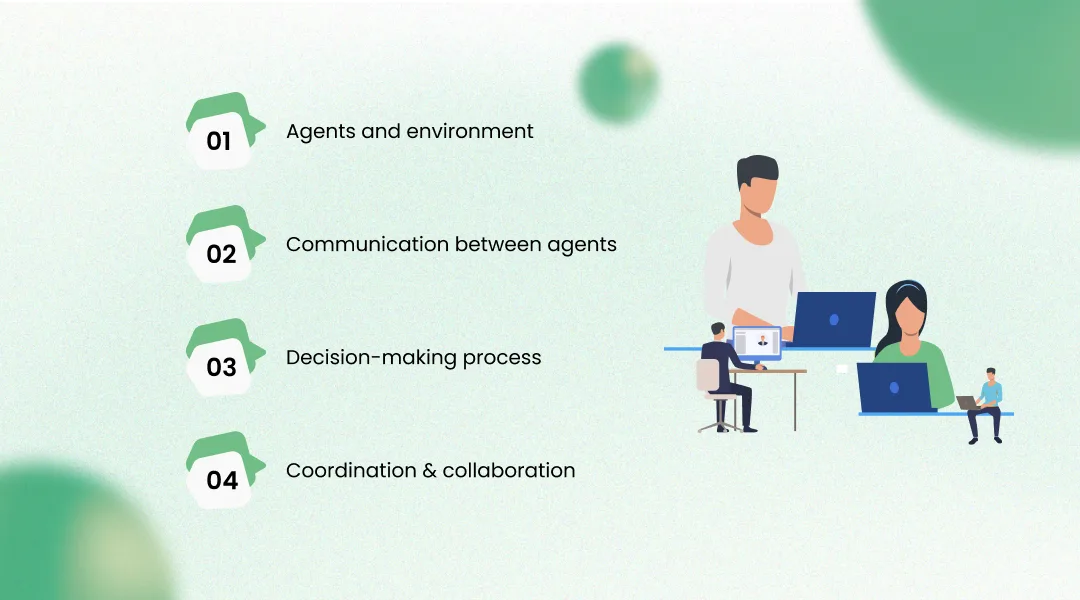
Each agent operates inside an environment.
It observes. Decides. Acts.
Repeat.
Here’s where things get interesting.
Agents talk.
Not like humans. But through structured messages, APIs, or signals.
And sometimes… they misunderstand each other. (Yes, even AI has communication issues.)
Each agent has its own logic.
Some follow rules. Others learn from data.
In advanced setups, they adapt in real time.
Now imagine 10 agents trying to solve one problem.
Without coordination? Chaos.
With coordination? Magic.
That’s where collaborative AI agents shine.
Agents work toward a shared goal.
Example: delivery optimization.
Agents compete.
Think of stock trading bots trying to outsmart each other.
A mix of both.
And honestly? This is where most real-world systems land.
Centralized: One controller manages all agents
Decentralized: Agents operate independently
I’ve seen decentralized systems outperform centralized ones… until they don’t.
(That’s the trade-off no one talks about.)
Some agents lead. Others follow.
Like a company structure.
This is where things scale.
Agents spread across systems, locations, even cloud environments.
Welcome to distributed AI systems.
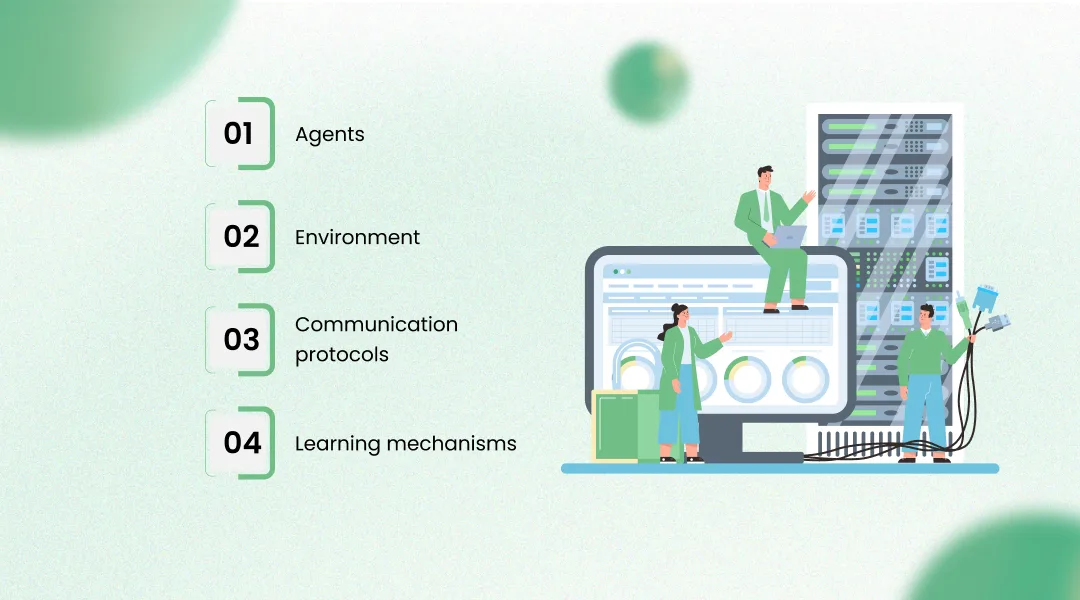
The core decision-makers.
Where everything happens.
Rules for interaction.
How agents improve over time.
Single-agent = one system solving everything. Multi-agent = multiple specialized systems collaborating
Multi-agent wins in:
Scalability
Flexibility
Complex problem-solving
But…
They’re harder to build. Harder to debug. Harder to trust.
Let’s be honest.
Multiple agents handle perception, navigation, and control.
Signals adjust dynamically based on real-time data.
Different agents handle queries, sentiment, and escalation.
This is where tools like AI Call Agents in eCommerce and AI Phone Agent systems are already evolving.
This is where most people lean forward.
“Okay… but how does this help my business?”
Good question.
Multi-agent systems power smarter support flows.
Example:
One agent understands intent
One retrieves data
One responds
Industries are already adapting:
AI Voice Agents in Healthcare
AI Voice Agents in Insurance
AI Voice Agents in Retail
AI Voice Agents in Travel
AI Voice Agents in Finance
Lead qualification. Follow-ups. Personalization.
All handled by coordinated agents.
Inventory. Logistics. Demand prediction.
Handled across multiple agents.
Fast. Competitive. Ruthless.
Exactly how markets behave.
Add more agents. Expand capabilities.
Modify one agent without breaking everything.
Parallel processing = faster outcomes.
Less manual work. More intelligent workflows.
Let’s not pretend it’s all perfect.
More agents = more chaos if not managed well.
Too much communication slows systems down.
More agents = more attack points.
And yes… this matters more than most teams realize.
Now this part?
This is where it gets serious.
Entire businesses are run by agent ecosystems.
Minimal human intervention.
Agents negotiating. Deciding. Acting.
Without humans in the loop.
Let that sink in.
Combine that with systems?
You get something powerful.
Tools like Best AI Voice Agent Software are already heading in this direction.
So… what are multi-agent systems really?
Not hype.
Not magic.
Just a smarter way to build complex AI systems using smaller, specialized pieces.
Engineering teams frequently overcomplicate orchestration design, whereas experts at KriraAI help organizations build balanced multi-agent architectures that drive measurable enterprise value.
And I’ve seen others ignore it completely.
Both are mistakes.
The real advantage?
Understanding when not to use it.
They are systems where multiple AI agents interact to solve problems collaboratively or competitively.
Agents observe, communicate, make decisions, and coordinate actions within an environment.
AI agents are individual units; multi-agent systems involve multiple agents working together.
They are used in robotics, customer support, traffic systems, finance, and automation.
Yes, especially for complex, scalable, and autonomous systems.
Founder & CEO
Divyang Mandani is the CEO of KriraAI, driving innovative AI and IT solutions with a focus on transformative technology, ethical AI, and impactful digital strategies for businesses worldwide.