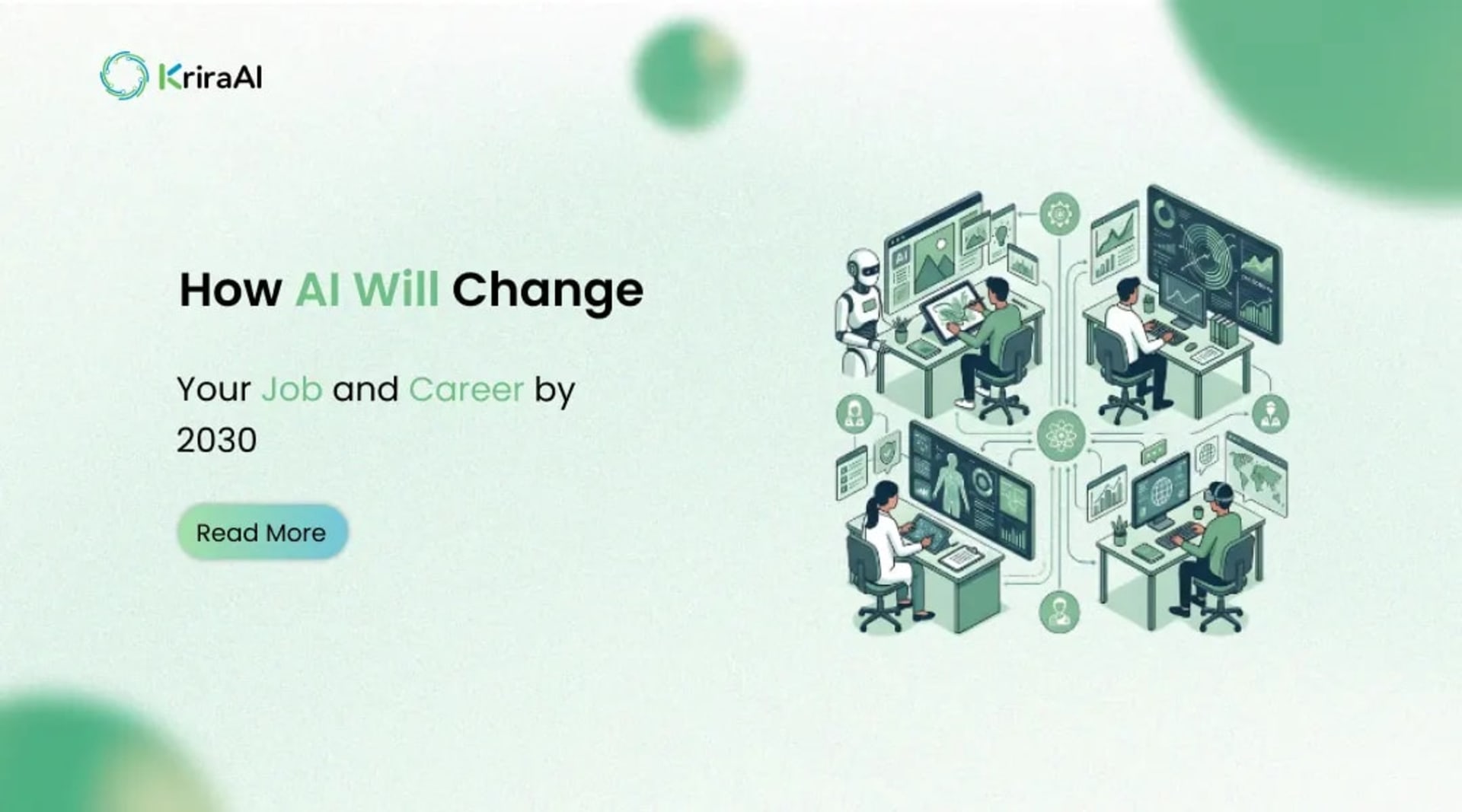
Picture yourself arriving at work in 2029. You do not spend the first two hours of your day clearing emails, reformatting reports, or chasing down data that should have been easy to find. An AI system has already done all of that. It has read the overnight correspondence, summarised what requires your attention, flagged one situation that genuinely needs your judgment, and drafted three responses for your review. Your calendar is organised around the two things that actually require your human presence today: a negotiation with a key partner, and a creative session with your team to solve a problem nobody has solved before.
This is not a fantasy. It is the logical destination of trends that are already accelerating right now, and the distance between today and that morning is shorter than most people expect. The question that matters is not whether this shift is coming. It is whether you will arrive at that morning having prepared for it, or having been overtaken by it.
Understanding how AI will change your job by 2030 is the most professionally important thing you can do right now. Not because AI is going to replace you, though for some roles the transformation will be severe, but because the gap between people who understand where this is heading and people who do not will become one of the most significant dividing lines in the workforce of the next decade. The people who thrive will not necessarily be the most technically skilled. They will be the people who understood the shift early, adapted their skills deliberately, and positioned themselves on the right side of the human and AI collaboration that is about to define every professional environment.
This blog is a preparation guide for that shift. It will show you what the current signals already tell us about where work is heading, give you an honest timeline of when different changes are likely to land in different industries, explain clearly which categories of work are most exposed and which are most durable, and close with specific and actionable guidance on what to do before 2030 arrives. The goal is not to frighten you. It is to give you the clearest possible picture of a change that is coming regardless, so that you can meet it on your own terms.
The transformation of work by AI is not a future event. It is a present-tense process that is already underway in every industry, and the pace of that process is accelerating. Understanding where we are right now is the necessary starting point for understanding where we are going.
Across industries, the first category of work to be affected by AI has been structured, repetitive, and information-processing tasks. Customer service teams are already handling more enquiries per person than they were three years ago, not because people are working harder, but because AI tools are resolving a growing proportion of standard requests before a human ever touches them. Marketing teams are producing more content with the same or smaller headcounts because AI writing and image tools have compressed the time required for first-draft production. Legal teams at large firms are reviewing contracts faster because AI can flag clauses that need attention. Finance teams are closing books faster because AI can perform reconciliations that once took days.
These are not anecdotes. They are documented productivity shifts happening at scale in organisations that have begun deploying AI tools seriously. And they represent only the earliest phase of a much deeper transformation. The AI systems doing this work today are relatively narrow. They can do specific, well-defined tasks well. The systems that will be deployed over the next three to five years will be dramatically more capable, more general, and more autonomous.
Right now, there is a growing split between organisations that have begun seriously integrating AI into their workflows and those that have not. That split is creating a competitive gap that will be very difficult to close once it opens fully. Companies like KriraAI, which builds production AI systems for organisations across industries, are seeing firsthand how quickly that gap grows once AI is genuinely embedded in operations. An organisation that has AI-augmented its sales, operations, and customer success functions by 2026 will not simply be a little more efficient than one that has not. It will be operating in a fundamentally different mode, able to do more with less, move faster, and free its people for higher-value work.
For workers, the implication of this split is clear. The organisations that are AI-integrating now will be the employers of the future. The skills that matter in those organisations will be different from the skills that mattered in organisations that have not yet changed. And the shift is happening faster than most career planning AI solutions for finance cycles account for.
The most useful thing any guide about AI and work can do is give honest, grounded predictions about timing. Vague warnings about AI changing everything someday are not helpful. What workers and business owners actually need is a realistic picture of when specific changes are likely to land.
Here is the most grounded timeline based on current technological trajectories and industry adoption patterns:
By 2026: AI copilots and writing assistants will be standard tools in the majority of white-collar workplaces, much as email clients and spreadsheets are today. Roles that resist adopting these tools will feel the same kind of professional friction that someone who refused to use email felt in the early 2000s.
In customer service, finance, legal, and marketing, productivity expectations per person will rise significantly because AI is handling the structured baseline work.
By 2027: Autonomous AI agents, systems that can complete multi-step tasks on your behalf without constant supervision, will move from early experimentation into mainstream business deployment. These are not chatbots that answer questions. They are systems that can research a topic, compile information, draft a proposal, check it against a set of criteria, and deliver a finished output. The roles most affected by this wave will be junior analyst positions, entry-level research roles, and any job that is primarily about gathering, organising, and summarising information.
By 2028: AI will be operating with persistent memory and contextual understanding of individual businesses, meaning the systems will not just complete tasks but will understand your specific company, your customers, your history, and your goals well enough to make genuinely useful recommendations and take actions aligned with your strategy. This will fundamentally change the role of operations managers, project managers, and business analysts.
By 2030: The majority of professional work will involve daily collaboration with AI systems that handle routine cognitive tasks, allowing human workers to focus on judgment, relationships, creative problem-solving, and leadership. Roughly 30 percent of current task content across white-collar jobs will be automated or substantially AI-assisted by this point, according to trajectories consistent with current adoption rates and model capability improvements.
This is the question everyone actually wants answered, and it deserves a direct and honest response. Understanding how AI will change your job by 2030 requires understanding which types of work AI is good at and which types it is not, and matching that against your own professional situation.
AI is exceptionally good at tasks that involve processing structured information, following consistent rules, and producing outputs in predictable formats. The job categories most exposed to significant automation or workforce reduction by 2030 include:
Data entry and data processing roles of all kinds, where the human value was primarily about moving information from one system to another.
Routine customer service and support roles that handle standard enquiries with standard responses, which AI can manage with higher speed and consistency than humans.
Junior research and analysis positions whose primary function is gathering publicly available information, summarising it, and presenting it in a report format.
First-draft content production roles, including certain journalism, copywriting, and content creation positions that are primarily about volume output.
Standard financial reporting and bookkeeping tasks that follow defined processes and produce defined outputs.
Routine legal document review, specifically the initial pass through large document sets looking for specific clause types or compliance issues.
This list is not meant to frighten people in these roles. It is meant to help them understand that the threat is real, that it is arriving in stages rather than all at once, and that the most powerful response is to begin moving toward the parts of these roles that AI cannot easily replicate.
AI is genuinely poor at a different category of tasks, and those tasks will not only survive the transformation but will increase in value precisely because AI handles everything around them. The most durable categories of work include:
Relationship-intensive roles where the human connection is the product, including sales relationships built on trust, therapy, coaching, and senior client management.
High-stakes judgment calls that require synthesising ambiguous information, reading between the lines, and taking responsibility for outcomes in situations where the right answer is not clear.
Creative work that involves genuine originality, cultural sensitivity, and emotional resonance rather than production of competent standard outputs.
Leadership and organisational culture work, including building teams, navigating conflict, inspiring people, and making decisions under uncertainty.
Physical and sensory work in complex real-world environments, including skilled trades, surgery, hands-on healthcare, and work in unpredictable physical settings.
Teaching and mentoring in their deepest form, the kind that reads a specific person's confusion and responds to it with exactly the right explanation at exactly the right moment.
Between the two categories above is the largest group of all: roles that will not disappear but will change so significantly that the person doing them in 2030 will be doing a fundamentally different job than the person doing them today. A marketing manager in 2030 will spend far less time briefing content writers and reviewing drafts, and far more time setting strategy, interpreting results, and making creative calls that require genuine taste and judgment. An accountant in 2030 will spend far less time on data processing and far more time advising clients on decisions. A lawyer in 2030 will spend far less time on document review and far more time on strategy and advocacy.
The people who thrive in these transformed roles will be the ones who deliberately cultivated the judgment, relationship, and creative skills that AI cannot supply, while becoming genuinely fluent in directing AI tools to handle everything else.
Beyond the question of which jobs survive is the more intimate question of what work will actually feel like when AI is deeply embedded in it. This is worth thinking about concretely, because the texture of daily professional life is about to change in ways that most people have not fully imagined.
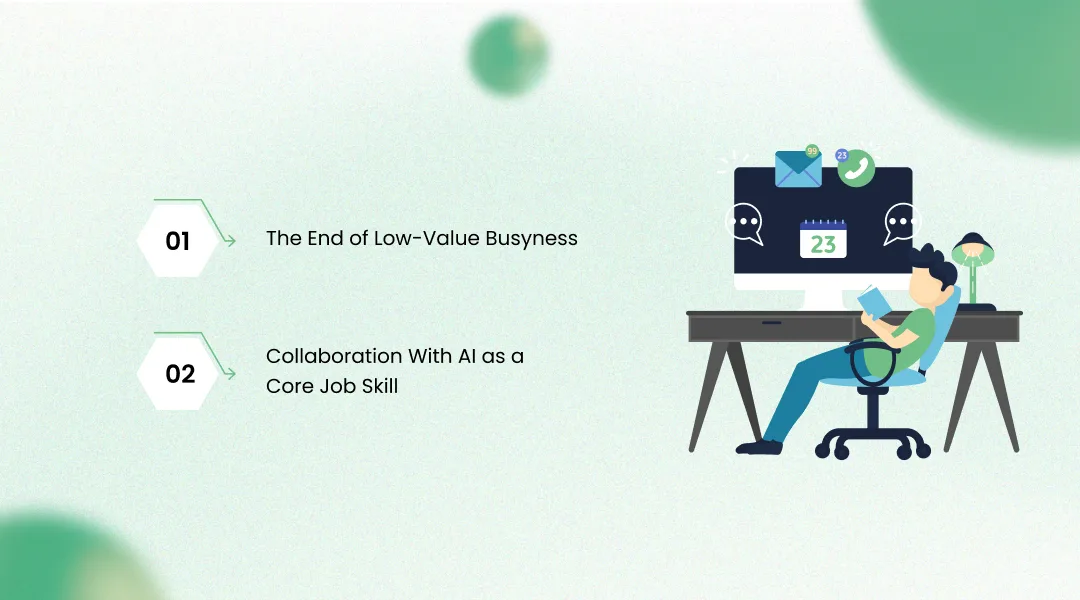
One of the least appreciated changes coming is the elimination of what might be called low-value busyness: the endless administrative overhead that fills professional days without producing genuine value. Scheduling, note-taking, status reporting, routine documentation, and the management of routine communications consume enormous amounts of time in almost every professional role today. By 2028, AI agents embedded in professional workflows will handle the vast majority of this overhead automatically and continuously. The net effect will be a significant expansion of the time available for the work that actually matters.
This sounds entirely positive, and in many ways it will be. But it will also create new pressures. When AI eliminates the padding from professional life, the expectation of output will rise to match. If you can produce three times as much genuine work because AI handles your administrative burden, the competitive baseline will shift accordingly. The workers who will benefit most from this change are those who are energised by the high-value parts of their work and have been frustrated by the administrative drag. The workers who will struggle are those who have been filling time with low-value activity without realising it.
By 2027, the ability to work effectively with AI systems will be as fundamental to most professional roles as the ability to use a computer is today. This does not mean writing code or understanding algorithms. It means knowing how to define problems clearly enough for AI to help solve them, how to evaluate AI outputs critically rather than accepting them uncritically, how to direct AI tools toward useful work and recognise when they are going wrong, and how to combine AI capabilities with your own judgment in ways that produce better outcomes than either could produce alone.
This skill is sometimes called prompt engineering in technical circles, but for non-technical workers a more useful frame is AI direction: the ability to be a clear, effective director of AI tools the way a good manager is a clear, effective director of human teams. This is a genuinely learnable skill, and the time to begin learning it is now, not when your employer mandates training in three years.
One of the most counterintuitive truths about the AI-transformed workplace is that the most specifically human skills will not decrease in value. They will increase. This happens precisely because AI is so good at the things it is good at. When routine cognitive work is automated, the scarce and valuable thing becomes the work that only humans can do well.
The skills that will command the highest premium in the AI economy of 2030 include:
Critical thinking and judgment in ambiguous situations: The ability to look at a situation where the right answer is not obvious, weigh competing considerations, and make a defensible decision. AI can generate options and analyse data, but the human sitting at the table who can make the call will be essential.
Emotional intelligence and interpersonal reading: Understanding what a person actually needs, reading the subtext of a difficult conversation, building genuine trust with someone who is uncertain or resistant. These capabilities are beyond current AI and will remain so throughout this decade.
Cross-domain synthesis: The ability to connect ideas from different fields, industries, and disciplines in ways that generate genuinely novel insights. AI is excellent at depth within a domain. It is much weaker at the kind of creative cross-pollination that produces breakthrough ideas.
Communication that moves people: Not the production of clear, competent text, which AI can already do, but the kind of communication that inspires, persuades, builds relationships, and changes how people feel. The gap between technically correct communication and genuinely compelling communication will be where human value concentrates.
Ethical reasoning and accountability: As AI systems take on more consequential tasks, the humans who can think clearly about what should and should not be done, and who are willing to take responsibility for difficult decisions, will become more important, not less.
KriraAI works with organisations to identify exactly where these human skills intersect with AI capability in their specific business contexts, helping teams understand which investments in human development will produce the most durable competitive advantage as the technology continues to advance.
If you are running a business or leading a team, the AI transformation of work creates both significant opportunities and significant risks, and the two are arriving at roughly the same time.
For the first time in the history of business, it is becoming possible for a small team to operate with the output and analytical depth of a much larger one. A ten-person business that integrates AI seriously into its operations by 2026 will be able to do the kind of research, content production, customer management, and data analysis that previously required a team of thirty or forty. This is not theoretical. Organisations that have already made this transition are seeing it in their numbers. The businesses that understand this and act on it while their competitors are still debating whether to engage will establish advantages that will be genuinely difficult for later movers to close.
The risk for business leaders is not that AI will destroy their business from the outside. The greater risk is making poor decisions about how to integrate AI on the inside. The two most common mistakes are moving too slowly out of uncertainty or resistance, and moving too quickly in ways that disrupt your team and produce systems that do not actually work in your specific context. The organisations navigating this transition well are the ones doing it thoughtfully, with clear understanding of where AI adds genuine value in their specific workflows, and with a real investment in helping their teams develop the skills to work alongside the technology rather than being threatened by it.
KriraAI helps business owners and leaders think through exactly this transition, building AI solutions that are calibrated to specific business needs rather than deploying generic tools and hoping they work. The difference between AI that genuinely transforms your operations and AI that creates expensive confusion is almost always in the quality of the implementation strategy.
No honest conversation about how AI will change your job by 2030 can avoid the anxieties that come with this territory. Those anxieties are real and they deserve direct answers.
The most accurate answer is: it depends on what your job actually is at the task level. AI will not take your job in a single event. What will happen is that specific tasks within your job will be automated over time, the mix of your responsibilities will shift, and the roles that are mostly composed of tasks AI does well will shrink while the roles composed of tasks only humans can do well will grow. The net effect on employment overall is genuinely uncertain. History suggests that major technological transitions create as many jobs as they eliminate, though not always for the same people or in the same places. The most important thing you can do is not wait to find out what happens to your role, but begin actively shaping what your role becomes.
This is a legitimate concern and the honest answer is: for some people, yes, the pace of change will exceed their individual capacity to adapt without support. This is why the institutions around work, including employers, governments, and educational systems, have a real responsibility to create conditions for managed transition rather than leaving individuals to navigate the shift alone. But for the individual reading this blog right now, the pace is not yet beyond manageability. There is still meaningful time to build skills, develop fluency with AI tools, and position for the transformed workplace rather than the disappearing one. The window is not indefinitely open, but it is open now.
You do not need to be technical to thrive in an AI-integrated workplace. The skills that will matter most, judgment, relationships, creativity, communication, and ethical reasoning, are not technical skills. What you do need is enough familiarity with AI tools to direct them effectively, which is a practical skill that can be developed through deliberate use rather than formal study. Think of it the way most people learned to use smartphones: not by studying the engineering, but by using them, experimenting, and gradually developing fluency through practice.
Understanding the future is only useful if it translates into action. Here is a specific and prioritised set of steps for workers and business owners preparing for how AI will change your job by 2030.
Audit your current role at the task level. Write down the ten most common tasks you perform in a typical week. For each one, ask honestly whether it involves structured information processing and predictable outputs, or whether it requires the kinds of human judgment, relationship, and creativity that are durable. This audit will tell you more about your real exposure than any general article can.
Begin using AI tools actively right now. Do not wait for your employer to mandate training. Use AI writing tools, AI research assistants, and AI productivity tools for your own work today. Develop fluency through genuine use. The goal is not to understand how they work at a technical level but to develop an intuitive sense of what they are good at, where they go wrong, and how to direct them effectively.
Invest in the skills that AI cannot replicate. Identify the most human-dependent skill in your current role or aspired role and invest deliberately in developing it. This might mean practising difficult conversations, developing a specialisation in a complex domain that requires deep contextual judgment, or building the kind of cross-functional relationships that turn you into the person others come to when they need something a tool cannot provide.
Learn the language of your industry's AI transformation. You do not need to understand machine learning. But you should understand what AI tools are relevant to your industry, what they can and cannot do, and what the mainstream adoption trajectory looks like. This knowledge will make you a more valuable participant in every conversation your organisation has about how to move forward.
Identify your highest-leverage AI integration opportunities. Rather than deploying AI broadly and hoping something works, identify the two or three workflows in your business where AI assistance would create the most significant impact on output quality, speed, or cost. Start there, do it properly, and build from a foundation of real success.
Build your team's AI fluency as a strategic priority. The organisations that will extract the most value from AI are not the ones with the best tools. They are the ones with teams who know how to use tools well. Investing in genuine training and practice for your people is the highest-return AI investment most businesses can make right now.
Redefine the roles in your organisation deliberately. As AI handles more routine tasks, the job descriptions that made sense three years ago will increasingly not fit the work that actually needs doing. The business owners who are proactively redefining what they need from their people, and helping their people develop toward those redefined roles, will build teams that are genuinely ready for the AI-integrated workplace.
The three most important things to understand about how AI will change your job by 2030 are these. First, the transformation is already in motion and the pace will accelerate significantly over the next three years, meaning the time for preparation is now rather than later. Second, the workers who will thrive are not necessarily the most technical but those who have developed genuine fluency with AI tools while deepening the human skills that AI cannot replicate, specifically judgment, relationships, and creativity. Third, the organisations that will come out ahead are those that approach this transition deliberately and strategically, integrating AI in ways that genuinely serve their specific workflows and invest seriously in developing their people alongside the technology.
The future of work is not a choice between humans and AI. It is a new kind of collaboration in which humans who understand how to direct AI effectively will achieve things that neither humans nor AI could achieve alone. That collaboration is not a distant possibility. It is arriving on a concrete and accelerating timeline, and the distance between where you are today and where you need to be is crossable if you begin moving now.
KriraAI exists at exactly this intersection, building production AI systems for organisations that want to move forward with intelligence and intention rather than uncertainty and delay. As a company that stays at the frontier of AI development and has seen what genuine AI integration produces for organisations across industries, KriraAI understands that the difference between AI that transforms your business and AI that creates expensive confusion is almost entirely in the quality of the thinking behind the implementation. If you are ready to understand what the AI future means specifically for your organisation and your people, and to build toward it with clarity rather than guesswork, explore how KriraAI can help you navigate what is coming before it arrives.
The transformation of work by AI will happen in waves rather than in a single event, and different industries and roles will experience those waves at different times. The first wave, already underway, primarily affects structured repetitive tasks in office and administrative environments. The second wave, likely to peak between 2026 and 2028, will affect junior analytical and research roles as AI agents become capable of completing multi-step cognitive tasks. The third wave, arriving closer to 2030, will reshape management and professional roles as AI systems develop genuine contextual understanding of specific businesses and domains. For most workers, this means the change will feel gradual until it suddenly feels significant. The advantage goes to those who begin adapting during the gradual phase rather than waiting for the significant one.
No category of job is entirely safe from transformation, but the jobs most at risk of significant reduction are those composed primarily of structured information processing: data entry, standard customer service, routine document review, first-draft content production at volume, and standard financial reporting. The jobs most durable against replacement are those requiring genuine human judgment in ambiguous situations, deep interpersonal relationships, creative originality, physical skill in complex environments, and ethical accountability. The largest category is in between: jobs that will be substantially transformed, with the routine portions automated and the human portions elevated. For most knowledge workers, the honest answer is that your job will change significantly rather than disappear, and the direction of that change is toward higher-value work if you prepare for it.
The most valuable skills to develop before 2030 fall into two categories. The first is practical AI fluency: the ability to direct AI tools effectively, evaluate their outputs critically, and integrate them into your workflow in ways that genuinely improve your output. This is developed through deliberate practice rather than formal study. The second category is the distinctly human skills that become more valuable as AI handles more cognitive routine work: judgment in ambiguous situations, genuine relationship building, creative synthesis across domains, and compelling communication. These are not new skills. They are the skills that distinguished excellent performers from average ones in every era of work. AI does not change what they are. It changes how much they are worth.
Small businesses and entrepreneurs stand to benefit disproportionately from the AI transformation of work, precisely because AI levels the capability playing field. Tasks that previously required hiring specialists, including content creation, data analysis, customer service, and research, will increasingly be accessible to a one-person or small-team business at a fraction of the previous cost. The AI-empowered solo operator or small business of 2028 will have access to analytical and operational capabilities that were previously available only to large organisations. The businesses most at risk are those in the middle: large enough to have built cost structures around human labour for routine tasks, but not large enough to absorb the disruption of rapid transformation. For entrepreneurs who embrace the shift early, the opportunity is genuinely significant.
The clearest indicator of near-term disruption is the proportion of work in your industry that involves processing documented information and producing documented outputs. Industries with high volumes of contracts, reports, correspondence, structured data, and standard procedures, including law, finance, insurance, consulting, and healthcare administration, are seeing AI tools penetrate fastest because the inputs and outputs are already in digital, structured form. Industries where work is primarily physical, relational, or creative in the most genuine sense, including skilled trades, social work, performing arts, and senior leadership, will see slower penetration. If your industry sits in the first category and your organisation has not yet begun AI integration, the window for planned and deliberate adaptation rather than reactive disruption is narrowing.
Founder & CEO
Divyang Mandani is the CEO of KriraAI, driving innovative AI and IT solutions with a focus on transformative technology, ethical AI, and impactful digital strategies for businesses worldwide.