It is a Tuesday morning in 2028. Maria owns a bakery with eleven employees in a mid-sized city. She wakes up, checks her phone, and sees that her AI business assistant has already done several things while she slept. It analysed yesterday's sales and adjusted tomorrow's ingredient orders to avoid the over-ordering that used to cost her thousands each year. It drafted three social media posts featuring her best-selling items, customised for the neighbourhoods where her delivery orders are growing fastest. It flagged that one of her refrigeration units is showing early signs of a mechanical issue and scheduled a repair visit before anything breaks down. It also prepared a summary of her cash flow for the week with a gentle note that she might want to delay a non-urgent equipment purchase by ten days to keep her buffer comfortable.
Maria did not hire a data analyst, a social media manager, a facilities coordinator, or a financial advisor to get all of this done. She pays less per month for this AI assistant than she used to pay for her old accounting software. Five years ago, this kind of operational intelligence was something only large corporations with dedicated technology teams could access. Now it is as routine for Maria as checking her email.
This scenario is not science fiction. Every individual capability described above exists in some form today, but only in fragmented, expensive, or complex tools that most small business owners cannot realistically use. What will change over the next five years is not the invention of these capabilities but their integration, simplification, and dramatic cost reduction to the point where a bakery owner, a plumbing contractor, a freelance designer, or a neighbourhood law firm can use them as easily as they use a smartphone.
This blog is about how AI will change small businesses between now and 2031. It is written for business owners, entrepreneurs, professionals, and anyone who wants to understand what is genuinely coming, when it will arrive, what it will mean for how small companies compete and operate, and what you should be doing now to be ready. We will walk through a clear, honest, year-by-year timeline. We will look at specific industries and specific tasks. We will address the real concerns about cost, job loss, and complexity. And we will be direct about what AI will not do, because the hype is just as dangerous as the ignorance.
If you run a small business or work in one, the next five years will bring changes to your daily operations that are as significant as the arrival of the internet was for the generation before you. Understanding those changes now is not optional. It is the difference between riding the wave and being caught underneath it.
Before we look forward, let us make sure we are speaking the same language. When this blog talks about AI for small business, it is not talking about the kind of artificial intelligence you see in movies. It is not talking about robots that think like humans or machines that will run your entire company. It is talking about software tools that can do specific cognitive tasks, things that used to require a human brain, faster, cheaper, and often more accurately than a person can do them alone.
Think of it this way. Over the past thirty years, software has automated physical paperwork. Spreadsheets replaced ledger books. Email replaced posted letters. Online calendars replaced desk diaries. What AI does is automate a layer above that. It automates the thinking involved in using those tools. Instead of you looking at a spreadsheet and deciding what the numbers mean, an AI tool can look at the same spreadsheet and surface the insight for you. Instead of you writing an email from scratch, an AI tool can draft it based on what you want to say and the tone you usually use.
Until very recently, these thinking-automation tools required enormous investment. A large retail chain could afford to build custom systems that predicted which products would sell in which stores next week. A major bank could afford software that detected unusual transactions in real time. A multinational corporation could afford AI systems that screened thousands of job applications and identified the strongest candidates. Small businesses could afford none of this. The cost of building, maintaining, and operating these systems ran into hundreds of thousands or millions of dollars per year, plus the salaries of specialist staff to manage them.
What is changing now, and what will accelerate dramatically over the next five years, is that these capabilities are being packaged into simple, affordable, ready-to-use tools that require no technical expertise, which is exactly where working with an AI consultancy for small businesses can help owners choose the right tools without wasting time or budget. The pattern is identical to what happened with website building. In 2005, creating a professional website required hiring a developer and spending thousands of dollars. By 2015, anyone could build one with a drag-and-drop tool for less than twenty dollars a month. AI capabilities are following the same curve, but faster.
For small business owners, the AI capabilities that will matter most over the next five years fall into three broad categories. First, AI will handle communication and content. This means drafting emails, writing marketing copy, creating social media posts, generating product descriptions, and handling routine customer enquiries without a human doing the writing every time. Second, AI will handle analysis and prediction. This means looking at your sales data, your customer behaviour, your expenses, and your market conditions and telling you what is likely to happen next so you can make better decisions. Third, AI will handle coordination and administration. This means scheduling, invoicing, inventory management, appointment booking, and the dozens of small operational tasks that consume hours of a business owner's week.
None of these three categories requires you to understand how the technology works. You do not need to know how your car engine works to drive to a meeting. Similarly, you will not need to understand what is happening inside an AI system to benefit from what it does for your business.
One of the most honest things we can do when discussing how AI will change small business is to be specific about timing. Vague statements like "AI will transform everything" are useless. What follows is a grounded forecast based on current technology trajectories, pricing trends, and adoption patterns. Some of these changes may arrive slightly earlier or later than predicted, but the overall direction is clear.
This is where we are now, in the early foundation period. During this phase, AI tools for small business owners are available but fragmented. A bakery owner might use one tool for social media content, another for bookkeeping assistance, and a third for customer email management, and none of them talk to each other. The tools work, but they require the owner to learn each one separately, manage multiple subscriptions, and manually connect the dots between different parts of their business.
By the end of 2026, we will see the first wave of integrated AI business platforms designed specifically for small companies. These platforms will combine content creation, customer communication, basic financial analysis, and scheduling into a single interface. Early adopters among small business owners will begin using these platforms, but the majority will still be watching from the sidelines, uncertain about cost and complexity.
The key development in this period is that AI tools will drop below the critical price threshold for small business adoption. When a tool that provides genuine daily value costs less than fifty dollars per month, small business owners begin to pay attention. Multiple AI business tools will cross this threshold by late 2026.
This is the period when adoption will accelerate rapidly. By 2027, AI business assistants will become conversational and contextual, meaning you will be able to talk to them the way you talk to a colleague. Instead of learning to use a complicated dashboard, you will simply say "show me which of my products had declining sales last month and suggest why." The system will understand your business context, pull the relevant data, and give you a clear answer.
By 2028, an estimated 60 percent of small businesses in developed economies will be using at least one AI tool as part of their daily operations. This is the period when the competitive pressure becomes real. Business owners who are using AI to optimise their pricing, personalise their customer outreach, and streamline their operations will have measurable advantages over those who are not. A small accounting firm using AI to prepare initial drafts of routine tax filings will be able to serve 40 percent more clients with the same staff compared to a firm doing everything manually.
This is also when industry-specific AI tools will mature. Instead of generic business AI, there will be AI tools built specifically for restaurants, specifically for dental practices, specifically for landscaping companies, specifically for independent retail shops. These tailored tools will understand the particular challenges, terminology, and workflows of each industry, making them dramatically more useful than general-purpose alternatives.
By 2029, AI tools will be as standard in small businesses as email and spreadsheets are today. Not using them will be like not having a website in 2020. It will be possible, but it will be a competitive disadvantage that is hard to sustain. The tools will be mature, reliable, and deeply integrated into everyday business software.
The most significant shift in this period will be in what small businesses can offer. A solo financial advisor will be able to provide clients with the kind of personalised, data-driven investment monitoring that previously required a team of analysts. A three-person marketing agency will be able to produce the volume and variety of content that previously required a staff of fifteen. A small manufacturing company will be able to run predictive maintenance on its equipment, forecast demand accurately, and optimise its supply chain in ways that only large manufacturers could afford five years ago.
By 2031, the advantage will shift from "using AI" to "using AI well." The businesses that thrive will not be the ones with the most advanced technology. They will be the ones that combine AI efficiency with genuine human qualities: creativity, empathy, local knowledge, personal relationships, and the kind of nuanced judgment that no software tool can replicate.
Let us get specific about what changes in daily operations, because abstract predictions are far less useful than concrete scenarios. If you run or work in a small business, here is what your workday will look like as these tools mature.
Today, most small business owners start their day by checking email, reviewing the previous day's sales or activity, scanning social media, and mentally prioritising what needs to happen. Much of this is reactive. You see a problem and respond to it. You notice a trend only after it has been running for weeks.
By 2028, your AI assistant will start your day with a briefing. This will not be a generic dashboard you have to interpret. It will be a plain-language summary tailored to what you need to know right now. For a restaurant owner, it might say: "Tonight is forecast to be 15 percent busier than a typical Wednesday based on local events and weather. Consider prepping additional portions of your three most popular dishes. Two customer reviews from yesterday mentioned slow service during the 7 pm rush, which has been a pattern on Wednesdays for the past month. You may want to shift one staff member's break earlier."
Every piece of that briefing requires analysis that would take a human manager thirty minutes to an hour to compile. The AI does it in seconds, overnight, drawing from point-of-sale data, weather forecasts, local event calendars, online reviews, and historical patterns. The business owner's job is not eliminated. It is elevated. Instead of spending the morning gathering information, you spend it making decisions based on information that has already been gathered and organised for you.
Small business marketing will be one of the areas most dramatically transformed by AI over the next five years. Today, most small business owners either handle their own marketing sporadically and inconsistently, or they pay marketing agency fees that feel disproportionate to the results. Many simply do not market their business at all because the time and cost feel prohibitive.
By 2027, AI tools for small business owners will generate personalized marketing content across every channel, email, social media, website updates, and even local advertising, with minimal input from the owner. But the key word is "personalised." These tools will not send the same generic message to every customer. They will learn from your customer data which customers prefer email, which respond to text messages, which engage with social media, and what kind of offers or content each segment finds most relevant.
A small pet grooming business, for example, will be able to automatically send appointment reminders customised to each pet's grooming schedule, follow up with photos of the freshly groomed pet (a practice that already drives word-of-mouth referrals), suggest seasonal services based on breed-specific needs, and offer loyalty incentives calibrated to each customer's visit frequency. All of this will happen without the owner writing a single email. The owner's role shifts to reviewing and approving the AI's suggestions, adding the personal touches that customers value, and focusing on the face-to-face relationships that no AI can replicate.
Cash flow management is the single biggest operational challenge for most small businesses, and it is an area where AI will deliver enormous value. By 2028, AI-powered financial tools will move beyond simple bookkeeping automation into genuine financial intelligence. These tools will forecast your cash flow weeks in advance, identify patterns in your expenses that suggest waste or opportunity, flag invoices that are likely to be paid late based on each client's payment history, and suggest timing for major purchases that aligns with your revenue cycles.
For small businesses that operate on thin margins, this kind of financial foresight can be the difference between surviving a slow quarter and going under. Today, this level of financial analysis is available only to businesses large enough to employ a full-time CFO or financial analyst. Within five years, it will be available to any business with a bank account and a willingness to connect its financial data to an AI tool.
Companies like KriraAI are already working on making these kinds of integrated AI capabilities practical for businesses that do not have in-house technology teams. The focus is on building systems that deliver measurable financial outcomes, not on showcasing technical sophistication for its own sake.
While how AI will change small businesses is a broad trend, the impact will not be uniform across every industry. Some sectors are positioned for earlier and more dramatic transformation than others, based on the nature of the work they do and the data they already generate.
Small professional services firms will be among the earliest and most significant beneficiaries. An independent accountant who currently spends 70 percent of their time on routine compliance work, preparing standard tax returns, reconciling accounts, and generating reports, will see AI handle the first draft of nearly all of this work by 2028. The accountant's value will shift entirely toward interpretation, advice, and the kind of personalised client guidance that requires human judgment and trust.
Small law firms will experience a similar shift. AI tools will draft initial versions of standard contracts, conduct legal research in minutes rather than hours, and summarise case law relevant to a client's situation. A solo practitioner or small firm will be able to take on more clients and handle more complex work because the time-consuming research and drafting tasks will be largely automated. The firms that thrive will be those that use the time savings to provide more attentive, more personalised client service rather than simply cutting their fees.
Small retailers and hospitality businesses will benefit from AI in ways that directly address their biggest challenges: managing inventory, understanding customers, and operating on thin margins. By 2027, a small clothing boutique will be able to use AI to predict which styles and sizes will sell best next season based on local trends, social media signals, and historical purchase data, a pattern already playing out among retail businesses adopting AI to cut dead stock and improve margins. This means less dead stock sitting on shelves and more of the right products available when customers want them.
For restaurants, AI in retail and services will transform everything from menu planning to staffing. A neighbourhood restaurant will be able to dynamically adjust its menu based on ingredient costs, customer preferences, and seasonal availability. It will predict staffing needs for each shift based on reservations, historical patterns, and local events. It will identify which menu items are most profitable and which are losing money when preparation time and waste are factored in.
Plumbers, electricians, HVAC technicians, landscapers, and other trades businesses will benefit from AI in scheduling, quoting, and customer management. By 2028, a plumbing company will be able to use AI to optimise its daily route planning, ensuring that technicians spend less time driving and more time on billable work. The AI will generate accurate quotes based on job descriptions, historical pricing, material costs, and the specific technician's speed and expertise.
Customer communication, which is often the weakest link for small trades businesses, will be automated and personalised, and many owners are already exploring AI voice agents for small business growth to handle booking calls and follow-ups around the clock. Follow-up emails after a service visit, seasonal maintenance reminders, and review requests will happen automatically. For a trades business owner who is often physically on a job site with no time to sit at a computer, this automation is not a convenience. It is a competitive necessity that will separate growing businesses from stagnating ones.
Small healthcare practices, including dentists, physiotherapists, chiropractors, optometrists, and mental health counsellors, will see AI transform their administrative burden. By 2029, AI tools built for small healthcare will handle appointment scheduling, insurance verification, patient communication, and preliminary intake assessments. A small physiotherapy clinic will be able to use AI to generate personalised exercise plans for patients between visits, track their progress through app-based check-ins, and flag patients who are not improving as expected for earlier follow-up.
The most impactful change for small healthcare businesses will be in documentation. Today, a solo practitioner might spend two hours at the end of each day completing clinical notes. AI transcription and documentation tools, trained on medical terminology and structured to meet compliance requirements, will reduce this to minutes. This frees up time that can be spent with patients, which is better for the practitioner, better for the patients, and better for the business.
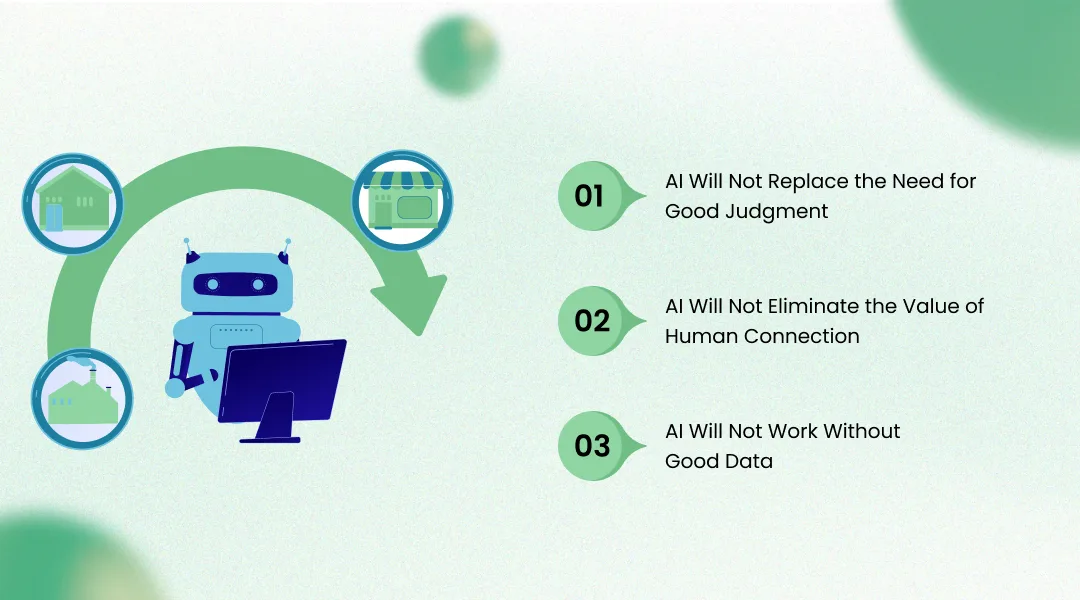
Honesty requires us to address not only what is coming but what is not. The hype surrounding AI often implies that it will solve every business problem, replace most employees, and make success effortless. None of this is true, and believing it could lead to poor decisions.
AI tools will provide better information faster. They will surface patterns you would miss, draft content you would struggle to write, and automate tasks you find tedious. But they will not tell you whether to open a second location. They will not decide whether a difficult employee deserves another chance. They will not know whether your community will respond to a new product or service. These decisions require the kind of contextual, emotional, and ethical judgment that remains firmly in human territory.
Business owners who treat AI as a decision-making replacement rather than a decision-support tool will make mistakes. The bakery owner in our opening scenario reviews the AI's recommendations each morning. She does not blindly follow them. She knows her neighbourhood, her customers, and her business in ways that no software tool can fully capture. The AI makes her better informed. She still makes the decisions.
In every industry, the businesses that customers love most are the ones where they feel known, valued, and genuinely cared for. AI can make your operations more efficient, your communications more consistent, and your marketing more targeted. It cannot make a customer feel that you genuinely care about their problem. It cannot replicate the warmth of a business owner who remembers a regular customer's name and preferences. It cannot build the kind of trust that makes someone choose your small business over a cheaper, larger competitor.
The businesses that will succeed in an AI-enabled future are those that use AI to handle the work that does not require a human touch so that they can invest more time and energy into the work that does. This is not a sentimental point. It is a strategic one. As AI makes efficiency abundant, genuine human connection becomes scarcer and more valuable.
One honest reality that many AI optimists downplay is that AI tools are only as useful as the data they have access to. A restaurant that does not track its sales digitally, a trades business that stores customer information in a paper notebook, or a retailer that does not maintain accurate inventory records will get less value from AI tools than competitors who have clean, organised digital records.
This is important for preparing your business for AI. The most valuable thing many small business owners can do right now, before any AI tool is purchased, is to get their basic business data in order. Make sure your sales, customers, inventory, and financial records are digital, reasonably accurate, and stored in systems that can connect to other software. This is the foundation that AI tools will build on, and without it, even the best AI will have little to work with.
No discussion of how AI will change small business is complete without addressing the question that keeps business owners and employees awake at night. Will AI replace jobs? The honest answer is nuanced, and it is important to get it right because both the "AI will take all the jobs" panic and the "nothing will change" denial are wrong.
The most accurate way to think about AI's impact on small business employment is at the task level, not the job level. Very few small business roles consist entirely of tasks that AI can do. Most roles are a mixture of routine cognitive work (data entry, scheduling, drafting standard communications) and non-routine work (problem solving, relationship building, creative thinking, physical tasks). AI will automate significant portions of the routine cognitive work, but the non-routine work will remain.
This means that most small business employees will not lose their jobs to AI. Instead, their jobs will change. A bookkeeper who currently spends 80 percent of their time on data entry and reconciliation will find that AI handles most of that work. Their role will shift toward reviewing AI output for accuracy, interpreting financial data for the business owner, handling unusual transactions that require judgment, and providing the kind of personalised financial guidance that clients value.
It would be dishonest to pretend that AI will not reduce the need for some roles in small businesses. Administrative assistants who primarily handle scheduling, email management, and basic document preparation will see much of their work automated by 2028. Businesses that currently employ a full-time person for these tasks may find that a part-time role or a redistribution of responsibilities is sufficient when AI handles the routine portion.
At the same time, new needs will emerge. Small businesses will need people who can manage and oversee AI tools, review AI-generated content for quality and accuracy, and handle the increased customer volume that AI-powered efficiency makes possible. A small marketing agency that uses AI to draft initial content will still need skilled editors and strategists, but it may need them in different proportions than before.
The most important prediction about when AI will replace business tasks is this: the replacement will be gradual, not sudden. It will happen task by task over several years, giving business owners and employees time to adapt if they are paying attention. The businesses that handle this transition well will be transparent with their teams, invest in retraining, and frame AI as a tool that makes every person more effective rather than a replacement waiting in the wings.
If you run a small business with employees, one of the most valuable things you can do in the next twelve months is to have an honest conversation with your team about AI. Not a scary conversation, not a cheerful corporate-speak conversation, but an honest one. Tell them that AI tools are coming to your business. Tell them that these tools will change some of their daily tasks. Tell them that your goal is to use AI to make the business more successful so that everyone benefits, not to find reasons to reduce headcount. And then follow through on that commitment.
Businesses that bring their teams along in the AI transition will have a significant advantage over those that impose AI tools from the top down. Employees who understand and trust the AI tools they work with will use them more effectively, catch errors more quickly, and find creative ways to combine AI capabilities with their own expertise.
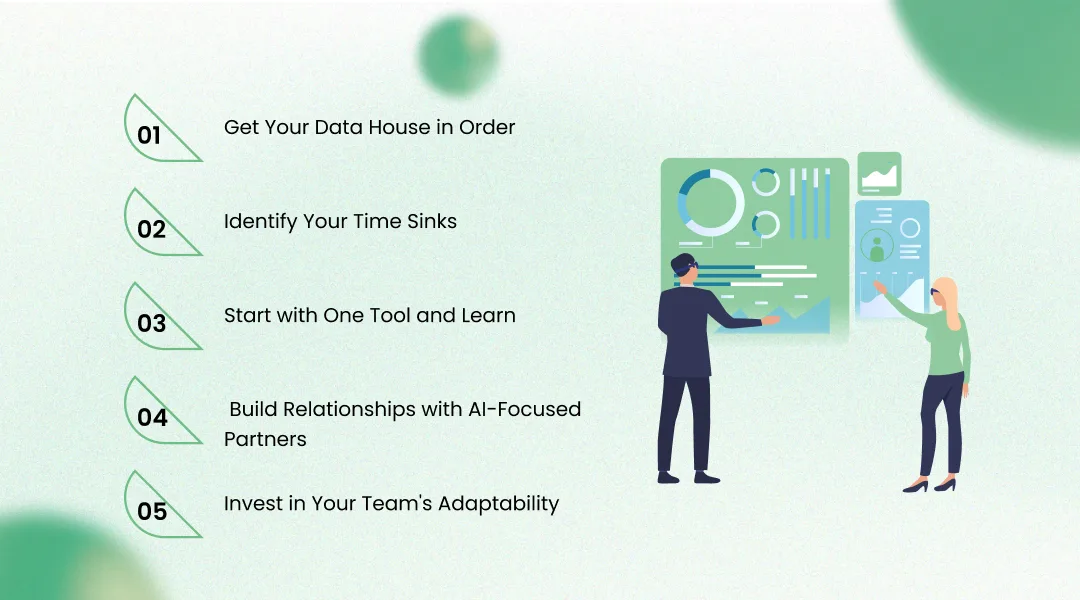
Given everything we have discussed, what should a small business owner actually do right now? Not in 2028. Now. Here is a practical, grounded preparation plan that any business can start today.
Before you buy any AI tool, make sure your business data is in good shape. This is the single most important preparation step, and it costs nothing but time and discipline.
Move any paper-based records (customer lists, sales logs, inventory counts) into digital form using whatever software you already use, whether that is a spreadsheet, an accounting package, or a point-of-sale system.
Make sure your financial records are current and accurate, because AI financial tools will be only as reliable as the data they analyse.
Organise your customer information in one place, whether that is a simple spreadsheet or a customer relationship management tool, including contact details, purchase history, and any notes about preferences or special requirements.
Clean up obvious errors in your existing data, such as duplicate customer entries, outdated email addresses, or miscategorised expenses.
This is not glamorous work, but it is the foundation. When AI tools arrive that can analyse your business data and provide insights, the businesses with clean, organised data will get useful results immediately. The businesses with messy or incomplete data will spend months catching up.
Make a list of the tasks in your business that consume the most time relative to the value they produce. For most small businesses, this list will include some combination of the following.
Responding to routine customer enquiries (hours, pricing, availability).
Creating and posting social media content.
Managing appointment scheduling and confirmations.
Preparing invoices and following up on late payments.
Writing and sending marketing emails.
Generating reports on sales, inventory, or financial performance.
Searching for and screening job applicants.
These are the tasks where AI tools will deliver the most immediate value. Knowing your specific time sinks helps you evaluate AI tools based on what your business actually needs rather than what a vendor wants to sell you.
Do not try to transform your entire business with AI at once. Pick one task from your time-sink list, find an AI tool that addresses it, and learn to use it well. Give yourself at least a month to evaluate whether it genuinely saves time and improves results. Many AI tools offer free trials, so the financial risk is minimal.
The goal in this phase is not maximum efficiency. It is building your own understanding of what AI can and cannot do. Once you have hands-on experience with one tool, you will be much better equipped to evaluate others. You will also begin to develop an intuition for where AI is trustworthy and where it still needs human oversight, and this intuition is more valuable than any feature comparison chart.
As AI becomes central to small business operations, the businesses that will adapt most smoothly are those with trusted partners who understand both AI and their specific industry. This is where working with companies like KriraAI becomes valuable. Rather than trying to navigate the constantly shifting landscape of AI tools on your own, a partner with deep expertise can help you identify which tools are genuinely useful for your specific situation, integrate them into your existing workflows, and avoid the costly mistakes that come from adopting technology without a clear strategy.
The time to build these relationships is before you urgently need them. Business owners who establish connections with AI-knowledgeable advisors now will have a significant advantage when the pace of change accelerates in 2027 and 2028.
If you have employees, begin building their comfort with AI tools now. This does not mean sending everyone to a technical training course. It means creating a culture where experimenting with new tools is encouraged, where questions are welcome, and where the goal is always to make each person's work more interesting and effective, not to measure them against a machine.
Encourage team members to try free AI tools for tasks they find repetitive. Share articles and resources about how AI is being used in your industry. Talk openly about what you are learning and what you plan for the business. The businesses that build AI literacy across their entire team, not just the owner, will adapt faster and more successfully than those where AI is a top-down initiative.
One of the most practical questions about how AI will change small businesses is what all of this will cost. Technology promises are meaningless if the price is wrong for a business that measures expenses in hundreds of dollars, not millions.
Today, individual AI tools for small businesses typically cost between fifteen and one hundred dollars per month, depending on the capability and usage level, and owners looking for budget-friendly AI tools for small businesses can start scaling operations without a large upfront investment. A basic AI writing assistant might cost twenty dollars monthly. An AI-powered customer communication tool might cost fifty to eighty dollars. An AI bookkeeping assistant might cost forty to seventy dollars. For a small business using two or three of these tools, the total monthly expense is typically between fifty and two hundred dollars.
By 2027, integrated AI platforms that combine multiple capabilities will be available at price points between seventy-five and two hundred dollars per month for a typical small business. This is comparable to what many small businesses currently pay for their existing software subscriptions (accounting software, email marketing, scheduling tools) combined. In many cases, the AI platform will replace several of these individual subscriptions, making the net cost increase modest or even negative.
The more important question is not what AI costs but what it returns. For a small business owner who currently spends ten hours per week on tasks that AI can automate, the value of those recovered hours is substantial. If those ten hours are redirected toward revenue-generating activities, the return on a hundred-dollar monthly AI investment can be measured in thousands of dollars of additional revenue.
By 2028, studies will likely show that small businesses using integrated AI tools generate 20 to 35 percent more revenue per employee than comparable businesses that do not. This revenue efficiency gap, more than any single feature or capability, is what will drive mass adoption. When business owners can see clearly that their competitors are getting more done with the same or fewer resources, the hesitation about adopting AI will evaporate.
It is worth noting that the cost savings are not only about money. They are about the most precious resource a small business owner has: time. An owner who reclaims two hours each day from administrative tasks can spend that time on the things that actually grow a business, meeting with potential clients, developing new products or services, training their team, or simply maintaining the energy and enthusiasm that sustains any entrepreneurial venture over the long term.
No honest guide to how AI will change small business would skip the genuine concerns that thoughtful business owners have. These concerns deserve direct, substantive answers.
Small business owners are right to ask who sees their business data when they use an AI tool. This is not paranoia. It is prudent business management. The answer varies by provider, and it will become increasingly regulated over the next few years. By 2027, most developed economies will have clear regulations governing how AI tools can use business data, and reputable providers will offer transparent data policies that specify what data is stored, how it is used, and whether it is shared with anyone.
When evaluating any AI tool, small business owners should ask three questions. Does the provider store my data, and if so, for how long? Is my data used to train or improve the AI for other customers? Can I delete all my data if I stop using the service? Any reputable provider will answer all three clearly. If they will not, that is a signal to look elsewhere.
AI tools are not perfect, and any provider who claims otherwise is not trustworthy. Current AI systems make mistakes, sometimes subtle ones that look correct on the surface but are wrong in ways that matter. An AI tool that drafts a marketing email might include a claim about your product that is not quite accurate. An AI financial tool might miscategorise an expense. An AI scheduling tool might double-book an appointment during a period of unusual demand.
The realistic expectation for AI tools over the next five years is that they will be highly reliable for routine, well-defined tasks and less reliable for unusual, complex, or ambiguous ones. This means human oversight remains essential, not for every output, but as a regular review process. Think of it the way you think about a new employee. You check their work carefully at first, you learn where they are strong and where they need supervision, and over time you develop a calibrated level of trust.
What happens if you build your business operations around an AI tool and the provider goes out of business, raises prices dramatically, or changes the product in ways that do not work for you? This is a legitimate concern, and it is one reason why the preparation advice earlier in this blog emphasises getting your own data in order first. If your business data is well-organised and portable, switching between AI tools, while inconvenient, is manageable. If your data exists only inside a single provider's proprietary system, you are vulnerable.
Over the next few years, industry standards for data portability in business AI will develop, similar to how you can currently export your contacts from one email provider and import them into another. Until those standards are mature, the best protection is to ensure that your own business data, such as customer records, financial history, and operational data, always has a copy that you control outside any single AI provider's system.
Three things stand out when you look clearly at how AI will change small businesses over the next five years. First, the capabilities that are coming are real, substantial, and grounded in technology that already exists in early forms today. This is not speculation about distant possibilities. It is a forecast based on tools that are working now and will become affordable, integrated, and simple enough for any business owner to use within the next three to five years. Second, the impact will be measured not in dramatic overnight transformation but in steady, cumulative improvements in how small businesses operate, compete, and serve their customers. The business owners who start preparing now will have a meaningful head start over those who wait. Third, the businesses that will thrive in this future are not the ones that adopt the most technology. They are the ones who use AI to amplify what makes them valuable in the first place: their knowledge, their relationships, their creativity, and their commitment to their customers and communities.
If you run a small business, the most important thing you can do right now is to start learning. Get your data in order. Try one AI tool. Talk to your team. And think seriously about how these capabilities can make your business stronger without losing what makes it yours.
KriraAI works with businesses that want to navigate these changes with clarity and purpose. Rather than selling technology for its own sake, KriraAI focuses on building practical AI systems that connect directly to measurable business outcomes, whether that means saving time, reaching more customers, improving financial visibility, or enabling a small team to compete with much larger ones. If you want to understand what AI means for your specific business and build a practical plan for the years ahead, exploring what KriraAI offers is a worthwhile next step.
The future of small business is not about being replaced by machines. It is about being empowered by tools that handle the work you never wanted to do so that you can focus on the work that matters most. That future is nearer than most people realise, and the businesses that prepare for it now will be the ones that define it.
AI will significantly expand what a solo entrepreneur or very small team can accomplish, but it will not replace the need for people in most business contexts. By 2029, a single person using AI tools effectively will be able to handle the administrative, marketing, and operational workload that currently requires two to three people in a typical small business. However, businesses that involve physical work, face-to-face service, complex problem solving, or deep customer relationships will still need human team members for those elements. The more accurate framing is that AI will allow a five-person team to produce the output that currently requires eight to ten people, or it will allow the same five-person team to serve significantly more customers at a higher quality level. The businesses that use AI to grow their capacity rather than simply to reduce their headcount will generally achieve better long-term results, because growth creates new opportunities while pure cost cutting has natural limits.
The cost of competitive AI capabilities for a small business will decrease steadily over the next five years. By 2028, a comprehensive AI tool that covers marketing content, customer communication, financial analysis, and administrative automation will likely cost between seventy-five and two hundred dollars per month for a typical small business. This is comparable to what most small businesses currently spend on the combination of accounting software, email marketing tools, and scheduling applications. For many businesses, the AI platform will replace several existing subscriptions, so the net increase in technology costs will be modest. The more significant investment will be in time rather than money, specifically the time spent learning to use the tools effectively, setting them up for your specific business context, and training your team to work alongside them. Business owners who budget ten to fifteen hours over the first month for setup and learning will see faster returns than those who expect instant results.
The biggest risk is not dramatic or sudden. It is gradual competitive erosion. As your competitors adopt AI tools that help them respond to customers faster, market more effectively, manage their finances more precisely, and operate more efficiently, your business will not collapse overnight. It will simply fall behind in small increments. You will lose the customer who went to a competitor because they responded to an enquiry in five minutes while you took five hours. You will miss the seasonal trend that a competitor spotted three weeks earlier because their AI flagged it. You will spend your evenings on bookkeeping while your competitor uses that time to develop new services. By the time the gap is obvious, it may take significant effort to close. The cost of getting started with AI is low and decreasing. The cost of waiting is cumulative and increasing. This does not mean you need to adopt every AI tool immediately, but it does mean that beginning to learn, experiment, and prepare now is far less risky than assuming you can catch up later.
The entire trajectory of AI development is moving toward making these tools easier to use, not harder. The AI tools that will succeed with small business owners are the ones that work through ordinary conversation rather than complex interfaces. By 2027, interacting with your AI business assistant will feel very similar to texting a knowledgeable colleague. You will type or speak your request in plain language, and the tool will respond in plain language. You will not need to learn special commands, navigate complicated menus, or understand any technical concepts. If you can send an email and use a smartphone, you will be able to use the AI business tools that are coming. The providers who make their tools most accessible to non-technical users will win the small business market, and they know it. This is driving a strong design trend toward simplicity and plain-language interaction that will make the next generation of AI tools dramatically more approachable than the current one.
Customer expectations will rise significantly as AI becomes standard in business operations. By 2028, customers will expect near-instant responses to enquiries at any hour, personalised recommendations based on their history and preferences, proactive communication about appointments and orders, and seamless experiences across every channel whether they contact your business by phone, email, text, or social media. These expectations are already being set by large companies, and AI will give small businesses the tools to meet them for the first time. The small businesses that will differentiate themselves will not just meet these expectations but exceed them by combining AI-powered efficiency with genuine human warmth. A customer who gets an instant AI-generated response to their enquiry followed by a personal phone call from the business owner has a better experience than one who gets either element alone. The future of customer experience in small business is not AI or human. It is AI handling the speed and consistency while humans provide the empathy and connection.
Ridham Chovatiya is the COO at KriraAI, driving operational excellence and scalable AI solutions. He specialises in building high-performance teams and delivering impactful, customer-centric technology strategies.