A single statistic has haunted the machine learning services industry for the better part of a decade. Industry surveys have repeatedly found that close to 85 percent of machine learning projects never reach production. They die in notebooks, stall in proof of concept, or quietly drain budgets while delivering nothing a customer ever touches. That failure rate is not a talent problem, and it is rarely a data problem alone. It is a delivery problem baked into how the industry has historically operated. The painful irony is that the very discipline built to make businesses smarter has been one of the worst at converting its own work into outcomes. What is changing now is that artificial intelligence is being turned inward, reshaping how machine learning services are scoped, built, deployed, and maintained. This blog examines the current state of the industry, the specific technologies driving the turnaround, the measurable impact early adopters are seeing, a realistic implementation roadmap, the challenges that still trip teams up, and where the next three to five years are headed.

The industry sells intelligence, yet it has long struggled with its own inefficiency. Most providers, whether boutique consultancies or large platform vendors, are paid to build models that solve a defined business problem. The trouble begins after the model performs well in a controlled experiment. Moving that model into a live environment where it serves real users reliably is where the work quietly collapses. Teams discover that the production gap is wider and more expensive than anyone scoped for.
A large share of this waste is structural rather than technical. Data scientists are trained to optimize accuracy, not to ship and maintain software. Engineering teams are handed models with no clear contract for monitoring, retraining, or rollback. The handoff between research and operations becomes a chasm where timelines slip and costs balloon. Clients grow frustrated because they were promised a competitive advantage and received a research artifact instead.
Most models never leave the laboratory because the industry has historically optimized for the wrong milestone. Success was defined as a high validation score on a clean dataset. Real production demands far more than that, including data pipelines that do not break, latency budgets that hold under load, and clear ownership when predictions drift. Many providers simply never built the operational muscle to clear that bar. The result is a portfolio of impressive demos and very few systems that survive contact with real traffic.
The economics of traditional model delivery are brutal and often misunderstood by buyers. Skilled machine learning engineers and data scientists are among the most expensive talent in technology, and demand consistently outpaces supply. A single bespoke project can absorb months of senior time before a model ever earns revenue. When a project then fails to reach production, that entire investment is written off. This is why machine learning consulting engagements so often feel risky to finance teams, and why so many promising initiatives are quietly defunded after the first disappointing quarter.
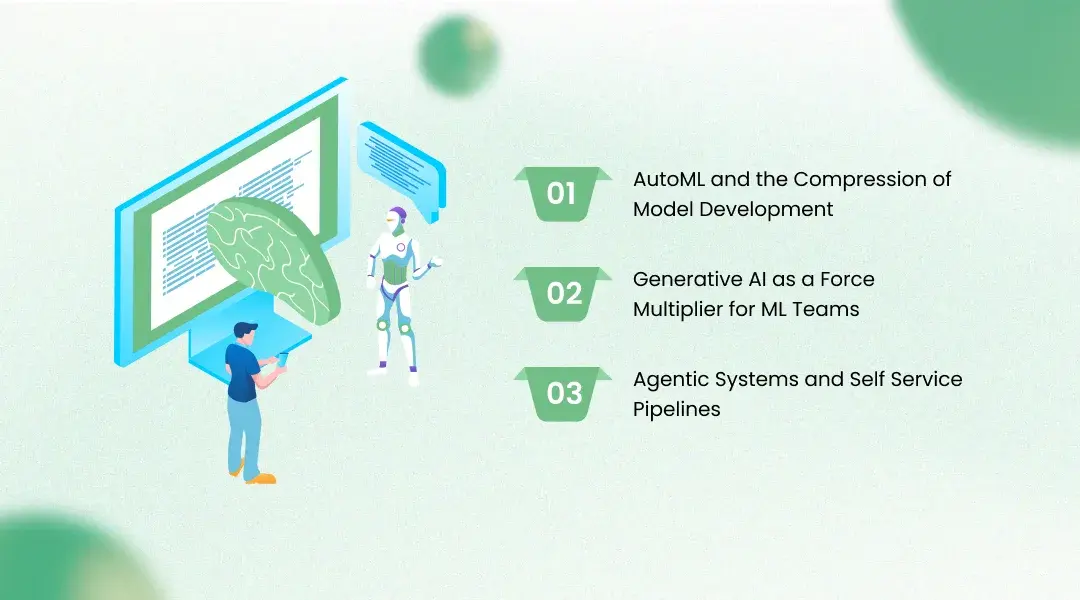
The most important shift in this industry is that AI is now building AI. Generative models, automated machine learning, and agentic systems are compressing work that used to take specialist teams weeks into tasks that take hours. This does not eliminate expertise. Instead, it moves human effort up the value chain, away from repetitive plumbing and toward problem framing, governance, and business outcomes. The technologies driving this change map cleanly onto the industry's oldest pain points.
The following technologies are reshaping how providers deliver work, and each one attacks a specific bottleneck:
Automated machine learning, or AutoML, addresses the slow and manual process of model selection and tuning by searching across algorithms and hyperparameters automatically.
Generative AI and large language models accelerate code generation, documentation, feature ideation, and synthetic data creation that previously consumed senior engineering hours.
Predictive analytics and anomaly detection now power model monitoring itself, flagging data drift and performance decay before they reach customers.
Computer vision and natural language processing have become packaged building blocks, so teams assemble proven components instead of training every model from raw data.
Agentic systems coordinate multi step workflows, chaining data preparation, training, evaluation, and deployment with limited human supervision.
AutoML has turned model development from an artisanal craft into a far more repeatable process. Tasks that once required a data scientist to hand tune dozens of parameters are now searched automatically across thousands of configurations. This frees senior talent to concentrate on framing the right business problem rather than grinding through experiments. For machine learning consulting firms, this compresses delivery timelines and lowers the cost of each engagement. The competitive advantage shifts from who can train the best model to who can identify the most valuable problem to solve.
Generative AI has become the single largest productivity lever inside modern machine learning teams. Studies of AI coding assistants have reported developer productivity gains in the range of roughly 25 to 55 percent on suitable tasks. Engineers use these tools to scaffold data pipelines, write tests, generate documentation, and produce synthetic training data where real data is scarce. This is the shift that specialist firms like KriraAI focus on, building practical AI systems that move models into production rather than leaving them stranded in research environments. The effect is a smaller team shipping more reliable software in less time.
Agentic systems represent the frontier of how this work is delivered today. These are AI agents that can plan and execute multi step technical workflows with minimal supervision. An agent can ingest a dataset, propose candidate models, run evaluations, and prepare a deployment package while a human reviews the decisions. This collapses the handoff between research and operations that has historically killed so many projects. Providers that wire these agents into their delivery process can offer faster turnaround and far more predictable ML model deployment than competitors relying on manual handoffs.
The business case for AI native delivery is now measurable rather than theoretical. Organizations that have rebuilt their delivery around automation and strong operational practices report results that would have seemed implausible a few years ago. The headline change is the production rate. Teams that adopt disciplined MLOps services and automation report moving a far higher share of models into live use, often reversing the historic pattern where most projects stalled.
The measurable gains cluster around a handful of metrics that finance teams actually care about:
Time to deploy a model has fallen sharply, with many teams reporting prototype to production timelines dropping from the historic 31 to 90 day range down to days or even hours.
Engineering productivity on routine tasks has improved by roughly a quarter to more than half, freeing senior staff for higher value work.
Model maintenance costs have dropped as automated monitoring catches drift early, reducing the expensive emergency fixes that follow silent model decay.
Project failure rates have improved as automation enforces the deployment discipline that human handoffs used to skip.
McKinsey's State of AI research has found that the share of organizations using AI in at least one business function has climbed past 70 percent. This matters because the buyers of these services are no longer experimenting. They are scaling, and they expect providers to deliver production systems with the same reliability they demand from any other software vendor. The MLOps market reflects this maturity. Analyst estimates, while they vary widely by source, generally project the global MLOps market growing from the low single digit billions in the early 2020s to somewhere in the range of 16 to 40 billion dollars by the end of this decade.
Revenue impact is the quietest but most important metric. When a recommendation engine actually reaches production, it lifts conversion. When a fraud model goes live, it stops losses in real time. The value of these services has never been in the model itself. It has always been in the model running reliably against real traffic, and AI driven delivery is finally closing that gap at scale.
Adopting AI inside an ML services practice is a sequenced transformation, not a single purchase. A company should move deliberately from assessment through controlled pilots to full deployment. Rushing to production without foundations is precisely how the industry earned its reputation for failure. The roadmap below reflects how disciplined teams actually sequence the work.
Run a readiness assessment that audits current data infrastructure, team skills, existing model inventory, and the real business problems worth solving first.
Establish a data and tooling foundation, including reliable pipelines, a feature store, version control for data and models, and a clear monitoring stack.
Select one high value pilot with a measurable outcome, a willing business owner, and data that is realistically available rather than aspirational.
Build the pilot using automation and strong MLOps services so that the path to production is designed in from the first sprint, not bolted on later.
Deploy to a limited live environment, measure against the agreed business metric, and capture the operational lessons before scaling.
Standardize the winning pattern into a repeatable delivery template that the whole organization can reuse across future engagements.
Scale to full deployment with governance, retraining schedules, and clear ownership for every model in production.
KriraAI approaches enterprise rollouts in exactly this sequence, designing AI solutions around measurable business outcomes rather than technology for its own sake. The discipline matters more than the tooling. A team that nails the readiness assessment and picks the right first pilot will outperform a better resourced rival that skips straight to building.
The most common and expensive mistake is starting with the model instead of the problem. Teams fall in love with a technique and then hunt for somewhere to apply it, which almost guarantees a solution looking for a use case. The fix is to anchor every project to a business metric a leader is willing to be measured on. The second frequent error is treating ML model deployment as an afterthought, designing the model first and worrying about production later. Successful teams design the deployment path before training begins. A third mistake is underinvesting in monitoring, which lets models decay silently until they quietly damage the business. Avoiding these traps is far less about advanced mathematics than about operational discipline and honest scoping.
Even with AI accelerating delivery, this work remains genuinely hard, and pretending otherwise does buyers a disservice. Data quality is still the most underestimated obstacle. Automation cannot rescue a project built on inconsistent, incomplete, or poorly labeled data, and most enterprise data is messier than anyone admits. Cleaning and structuring that data often consumes more effort than the modeling itself.
The talent gap is real and stubborn even as tools improve. Automation reduces the number of engineers needed, but it raises the bar for the ones who remain. The market now rewards people who understand both the business domain and the operational realities of production systems, and that combination is scarce. Hiring and retaining such people remains expensive and competitive.
Regulation and governance add another layer of difficulty that is intensifying rather than fading. Frameworks such as the EU AI Act are introducing real obligations around model explainability, documentation, and risk classification. Enterprises in regulated sectors cannot deploy a model they cannot explain or audit. This is why providers such as KriraAI build governance and monitoring into systems from the beginning, treating compliance as a design constraint rather than a final hurdle. Integration complexity and organizational change management round out the list, because even a perfect model fails if the people meant to use it never trust or adopt it.
Over the next three to five years, this industry will look very different from the way it does today. The routine work of building and tuning standard models will largely become automated and commoditized. Value will migrate decisively toward problem definition, system integration, governance, and the ability to deliver measurable business outcomes. Providers who still sell hours of manual model training will struggle to compete on price with automated pipelines.
The competitive landscape will split into two clear groups. The first group will be AI native firms that use agents and automation to deliver faster, cheaper, and more reliably while concentrating human expertise on strategy and trust. The second group will be legacy providers that treat AI as an add on rather than a rebuild of their operating model. The second group will be undercut on speed and price and will gradually lose their most demanding clients. The firms left behind will not fail because their people lacked skill. They will fail because their delivery model assumed scarce human effort at every step that has since been automated.
Three capabilities will increasingly separate winners from the rest. Providers will compete on the speed and reliability of ML model deployment rather than on raw modeling skill. They will compete on trustworthy governance that satisfies regulators and risk teams without slowing delivery. And they will compete on the depth of domain understanding that lets them frame the right problems. Custom machine learning solutions will not disappear, but they will be assembled faster from proven, automated components rather than built from scratch each time.
Three points matter most from everything above. First, the machine learning services industry has long suffered from a failure rate near 85 percent, driven by operational gaps rather than weak science. Second, AI itself, through AutoML, generative models, and agentic systems, is now reversing that pattern by building production discipline directly into delivery. Third, the next few years will reward providers who compete on reliable deployment, trustworthy governance, and deep domain understanding rather than on manual modeling effort. The winners will treat AI as a rebuild of their operating model, not a feature bolted onto an old one.
This is where a partner focused on practical execution becomes valuable. KriraAI helps enterprises implement machine learning services that are practical, measurable, and built for scale, designing each solution around a clear business outcome and the operational foundations needed to keep it running in production. The goal is never a clever model that impresses in a demo. The goal is a working system that earns its keep quarter after quarter. If your organization wants to move from stalled experiments to models that actually deliver, it is worth exploring how KriraAI builds and deploys AI solutions designed to last.
Machine learning services are professional offerings that help organizations design, build, deploy, and maintain machine learning models that solve specific business problems. They span several forms, including managed cloud platforms that host and serve models, consulting engagements that provide strategy and custom development, and MLOps services that handle the operational side of running models in production. The core promise is to turn raw data and a business question into a working system that makes predictions reliably at scale. Modern providers increasingly use automation and generative AI internally, which lowers cost and shortens the time it takes to move a model from prototype into live use.
Machine learning services cost anywhere from a few thousand dollars for a narrow proof of concept to several hundred thousand dollars or more for a complex, fully deployed enterprise system. The price depends heavily on data readiness, the difficulty of the problem, the level of regulatory compliance required, and whether the work is a one time build or an ongoing managed service. Historically, costs were driven up by the scarcity of senior data science talent and the high rate of failed projects. Automation and AutoML are now reducing delivery costs, so buyers should evaluate providers on total cost to a working production system rather than on the hourly rate alone.
MLOps is a discipline within the broader category of machine learning services, focused specifically on the operational lifecycle of models in production. Machine learning services is the umbrella term that covers everything from initial strategy and machine learning consulting through model building to ongoing maintenance. MLOps services handle the parts that keep a deployed model healthy, including continuous deployment, monitoring for data drift, automated retraining, version control, and rollback. In practice, strong MLOps is what separates models that survive in production from those that quietly fail. A complete engagement should always include an MLOps plan, because a model with no operational support rarely delivers lasting value.
Machine learning projects fail most often because of operational and organizational gaps rather than weak algorithms. Industry surveys have repeatedly found that around 85 percent of projects never reach production, usually because deployment was treated as an afterthought rather than designed in from the start. Common causes include poor data quality, models that are never connected to a real business metric, missing monitoring that lets performance decay silently, and a handoff gap between research and engineering teams. Projects also fail when the wrong problem is chosen, so a technically excellent model solves something no one needed. AI driven delivery and disciplined MLOps services directly address these failure modes by building the path to production into the work itself.
Businesses should choose a machine learning services provider based on its track record of getting models into production and delivering measurable outcomes, not on its demos alone. The strongest signal is evidence of real ML model deployment that survived in live environments and produced documented business results. Buyers should ask how the provider handles data quality, monitoring, retraining, and governance, since these operational practices determine whether a model lasts. It also helps to confirm the provider understands the specific industry domain, because framing the right problem matters more than raw technical skill. Finally, businesses should favor partners who design for measurable ROI and scale rather than one off custom machine learning solutions with no plan for what happens after launch.
Founder & CEO
Divyang Mandani is the CEO of KriraAI, driving innovative AI and IT solutions with a focus on transformative technology, ethical AI, and impactful digital strategies for businesses worldwide.