Every year, approximately 12 million adults in the United States experience a diagnostic error in outpatient settings, and in hospital environments the consequences are graver because delayed or incorrect diagnoses cascade into longer stays, unnecessary procedures, and preventable harm. When one of our healthcare clients, a 400-bed mid-size hospital network processing over 95,000 inpatient encounters annually, approached KriraAI, the conversation did not begin with artificial intelligence. It began with a spreadsheet showing that 17.3% of cases flagged through their internal quality review had involved a diagnostic discrepancy, meaning the initial working diagnosis did not match the final discharge diagnosis. The clinical leadership knew their physicians were talented. The problem was that the sheer volume of data flowing through the hospital, lab results, imaging reports, medication histories, prior encounter notes, had outpaced any single clinician's ability to synthesise it all in real time. This blog details how KriraAI designed, built, and deployed a machine learning system for hospital diagnostics that reduced diagnostic discrepancies by 28% within nine months of going live. It covers the clinical problem in full context, the technical architecture KriraAI delivered, the implementation journey including real challenges encountered during delivery, and the measurable outcomes the hospital achieved after the system entered production.
The hospital operated a modern electronic health record system and had recently completed a data warehouse migration. On paper, data infrastructure was not the issue. In practice, clinical data was siloed across systems that did not communicate in clinically meaningful ways. Lab results arrived as discrete values, but imaging reports came through as unstructured radiology narratives. Medication reconciliation data lived in the pharmacy module, while prior encounter histories were scattered across outpatient and inpatient records with inconsistent coding. Physicians on the hospitalist service were responsible for reviewing an average of 47 discrete data points per patient within the first six hours of admission, not counting imaging or specialist notes.
The diagnostic process followed a pattern common across mid-size facilities. A patient would present to the emergency department or be admitted through direct referral. The admitting physician would perform an initial assessment, order labs and imaging, form a working diagnosis, and initiate treatment. As results returned over the following 12 to 48 hours, the diagnosis would either be confirmed or revised. The problem lay in the revision process. When new data contradicted the initial working diagnosis, the signal was often buried. A mildly abnormal lab value arriving at 2 AM might not be reviewed until morning rounds. An imaging report containing a subtle qualifier, language like "cannot exclude" or "clinical correlation recommended," would not always trigger reassessment.
Diagnostic discrepancies were concentrated in three clinical domains: sepsis identification in patients presenting with nonspecific symptoms, pulmonary embolism in post-surgical patients where symptoms overlapped with expected recovery patterns, and acute kidney injury in patients on complex medication regimens where early lab trends were misattributed to hydration status. In each domain, the information required to reach the correct diagnosis earlier was already available in the EHR. It was simply not being surfaced or correlated at the tempo of clinical decision making.
The financial impact was substantial. Diagnostic discrepancies correlated with an average of 2.4 additional hospital days per affected case, each day costing approximately $2,800 in direct care costs. For roughly 1,200 flagged cases per year, this translated to an estimated $8 million annually in avoidable costs, not counting malpractice exposure or readmission penalties under value-based care contracts.
KriraAI designed and delivered an AI clinical decision support system that continuously monitors incoming patient data streams across the EHR, laboratory information system, radiology PACS, and pharmacy module. The system operates as a real-time diagnostic co-pilot, generating structured risk assessments that surface on the physician's existing EHR dashboard without requiring a separate application.
The system combines two complementary ML architectures. The first is a multimodal temporal fusion model that ingests structured clinical data as time-series features and processes them through a transformer-based encoder with temporal attention. This model recognises evolving clinical trajectories rather than static snapshots, identifying patterns where a sequence of individually unremarkable data points collectively signals a diagnostic shift. The second is a clinical NLP pipeline built on a domain-adapted biomedical language model fine-tuned on over 280,000 de-identified radiology and pathology reports from the hospital's historical data. This model extracts semantic signals from unstructured narratives, including hedge language, negation patterns, and differential diagnosis mentions, converting them into structured features for the temporal fusion model.
The two model outputs combine through a learned ensemble layer producing diagnostic risk scores for sepsis, pulmonary embolism, and acute kidney injury. When scores cross calibrated thresholds, the system generates alerts with structured evidence summaries showing exactly which data points contributed, ranked by influence using integrated gradient attribution. Physicians can evaluate each alert in under 30 seconds. The system processes new data within 90 seconds of arrival and performs between 15 and 40 reassessments per patient stay. KriraAI also built a closed-loop feedback mechanism from day one, capturing physician accept, dismiss, and defer interactions as labelled training data. Within six months this mechanism contributed over 14,000 labelled interactions for model retraining, enabling measurable improvement in alert precision.
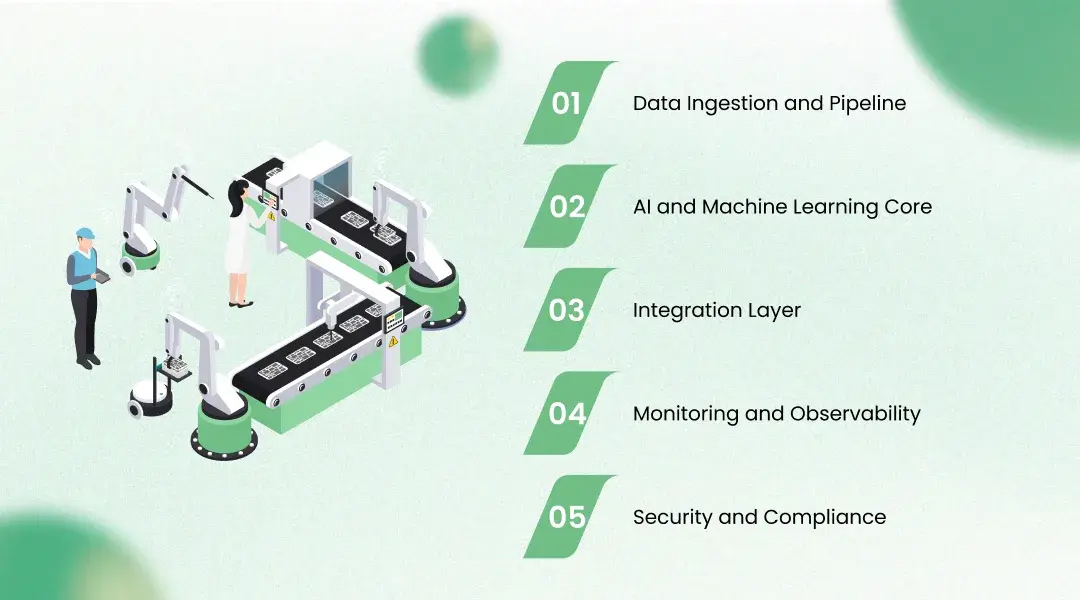
Patient data enters through three parallel channels. Structured clinical data flows through HL7 FHIR R4 interfaces into a Kafka-based event streaming architecture, parsed and validated against FHIR resource schemas, then routed via Kafka topics partitioned by message type. Unstructured narratives arrive through a dedicated HL7 ORU channel routed to the NLP pipeline. Imaging metadata is ingested from the PACS integration layer to correlate report and order timing.
Transformation is orchestrated by Apache Airflow DAGs for batch reprocessing and Apache Flink for real-time stream processing, handling schema normalisation, temporal feature engineering including rolling window calculations for lab trends, and embedding generation for every new unstructured document. Entity resolution uses a probabilistic patient matching algorithm reconciling medical record numbers, encounter IDs, and demographics to maintain a unified longitudinal patient view.
The temporal fusion model uses a modified Temporal Fusion Transformer architecture with domain-specific adaptations. Input features are grouped into static covariates (age, sex, comorbidity indices), known future inputs (scheduled medications, planned procedures), and observed time-varying inputs (vitals, lab values). Multi-head temporal attention with variable selection networks dynamically weights features based on clinical context.
The NLP component uses a PubMedBERT-derived encoder fine-tuned through curriculum learning, starting with general biomedical NER before progressing to institution-specific report classification and hedge-language detection. Both models are served through NVIDIA Triton Inference Server with TensorRT optimization for the temporal model and ONNX Runtime for the NLP model, running on dedicated NVIDIA A10G GPUs. Inference latency at p95 is 340 milliseconds for the combined pipeline.
Outbound alert delivery uses CDS Hooks specification compliant service calls so diagnostic risk alerts appear within the EHR's native alert framework. Alert payloads render as SMART on FHIR applications embedded within the EHR, providing full evidence summaries without context switching. Internal communication between inference and alert formatting services uses gRPC, while administrative APIs use REST with OpenAPI 3.0 contracts.
Data drift detection runs hourly using population stability index calculations, with alerts when PSI exceeds 0.2 for critical features. Model performance is tracked against monthly refreshed held-out evaluation sets, monitoring AUROC, precision at fixed recall thresholds, and calibration metrics. Feature distribution shift alerts use KL divergence calculations. System observability uses Prometheus, Grafana, and Jaeger for distributed tracing. Latency is tracked at p50, p95, and p99 with escalation when p99 exceeds 800 milliseconds. Automated retraining triggers when AUROC drops below 0.92.
The system operates within the hospital's private VPC with no public endpoints. Data in transit uses TLS 1.3 encryption, data at rest uses AES-256 with AWS KMS key management. Role-based access control with attribute-level data masking ensures infrastructure administrators cannot access protected health information. Audit logging uses an immutable append-only store backed by S3 with Object Lock for HIPAA compliance. Training data de-identification followed Safe Harbor guidelines with expert determination for edge cases.
The stack was selected to balance performance with the hospital's existing AWS infrastructure and IT team familiarity. Apache Kafka 3.5 handles event streaming because the hospital's HL7 interface engine already supported Kafka producers. Apache Flink was chosen over Spark Structured Streaming for its superior event-time processing and watermark handling, critical for temporal alignment of clinical events arriving out of order. NVIDIA Triton Inference Server supports both TensorRT and ONNX models within a single framework, reducing operational complexity. PostgreSQL 15 with TimescaleDB extension serves as the analytical store for temporal patient data. Pinecone provides managed HNSW indexing for embedding-based similarity retrieval in the NLP pipeline's context enrichment step. Infrastructure runs on AWS with EKS for container orchestration, EC2 G5 instances for GPU inference, S3 for storage and audit logs, Terraform for infrastructure as code, and ArgoCD for GitOps deployment.
The engagement began with a four-week discovery phase during which KriraAI embedded a clinical AI specialist and data engineer with the hospital's quality improvement team. The team attended morning rounds, reviewed quality committee case analyses, and conducted structured interviews with 22 physicians. This immersion produced the clinical domain prioritisation that shaped the technical design.
The first challenge emerged in data readiness. The hospital's lab value schema had changed three times during EHR upgrades, with different LOINC code mappings across eras. KriraAI built a retrospective normalisation pipeline reconciling these schema changes, producing a unified dataset of 412,000 inpatient encounters. This effort took five weeks, two weeks longer than estimated, but was essential for training data quality.
Model development proceeded through three iterations. The first version achieved AUROC of 0.89 for sepsis detection but showed unacceptable false positive rates in post-surgical patients. KriraAI addressed this by engineering a surgical context feature set incorporating procedure type, time-since-surgery, and expected recovery trajectory. The final model achieved AUROC of 0.94 for sepsis, 0.91 for pulmonary embolism, and 0.93 for acute kidney injury.
EHR integration presented a second challenge. The vendor supported CDS Hooks in principle, but production had not been configured for external services. KriraAI worked through a six-week integration sprint including endpoint configuration, SMART on FHIR registration, and load testing. Alert threshold calibration required two weeks of shadow-mode validation, with KriraAI adjusting thresholds to achieve positive predictive value above 40%.
Go-live followed a phased rollout, first activating for the hospitalist service, then extending to emergency and surgical services after four weeks of stable operation. A processing spike from batch lab result releases pushed p99 latency above threshold during week one. KriraAI resolved this within 48 hours by implementing message-level debatching at the Kafka consumer layer.
Within nine months of full deployment, measured against the same quality review methodology:
Diagnostic discrepancy rate decreased from 17.3% to 12.5%, a 28% reduction.
Median time to correct diagnosis for priority domains decreased by 6.2 hours, with sepsis improving most at 8.1 hours faster.
Average length of stay for previously discrepant cases decreased by 1.7 days, translating to $5.7 million in annualised cost avoidance.
Alert acceptance rate stabilised at 34%, with 89% of physicians rating alerts as clinically useful at six months.
False positive rate decreased from 62% to 48%, driven by the feedback loop and two retraining cycles.
These results were measured over nine months comparing 14,200 post-deployment encounters against the 12-month pre-engagement baseline. The 28% reduction in diagnostic discrepancies translates to approximately 330 fewer patients per year experiencing a significant diagnostic error, each case representing a concrete clinical outcome improvement. Beyond the quantitative metrics, the hospital's quality committee noted a qualitative shift in clinical culture. Physicians began proactively referencing the system's evidence summaries during handoff conversations, using the attribution data as a structured framework for communicating diagnostic uncertainty between shifts. This behavioural change, while harder to quantify, represents a durable improvement in diagnostic reasoning practices that persists independently of the technology itself.
The temporal fusion model's variable selection network can incorporate new input feature groups without full retraining, using transfer learning where only attention heads and output layers are fine-tuned on new domain data. The hospital has identified three expansion targets for the next 18 months: heart failure decompensation detection, medication interaction risk scoring, and early deterioration prediction for ICU step-down patients.
New data sources such as continuous waveform data from ICU monitors can be onboarded through the existing Kafka ingestion framework by adding topic consumers and Flink transformation jobs. The NLP model can be fine-tuned on new document types with as few as 5,000 annotated examples, a volume achievable within two to three months of focused clinical annotation effort.
The modular architecture also enables the hospital to pursue integration with external clinical data sources. As regional health information exchanges mature, the system can ingest encounter data from affiliated outpatient clinics and urgent care facilities, enriching the temporal patient view with pre-admission clinical trajectories that are currently invisible to the inpatient model. KriraAI designed the FHIR ingestion layer with this extensibility in mind, supporting multi-source patient matching and federated data access patterns.
For other hospitals evaluating similar initiatives, the most transferable architectural element is the closed-loop feedback design, which KriraAI built as a modular component deployable independently of specific clinical models. Any hospital deploying clinical decision support benefits from the ability to continuously adapt models to their institutional data distribution, documentation patterns, and clinical decision culture.
Three insights from this engagement apply broadly to any hospital pursuing machine learning hospital diagnostics. Technically, combining structured time-series modelling with clinical NLP into a single multimodal architecture delivered the highest impact because diagnostic errors rarely stem from a single data type but from failures to connect signals across structured and unstructured information. Operationally, physician adoption is an engineering problem, not a change management problem: when alerts integrate into existing workflows with transparent evidence and calibrated relevance, adoption follows naturally. Strategically, the most valuable outcome was not the 28% reduction itself but the continuously learning platform the hospital now operates, capable of expanding to new clinical domains without rebuilding.
KriraAI brings this same combination of deep ML engineering, clinical domain expertise, and production delivery discipline to every healthcare engagement. From clinical discovery through architecture design, model development, EHR integration, and long-term operational support, KriraAI builds AI systems that work in the real complexity of hospital operations. If your organisation is facing diagnostic accuracy challenges or untapped value in clinical data, bring your AI challenge to KriraAI.
Machine learning reduces diagnostic errors by continuously monitoring the full stream of clinical data arriving throughout a patient's stay and identifying patterns suggesting the working diagnosis may need reassessment. Unlike rule-based alert systems that trigger on single threshold violations, ML models trained on historical trajectories recognise complex multi-variable patterns where no individual data point is alarming but the combination indicates diagnostic risk. In the system KriraAI deployed, the ML model processes structured data alongside unstructured radiology narratives, producing holistic risk assessments that would require a physician to mentally synthesise dozens of data points simultaneously. The system surfaces the most diagnostically relevant information at the moment it matters, closing the gap between data availability and clinical awareness.
A realistic timeline for production-grade AI clinical decision support in a mid-size hospital is seven to ten months from initiation to full deployment. This includes four weeks for clinical discovery, five to seven weeks for data normalisation, eight to ten weeks for model development, six weeks for EHR integration and calibration, and four to six weeks for phased go-live. The most common source of variance is data readiness. Hospitals with well-maintained warehouses and consistent coding move faster, while those with legacy schema migrations require additional engineering before model training can begin.
Physician adoption depends on three factors addressed during system design. First, alerts must appear within the existing EHR workflow, which KriraAI achieved through CDS Hooks integration placing alerts directly in the patient chart. Second, every alert must include transparent evidence showing which data points contributed, because physicians will not act on opaque scores. Third, positive predictive value must be high enough that alerts feel clinically useful. KriraAI calibrated thresholds to achieve above 40% PPV, and survey data at six months showed 89% of physicians rated alerts as valuable, confirming that integration design and explainability matter more than raw model accuracy for adoption.
Total cost depends on the hospital's data infrastructure maturity, the number of clinical domains targeted, and EHR platform readiness. Investment spans data engineering, model development, EHR integration, and ongoing operational costs including cloud infrastructure and monitoring. The return on investment in this engagement was driven by length-of-stay reduction generating $5.7 million in annualised cost avoidance, with total project and first-year operational costs representing a fraction of that figure. Hospitals evaluating this investment should focus on measurable clinical and financial outcomes rather than absolute cost figures.
Patient data privacy requires comprehensive security architecture addressing data in transit, at rest, access controls, and audit compliance. KriraAI's system operates within the hospital's private cloud with no public endpoints. All transit data uses TLS 1.3, data at rest is protected with AES-256 encryption via dedicated key management. Role-based access control with attribute-level masking ensures technical personnel cannot access protected health information. Every data access and inference is logged to an immutable audit store supporting HIPAA compliance reviews. Training data underwent Safe Harbor de-identification with expert determination for edge cases, and the system completed formal security assessment including penetration testing before deployment.
Founder & CEO
Divyang Mandani is the CEO of KriraAI, driving innovative AI and IT solutions with a focus on transformative technology, ethical AI, and impactful digital strategies for businesses worldwide.