A citizen applies for a disability support benefit in March. She receives a decision in late May. In between, her file sits in three different queues, gets touched by five caseworkers, and is returned twice for a missing income document she already submitted in a different format. This is the operational reality that shaped this government AI implementation case study, and it is not an outlier. It is the median experience at most large public service agencies in the world today.
The agency we worked with processes 2.1 million benefit, licence, and entitlement applications every year. When our engagement began, median time to determination was 62 days. The backlog stood at 411,000 open files. Public trust scores were falling, legislative oversight was tightening, and headcount growth was not politically or fiscally available.
KriraAI was brought in to fix the throughput problem with custom AI software built for regulated environments, without asking the agency to hire another thousand caseworkers. This blog documents what we built, how the architecture was designed layer by layer, the challenges we hit during delivery, and the measured outcomes after the system went into production. Everything described here shipped and is running today.

The agency was not short of data. It was drowning in it. Every application arrived as a bundle of unstructured artefacts, including scanned income statements, medical assessments, employer letters, utility bills, and handwritten declarations. Roughly 4.6 million pages entered the system every month. Almost none of it was machine-readable in any useful sense.
The core failure was not a technology failure. It was a sequencing failure. A caseworker could not begin an eligibility determination until every required document was present, validated, and reconciled against the policy in force on the application date. That reconciliation was entirely manual. It required a human to read the file, recall the correct rule version, and check it against a policy manual that ran to more than 3,000 pages across statute, administrative code, and internal directives.
Three workflows carried most of the damage. Each one compounded the others, which is why incremental process improvement had failed twice before we arrived.
Intake triage was performed by clerical staff who classified documents by eye, misrouting an estimated 14 percent of submissions into the wrong programme queue.
Completeness checking happened after routing rather than at intake, so 39 percent of files were returned to applicants for missing evidence, restarting the clock.
Eligibility determination required manual policy lookup, producing inconsistent outcomes across regional offices and an appeal overturn rate of 21 percent.
Contact centre agents had no visibility into case state, so average handling time sat at 11.4 minutes with 31 percent of calls escalated.
The agency held 19 years of adjudicated case history in a mainframe system. Every one of those cases contained a decision, a rationale, and a documented evidence set. It was, in effect, a labelled training corpus of enormous value that nobody had ever touched, because it lived in a Db2 instance behind a batch reporting layer with no analytical access path.
Meanwhile, the competitive pressure was real, even in a monopoly service. Neighbouring jurisdictions had begun publishing determination times as public performance metrics. Legislators were citing those numbers in committee. The agency's leadership understood that the status quo had roughly two budget cycles left before intervention arrived from outside.
KriraAI designed and delivered a production casework intelligence platform that automates document understanding, evidence completeness verification, and policy-grounded eligibility pre-adjudication. The system does not make final determinations. It assembles a decision-ready case package with a machine-generated recommendation, a confidence band, and a full citation trail back to the exact statutory provision in force on the application date. A human caseworker approves, edits, or rejects it.
The pipeline begins the moment a document arrives, whether through the citizen portal, a scanning centre, or an inbound email gateway. Each page passes through a layout-aware document understanding stage built on a fine-tuned LayoutLMv3 encoder, paired with a Donut style encoder-decoder for the low-quality scans where OCR text extraction was unreliable. We trained these on 340,000 annotated pages drawn from the agency's own archive, covering 41 distinct document types.
Once a document is classified and its fields extracted, the platform performs entity resolution against the existing case record. This step matters more than it sounds. Applicants appear across legacy systems under inconsistent identifiers, name spellings, and address histories. We implemented a two-stage resolver using blocking on normalised keys followed by a fine-tuned cross-encoder scoring candidate pairs, reaching 99.1 percent linkage precision on a held-out set.
The eligibility layer is a retrieval-augmented generation for a government pipeline built for auditability rather than fluency. The policy corpus is chunked semantically, embedded with a fine-tuned BGE M3 model, and indexed with effective date metadata so retrieval is always time-scoped to the application date. This single design decision eliminated an entire class of error where a model cites a rule that was not yet in force.
Generation runs on a Llama 3.1 70B base, supervised fine-tuned with LoRA adapters on 12,400 gold standard adjudications written by senior caseworkers. Output is constrained to a strict JSON schema using grammar-constrained decoding, so the model cannot emit a rationale without an accompanying citation object. A verification pass then checks every citation string against the retrieved chunk set, and any unverifiable claim triggers abstention rather than delivery.
Outputs reach caseworkers through a purpose-built review cockpit and reach the contact centre through the existing CRM. Nothing about the agency's system of record changed. The platform augments the workflow rather than replacing the operational spine, which is why the change management burden stayed manageable across 2,800 staff.
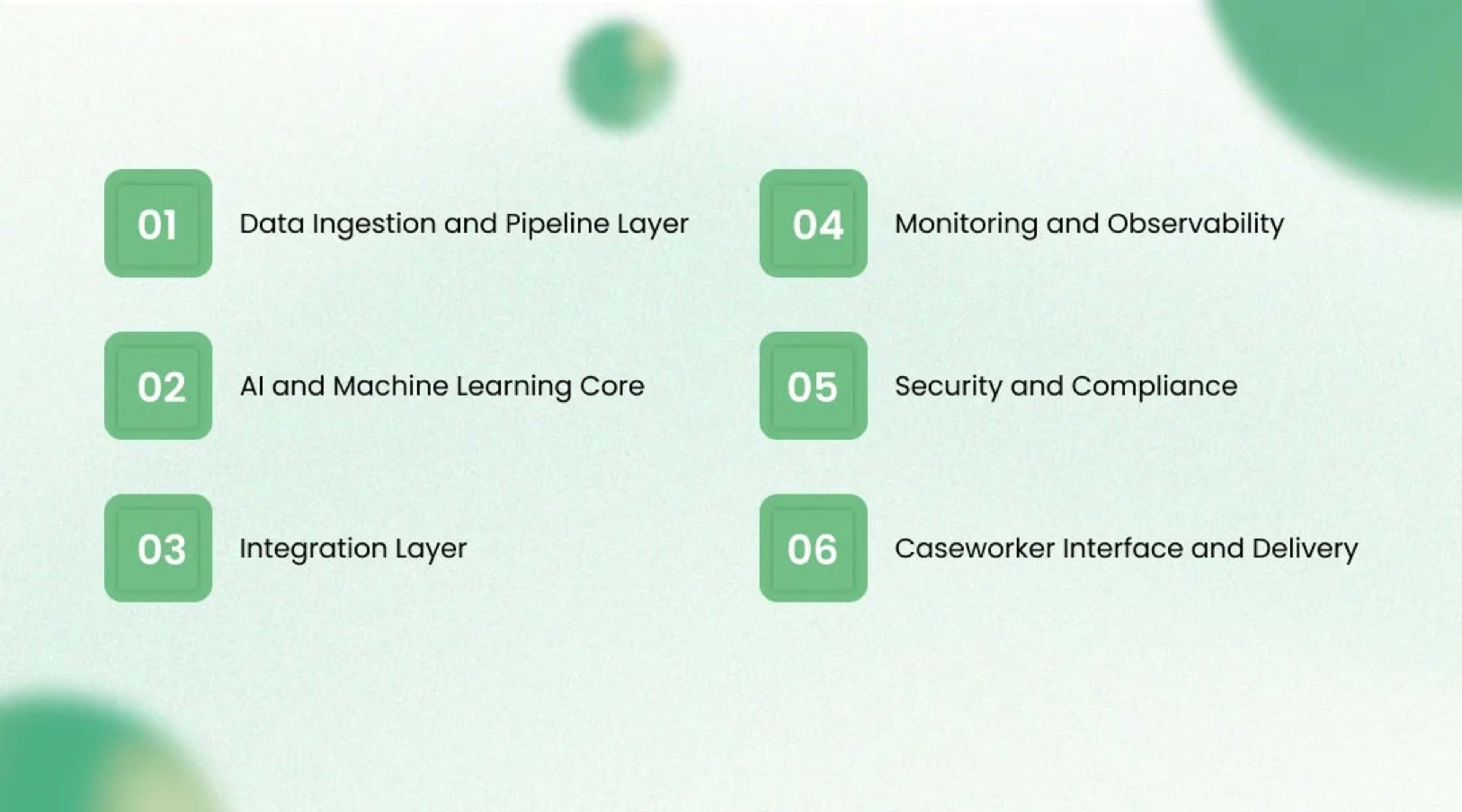
This section of our government and public sector technology work covers the architecture, which had to satisfy three non-negotiable constraints.
The architecture had to satisfy three non-negotiable constraints. It had to run entirely inside a state-controlled private network with no public model endpoints. It had to produce an immutable audit record for every automated inference. And it had to degrade gracefully, because a public benefits system cannot stop accepting applications when a GPU node fails.
Ingestion is event-driven end-to-end. We deployed Debezium for change data capture against the operational Db2 and PostgreSQL instances, publishing row-level change events into Apache Kafka. Document binaries land in an S3-compatible object store with versioning and object lock enabled, and an object created event fans out to the processing topic.
Stream processing runs on Apache Flink, handling schema normalisation, deduplication, and temporal feature construction in flight. Batch extraction from the ERP and finance systems runs nightly. Orchestration across all of it is managed by Dagster, chosen over Airflow specifically for its asset-based lineage model, which made regulatory data provenance questions answerable in minutes rather than days.
Kafka topics are partitioned by programme and region, giving us natural backpressure isolation during seasonal application surges.
Flink jobs write curated features to a Feast feature store with separate online and offline serving paths.
Embedding generation happens at ingestion time rather than query time, keeping retrieval latency predictable under load.
Dead letter queues capture malformed submissions for human triage instead of silently dropping citizen data.
The model core runs on a dedicated GPU cluster of 16 NVIDIA H100 nodes inside the state data centre. Serving is handled by vLLM with FP8 quantisation and continuous batching, which took p95 generation latency down to 1.9 seconds for a full case rationale. Document models are compiled to TensorRT for inference, roughly halving per-page processing cost against the raw PyTorch baseline.
Vector search sits in Qdrant using HNSW indexing for the hot policy corpus, with an IVF PQ tier for the 19-year historical case archive where recall tolerance is looser, and storage economics dominate. Retrieval is hybrid, combining BM25 sparse matching with dense vectors, then reranked by a cross-encoder before the context window is assembled. Reranking mattered enormously here, because statutory language is lexically repetitive and pure dense retrieval returned near duplicates.
Training infrastructure uses distributed fine-tuning across the same cluster with DeepSpeed ZeRO stage 3, with experiment tracking in MLflow. Every adapter version is registered, immutable, and traceable to the exact training dataset snapshot that produced it.
Integration was the layer most likely to sink the project, so KriraAI treated it as a first-class engineering concern rather than a final phase task. Internal service-to-service communication runs on gRPC with protocol buffer contracts, chosen for low latency and strict schema evolution guarantees. External and partner-facing surfaces are REST with versioned OpenAPI specifications behind a Kong gateway.
Downstream business systems are triggered through a webhook dispatch service with exponential backoff and idempotency keys. When a case package reaches approved state, that event propagates to payments, correspondence generation, and the citizen portal without any synchronous coupling. The legacy mainframe integration runs through a dedicated anti-corruption layer that translates modern event payloads into the fixed-width formats the system of record still expects.
Every inference emits a structured trace. We instrumented the full stack with OpenTelemetry, shipping metrics to Prometheus and traces to Grafana Tempo, with LLM-specific tracing in Langfuse. Latency is tracked at p50, p95, and p99 per model and per document class, because averages hide exactly the failures that erode caseworker trust.
Drift detection runs continuously. Population stability index is computed weekly across input feature distributions, and KL divergence is monitored on extracted field value distributions per document type. A PSI reading above 0.25 on any monitored feature raises an alert and quarantines affected predictions for human review. Model quality is scored nightly against a frozen held-out evaluation set of 3,100 adjudicated cases, and a drop of more than two points in weighted F1 automatically triggers a retraining workflow in Argo.
Security design followed NIST 800 53 controls with StateRAMP alignment. The entire platform runs in a private VPC with no public endpoints, accessed only through the agency's existing zero trust access broker. Authorisation is enforced with role-based access control layered over attribute-based policies evaluated in Open Policy Agent, so a regional caseworker cannot retrieve a case outside their jurisdiction even through the API.
Personally identifiable information is detected and masked at column level using Microsoft Presidio before any data reaches a training pipeline. Model inputs and outputs are encrypted in transit and at rest with envelope encryption backed by a hardware security module. Every inference, prompt, retrieved chunk, and human override writes to an append-only audit store with object lock, satisfying records retention requirements and giving oversight bodies a reconstructable decision history.
The delivery surface is a React-based review cockpit served through the agency's existing identity provider. It presents the recommendation, the confidence band, the extracted evidence with page-level provenance, and the cited policy text side by side. Caseworkers can accept, amend, or reject with a structured reason code, and every rejection becomes a training signal in the next evaluation cycle.
Every technology in this stack was selected against the agency's constraints, not against a general preference. Two constraints dominated. The infrastructure had to be self-hosted, and the operations team had to be able to run it after handover without specialist AI staffing.
Data and pipeline layer. Kafka was chosen over managed cloud queuing because no public cloud path was permitted for citizen data. Flink was selected over Spark Structured Streaming for genuine event time semantics with low-latency windowing, which mattered for real-time completeness checks. Dagster beat Airflow on asset lineage, which turned out to be a compliance feature as much as a developer experience one.
Model and serving layer. An open-weight Llama 3.1 70B was mandatory because no commercial API could be used inside the network boundary. vLLM was chosen over Text Generation Inference for its paged attention memory efficiency at high concurrency, letting us serve peak load on 16 GPUs instead of the 24 our first capacity model predicted. Qdrant was selected over pgvector because filtered vector search with effective date predicates needed to stay fast at 40 million vectors, and payload filtering performance was the deciding benchmark.
Operations layer. Kubernetes with Argo CD gave the agency a GitOps deployment model their platform team already understood. Prometheus and Grafana were already in-house, so we extended rather than replaced. This is a pattern KriraAI applies deliberately, since an enterprise AI implementation roadmap for public agencies fails far more often on operability than on model quality.
The delivery approach below mirrors what actually works in AI implementation for regulated industries, and it ran nine months from first workshop to full production cutover.
Delivery ran nine months from first workshop to full production cutover. KriraAI structured it in five phases with a working artefact at the end of each, because agencies with prior failed AI programmes need evidence, not roadmaps.
Discovery and requirements, six weeks. We shadowed 22 caseworkers across four regional offices and instrumented the existing workflow to get real cycle times rather than reported ones.
Architecture and data foundation, ten weeks. Ingestion, feature store, and audit infrastructure went live before a single model was trained.
Model development, fourteen weeks. Document understanding, entity resolution, and the retrieval-augmented generation for government pipeline were built and evaluated in parallel tracks.
Shadow mode validation, eight weeks. The system ran against live traffic, producing recommendations that nobody saw, scored against actual caseworker decisions.
Phased rollout and handover, eight weeks. Two programmes first, then regional expansion, with a full runbook and training programme for the internal platform team.
Three problems threatened the timeline, and none of them were the ones the agency expected.
The first was archive quality. A significant share of historical documents were microfiche scans from the 1990s with skew, bleed-through, and stamp overlays. Baseline OCR returned character error rates above 12 percent on that cohort. We resolved it with a preprocessing stage using deskewing, adaptive binarisation, and a fine-tuned Donut model that reads layout directly from pixels without an OCR intermediary, cutting field-level error on that cohort by 71 percent.
The second was policy versioning. Early evaluation showed the model citing correct policy text from the wrong effective period, a failure invisible to anyone without deep programme knowledge. We rebuilt the corpus ingestion to attach validity intervals to every chunk and made date scoping a hard retrieval filter rather than a soft ranking signal. Unverifiable citations now trigger abstention.
The third was trust, not technology. Caseworkers who had lived through a failed rules engine deployment in 2019 were understandably sceptical. We addressed it by exposing confidence bands honestly, routing low-confidence cases away from automation entirely, and publishing weekly accuracy scorecards to the staff themselves. Adoption moved from 34 percent voluntary usage in week two to 91 percent by week twelve.
As in a similar KriraAI case study cutting response times in a legacy-heavy industry, the measurements below cover the twelve months following full production rollout.
Median time to determination fell from 62 days to 9 days, a reduction of 85 percent across all in-scope programmes.
The open backlog of 411,000 files was cleared within seven months without additional permanent headcount.
First pass completeness at intake rose from 61 percent to 94 percent, largely eliminating the return and resubmit loop.
Document field extraction reached a weighted F1 of 0.973 across all 41 document types in production traffic.
Contact centre average handling time dropped from 11.4 minutes to 4.2 minutes, with escalations down from 31 percent to 12 percent.
Cost per processed case fell 41 percent, driven mainly by eliminated rework rather than by reduced staffing.
The appeal overturn rate fell from 21 percent to 13.8 percent, indicating more consistent first-time decisions.
Approximately 238,000 caseworker hours were reallocated over the year. Critically, none of that translated into layoffs. Staff moved from document handling into complex case management and applicant support, which is where public sector AI ROI actually compounds. The agency now resolves complex hardship cases with senior staff attention that previously went to sorting scanned bank statements.
The platform was designed as a foundation rather than a point solution, and that shows in what has been added since go-live. Because ingestion, feature storage, retrieval, and audit are shared services, a new programme can be onboarded by adding document schemas, a policy corpus, and an evaluation set. The second programme took eleven weeks to onboard. The fifth took nineteen days.
Scaling behaviour is predictable by design. Kafka partitioning and Flink parallelism scale horizontally with volume, and the serving tier autoscales on queue depth rather than CPU, which is the correct signal for batched GPU inference. The IVF PQ archive tier means historical corpus growth adds storage cost roughly linearly while keeping query latency flat.
The agency's roadmap over the next two to three years includes proactive eligibility outreach, where the same retrieval stack identifies citizens likely entitled to benefits they have never claimed. Fraud pattern detection using graph neural networks over the resolved entity graph is in evaluation. Multilingual correspondence generation across eleven languages is in build.
For other public agencies, the transferable lesson is architectural rather than programmatic. Build the audit layer before the model layer, treat effective-dated policy as a retrieval constraint rather than a prompt instruction, and design for human approval as the default path. AI document processing for government agencies succeeds when it removes the mechanical work around the decision, not when it tries to own the decision itself.
Three insights from this engagement travel beyond this agency. Technically, the decisive design choice was making effective dated retrieval a hard constraint and forcing abstention on unverifiable citations, because in regulated decision-making a confident wrong answer is worse than no answer. Operationally, the throughput gain came almost entirely from moving completeness checking to intake rather than from faster adjudication, which is a workflow insight that no amount of model quality would have surfaced. Strategically, the agency succeeded because it built shared foundations, so programme five onboarded in nineteen days rather than eleven weeks.
KriraAI approaches every engagement this way. We build production systems with audit trails, drift detection, and operability designed in from the first sprint, not retrofitted after a promising pilot stalls at the compliance review. Our teams work inside your constraints, whether that means a private network boundary, a mainframe system of record, or a workforce that has seen an AI programme fail before. This government AI implementation case study reflects the same engineering discipline we bring to enterprise clients across sectors, and the same enterprise AI implementation roadmap for public agencies that we adapt to each institution's real operating environment.
If your organisation is carrying a backlog, a manual bottleneck, or a decision process that cannot scale with your headcount, bring it to KriraAI and let us show you what a hardened production architecture looks like for your specific problem.
This engagement ran nine months from the first discovery workshop to full production cutover across all in-scope programmes. Roughly forty percent of that time went into data foundation and audit infrastructure before any model training began. Agencies that attempt to compress this by starting with model development almost always spend the saved time later fixing provenance, integration, and compliance gaps. A realistic planning assumption for a comparable large agency is eight to twelve months, with phased value delivery starting around month five rather than a single big bang release at the end.
No, and the system KriraAI built was deliberately designed not to. The platform produces a decision-ready recommendation with a confidence band and full citation trail, and a qualified caseworker makes the binding determination. This preserves statutory accountability, satisfies administrative law requirements around reasoned decisions, and keeps a human answerable for every outcome. Low confidence cases are routed away from automation entirely. The measured value comes from eliminating the mechanical work surrounding the decision, which reduced median processing from 62 days to 9 days without transferring any decision authority to a model.
The critical difference is time scoping. Government policy is effective dated, meaning a rule that applies to a March application may not apply to a June one. Standard retrieval pipelines have no concept of this and will confidently cite valid text from the wrong period. We attached validity intervals to every corpus chunk and made date filtering a hard retrieval constraint rather than a ranking hint. Combined with citation verification and forced abstention on unverifiable claims, this eliminated an entire error class that programme experts consider disqualifying.
For this agency, cost per processed case fell 41 percent within twelve months of production rollout, driven primarily by eliminated rework rather than reduced staffing. A backlog of 411,000 files cleared in seven months with no permanent headcount increase. Approximately 238,000 caseworker hours were reallocated to complex case management. Public sector AI ROI is usually understated when measured only in labour cost, because avoided appeals, reduced call volume, and improved statutory compliance carry real fiscal weight that rarely appears in a standard business case.
The three we encountered were archive scan quality, entity resolution across legacy identifiers, and policy version drift. Historical microfiche scans produced OCR character error rates above 12 percent until we deployed a layout native model that reads directly from pixels. Applicant records appearing under inconsistent identifiers required a two-stage resolver reaching 99.1 percent linkage precision. Policy drift required effective-dated retrieval. None of these are model capability problems, which is why AI document processing for government agencies fails far more often on data engineering than on model selection.
Ridham Chovatiya is the COO at KriraAI, driving operational excellence and scalable AI solutions. He specialises in building high-performance teams and delivering impactful, customer-centric technology strategies.