By the end of 2025, global enterprise spending on generative AI development crossed $180 billion, representing a 47% year-over-year increase from 2024. That figure is not a projection from an optimistic venture capitalist. It is an observed reality confirmed by industry analysts tracking procurement data, cloud compute contracts, and talent acquisition across Fortune 2000 companies. What was once a novelty confined to chatbot demos and image generators has become a core layer of enterprise infrastructure, and the organizations that treated it as optional are now scrambling to catch up.
The shift happened faster than most executives anticipated. In 2023, generative AI was a curiosity. By mid 2024, it was a boardroom priority. In 2026, it will be a competitive prerequisite. Companies across healthcare, financial services, manufacturing, legal, and retail are not simply experimenting with large language model applications anymore. They are deploying production-grade systems that handle customer interactions, generate regulatory filings, write and review code, synthesize research, and automate creative workflows that previously required teams of specialists. The organizations that understood this trajectory early invested in AI model fine-tuning, built internal competencies, and are now realizing returns that their slower peers cannot replicate quickly.
This blog examines the current state of generative AI development with the depth and specificity that decision makers need. It covers the industry pressures driving adoption, the specific technologies creating value through dedicated generative AI development services, the quantified business impact that justifies investment, and the practical roadmap for implementation. It also addresses the real challenges and limitations that no vendor will tell you about, and projects where this field is heading over the next three to five years. Whether you are a CTO evaluating your first pilot or a founder scaling an existing deployment, this analysis will sharpen your understanding of what generative AI development actually requires in practice.
The generative AI development industry does not exist in a vacuum. It has grown so rapidly because it addresses structural problems that have plagued enterprises for decades, problems that traditional software and automation could never fully solve. Understanding these pressures is essential before examining any technology, because the technology only matters if it solves a real problem.
The first and most persistent pressure is the cost of knowledge work. Across industries, the most expensive line items on an operating budget are the salaries of people who read, write, analyze, synthesize, and communicate for a living. Lawyers reviewing contracts. Analysts writing reports. Engineers debugging code. Marketing teams are producing campaign content. Customer support agents answering complex questions. These are not rote tasks that robotic process automation can handle. They require language comprehension, contextual judgment, and the ability to generate novel output. Before generative AI, there was no scalable way to augment or accelerate this work. Companies could hire more people or accept slower throughput. Neither option was sustainable in a competitive market.
The second pressure is data volume outpacing human capacity. Enterprises today generate and receive more unstructured data than any human workforce can process. A mid-sized pharmaceutical company might produce 50,000 pages of clinical documentation per drug candidate. A financial institution might ingest 10,000 news articles per day for risk monitoring. A legal department might face 200,000 documents in a single discovery request. The data exists, and the insights are buried inside it, but the bottleneck has always been the human time required to read, comprehend, and act on that information. Traditional search and indexing tools help locate documents, but they cannot understand them, summarize them, or extract actionable conclusions.
The third pressure is competitive velocity. Product cycles are shrinking. Customer expectations are rising. Regulatory environments are shifting faster than compliance teams can respond. In this context, the ability to move from insight to action in hours rather than weeks is not a luxury. It is a survival requirement. Companies that can generate a market analysis overnight, produce a first draft of a regulatory submission in a day, or respond to a customer complaint with a personalized resolution in minutes will outcompete those that cannot. Generative AI is the first technology that credibly addresses this speed gap across the full spectrum of knowledge work.
The fourth pressure is talent scarcity. Finding and retaining skilled professionals in fields like software engineering, data science, legal analysis, and medical research has become increasingly difficult and expensive. Enterprise generative AI adoption offers a path to amplify the output of existing teams rather than engaging in bidding wars for scarce talent. A team of five engineers with well-integrated AI tools can now achieve the output that previously required eight or nine, not because the AI replaces engineers, but because it eliminates the time they spend on boilerplate, documentation, code review, and context switching.
The phrase "generative AI" encompasses a range of technologies, and conflating them leads to poor decisions. Understanding which specific technology solves which specific problem is the difference between a successful deployment and an expensive experiment that delivers nothing. This section maps the core technologies in generative AI development to the business functions they are transforming.
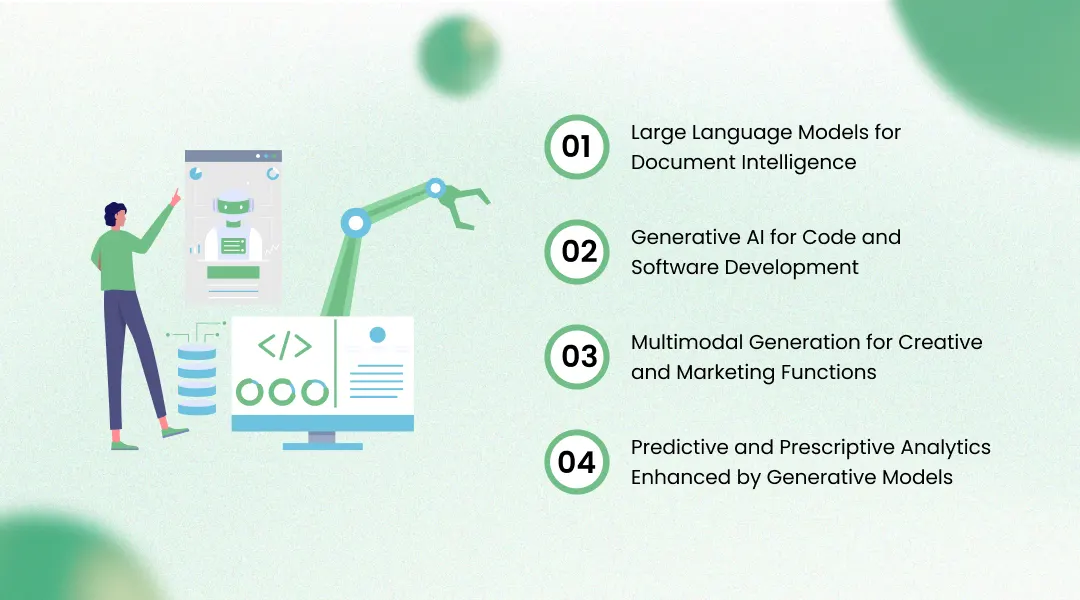
Large language model applications have matured significantly since the initial wave of general-purpose chatbots. In 2026, the most impactful enterprise deployments use fine-tuned models trained on domain-specific corpora to perform document intelligence tasks. These include contract analysis in legal departments, where models extract key clauses, flag non-standard terms, and compare language against approved templates. In financial services, LLMs process earnings transcripts, regulatory filings, and analyst reports to generate investment summaries and risk assessments, a pattern increasingly common across finance industry AI solutions. In healthcare, they synthesize patient records, clinical notes, and published research to support diagnostic reasoning and treatment planning.
The key advancement is retrieval-augmented generation, commonly known as RAG, which allows models to ground their outputs in an organization's proprietary data without requiring full retraining. A company can connect its internal knowledge base, policy documents, and historical records to a language model and receive answers that are specific to its context. KriraAI has built enterprise RAG architectures for clients across multiple industries, enabling them to deploy document intelligence systems that achieve over 92% accuracy on domain-specific queries while maintaining strict data governance controls.
Code generation and code assistance represent one of the most quantifiably impactful large language model applications in enterprise settings. Developers using AI-assisted coding tools report completing tasks 30% to 55% faster, depending on the complexity of the work. These tools go beyond simple autocomplete. They generate entire functions from natural language descriptions, write unit tests, refactor legacy code, and produce documentation from codebases. AI model fine-tuning on proprietary codebases allows enterprises to create assistants that understand their specific frameworks, naming conventions, and architectural patterns, producing suggestions that are immediately usable rather than generic.
The impact extends beyond individual developer productivity. AI code review tools can scan pull requests for security vulnerabilities, performance bottlenecks, and style inconsistencies at a speed and consistency that human reviewers cannot match. This does not eliminate the need for human code review, but it elevates the quality of code that reaches human reviewers, allowing them to focus on architectural decisions and business logic rather than on catching syntax errors and formatting issues.
Generative AI development now encompasses text, image, audio, and video generation within unified pipelines. Marketing teams use these capabilities to produce campaign variations at scale, generating dozens of ad copy versions, corresponding visual assets, and localized adaptations in hours rather than weeks. Product teams use image generation to create concept visualizations and prototype designs before committing engineering resources. Training departments use video generation and voice synthesis to produce instructional content in multiple languages without the cost of filming and translation.
The critical evolution here is the shift from standalone generation tools to integrated workflows where generative AI is embedded in existing creative platforms. Designers are not switching to a separate AI tool. They are using AI capabilities within their design software. Writers are not pasting text into a chatbot. They are using AI suggestions within their content management systems. This integration is what separates productive enterprise deployments from the novelty experiments of 2023 and 2024.
Traditional predictive analytics required data scientists to build, validate, and explain models manually. Generative AI has transformed this workflow by enabling natural language interfaces to analytical systems. Business users can now ask questions in plain English and receive not just answers but explanations, visualizations, and recommended actions. A supply chain manager can ask "What is the probability of a delay on our Southeast Asian shipping routes next quarter?" and receive a synthesized analysis drawing from historical logistics data, weather patterns, geopolitical risk indicators, and carrier performance records.
KriraAI's generative AI implementation strategy for analytics clients focuses on building these natural language layers on top of existing data infrastructure, ensuring that organizations can unlock the value of their data assets without rebuilding their entire analytics stack. This approach reduces implementation timelines from 12 to 18 months down to 4 to 6 months and dramatically lowers the technical barrier for business users who need insights but lack programming skills.
The most important question for any executive evaluating generative AI is not "what can it do" but "what will it return." The following results are drawn from documented enterprise deployments and industry benchmarking studies published through early 2026. They represent the outcomes that mature implementations are achieving, not theoretical projections.
In customer service operations, companies deploying generative AI for first-line support resolution have reduced average handling time by 38% while improving customer satisfaction scores by 12 to 18 percentage points. The reduction comes from AI systems handling routine inquiries autonomously and providing human agents with pre-drafted responses, relevant knowledge base articles, and customer history summaries for complex cases. One telecommunications provider reported saving $23 million annually after deploying a generative AI system that resolved 64% of inbound support queries without human intervention.
In legal and compliance functions, much like recent AI implementation in financial services, AI model fine-tuning on contract language has reduced contract review time by 60% to 70% across organizations that have deployed these systems at scale. A global insurance company reported that its legal team now processes 340% more contracts per quarter with the same headcount, while simultaneously reducing the rate of missed non-standard clauses from 8.2% to under 1.5%. The financial impact extends beyond labor savings. Faster contract processing accelerates deal cycles, which directly affects revenue recognition timing.
In software development, enterprises using AI coding assistants report a median productivity increase of 42%, measured by completed story points per sprint. More importantly, the quality metrics have improved alongside the speed metrics. Defect rates in organizations with mature AI coding tool adoption have declined by 22% on average, driven by automated testing, code review, and documentation generation. A financial technology company documented $4.7 million in annual savings from reduced bug remediation costs alone.
In marketing and content production, generative AI has compressed content creation cycles by 60% to 75%. A consumer goods company that previously required three weeks to produce a full campaign across digital channels now completes the same scope in four to five days. The cost per content asset has decreased by 52%, and the ability to produce more variations has improved campaign performance metrics by 28% through better personalization and A/B testing at scale.
These numbers are significant, but they require context, similar to the operational gains seen in AI predictive maintenance results in manufacturing. The organizations achieving these results did not simply purchase an AI tool and activate it. They invested in data preparation, workflow redesign, change management, and ongoing optimization. The technology is the enabler, but the results come from the organizational commitment to using it properly.
Moving from interest to impact requires a structured generative AI implementation strategy. The companies that succeed follow a disciplined process. The companies that fail skip steps, underinvest in foundations, or try to scale before they have validated their approach. This section outlines the process that works, based on patterns observed across hundreds of enterprise deployments.
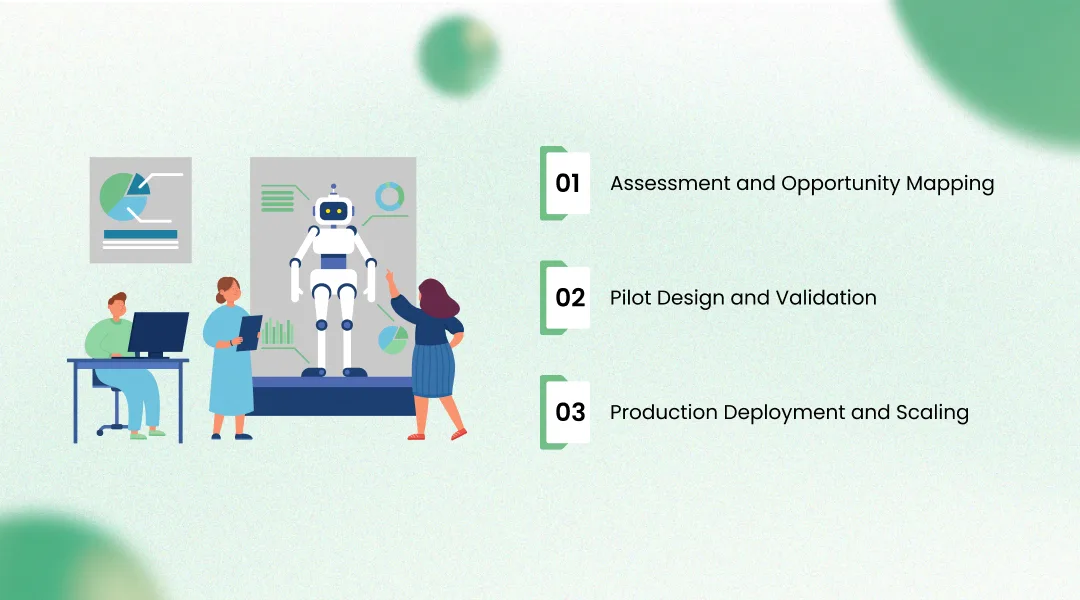
The first step is not selecting a technology. It is identifying the highest-value use cases within the organization. This requires a structured audit of business processes to find the intersections of three criteria: high volume of knowledge work, high cost or time burden, and tolerance for AI-assisted output. Not every process meets all three criteria, and trying to apply generative AI everywhere simultaneously is a reliable recipe for failure.
The assessment should produce a ranked list of five to ten candidate use cases, each with an estimated impact value, a data readiness score, and an integration complexity rating. KriraAI typically conducts this assessment over a four- to six-week engagement, working with cross-functional teams to ensure that the selected use cases reflect genuine business priorities rather than the enthusiasms of the technology team alone.
Once the top two or three use cases are selected, the next step is designing a controlled pilot. A well-designed pilot has the following characteristics:
A clearly defined success metric tied to a business outcome, not a technical benchmark.
A bounded scope that can be completed in 8 to 12 weeks.
A representative sample of real data, not a cleaned or curated test dataset.
Active participation from the end users who will ultimately adopt the system.
A comparison framework that measures AI-assisted performance against the current baseline.
The pilot phase is where most enterprise generative AI adoption efforts succeed or fail. Organizations that treat the pilot as a proof of concept destined for a slide deck will get a slide deck. Organizations that treat it as the first iteration of a production system will get a production system.
Scaling from pilot to production introduces challenges that do not exist at small scale. These include infrastructure requirements for handling production workloads, monitoring systems for tracking model performance and detecting drift, governance frameworks for managing access and audit trails, and integration work to embed AI outputs into existing business systems and workflows.
The transition from pilot to production typically requires 12 to 20 weeks and involves significant engineering effort beyond the AI model itself. Data pipelines must be hardened. Failover mechanisms must be built. User interfaces must be designed for the workflow context in which they will be used. Training programs must be developed for end users. These are not optional steps, and organizations that treat them as afterthoughts will find that their technically successful pilot becomes an operationally failed deployment.
The most frequent mistake is starting with the technology rather than the problem. Teams that begin by selecting a model or platform and then searching for problems to solve with it almost always produce solutions that do not fit their actual needs. Starting with a clearly articulated business problem and working backward to the appropriate technology prevents this.
The second most common mistake is underinvesting in data quality. Generative AI systems are only as good as the data they access. Organizations with fragmented, inconsistent, or poorly organized data assets will not achieve the results described in the impact section above, regardless of how advanced their model is. A realistic data preparation effort should be budgeted as 30% to 40% of the total implementation cost.
The third mistake is neglecting change management. Even a perfectly functioning AI system will fail if the people who are supposed to use it do not trust it, do not understand it, or do not have incentives to adopt it. Successful implementations include structured training, clear communication about how AI augments rather than replaces human work, and feedback loops that allow users to report issues and request improvements.
Intellectual honesty requires acknowledging that generative AI development is not a universal solution, and its limitations are real. Any organization considering adoption should understand these challenges clearly before committing resources.
Data privacy and security remain the most significant barriers for regulated industries. Language models can inadvertently memorize and reproduce sensitive information from their training data. Enterprise deployments must implement strict data isolation, access controls, and audit mechanisms to prevent unauthorized data exposure. In industries like healthcare and financial services, regulatory frameworks such as HIPAA and SOX impose specific requirements on how AI systems handle protected information, and non-compliance carries severe penalties.
Hallucination, the tendency of generative models to produce plausible but factually incorrect outputs, remains an unsolved problem at the fundamental level. While techniques like retrieval-augmented generation significantly reduce hallucination rates, they do not eliminate them. Any deployment where AI-generated output is used for decision-making must include human review processes. The cost and time required for this review partially offset the efficiency gains from AI, and organizations must account for this in their ROI calculations.
The talent gap in generative AI is real and widening. Building, deploying, and maintaining enterprise generative AI systems requires skills that are in short supply, including ML engineering, prompt engineering, data engineering, and AI governance. The demand for these skills far exceeds the available workforce, and salaries have increased by 35% to 50% over the past two years. Organizations that cannot attract or develop this talent internally often struggle to move beyond the pilot phase.
Integration complexity should not be underestimated. Enterprise IT environments are complex ecosystems of legacy systems, proprietary databases, custom workflows, and interconnected applications. Embedding generative AI into these environments requires significant engineering effort, and the integration work often takes longer and costs more than the AI development itself. KriraAI addresses this challenge by building integration layers that connect generative AI capabilities to existing enterprise systems without requiring wholesale infrastructure replacement.
The next three to five years will see generative AI development evolve from a set of impressive but largely standalone capabilities into the foundational layer of enterprise software. Three trends will define this evolution, and understanding them is critical for any organization planning its long-term technology strategy.
The first trend is the convergence of generative and agentic AI. Current systems generate outputs. Future systems will generate, evaluate, plan, and execute multi-step workflows autonomously. An AI system will not just draft a market analysis. It will identify the need for one based on incoming data signals, gather the relevant information, produce the analysis, route it to the appropriate decision makers, and track whether the resulting decisions were implemented. This shift from tool to autonomous agent will create enormous value for organizations that are prepared for it and existential competitive threats for those that are not.
The second trend is the commoditization of foundation models and the rising importance of fine-tuning and customization. As open source and commercial foundation models converge in baseline capability, the competitive advantage will shift entirely to how well an organization adapts those models to its specific domain, data, and workflows. AI model fine-tuning will become a core enterprise competency, as important as software development is today. Organizations that invest in building this competency now will have a structural advantage that compounds over time.
The third trend is the emergence of AI governance as a strategic function rather than a compliance checkbox. As generative AI systems become more deeply embedded in business operations, the risks associated with model failures, biased outputs, data breaches, and regulatory violations will increase proportionally. Organizations that establish robust governance frameworks early will be able to scale their AI deployments confidently. Those who treat governance as an afterthought will face costly incidents that erode trust, invite regulatory scrutiny, and slow their adoption trajectory.
Companies that delay enterprise generative AI adoption beyond 2027 will face a compounding disadvantage. Their competitors will have accumulated proprietary training data, refined their models through years of production feedback, built internal expertise, and redesigned their workflows around AAI-augmentedprocesses. Catching up will not be a matter of purchasing the same tools. It will require replicating years of organizational learning that cannot be compressed.
Three themes emerge from this analysis with particular clarity. First, generative AI development has crossed the threshold from experimental technology to enterprise infrastructure, and the organizations succeeding with it are those that treat it as an operational capability rather than a technology project. Second, the business impact is real and measurable, but it requires disciplined implementation, genuine investment in data quality, and sustained commitment to change management. Third, the competitive window for adoption is narrowing. Companies that delay will face not just a technology gap but an organizational learning gap that compounds with each passing quarter.
Navigating this landscape requires more than purchasing tools. It requires a partner that understands both the technology and the business context in which it must operate. KriraAI works with enterprises across industries to design and implement generative AI solutions that are grounded in real business problems, built on solid data foundations, and engineered for production scale. From initial assessment through pilot deployment to full-scale operations, KriraAI brings the technical depth and industry experience that transform AI ambition into measurable business outcomes. If your organization is ready to move beyond experimentation and build generative AI capabilities that deliver lasting competitive advantage, reach out to KriraAI to start that conversation.
Generative AI development refers to the process of building, training, and deploying artificial intelligence systems that can create new content, including text, images, code, audio, and video. This stands in contrast to traditional AI, which focuses primarily on classification, prediction, and pattern recognition within existing data. Traditional AI might analyze a dataset and predict an outcome. Generative AI creates entirely new outputs that did not previously exist, such as drafting a legal contract, writing functional code, or producing a marketing image. The underlying technology relies on large neural networks trained on vast datasets, using architectures like transformers that can learn the statistical patterns of language, imagery, and other data modalities and then produce novel outputs that follow those patterns. The practical implication for enterprises is that generative AI can automate knowledge work and creative tasks that were previously considered exclusively human domains.
The cost of implementing generative AI in an enterprise varies significantly based on scope, complexity, and the organization's data readiness. A focused pilot project targeting a single use case, such as customer support automation or document summarization, typically costs between $150,000 and $500,000 over a 3 to 6 month period, including data preparation, model development or fine tuning, integration, and testing. Scaling to production across multiple use cases increases costs to between $1 million and $5 million annually, factoring in infrastructure, ongoing model maintenance, monitoring, and dedicated AI engineering staff. Organizations with poor data quality or fragmented systems should budget an additional 30% to 40% for data preparation and integration work. The return on investment typically materializes within 12 to 18 months for well executed implementations, with the strongest returns appearing in high volume knowledge work processes where AI can automate or significantly accelerate repetitive tasks.
The industries that benefit most from generative AI development are those with high volumes of unstructured data, significant knowledge work costs, and processes that involve generating, reviewing, or synthesizing text and documents. Financial services leads adoption due to the enormous volume of regulatory filings, risk reports, and client communications that can be automated or accelerated. Healthcare benefits from AI's ability to synthesize medical literature, assist in clinical documentation, and support diagnostic reasoning. Legal services gain from contract analysis, legal research, and document drafting capabilities. Software development benefits from code generation, testing automation, and documentation. Retail and e-commerce use generative AI for personalized content creation, product descriptions, and customer interaction at scale. Manufacturing applies it to technical documentation, quality reporting, and supply chain communications. The common thread across all of these industries is the presence of repetitive knowledge work that requires language comprehension and content creation.
How long does it take to see ROI The biggest risks of generative AI for businesses fall into five categories. First, accuracy risk, as generative models can produce confident but incorrect outputs that may lead to flawed decisions if not properly reviewed. Second, data privacy risk, since models may inadvertently expose sensitive information from training data or retrieval sources. Third, regulatory risk, as evolving AI regulations across jurisdictions create compliance obligations that organizations must track and satisfy. Fourth, dependency risk, because over reliance on AI generated outputs without adequate human oversight can degrade organizational expertise over time. Fifth, reputational risk, since public facing AI systems that produce biased, offensive, or factually wrong content can damage brand trust rapidly. Mitigating these risks requires a comprehensive AI governance framework that includes human review workflows, data access controls, regular model auditing, bias testing, and clear escalation procedures for AI failures. The organizations that address these risks proactively rather than reactively are the ones that scale their AI deployments successfully.
Most enterprises that follow a structured generative AI implementation strategy begin seeing measurable returns within 6 to 18 months of their initial deployment, though the timeline depends heavily on the use case and organizational readiness. Customer service automation and internal knowledge management tend to deliver the fastest returns, often within 3 to 6 months, because they address high volume, repetitive tasks with clear baseline metrics. More complex applications like regulatory compliance automation or AI assisted drug discovery may require 12 to 24 months before delivering measurable financial returns, because the validation and integration requirements are more extensive. The key accelerator is data readiness. Organizations that enter the process with well organized, accessible, and high quality data assets reach positive ROI significantly faster than those that must invest months in data cleanup before their AI systems can function effectively. Tracking ROI requires establishing clear baseline metrics before deployment, including task completion time, error rates, cost per output, and customer satisfaction scores.
Founder & CEO
Divyang Mandani is the CEO of KriraAI, driving innovative AI and IT solutions with a focus on transformative technology, ethical AI, and impactful digital strategies for businesses worldwide.