Picture this. It is a Tuesday morning in 2029. A small business owner who runs a logistics company sits down with her coffee and opens a dashboard, not to answer emails or chase invoices or schedule meetings. Those tasks were handled overnight. An AI system she configured some months ago reviewed fourteen supplier contracts, flagged three renewal deadlines, drafted response templates, rescheduled a conflicted calendar, followed up on five outstanding invoices, and compiled a briefing on a competitor who just entered her market. She reads the briefing. She picks up the phone. She calls her most important client because she has something specific and valuable to say, something the AI identified but cannot say itself. The call goes well.
That scenario is not science fiction. It is an honest picture of where the future of work with AI agents is heading, built from observable trends that are already in motion today. The technology exists in early, imperfect form right now. Within the next three to five years, it will become accessible, affordable, and reliable enough to change what a working day feels like for the majority of people in knowledge-based jobs.
Here is why this matters to you personally, whether you run a business, manage a team, work in finance or healthcare or marketing or law, or simply want to understand what is coming before it arrives. The change that AI agents will bring to work is not simply about efficiency or cost reduction. It is about a fundamental shift in what humans are expected to do, what skills will matter, what a career looks like, and what organisations will pay for. The people and businesses who understand this shift early, who see it clearly rather than either dismissing it or fearing it, will navigate it far better than those who are caught by surprise.
This blog covers the honest, grounded, human-scale story of what AI agents are, when the major changes will arrive, what they will mean for specific jobs and industries, what the genuine concerns are and how to think about them carefully, and what you should do right now to prepare. Nothing in this blog requires you to understand technology. Everything in it matters to anyone who works for a living.
Before diving into what the future of work with AI agents will look like, it helps to understand what an AI agent actually is, in plain human terms, because the word "agent" is being used loosely in ways that confuse rather than clarify.
An AI agent is not simply a chatbot you ask questions. It is an AI system that is given a goal rather than a question, and then goes and does the work required to reach that goal on its own, across multiple steps, using tools, accessing information, making decisions, and completing tasks, much like a capable assistant who can work without constant supervision.
Think of the difference this way. A regular AI tool is like a very fast, very knowledgeable reference librarian. You ask it something, it gives you an answer. That is useful. An AI agent is more like a capable junior employee. You tell it you need a full competitive analysis of three companies in your market, and it goes away, searches publicly available information, organises the findings, identifies the most relevant patterns, and puts a structured report on your desk. You did not need to tell it every step. You set the goal, and it figured out the path.
What makes AI agents meaningfully different from the AI tools that came before is the combination of three capabilities working together, and this combination is what will reshape work.
First, they can plan. Rather than responding to one question at a time, AI agents can take a large goal, break it down into the steps needed to reach it, figure out what order those steps should go in, and adjust the plan when something unexpected happens partway through.
Second, they can use tools. An AI agent can search the internet, read a document, send a message, update a spreadsheet, access a database, make an API call to another software system, or trigger an action in another application. This means they do not just produce text. They can actually do things in the real world of software.
Third, they can work with other AI agents. Just as a company has specialists who hand work to each other, a network of AI agents can divide a complex task among themselves. One agent researches. One writes. One checks the work. One formats and sends. Each handles its area of competence. The human sets the overall direction and reviews the outcome.
This combination of planning, tool use, and coordination is what is shifting AI from a tool you use to a colleague that works alongside you. And that shift is what will change the future of work most profoundly.
Understanding when different changes will arrive is just as important as understanding what those changes are. Too many forecasts treat AI's impact on work as either happening right now or happening in some vague distant future. Neither framing is useful. The honest picture is a progression, and it unfolds in stages that are already underway.
The first and most immediate stage is already visible today and will accelerate sharply through 2027. This is the stage where routine, structured, predictable tasks inside existing workflows get handed to AI agents.
Think about the work that fills a significant portion of most professional days: drafting initial emails, summarising long documents, pulling data from multiple sources into a report, scheduling across complex calendars, responding to standard customer enquiries, categorising incoming requests, preparing meeting notes, updating records after a call. These tasks share a characteristic. They follow recognisable patterns. They are done the same way every time. They consume time without requiring deep judgement or relationship.
By 2027, most organisations that adopt AI tools seriously will have automated a substantial portion of these tasks. McKinsey research suggests that AI is already boosting productivity by roughly 14 percent in customer service and around 26 percent in software development, and these early gains are coming from exactly this kind of workflow automation. The gains will compound as the tools improve and spread.
For individuals, this stage feels like getting several hours back each week. For organisations, it reduces the cost and time associated with high-volume routine work. For people who built their careers primarily around executing these tasks efficiently, this stage creates real anxiety, and that anxiety deserves honest attention rather than dismissal.
The second stage, which will arrive in force between 2027 and 2030, is deeper and more significant. This is when AI agents begin assisting with work that currently requires professional training and judgement, not by replacing the professional, but by extending what that professional can accomplish.
A doctor will have an AI system that reviews a patient's complete medical history, compares it against patterns in millions of similar cases, generates a differential diagnosis, flags potential drug interactions, and presents the doctor with a structured picture before the consultation begins. The doctor still sees the patient. The doctor still exercises clinical judgement. But the doctor walks into that room better prepared than any human could be relying on memory and experience alone.
A lawyer will have an AI system that reads a thousand pages of contract precedent overnight, identifies the clauses most likely to create disputes in a specific type of transaction, and drafts a first version of a new contract. The lawyer reviews, advises, negotiates, and argues. But the work that used to take weeks of associate time can now be done in hours.
A financial adviser will have an AI system that monitors a client's full financial picture in real time, models thousands of scenarios, and flags changes in circumstance or opportunity that warrant a conversation. The adviser still builds the relationship. The adviser still understands the client's fears and goals in ways that no AI can replicate. But the quality of advice improves because the analysis underneath it becomes far more comprehensive and timely.
This stage will create visible disruption in entry-level professional roles because many of the tasks that junior lawyers, junior doctors, junior financial analysts, and junior consultants do today are exactly the kind of tasks AI agents will handle well by 2027 to 2030. Entry-level hiring in these professions will contract, and people entering these fields will need to develop the higher-order skills earlier rather than earning them through years of routine work.
By 2030 and continuing through the decade that follows, the nature of work itself will have changed for a significant portion of knowledge workers. The dominant shift will be from being a person who does tasks to being a person who directs, oversees, quality-checks, and improves the work of AI systems.
IDC forecasts that by 2030, approximately 45 percent of organisations will be orchestrating AI agents at scale across their business functions. That does not mean half of all workers will be displaced. It means half of all organisations will have restructured work so that AI agents handle a large portion of execution while humans focus on direction, judgement, relationships, creativity, and accountability.
The job titles and role descriptions that emerge from this era will look different from today. But the humans in those roles will be doing work that is genuinely harder to replicate and, in many cases, more interesting and more valued. The question is who will be ready.
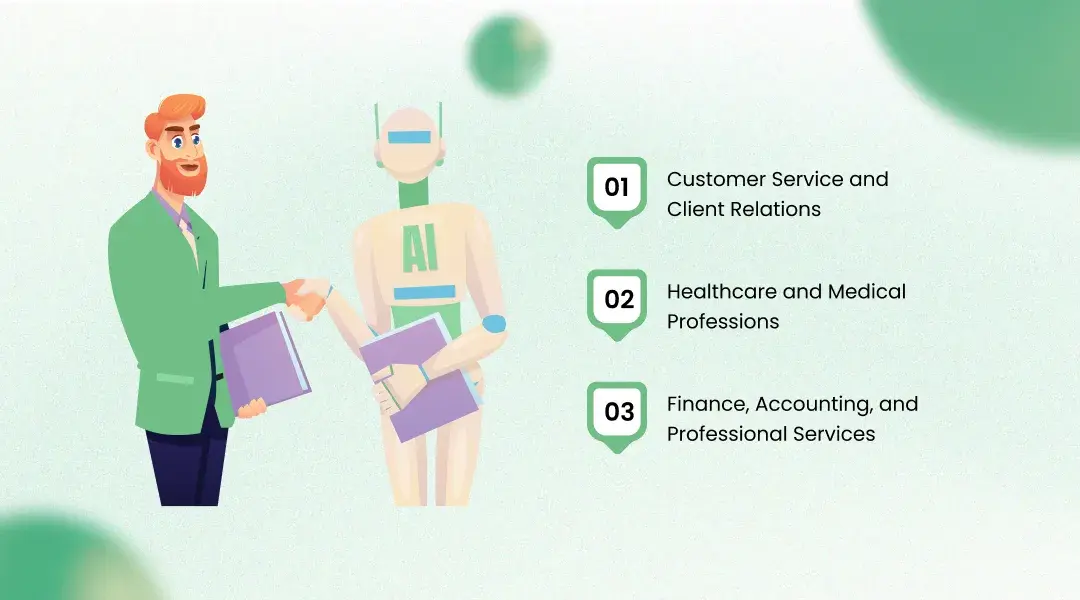
The future of work with AI agents will not affect all jobs equally or on the same timeline. Understanding which roles and industries will change most profoundly, and how, helps both individuals and organisations make better decisions about where to invest attention and preparation.
Customer service is already experiencing the fastest transformation of any function. AI systems can now resolve around 80 percent of standard customer enquiries in banking and financial services, and this capability is expected to exceed 90 percent by the end of 2026. Within five years, the vast majority of initial customer contact across retail, banking, telecoms, and services will be handled by AI agents that can understand what the customer needs, access their account history, resolve standard issues, and do all of this at any hour without wait times.
What this means for customer service roles is not that they disappear entirely. It means they change dramatically. The humans who remain in customer-facing roles will handle situations that require genuine empathy, complex problem-solving, escalation management, and relationship maintenance. These are the moments that determine whether a customer stays with a company or leaves. They are also the moments that an AI agent cannot handle well, not because it lacks information, but because human connection in a difficult moment requires something that goes beyond information retrieval and response generation.
The customer service professional of 2028 will spend most of their day doing the work that used to represent five percent of their day, the hardest, most consequential interactions, the ones where the company's reputation is genuinely at stake.
Healthcare will experience one of the most profound transformations of any sector, and the evidence that this is beginning is already compelling. Microsoft's AI diagnostic system demonstrated 85.5 percent accuracy on complex medical cases in 2025, compared to an average of 20 percent for experienced physicians facing the same cases cold. This does not mean AI is a better doctor. It means AI is very good at pattern recognition across vast amounts of medical knowledge, which is genuinely useful when a physician faces a complex or unusual case.
By 2028, primary care physicians will routinely work alongside AI systems that review patient histories, suggest diagnostic pathways, flag medication risks, monitor chronic conditions through connected devices, and handle documentation. The time a doctor currently spends on administrative tasks, which research suggests accounts for roughly 40 percent of a physician's working day, will be substantially reduced. That time will either be reinvested in patient care, which would represent a significant improvement in healthcare quality, or it will reduce the number of physicians needed, which is a more uncomfortable outcome that healthcare systems and policymakers will need to navigate carefully.
For nurses, radiologists, pharmacists, physiotherapists, and other allied health professionals, similar patterns will emerge, with AI handling the pattern recognition and documentation aspects of their work while humans focus on physical care, relationship, and the clinical judgements that require human presence.
Finance and accounting are experiencing one of the fastest rates of AI adoption of any professional sector. Approximately 85 percent of financial institutions are already using AI in at least one area of their operations. By 2028, AI agents will be handling the majority of routine accounting tasks, including transaction categorisation, reconciliation, compliance checking, standard report generation, and audit trail documentation.
For accountants and financial analysts, this shifts the value of their role toward interpretation, strategic advice, and relationship management. A CFO who previously relied on a team of analysts to produce monthly reports will instead have AI that produces those reports continuously, flagging anomalies in real time. The CFO's role becomes less about understanding the numbers and more about deciding what to do with the understanding.
Law firms, consulting firms, and other professional service organisations will go through a parallel restructuring. The work that justifies premium billing will shift from the volume of analysis produced to the quality of judgement applied. Senior professionals will find their time is freed from supervision of junior work and reinvested in direct client engagement. Junior professionals will face a steeper initial learning curve because the scaffolding of routine work that used to build competence gradually will be compressed.
The transformation of small business by AI agents deserves particular attention because it represents one of the most significant levelling effects in the history of commercial competition. Today, a large enterprise can afford teams of specialists across marketing, HR, legal compliance, financial analysis, customer service, and data analytics. A small business with ten employees cannot. The result is a structural disadvantage that has always made it harder for small operators to compete on quality of operations.
By 2028, AI agents will make enterprise-grade capabilities accessible to a business of any size. A sole trader will be able to deploy an AI agent that monitors their finances, chases invoices, handles customer enquiries at 3am, produces marketing content calibrated to their specific audience, checks contracts for problematic clauses, and analyses which products or services are most profitable. These capabilities, which today require either expensive human specialists or expensive software subscriptions with steep learning curves, will become as accessible as a smartphone.
KriraAI works directly with small and medium businesses to build these kinds of practical AI systems, focused on real business outcomes rather than technology for its own sake. The opportunity for business owners who move early is significant, and the cost of waiting is measured not in missed efficiency but in ground ceded to competitors who act sooner.
One of the most important questions anyone asks about the future of work with AI agents is: what do humans do when AI handles more and more of what we currently get paid to do? The honest answer is that human value concentrates in a set of capabilities that AI agents, however capable they become, are genuinely and structurally poor at.
AI agents are excellent at tasks with clear parameters, consistent patterns, and measurable outcomes. They are structurally weak at situations where the right answer is genuinely unclear, where the context is novel, where ethical trade-offs are involved, or where the stakes of a mistake are high enough to require accountability.
A doctor who faces a patient whose symptoms match no clear pattern needs not just information but clinical intuition built from experience. A lawyer advising a client on a business decision that sits in a legal grey area needs not just knowledge of the law but judgement about risk tolerance, relationships, and what will hold up under scrutiny. A business owner deciding whether to enter a new market needs not just data but a feel for timing, culture, and competitive dynamics that no AI system can fully model.
These judgement calls will become more valuable as AI handles more of the routine work around them, because the judgement is what the client or patient or employer is ultimately paying for.
No AI agent will replace the experience of being understood by another human being. The customer who has just received terrible news about their insurance claim does not want to be processed by a system, however empathetic its language. The employee who is struggling with a difficult project needs a manager who sees them as a person, not as a resource allocation problem. The client who is considering a major business decision needs an adviser who has demonstrated over time that they understand what the client actually cares about, not just what they say they care about.
Relationships built on genuine trust and mutual understanding will become more commercially valuable as AI handles more of the transactional work that currently surrounds those relationships. The professional who has invested in deep, authentic relationships with clients and colleagues will find that investment compounding in value. The professional who has relied on technical knowledge alone as their competitive advantage will find that advantage eroding.
AI agents are powerful generative tools. They can produce vast quantities of text, images, code, and plans. What they cannot do is originate a genuinely new idea, understand why a particular creative choice matters to a specific human audience, or take responsibility for a creative direction when the stakes are real. The humans who provide creative direction to AI tools, who understand what good looks like, who can evaluate and edit and push back and insist on something better, these are the people who will thrive in a world where AI handles generation.
A writer who uses AI to produce first drafts but brings the judgement, voice, and structural instinct that makes writing worth reading will be far more productive than before. A designer who uses AI to generate visual options but brings the taste and client understanding to know which option works will produce more and better work. In every creative field, the humans who direct and curate will be more valuable than those who resist the tools.
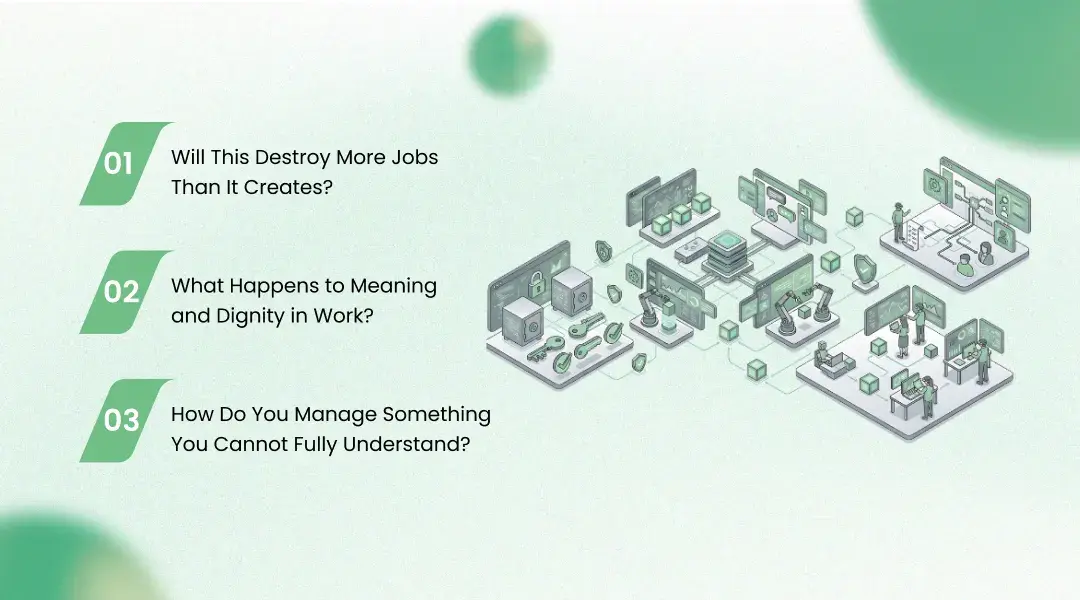
It would be dishonest and unhelpful to write about the future of work with AI agents without addressing the genuine concerns that intelligent, thoughtful people have about this transition. Not every concern is well-founded, but some are, and they deserve honest engagement.
This is the central question, and it deserves a specific, honest answer rather than either reassurance or alarm. The short answer is: in certain categories of work, yes, AI agents will eliminate roles entirely or reduce headcount significantly. In other categories, AI will reshape roles without eliminating them. And in some areas, the productivity gains from AI will create new economic activity that supports new roles.
The Stanford AI Index noted in early 2026 that employment for software developers aged 22 to 25 has fallen nearly 20 percent since 2022, with AI playing a measurable role alongside other economic factors. McKinsey surveys from 2025 show that approximately one third of organisations expect AI to reduce their workforce in the coming year, particularly in service operations and supply chain management.
These are real disruptions happening to real people. The honest picture is that the transition will not be painless and will not be evenly distributed. Workers in roles heavily focused on routine cognitive tasks, data entry, standard report generation, and repetitive customer interaction face the most immediate risk. Workers in roles requiring complex judgement, physical presence, relationship management, and creative direction face far less risk in the near term.
This is a concern that economists and business schools are beginning to take seriously, and it is a concern that matters deeply to many people. Harvard Business School researchers noted in late 2025 that AI is creating "second-order effects" on the experience of work itself. When a customer service representative no longer gets to help a customer directly, and that interaction is handled by an AI system, the representative loses something real, not just a task, but a source of meaning and human connection.
This effect will be felt broadly as AI handles more of the human interactions that gave work its texture. Leaders and business owners will need to think carefully about how to redesign work so that it preserves and creates opportunities for meaning, not just efficiency. This is not a soft concern. It directly affects motivation, retention, and the quality of work that humans produce alongside AI systems.
As AI agents handle more complex work, a legitimate concern emerges about oversight and accountability. If an AI agent makes a bad decision in a medical recommendation, a legal document, or a financial plan, who is responsible? How does a professional maintain accountability for work that AI has substantially produced?
The answer that is emerging across responsible organisations is clear: AI handles execution, humans retain accountability. This means professionals will need new skills in evaluating, auditing, and correcting AI-produced work. Being able to review a contract drafted by AI and identify the clauses that require human judgement is a skill that lawyers will need. Being able to evaluate an AI-generated diagnosis and know when to push further is a skill that physicians will need. The oversight role is genuinely a skilled role, and developing it deliberately is one of the most important forms of career preparation for the coming decade.
The organisations that will benefit most from AI agents are not simply those that deploy the technology fastest. They are the organisations that redesign their work intelligently, build real capability in their people, and maintain the human elements that create trust with clients and employees.
The most important structural change an organisation can make is to stop thinking about AI as a cost-cutting tool and start thinking about it as a capacity expansion. The question should not be how many people can be replaced but what becomes possible when people are freed from routine work. This distinction in framing leads to very different choices, and those choices determine whether the organisation ends up more capable and more trusted, or cheaper and more fragile.
Practical steps for organisations include conducting a genuine audit of where routine cognitive work consumes the most time across roles, identifying which of those tasks are good candidates for AI handling versus which require human judgement even when they appear routine, creating clear accountability structures for AI-assisted work before AI handles anything consequential, and investing deliberately in the skills that will make human workers more valuable alongside AI, specifically judgement, relationship depth, creative direction, and oversight capability.
KriraAI has helped many businesses work through exactly this kind of transition planning, building AI systems calibrated to the specific workflow and risk profile of each organisation rather than deploying generic tools and hoping they fit. The difference between AI that genuinely improves a business and AI that creates new complications is almost always in the design and implementation, not in the underlying technology.
Whether you are an individual professional, a business owner, a manager, or someone early in their career, the choices you make in the next two to three years about how you respond to AI agents in the workplace will significantly shape your position in the decade that follows.
The most valuable immediate action most people can take is not to become an AI expert. It is to become genuinely skilled at the work that AI cannot do well while becoming fluent enough with AI tools to use them effectively. This combination of deep human skill and practical AI fluency is what the most valuable professionals in every field will share by 2030.
Specific preparation steps worth taking now:
Identify which parts of your current role consist of routine, pattern-based work that AI will likely handle within three years, and actively invest in developing the higher-judgement, relationship, and creative aspects of your work to compensate.
Start using the AI tools available to you regularly, not to replace your thinking but to extend your capacity. The professionals who will adapt best are those who develop a practical working relationship with AI tools before those tools become essential.
Invest in the skills most resistant to AI automation: deep listening, complex negotiation, ethical reasoning, creative judgement, and the ability to build and maintain trust with clients, colleagues, and communities.
If you lead a team or run a business, begin the honest conversation about which work your people should be doing and which work AI should be doing. This conversation is far better to have proactively than to have it forced upon you by a competitor who had it first.
Pay attention to how AI changes the work of your most experienced colleagues and senior professionals in your field, because what they do today is likely to be what everyone does tomorrow.
The organisations and professionals who navigate this transition best will not be those who resisted or those who surrendered. They will be those who made clear, intelligent, human-centred choices about what to hand over and what to hold onto.
The future of work with AI agents is not predetermined. It will not simply happen to people and organisations while they watch. It will be shaped, for better and worse, by the choices made in the next several years by business leaders, policymakers, educators, and individuals.
The optimistic version of this future is one where AI handles the grinding, repetitive, energy-draining elements of cognitive work, freeing human beings to spend more of their working lives in the modes of work that people actually find meaningful: solving hard problems, building real relationships, creating things of genuine value, making judgements that matter, and contributing to organisations and communities in ways that technology cannot replicate. That future is genuinely within reach.
The less optimistic version is one where the gains from AI flow primarily to organisations and shareholders while workers absorb the disruption without a proportionate share of the benefit, and where the transition is handled carelessly enough that many people lose livelihoods before new roles emerge to replace them. That version is also possible, and the difference between the two will be determined by policy choices, organisational ethics, and the degree to which the people most affected understand what is coming clearly enough to advocate for their own interests.
What is not in question is that the transition is coming. The pace of adoption of AI capabilities is faster than the adoption of the personal computer or the internet in their early years, according to the Stanford 2026 AI Index. The question is not whether work will change. It is whether the change will be navigated wisely.
Three things should stay with you from this blog. First, the future of work with AI agents is not a distant theoretical concern. It is a transition that is already underway and will reshape professional life substantially within the next three to five years, across industries ranging from customer service and healthcare to finance, law, and small business. The timeline is specific, the direction is clear, and the opportunity to prepare is now.
Second, this transition is not simply about replacement. It is about a profound shift in what humans are expected to contribute. The work that will remain distinctly and durably human, complex judgement, relationship depth, creative direction, ethical accountability, and the ability to oversee and guide AI systems, is also the work that most people find most meaningful and most valuable. The transition, navigated wisely, points toward a working world where humans do more of the work that matters and less of the work that simply fills time.
Third, the difference between a good outcome and a difficult one for any individual or organisation is determined primarily by whether they engage with this transition actively and thoughtfully, making clear choices about what to hand over and what to hold, investing in the human capabilities that will compound in value, and building the structures needed to maintain accountability and trust as AI handles more of the execution.
KriraAI exists precisely to help businesses navigate this kind of transition with clarity and practical intelligence. Rather than deploying AI for its own sake, KriraAI builds AI systems designed around the specific operational realities and strategic goals of each business it works with, creating measurable outcomes rather than impressive-sounding capability demonstrations. The company works with business owners and teams to understand where AI genuinely adds value, where human judgement remains essential, and how to build the kind of human-AI collaboration that makes organisations more capable and more trusted rather than simply cheaper to run. If you want to understand how the changes described in this blog apply to your specific business and what steps make sense to take now, exploring what KriraAI can offer is a practical place to start that conversation.
The future of work is not something that will happen to you. It is something you are already choosing how to meet.
Whether AI agents will eliminate your specific role depends significantly on what kind of work fills your days. If the majority of your work consists of routine, structured, repeatable tasks such as data entry, standard report generation, answering repetitive enquiries, or following predictable processes, then yes, AI agents will automate a substantial portion of those tasks within three to five years, and some roles built entirely around such tasks will shrink significantly. However, most professional roles contain a mix of routine and non-routine work. The more honest question is not whether your job will disappear but which parts of it will be handled by AI and which parts will become more central to your value. The professionals who will thrive are those who actively develop the skills AI handles poorly: complex judgement, relationship depth, creative direction, ethical reasoning, and oversight of AI-produced work. Starting that development now puts you in a significantly stronger position than waiting.
Small businesses are already beginning to access AI agent capabilities through off-the-shelf tools, and this access will expand considerably between now and 2028. The economics are moving in a favourable direction: hardware costs for running AI have been declining by approximately 30 percent annually, and the competition among AI providers is pushing prices down sharply. Within two to three years, a small business owner will be able to deploy AI agents that handle customer communication, financial monitoring, content production, and administrative tasks for a monthly cost comparable to a software subscription today. The organisations best positioned to help small businesses make this transition effectively are those who understand both the technology and the real operational challenges of a small business, building systems designed around measurable business outcomes rather than technical capability demonstrations.
By 2030, the majority of roles in knowledge-based industries will be structured around the oversight, direction, and quality assurance of AI-produced work rather than the direct production of that work. A marketing role will spend less time writing copy and more time judging which AI-generated content resonates with the audience and why. A financial analysis role will spend less time building models and more time interpreting what the models reveal and advising on what to do. A human resources role will spend less time on administrative processing and more time on the human conversations that determine whether talented people stay and grow within an organisation. Roles that involve physical presence, human connection, and complex ethical judgement will be relatively unchanged in their human intensity but will be surrounded by AI systems that handle information management and routine coordination. The most significant change will be at the entry level of most professions, where the stepping-stone tasks that currently build competence will increasingly be handled by AI, requiring a rethinking of how professionals develop early in their careers.
Trust in AI-produced work is earned through verification, not assumed through confidence. The most practical approach for anyone using AI agents in a professional context is to treat AI output the way a careful editor treats a first draft: it is a starting point that requires review, not a finished product that can be passed on without examination. For high-stakes work, meaning anything involving legal, financial, medical, or safety-critical decisions, human review by a qualified professional remains essential and should remain so for the foreseeable future. The skill of evaluating AI output, knowing what kinds of errors AI tends to make, checking its reasoning rather than just its conclusions, and identifying when it has missed context that a human would recognise, is itself a valuable professional capability. Building this evaluative muscle now, through regular use of AI tools in lower-stakes work, is one of the most practical ways to prepare for a world where AI produces more of the raw material professionals work with.
The most valuable thing a business owner can do right now is to start from a clear-eyed audit of where time in their business is spent on work that follows predictable patterns versus work that requires genuine human judgement and relationship. That distinction maps directly onto what AI agents will handle well and what they will not. Once you understand where that boundary sits in your business, you can begin experimenting with AI tools for the routine work while deliberately protecting and investing in the human work that creates real differentiation. It is also worth having a frank conversation with your team about how their roles will evolve, because the organisations that handle this transition best are those where the people affected are part of designing the new reality rather than having it imposed on them. Finding a partner who understands both AI capabilities and real business operations, rather than just AI technology, will accelerate this process significantly and help you avoid the common mistakes of deploying AI tools without the thinking needed to make them work.
Founder & CEO
Divyang Mandani is the CEO of KriraAI, driving innovative AI and IT solutions with a focus on transformative technology, ethical AI, and impactful digital strategies for businesses worldwide.