Let me start bluntly: the phones aren’t stopping. Customers still call — even in an era of apps, chatbots, and self-service portals. And when they do, the stakes are high. They’re calling because they couldn’t fix it elsewhere, because it’s urgent, or because they just want a human voice.
I’ve seen support managers sit with coffee going cold as the queue counter ticks up. I’ve sat in those late-night “war rooms” debugging call-routing flows while the CEO wants answers on churn. That’s why I care about AI phone answering services. Not because they’re trendy, but because 2025 is the first time the tech stack is mature enough to actually matter.
The question is simple: will these systems save your agents or alienate your customers? Let’s walk through the reality.
Support is shifting for three undeniable reasons:
Customer patience is evaporating. Nobody wants to “press 5 to hear this menu again.” They want natural conversation.
Call volumes are spiking. Especially in e-commerce, healthcare, and banking. Seasonal peaks can triple traffic overnight.
Budgets are tightening. Boards don’t want to add 40 new agents. They want efficiency without burnout.
So the future of customer support 2025 isn’t about adding headcount. It’s about AI call answering solutions that absorb repetitive requests, route intelligently, and free humans for higher-value work.
The last few years changed the game. Speech recognition finally cracked the accent problem (still not perfect, but usable). Natural language models stopped guessing and started actually interpreting intent. And cloud telephony made integration faster.
Now, an AI phone agent for business can answer instantly, handle five requests in parallel, and sync the outcome into your CRM. In industries like retail or banking, this isn’t an experiment — it’s running daily.
An AI-powered phone answering system is basically your digital front desk. It:
Answers calls immediately.
Greets the customer with context-aware scripts.
Identifies intent (“check order status,” “book appointment,” “block card”).
Resolves simple requests automatically.
Escalates complex calls to humans — but with transcripts, context, and history ready.
The engine: speech-to-text, natural language understanding, dialogue management, and API calls into your systems.
Traditional call centers scale linearly — more calls mean more agents. AI call answering services scale elastically. Add 1,000 calls in an hour, and the AI doesn’t flinch.
But here’s the kicker: humans win on empathy and judgment. Machines win on speed and memory. If you confuse the two, you set yourself up for disaster.
By 2025, customers expect:
First-call resolution. Don’t transfer me five times.
Personalization. Know my order, know my issue, don’t ask me to repeat it.
Natural conversation. I want to talk, not navigate menus.
Companies aren’t running “AI pilots” for PR anymore. They’re deploying AI call center automation with real KPIs: lower average handle time, higher CSAT, reduced cost per ticket.
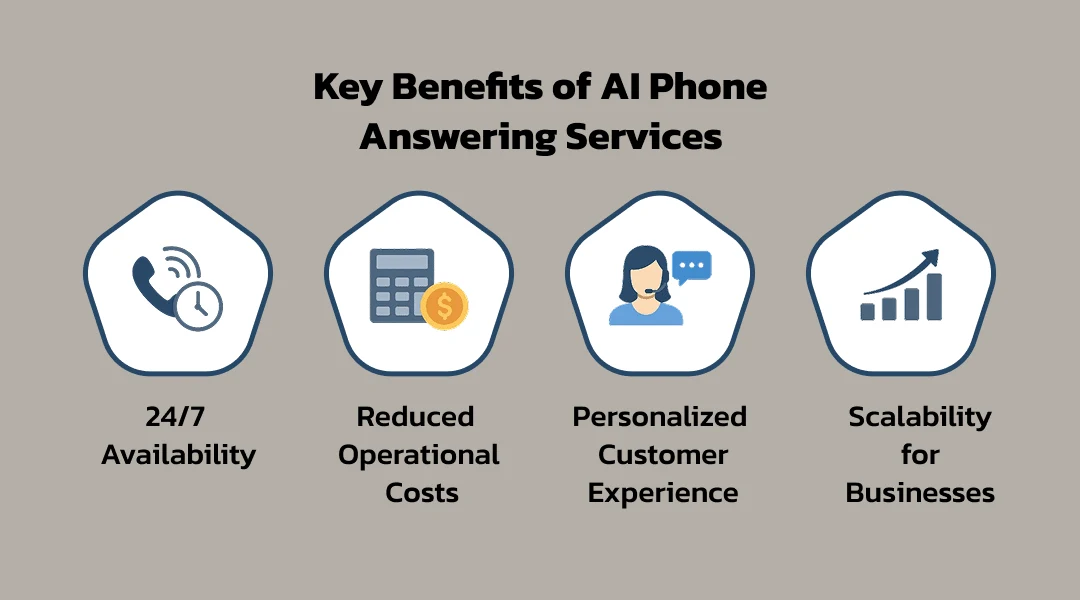
Support doesn’t sleep. With AI, neither does your phone line. I’ve seen SMEs win back customers just because they picked up calls at 11 p.m.
Here’s a number: blended AI-human support can cut 18–35% of costs in the first quarter. Why? Fewer idle agents, fewer repeat calls, and lower overtime.
The benefits of AI in customer service aren’t generic. It’s about pulling up a customer’s last order, checking delivery status, and updating them live without human lookup time.
Seasonal rush? Launch campaign? Flash sale? An AI call answering software for SMEs can absorb call floods without leaving customers hanging.
Instant recall of policies and data.
Never tired, never inconsistent.
Great at repetitive FAQs.
Humans are still unbeatable in:
Handling angry, emotional customers.
Navigating complex, multi-step negotiations.
Building trust in sensitive industries like healthcare or finance.
This isn’t man vs. machine. It’s man + machine. The AI call bot for customer experience triages, humans handle nuance. That’s how AI customer service automation actually works.
(Quick challenge for you: write down five customer requests your team hates. That’s your automation starter pack.)
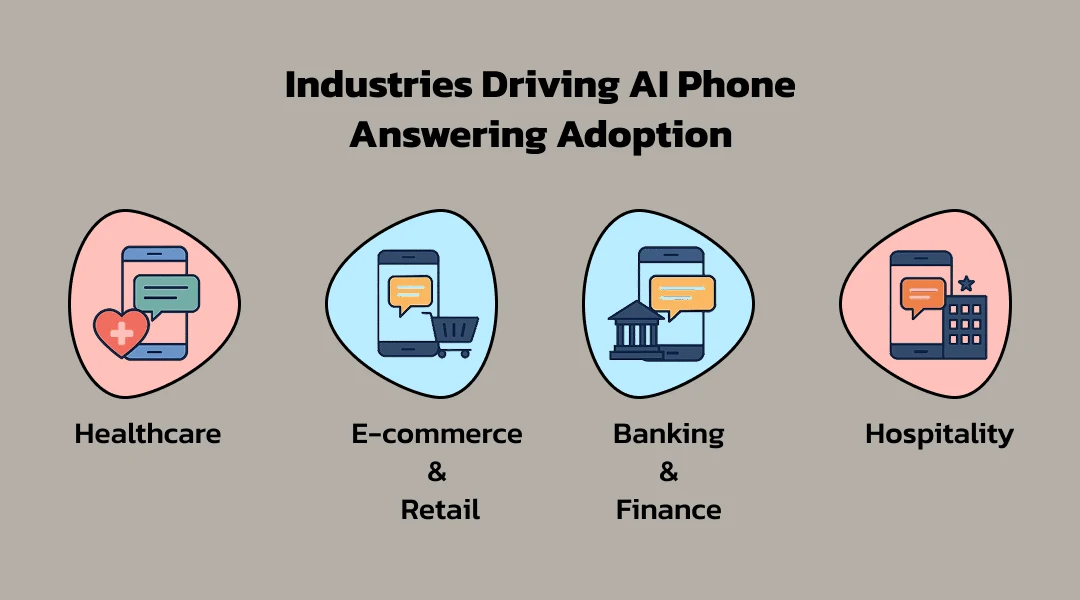
Appointment scheduling, reminders, lab results — all sensitive, but repeatable. With audit trails and compliance, AI voice agents for customer support thrive here.
Promotions trigger call floods. “Where’s my order?” is 60% of volume. AI answers in seconds.
Fraud alerts, balance checks, card blocks. With multi-factor authentication, AI phone answering for small businesses in fintech is already mainstream.
Bookings, modifications, loyalty queries. A tired traveler calling at midnight doesn’t want to wait 20 minutes.
If your vendor can’t prove compliance, walk away. PII needs encryption, retention policies, and human access limits.
AI will mishear. It’s inevitable. Smart deployments use confidence thresholds and escalate when uncertain.
Use sentiment detection. When frustration rises, hand the call to a human. This balance is the difference between delight and churn.
Early models can detect tone and adjust pacing. By 2025, sentiment-driven call flows will be standard.
In India, bilingual (Hindi + English) is table stakes. Regional language support is the next big frontier.
Expect tighter integrations with CRM, analytics, and compliance dashboards. AI voice
Conclusion
2025 is the year AI phone answering systems stop being novelty projects. They become operational infrastructure.
But here’s the truth: AI isn’t here to replace your agents. It’s here to stop wasting their time. The hybrid model — AI for routine, humans for nuance — is the sustainable path.
Start small. Measure obsessively. Respect the customer’s voice. That’s how AI call answering services in 2025 evolve from hype into help.
Projects often start in the low lakhs for setup. Costs scale with call volume, integrations, and compliance.
Yes. Conversational AI beats menu trees for common requests, while IVR can stay as a fallback.
Typically 18–35% cost savings, plus faster resolutions and higher satisfaction scores.
Look for industry case studies, transparent pricing, and multilingual accuracy. Compare affordable AI answering service plans carefully.
For standard use cases, off-the-shelf works. For regulated sectors, Hire AI Developer for custom builds.
Founder & CEO
Divyang Mandani is the CEO of KriraAI, driving innovative AI and IT solutions with a focus on transformative technology, ethical AI, and impactful digital strategies for businesses worldwide.