Enterprise Chatbot AI Solution: Our Production RAG Build
A conversational AI platform serving over five million customer conversations every month had hit a wall. Its chatbots answered the questions they were built for, yet anything outside a fixed set of intents fell straight to a human agent. For this client, an enterprise chatbot AI solution was no longer a nice-to-have; it was the difference between margin and loss. Roughly fifty-five percent of incoming conversations escalated to live support, and each escalation carried real cost. The platform held years of conversation logs, knowledge base articles, and resolved tickets, but almost none of that data was working for it. KriraAI engaged with this client to rebuild the intelligence underneath their product from the ground up. We replaced a brittle intent classification engine with a grounded retrieval and generation system built for production scale. This blog walks through the problem we inherited, the architecture we designed, the path to go live, and the measurable results the client achieved.
The Problem KriraAI Was Called In To Solve
The platform had grown faster than its core technology could support. Its chatbots ran on a classic intent and entity model, where every supported question was mapped to a predefined intent. New customer domains meant new intents, new training utterances, and weeks of manual labeling. The platform could not keep up with the volume of fresh content its enterprise tenants kept publishing. As a result, the chatbots felt smart on the demo path and brittle everywhere else.
Containment was the metric that hurt most. Only forty-five percent of conversations were resolved without a human, which meant the majority of traffic landed on paid support agents. Each tenant measured this number, and several were threatening to churn. The platform was effectively selling automation while paying for human labor underneath it. That gap was unsustainable as conversation volume kept climbing.
The Containment Ceiling of Intent-Based NLU
Intent-based natural language understanding has a structural ceiling. It can only answer what it was explicitly trained to recognize, so the long tail of real user phrasing slips through. When a customer unexpectedly asked the same question, the classifier returned low confidence, and the bot defaulted to escalation. The platform tried to patch this by adding more intents, but every addition raised the risk of intent collision. Two intents with overlapping utterances began competing, and accuracy degraded across the board.
The maintenance burden compounded the problem. Each tenant required its own intent taxonomy, and those taxonomies drifted apart over time. Engineers spent more hours curating training data than improving the product. The system was technically functioning yet strategically stuck.
Data That Existed but Was Never Used
The most valuable asset in the building was sitting unused. The platform had millions of resolved support tickets, thousands of help center articles, and detailed product documentation per tenant. None of this content fed the chatbots in any meaningful way. The bots could not read a help article and answer from it, because the intent model had no mechanism to ground a response in the source text.
This is the situation any conversational AI leader recognizes immediately. The answers existed, the data existed, but the architecture could not connect the two. Every unanswered question represented knowledge the company already owned. KriraAI was brought in to close that gap with a production-grade retrieval and generation system rather than another round of intent tuning.
What KriraAI Built: An Enterprise Chatbot AI Solution Grounded in Retrieval
KriraAI designed and delivered a grounded conversational engine that replaced the intent classifier with a retrieval-augmented generation core. Instead of matching utterances to fixed intents, the new system retrieves relevant source passages and generates an answer grounded in that evidence. Every response is tied to retrieved content, which is what makes the output trustworthy at enterprise scale. This is the foundation of the RAG chatbot implementation we shipped.
Retrieval augmented generation reduces chatbot hallucination by anchoring each response in retrieved source passages rather than in the model's parametric memory. When a customer asks a question, the system first finds the most relevant chunks from that tenant's knowledge base, then conditions the language model on those chunks. If no grounded evidence exists, the system declines to invent an answer and routes the conversation to a human. That single design choice changed the trust profile of the product.
From Intent Matching to Grounded Generation
The end-to-end flow is straightforward to describe and hard to engineer well. A user message first passes through a lightweight router that classifies the request and detects language, including Hinglish and other code-switched inputs common in Indian markets. The router decides whether the query needs retrieval, a direct action, or immediate escalation. For knowledge questions, the system runs hybrid retrieval, reranks the candidates, and assembles a tight context window.
The fine-tuned language model then generates a grounded answer with inline citations back to source documents. A faithfulness check verifies that the answer is supported by the retrieved evidence before it ever reaches the user. If the check fails, the response is suppressed, and the conversation escalates cleanly.
KriraAI built this pipeline as a multitenant service, so every tenant gets isolated retrieval and configurable behavior. New tenant content flows into the index continuously, which means the bot improves as the tenant publishes more. There is no intent retraining cycle and no manual taxonomy to maintain. The platform moved from managing intents to managing knowledge, and that shift unlocked the rest of the results.
Solution Architecture for the Enterprise Chatbot AI Solution
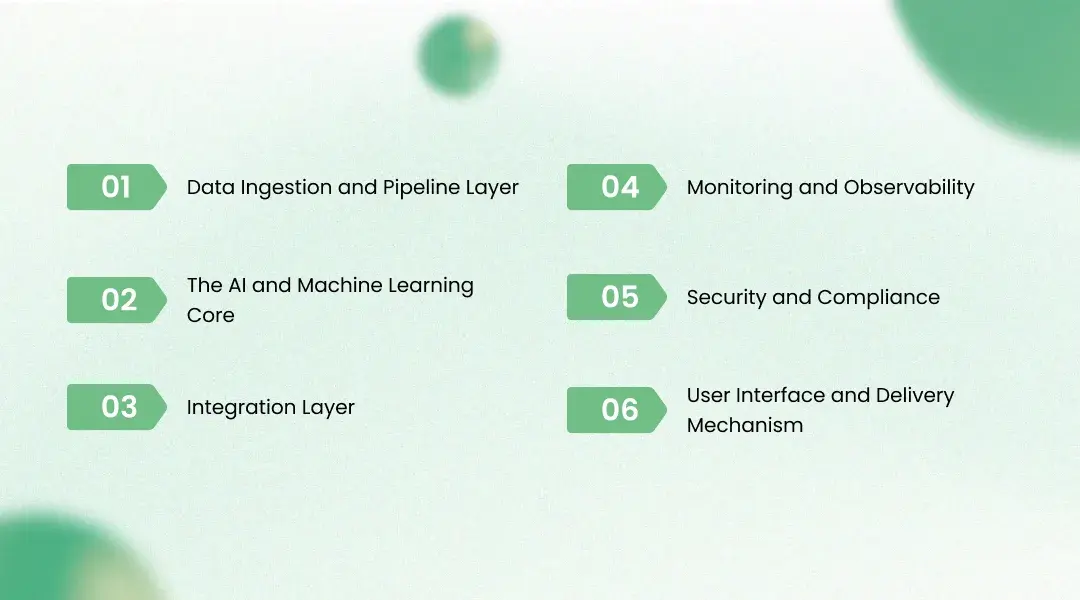
The architecture is the part KriraAI is most proud of, because it had to survive real production traffic from day one. We designed six clear layers, each with a defined responsibility and a deliberate technology choice. The layers connect through well-versioned contracts so that any single component can evolve without breaking the others. This is the engineering backbone of the entire enterprise chatbot AI solution.
Data Ingestion and Pipeline Layer
The ingestion layer keeps every tenant's knowledge current without manual effort. We pull content through change data capture from operational stores using Debezium, and we stream those change events through Apache Kafka. Batch sources such as help center exports and ticket archives are ingested on schedules orchestrated by Dagster, which manages our pipeline DAGs with strong typing and asset awareness. Apache Flink handles stream processing where near-real-time freshness matters.
Raw documents are parsed, cleaned, and chunked before they ever reach the model. Parsing uses layout-aware extraction so that tables and headings survive intact. We apply schema normalization and entity resolution to remove duplicate and contradictory content across tenant sources. Embedding generation happens at ingestion time, so vectors are written alongside metadata in a single pass.
A few non-negotiable steps run inside this layer:
Deduplication and freshness scoring remove stale passages that previously caused contradictory answers across the knowledge base.
PII redaction strips sensitive customer data from ticket-derived content before any of it is embedded or stored.
Tenant tagging attaches strict isolation metadata to every chunk so retrieval can never cross tenant boundaries.
The AI and Machine Learning Core
The core is where the RAG chatbot implementation earns its accuracy. Retrieval is hybrid, combining sparse BM25 search in OpenSearch with dense vector search served from Qdrant. The dense index uses HNSW graphs for low-latency recall, with IVF PQ compression reserved for the largest tenants to control memory. We fine-tuned a bi-encoder embedding model with contrastive learning so that retrieval aligns to support style queries rather than generic web text.
Candidate passages from both retrievers are fused and then reranked by a cross encoder, which scores true query passage relevance with far higher precision than first-stage retrieval alone. The generation model is an open-weight large language model fine-tuned with QLoRA on the client's domain corpus of resolved conversations. We serve it through vLLM with continuous batching and INT8 quantization, which is what made the latency budget achievable. A separate natural language inference model performs grounding verification, checking that every generated claim is entailed by the retrieved context.
This layered LLM chatbot architecture means no single model is asked to do everything. Routing, retrieval, reranking, generation, and verification are distinct stages with measurable quality at each step. That separation is what lets us debug and improve the system in production without guesswork.
Integration Layer
The integration layer connects the AI to the systems that already run the client's business. We exposed the engine through versioned REST and GraphQL contracts for tenant-facing applications, and gRPC for low-latency internal service calls. Escalation events are published to a message queue, which drives an event-driven handoff into ticketing systems such as Zendesk and Salesforce. Webhooks deliver AI outputs and conversation summaries to downstream business systems in near real time.
Versioning was treated as a first-class concern from the start. Tenants integrate at their own pace, so the contract had to remain stable while the internals evolved. This is the discipline that keeps a conversational AI deployment from breaking customer integrations during upgrades.
Monitoring and Observability
Monitoring is what separates a demo from a production system, and KriraAI instrumented this layer heavily. We track data drift on incoming queries using the population stability index and the KL divergence, so distribution shifts trigger alerts before they degrade answers. Retrieval quality, faithfulness scores, and answer relevance are measured continuously against a held-out evaluation set. Latency is tracked at p50, p95, and p99, with alerts wired to defined service level objectives.
Every conversation is traced end to end, so engineers can inspect routing, retrieval, and generation for any single turn. When faithfulness or containment crosses a defined threshold, an automated retraining trigger queues a new fine-tuning and reindexing job. An LLM as a judge harnesses scores from a sampled stream of live conversations daily. That feedback loop keeps quality honest long after launch.
Security and Compliance
Security was designed for a multitenant platform handling regulated customer data. We enforced role-based access control with attribute-level data masking, so users only ever see fields their role permits. Model inputs and outputs are encrypted in transit and at rest, and the entire system runs inside a private VPC with no public model endpoints. Audit logs are written to an immutable append-only store for traceability.
Tenant isolation is absolute at the data layer. Vector namespaces, metadata filters, and access policies all enforce the same boundary, with no shared retrieval path between tenants. The deployment was aligned to SOC 2 controls and to India's DPDP Act 2023 for data handling. For a platform serving regulated enterprises, this rigor was a precondition, not an afterthought.
User Interface and Delivery Mechanism
Delivery had to feel instant to the end customer. Responses stream token by token over a WebSocket connection, so users see the answer forming rather than waiting for a full payload. A semantic cache in Redis serves near identical questions without invoking the model, which trimmed both latency and cost. An agent assist surface shows human agents the grounded answer and its citations when a conversation escalates.
KriraAI also delivered an analytics dashboard for tenant administrators. It exposes containment, escalation reasons, and answer quality per topic in near real time. This visibility is what lets tenants trust the automation and act on its gaps.
The Technology Stack Behind the Build
Every technology in this stack was chosen against the client's existing environment and scale, not picked for novelty. We standardized the runtime on Kubernetes using AWS EKS, because the client already operated on AWS and needed predictable autoscaling for spiky conversation traffic. Object storage and data lake assets live in Amazon S3, which keeps ingestion costs low at their volume.
For orchestrating, we chose Dagster over Airflow because its asset-based model fit our continuous reindexing pattern more cleanly than task-only DAGs. Apache Kafka and Apache Flink handle streaming, chosen for proven throughput at the platform's event volume. Qdrant was selected as the vector store for its strong HNSW performance and native multitenancy, while OpenSearch provided the sparse retrieval that the client already understood operationally.
On the model side, we served the fine-tuned LLM with vLLM for its continuous batching and memory efficiency, paired with NVIDIA Triton and TensorRT for the embedding and reranker models. QLoRA made domain fine-tuning affordable on a modest GPU footprint. MLflow tracked experiments and model versions, Feast managed online and offline features, and Evidently drove drift detection. Redis served the semantic cache, and FastAPI fronted the inference services. Each choice reflected a deliberate trade between performance, cost, and the team's ability to operate it after handover.
How We Delivered It: The Implementation Journey
A production RAG chatbot deployment took our team roughly thirty-four weeks from discovery to full rollout. KriraAI runs every engagement through clear phases, and this project moved through discovery, architecture design, data engineering, model development, validation, phased rollout, and handover. We measured a baseline before writing a line of production code. That baseline is what made the final results provable rather than anecdotal.
Discovery ran for four weeks and focused on the data and the numbers. We audited conversation logs, mapped tenant knowledge sources, and established the forty-five percent containment baseline precisely. Architectural design followed across three weeks, where we locked the six-layer design and the contracts between them. Data engineering then consumed six weeks, and it surfaced the first hard problem.
The challenges were real, and being honest about them matters more than a clean story.
Stale and duplicate knowledge content produced contradictory retrievals, so we added entity resolution, deduplication, and freshness scoring to the ingestion layer.
Initial p95 latency sat at 4.2 seconds, which we cut to 1.1 seconds through INT8 quantization, vLLM continuous batching, and the semantic cache.
Naive retrieval still hallucinated on about twelve percent of edge case answers, so we introduced cross-encoder reranking and natural language inference grounding to push factual errors below two percent.
Tenant isolation needed hardening, so we enforced namespace separation and metadata filters at every retrieval call.
Model development ran for eight weeks and centered on grounding quality, not just fluency. We fine-tuned the embedding model and the generation model on the client corpus, then iterated against the held-out evaluation set. Validation took four weeks, including a shadow mode phase where the new engine answered silently alongside production for comparison. We then rolled out tenant by tenant using canary releases, watching containment and faithfulness at each step. Handover included full runbooks, the observability stack, and training for the client's own MLOps engineers. KriraAI does not consider an engagement complete until the client team can operate the system without us.
Results the Client Achieved
The outcomes were measured over the first ninety days after full go-live. Chatbot containment rate improvement was the headline result, rising from forty-five percent to seventy-eight percent, a seventy-three percent relative gain. Escalations to human agents fell by forty-one percent, which directly reduced support payroll pressure. Average resolution time for contained conversations dropped from roughly eight minutes with a human to under thirty seconds.
The quality and economics improved together, which is the combination that matters. Factual error rate fell from about twelve percent to under two percent after grounding verification went live. The p95 response latency dropped from 4.2 seconds to 1.1 seconds, keeping the experience genuinely conversational. Cost per conversation declined by fifty-eight percent once human escalations were cut and the semantic cache absorbed repeat questions.
The operational gains extended beyond the metrics dashboard. New tenant onboarding fell from six weeks of intent engineering to four days of content ingestion. Customer satisfaction across automated conversations rose from 3.4 to 4.3 on a five-point scale. These were confirmed outcomes from a completed engagement, not projections, and they held steady through the full measurement window.
What This Architecture Makes Possible Next
An enterprise chatbot AI solution scales across tenants through strict namespace isolation and a shared retrieval and generation core. As conversation volume grows, the stateless inference services scale horizontally on Kubernetes, and the vector store shards by tenant. Larger tenants move to IVF PQ indexing to keep memory and cost flat as their content expands. The architecture was sized for ten times the current volume without a redesign.
New use cases attach to the same foundation rather than requiring a rebuild. Because the system is grounded in retrieval, adding a new knowledge domain is a data task, not a modeling task. The client is already extending the engine toward agentic actions, where the bot completes transactions and not just answers questions. Voice channels and proactive outreach sit naturally on the same retrieval and generation core.
Any conversational AI deployment in this space can apply the central lesson here. The path to reliability runs through grounding, reranking, and verification, not through ever larger intent taxonomies. Companies sitting on unused knowledge data already own the raw material for this kind of system. The roadmap KriraAI handed the client spans the next two to three years, from agentic workflows to deeper analytics, all on the foundation already in place.
Conclusion
Three insights from this engagement stand out, and they map cleanly to engineering, operations, and strategy. The technical lesson is that grounding, reranking, and verification, not larger intent taxonomies, are what make a chatbot reliable. The operational lesson is that unused knowledge data is the single most valuable and most overlooked asset a conversational AI company owns. The strategic lesson is that the right enterprise chatbot AI solution converts that buried knowledge into a measurable margin, here a fifty-eight percent reduction in cost per conversation.
KriraAI brought this same discipline to every phase, from baselining the problem to handing the client a system their own team can operate. We design production architectures with deliberate technology choices, honest engineering trade-offs, and observability built in from the start. That is how KriraAI turns an ambitious AI brief into a hardened system handling real enterprise traffic. If your team is wrestling with containment, hallucination, or scale in your own conversational AI deployment, bring that challenge to KriraAI, and we will architect the path to production with you.
FAQs
Retrieval augmented generation reduces chatbot hallucination by forcing the language model to answer from retrieved source passages rather than from its internal memory. In the system KriraAI built, every user query first triggers hybrid retrieval and cross-encoder reranking to find the most relevant evidence. The model is then conditioned only on that evidence and instructed to cite it. A separate natural language inference model verifies that each generated claim is entailed by the retrieved context before the answer reaches the user. If grounding fails, the response is suppressed, and the conversation escalates. This pipeline cut the client's factual error rate from twelve percent to under two percent.
Chatbot containment rate improvement comes from replacing fixed intent classifiers with hybrid retrieval and grounded generation that can answer the long tail of questions. Intent-basedd systems only resolve what they were explicitly trained to recognize, which caps containment and forces escalation on unexpected phrasing. By grounding answers in the tenant's full knowledge base, the system answers questions it was never explicitly programmed for. In this engagement, KriraAI raised containment from forty-five percent to seventy-eight percent over ninety days. The key was pairing retrieval quality with strict grounding verification, so containment rose without sacrificing accuracy or letting the bot invent answers it could not support.
A production LLM chatbot architecture separates the work into distinct stages rather than asking one model to do everything. The architecture KriraAI delivered has six layers: data ingestion, an AI core, integration, monitoring, security, and delivery. The AI core itself runs routing, hybrid retrieval across sparse and dense indexes, cross-encoder reranking, fine-tuned generation served with vLLM, and a grounding verification step. This separation makes each stage independently measurable and improvable in production. It also keeps latency controlled, since lightweight components handle routing while the expensive generation model runs only on grounded context. The result is a system that is debuggable, observable, and safe at enterprise scale.
A production RAG chatbot implementation typically takes around eight months from discovery to full rollout for an enterprise platform. In this engagement, KriraAI completed delivery in roughly thirty-four weeks across seven phases. Discovery and baselining took four weeks, architecture design three weeks, data engineering six weeks, and model development eight weeks. Validation, including a shadow mode comparison, took four weeks, followed by a phased tenant-by-tenant rollout and handover. The timeline depends heavily on data quality and integration complexity, both of which surfaced real challenges here. A clean knowledge base and well-defined integrations can shorten this, while messy or contradictory source data extends the data engineering phase.
A secure conversational AI deployment combines tenant isolation, encryption, access control, and auditable logging from the first day of design. In the system KriraAI built, role-based access control with attribute-level masking restricts what each user can see. Model inputs and outputs are encrypted in transit and at rest, and the entire stack runs in a private VPC with no public model endpoints. Tenant data is isolated at the vector namespace and metadata level, so retrieval can never cross boundaries. Audit logs are written to an immutable append-only store, and the deployment aligns to SOC 2 controls and India's DPDP Act 2023. For regulated enterprises, this rigor is a precondition for adoption.
Ridham Chovatiya is the COO at KriraAI, driving operational excellence and scalable AI solutions. He specialises in building high-performance teams and delivering impactful, customer-centric technology strategies.