Here is the statistic that should reframe every boardroom AI conversation this year. MIT's NANDA research found that 95 percent of generative AI pilots deliver zero measurable impact on the bottom line. Read quickly, that number sounds like proof that AI is overhyped. Read carefully, it says something far sharper. The failures cluster around timid, half built pilots, not around bold execution. That distinction sits at the center of enterprise AI trends 2026.
The companies pulling ahead are not buying better models than everyone else. They are building the data foundations, governance, and workflow integration that turn models into outcomes. Meanwhile, McKinsey's 2025 State of AI report puts adoption at 88 percent. That is the share of organizations now using AI in at least one function. Adoption itself is no longer a differentiator. Operationalization is the new dividing line.
This blog breaks down which AI trends actually matter in 2026 and why. It covers the measurable business results these trends are producing right now. It lays out a realistic implementation roadmap that reaches production instead of stalling. It also confronts the genuine obstacles honestly, because pretending they do not exist is exactly how pilots die.
Most enterprises did not arrive in 2026 with clean, efficient operations. They arrived carrying years of accumulated complexity and cost. Margins have tightened across nearly every sector as input costs, wages, and capital expenses climbed. Leaders are under constant pressure to do more with the same headcount.
Data is the quietest part of the problem and the most expensive. The average large enterprise stores critical information across dozens of disconnected systems. Sales data lives in one place and finance data in another. Operations records sit in formats that do not talk to each other. This fragmentation makes even simple questions slow to answer.
Software sprawl made the situation worse, not better. Companies bought tool after tool to patch specific gaps. Each tool solved one problem and created two new integration headaches. Teams now spend real hours moving information between systems by hand. That manual work is invisible on the income statement but very real in lost time.
Customer expectations rose at the same moment internal capacity flattened. Buyers now expect instant responses and personalized service as a baseline. They compare every vendor against the fastest experience they have ever had. A slow quote or a delayed support reply quietly erodes loyalty. Few companies have the staff to meet that bar manually.
Competitive speed is the final pressure. Markets reward the company that ships, answers, and decides fastest. A rival that compresses a two week process into two days wins deals you never see. None of these pressures are new. What is new is that a credible answer now exists. Competitors are already starting to use it.
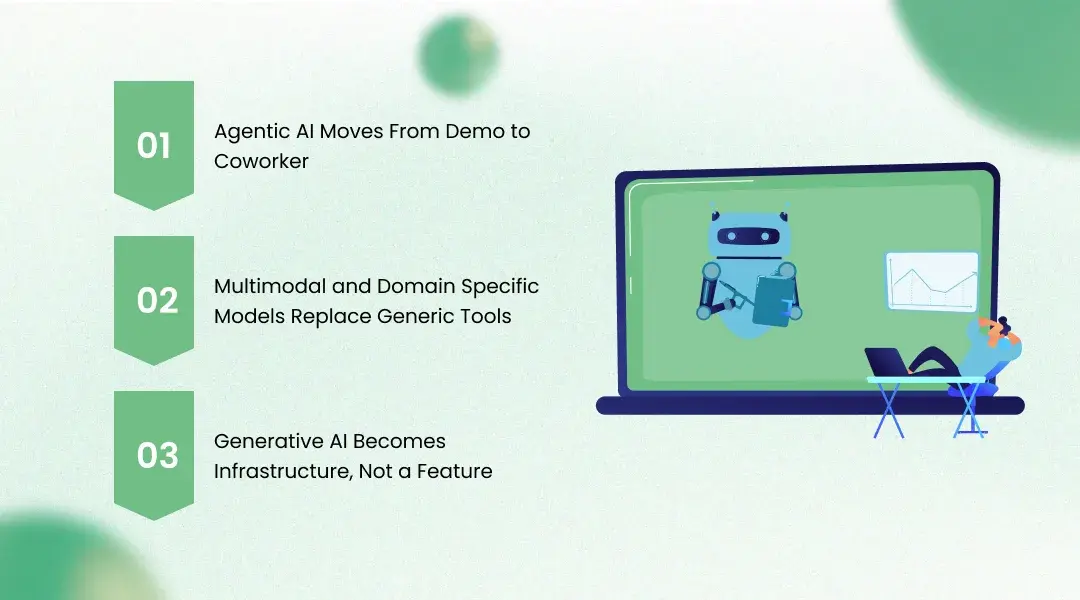
The enterprise AI trends 2026 conversation has moved past generic chatbots entirely. The technologies reaching production are specific, and each one maps to a concrete operational problem. Understanding that mapping is what separates real strategy from hype. Below are the shifts producing measurable change this year.
Agentic AI is the defining enterprise AI trend of 2026. These are systems that do not just answer questions but execute multi step tasks with memory and tool access. Gartner reports a striking figure for the first quarter of 2026. Around 80 percent of enterprise applications shipped or updated now embed at least one AI agent. That figure stood near 33 percent in 2024. The shift in two years is dramatic.
The problem agents solve is the manual handoff between systems. A finance agent can pull invoices, reconcile them against purchase orders, and flag exceptions without a human in the loop. A sales development agent can research a lead, draft outreach, and update the CRM automatically. These were once full roles. They are now supervised workflows. Agentic AI adoption is moving fastest in banking and insurance, where S&P Global places production rates near 47 percent.
Multimodal AI is the second major shift, and it closes a real gap. A multimodal model reads text, images, audio, and structured records inside one system. That means an assistant can interpret a contract PDF, read an attached chart, and produce an action plan. The use case is not a novelty. It is removing the human who currently bridges those formats by hand.
Domain specific models are the quieter counterpart to general purpose tools. Smaller, specialized models now run faster and cheaper on narrow tasks. They also keep sensitive data inside company infrastructure rather than sending it out. For regulated industries, that control matters more than raw capability. This is where firms like KriraAI focus much of their build work. They design models and pipelines tuned to a specific industry. That beats deploying a generic copilot and hoping it fits.
Generative AI in business is no longer an experiment bolted onto the side. It is becoming infrastructure embedded inside core workflows. McKinsey ranked the top three generative AI use cases. Content creation leads at 71 percent. Code generation follows at 58 percent, and customer interaction at 54 percent. Each one targets a high volume, repetitive task.
The transformation is in where the value sits. Generative AI used to live in a separate browser tab. Now it runs inside the document, the ticket queue, and the codebase. Developers write with it, support teams answer with it, and marketers draft with it. The technology has stopped being a destination and started being a layer.
The strongest argument for moving now is not the technology. It is the return that disciplined adopters are already reporting. McKinsey's Global AI Survey found a strong average return. Organizations achieved 5.8 times their investment within roughly 14 months of deployment. Early adopters reported average cost savings of 15.2 percent and productivity gains of 22.6 percent. These are not projections. They are reported outcomes.
The fastest payback in 2026 comes from back office automation, not the flashy front office. BCG and Forrester data place the median time to value on agent deployments at 5.1 months. Sales development agents pay back fastest at around 3.4 months. Finance and operations agents take longer at roughly 8.9 months. The pattern is consistent across functions.
Customer outcomes are improving in measurable ways too. McKinsey's data shows AI can improve customer satisfaction by up to 45 percent when deployed in service workflows. The gain comes from speed and first contact resolution. A query that once waited in a queue gets answered immediately. A support agent armed with an AI assistant resolves issues on the first try more often.
The ROI window itself is shrinking, which changes the math on waiting. Median time to ROI has dropped from 24 months in 2024 to 14 months. Falling model costs and maturing implementation patterns drove that compression. Each quarter a company waits, the entry cost falls and the competitor lead grows. That is the quiet penalty inside the trend data.
Spending confirms the seriousness of the shift. IDC places total enterprise AI spending at roughly 184 billion dollars in 2026. That covers software, hardware, and services, and is on track toward 632 billion by 2028. Hyperscalers alone are projected to spend around 675 billion dollars on AI infrastructure in 2026. That is a capital commitment that does not reverse. The infrastructure being built this year sets the cost curve for the next decade.
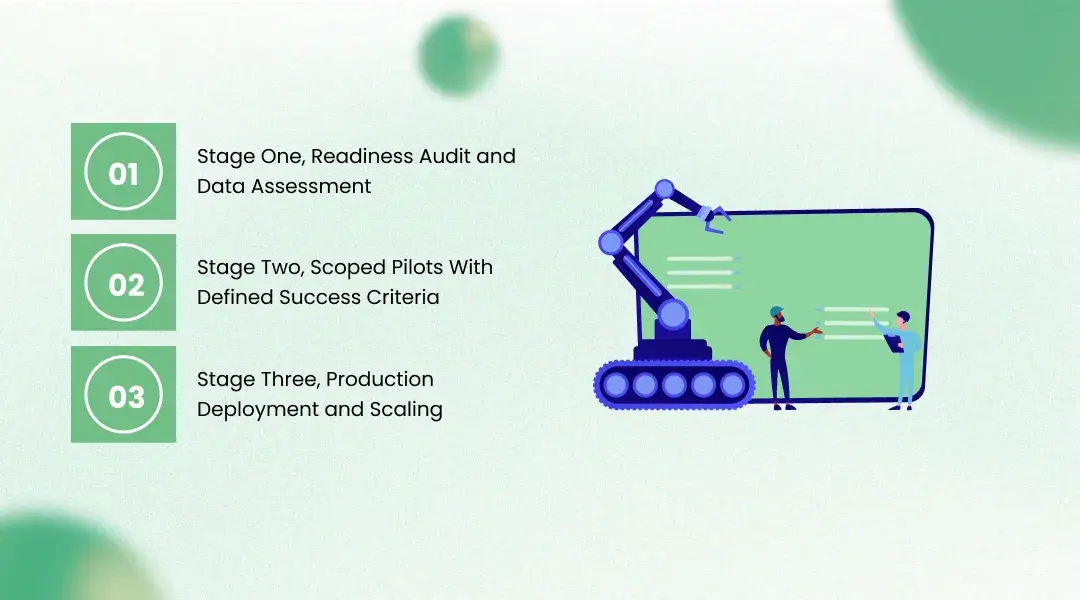
A credible AI implementation roadmap is what separates the 5 percent from the 95 percent. The failures rarely stem from weak models. Terminal X analysis found a telling pattern. Roughly 80 percent of the work to reach production is data engineering, governance, and measurement. The roadmap below reflects that reality rather than the demo narrative.
The first stage is an honest audit, not a tool purchase. Map where your critical data actually lives and how clean it is. Identify the three to five workflows that consume the most manual hours. Score each one for data availability, repeatability, and clear success metrics. This stage prevents the most common cause of failure, which is starting a build with no defined outcome.
The audit should also surface integration reality. Your future agent will need live access to your CRM, ERP, and databases. In a pilot, those connections are often mocked or faked. In production, they must be real and reliable. Naming that requirement early is what keeps the project honest.
The second stage is a tightly scoped pilot with a number attached. Pick one workflow with a measurable target before you build anything. Define what success looks like in dollars, hours, or resolution rates. Forrester found that 41 percent of failed agent deployments traced back to unclear success criteria. A pilot without a defined outcome cannot succeed even when the technology works.
Keep the pilot narrow on purpose. A startup that scales fast usually solves one pain point extremely well. Enterprises that try to boil the ocean stall in pilot purgatory. Resist the urge to expand scope until the first workflow proves out. This is where an experienced partner like KriraAI earns its place. Scoping discipline is harder than it sounds, and most teams overreach.
The third stage moves the proven pilot into real operations with monitoring. Production means live data, real users, and continuous evaluation. Build logging and override controls before you scale, not after. Track drift in performance so quality does not silently degrade. Only expand to the next workflow once the first one is stable.
Scaling is a sequence, not a switch. Each new workflow reuses the data and governance foundation built earlier. That compounding is why the second deployment is faster than the first. The roadmap is deliberately incremental for this reason.
The most damaging mistakes in AI adoption are organizational, not technical. The following errors appear again and again in the failure data. Each one has a direct and well understood fix.
Concentrating budget in sales and marketing pilots while ignoring the back office, where ROI is consistently highest.
Building everything in house. MIT data shows proprietary builds succeed only about one third as often as specialized vendor solutions.
Launching with no predefined success metric, which makes it impossible to declare a win even when the system performs.
Treating AI as a corporate lab project instead of empowering the line managers who own the workflow.
Expecting too much too fast, which Gartner found 57 percent of failed projects cited as their root cause.
Avoiding these is mostly about discipline and ownership. Assign a clear business owner to every deployment. Tie every project to a number that finance recognizes. Choose build versus buy on evidence, not pride.
The honest picture of AI adoption includes serious friction that no vendor slide will show you. The biggest barrier to AI adoption is not the model, it is the data underneath it. Most enterprise data is messy, siloed, and not ready for production use. Gartner predicts that 60 percent of AI projects lacking suitable data will be abandoned through 2026. That number is already near 42 percent of United States companies according to S&P Global.
The talent gap is the second hard constraint. The skills to design, integrate, and govern AI systems are scarce and expensive. S&P Global's banking survey found a revealing gap. Boards approved AI programs at 91 percent, while only 26 percent could actually execute them. That gap between approval and ability is where budgets quietly burn. Hiring alone cannot close it fast enough for most firms.
Regulatory pressure is rising and will not ease. The EU AI Act is taking effect, and compliance is no longer optional. Regulated industries face data residency, explainability, and audit requirements at the same time. Sovereign AI, meaning systems aligned to local laws and data rules, has become a real buying factor. These constraints add cost and slow naive deployments.
Integration complexity and change management round out the list. Agents need reliable connections to live systems that often resist easy access. Employees need training and trust before they actually use new tools. RAND research found that 80.3 percent of enterprise AI initiatives fail to deliver intended value. The recurring theme is not bad technology. It is unfinished groundwork and human resistance that nobody planned for.
Project forward three to five years and the competitive landscape splits cleanly. The companies that operationalized AI early will compound their lead each quarter. Their data foundations get richer and their agents get more capable. The gap is not linear, it widens. A rival who started in 2026 will be very hard to catch by 2029.
Agents will graduate from single tasks to coordinated systems. Today an agent handles one workflow under supervision. Soon multiple agents will coordinate across functions through shared protocols. Standards like the Model Context Protocol are already laying that groundwork. Researchers describe an emerging agentic web where systems negotiate and act across organizations. Many static software tools will be absorbed into these flows.
Multimodal and physical AI will cross further into the real world. Models that understand sensors, video, and machinery will run factories and logistics. Healthcare triage will combine symptoms, images, and history in one pass. The interface between software and the physical environment will keep thinning. Work that requires a human bridge will increasingly run end to end.
The companies left behind will share a profile. They will have treated AI as a series of disconnected experiments rather than infrastructure. They will be under invested in data readiness and governance. When their first serious budget reviews arrive, cancelled pilots will leave them with nothing to scale. By then the cost of catching up will dwarf the cost of starting now. That is the real warning inside the enterprise AI trends 2026 data.
Three points carry the most weight from everything above. First, the central enterprise AI trends 2026 story is operationalization. At 88 percent adoption, the technology itself is no longer a differentiator. Second, the 95 percent failure rate is not evidence that AI does not work. It is evidence that timid, ungrounded pilots do not work. Third, the ROI is real and the window is closing, with median payback now near 14 months and falling. Slow adoption has quietly become the riskiest strategy available.
This is the gap that KriraAI was built to close. KriraAI builds practical AI solutions for enterprises. The focus is the data foundations, agentic workflows, and governance that move a system from pilot to production. KriraAI does not sell a generic tool. It designs solutions that are measurable, scoped to a real workflow, and built to scale across functions over time. The goal is the same outcome: the data rewards, which is AI that finance recognizes as return rather than cost.
Perhaps you are weighing where to start, or wondering why an earlier pilot stalled. That is exactly the conversation worth having now. Reach out to KriraAI to map your readiness and pick a first workflow with a defined number attached. Together you can build an AI implementation roadmap designed to reach production rather than purgatory. The companies that act with discipline this year will be the ones still pulling ahead in 2029.
The biggest enterprise AI trends 2026 center on five shifts. They are agentic AI, multimodal models, smaller domain specific models, stronger governance, and the move from pilots to production ROI. Agentic AI leads the list for a clear reason. Gartner reports that 80 percent of enterprise applications updated in early 2026 now embed at least one agent. Multimodal systems matter because they process text, images, audio, and records together in one model. Domain specific models are rising because they run cheaper and keep sensitive data in house. Underneath all of them sits the single dominant theme of 2026, which is operationalization. The defining question has shifted from whether to adopt AI to which workflows justify production deployment and measurable return.
Most enterprise AI projects fail because of process and data problems, not weak models. MIT's NANDA research found that 95 percent of generative AI pilots deliver zero measurable impact on profit and loss. Analysis suggests roughly 80 percent of the work to reach production lies elsewhere. It sits in data engineering, governance, and workflow integration, not model selection. The most common failures are easy to name. Teams launch with no defined success metric. They concentrate on the budget where ROI is lowest. They build in house when specialized solutions succeed three times more often. Forrester found that 41 percent of failed agent deployments traced to unclear success criteria. The fix is disciplined scoping, clean data, and a business owner attached to every project from the start.
Agentic AI refers to systems that execute multi step tasks autonomously. They use memory and access to your tools and data. That is a step beyond just answering single questions. It matters in 2026 because it removes the manual handoffs between software systems that consume enormous amounts of staff time. A finance agent can reconcile invoices against purchase orders and flag exceptions without a human in the loop. BCG and Forrester place the median payback on agent deployments at 5.1 months. Sales development agents pay back fastest, in around 3.4 months. Agentic AI adoption is concentrated in banking and insurance, where S&P Global reports production rates near 47 percent. The technology is maturing fastest where workflows are repetitive and rules based.
The median time to ROI from AI adoption has fallen to roughly 14 months in 2026. That is down from 24 months in 2024, according to McKinsey and supporting industry surveys. Back office and operational workflows tend to deliver the fastest returns because they are repetitive and measurable. Sales development agents can pay back in as little as 3.4 months. Finance and operations agents average closer to 8.9 months. McKinsey's Global AI Survey reported an average return of 5.8 times. That came within about 14 months of deployment for organizations that scaled properly. The single biggest factor in achieving ROI is defining a clear success metric before the build begins. Projects without one cannot demonstrate value, even when the technology works.
No, it is not too late to adopt AI in 2026. But the window for easy advantage is narrowing each quarter. The cost of entry is falling as model prices drop and patterns mature. That makes 2026 a more favorable starting point than 2024 in many respects. The real risk is not starting late. It is starting badly, by repeating the mistakes that caused 95 percent of pilots to fail. Companies that begin now can still reach production within a year. The recipe is a disciplined roadmap, clean data, and a narrow first workflow. The danger is waiting until competitors have compounded their lead. By 2029 the gap between and late starters will be very hard to close.
Founder & CEO
Divyang Mandani is the CEO of KriraAI, driving innovative AI and IT solutions with a focus on transformative technology, ethical AI, and impactful digital strategies for businesses worldwide.
