Every enterprise AI company eventually hits the same wall. Its product surface grows faster than any human can keep current with it. Documentation lags releases, support queues swell, and tribal knowledge stays trapped in resolved tickets.
This enterprise AI case study documents an engagement that began at exactly that wall. The client, a leading enterprise AI company, was fielding more than 12,000 complex technical inquiries every month. Each inquiry touched integration, deployment, compliance, or live troubleshooting across a sprawling platform.
Their solution engineers were the bottleneck. First response time averaged nine hours, and the hardest cases took two to three days to close. New engineers needed roughly six months before they could answer questions unassisted.
KriraAI was brought in to fix the operational reality behind those numbers. We design and deliver production grade AI systems, and this was an enterprise RAG implementation built for hardened daily use. This case study walks through the problem, the system we shipped, the full architecture, the delivery journey, and the measured results.
The client sold a fast moving machine learning platform to large enterprises. Their product releases change weekly, sometimes daily. Every release expanded the surface area that support and pre-sales engineers had to explain accurately.
Knowledge lived everywhere except one place. Authoritative answers were scattered across Confluence pages, GitHub repositories, Zendesk ticket history, internal runbooks, and Slack threads. The same question often had three conflicting answers, and nobody knew which one reflected the current release.
The workflows that mattered most were the ones breaking down. Pre-sales technical validation stalled while engineers hunted for deployment references. Post sales troubleshooting required cross checking config, telemetry, and documentation by hand.
The data that could have helped was sitting unused. Years of resolved Zendesk tickets contained near perfect answers to recurring problems. Nobody mined that history, so the same questions were solved from scratch again and again. Institutional memory existed, but it was effectively invisible.
The human cost compounded quietly. Junior engineers stayed unproductive for months because the knowledge had no structure on ramp. Burnout rose, and two strong engineers left during the quarter before our engagement.
The financial picture was equally clear. Cost per inquiry was high because every answer consumed senior time. Slow pre-sales validation lengthened deal cycles and put revenue at risk. Slow post sales resolution pushed customer satisfaction down and churn risk up.
Competitive pressure made the status quo unsustainable. Newer competitors closed deals faster because their technical validation moved faster. The client could not scale headcount fast enough to keep pace with product growth.
This is the situation any decision maker at a scaling enterprise AI company recognizes immediately. The knowledge exists, the demand exists, and the humans cannot bridge the gap alone. That gap is exactly where this engagement began.
KriraAI built a production agentic retrieval augmented generation system, delivered as a technical solutions copilot. The copilot answers deep technical inquiries in seconds, with grounded citations, instead of in hours. It augments solution engineers rather than replacing the judgment they bring.
The system does three things in sequence. It retrieves the most relevant evidence from a unified knowledge corpus. It reasons over that evidence with a tuned language model. It returns a grounded answer with sources and, when needed, live diagnostic data.
Data flows through the copilot along a clear path. A question enters through Slack, the internal portal, or the Zendesk console. The system embeds the query and runs hybrid retrieval against the corpus.
The AI does not answer from memory alone. The generation model receives only the retrieved evidence as grounding context. It is instructed to answer strictly from that evidence and to cite each claim. A groundedness check rejects any answer that drifts away from its sources.
For hard cases, the copilot acts as an agent. It can call live tools to fetch customer configuration, query telemetry, or run a diagnostic check. This is what separates an enterprise RAG implementation from a simple document chatbot.
The copilot replaced manual knowledge hunting and augmented human resolution. Tier one inquiries are now frequently resolved without human involvement. Complex inquiries arrive at an engineer pre researched, with sources and diagnostics already attached.
Three design decisions defined the build. First, every answer must be traceable to a source, because trust is the product. Second, retrieval quality matters more than model size, so we invested heavily there. Third, the system must serve answers in real time under genuine production load.
KriraAI engineered the copilot as a hardened service, not a demo. It runs on private infrastructure, isolates customer data, and logs every interaction for audit. This is the level of rigor we bring to every enterprise AI implementation we deliver.
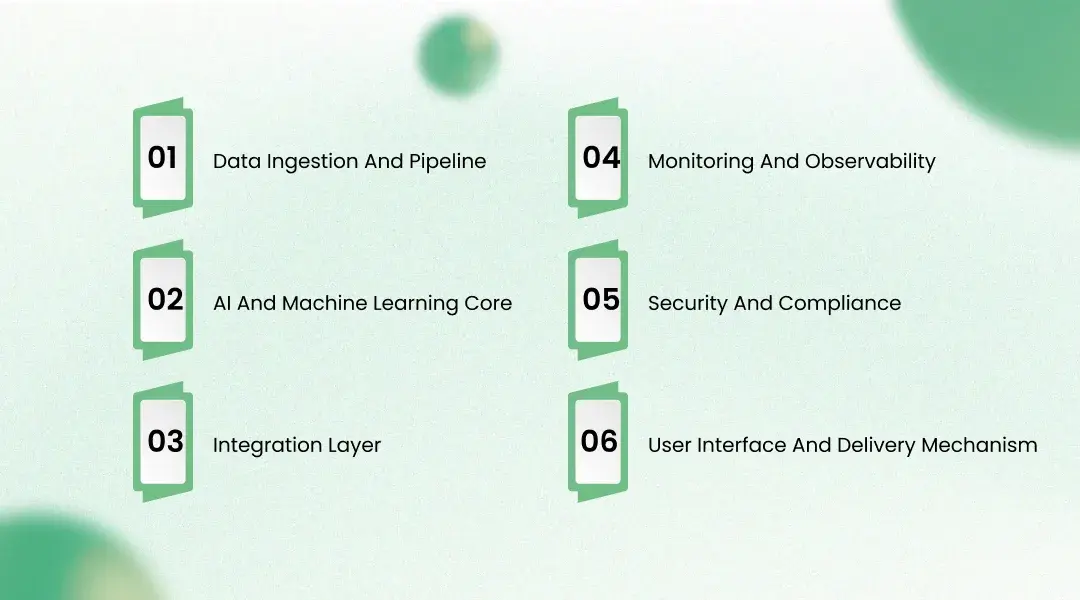
The architecture is the heart of this enterprise AI case study, so we will walk through it layer by layer. Each layer had a specific job, a specific failure mode to guard against, and a deliberate technology choice. The layers connect through well defined contracts so each one can scale independently.
The ingestion layer unified five fragmented sources into one governed corpus. We used change data capture from the operational Zendesk database to stream new and updated tickets. Batch and incremental connectors pulled from Confluence, GitHub, and internal runbook stores on a schedule.
New content moved through Apache Kafka as an event stream. Apache Flink handled stream processing, deduplication, and routing in flight. This let fresh documentation become searchable within minutes of publication, not days.
Transformation was where most of the engineering effort went. We applied semantic chunking so passages aligned with meaning rather than arbitrary token counts. We ran entity resolution to merge duplicate references to the same product feature.
Embeddings were generated at ingestion time, not query time. Each chunk was encoded once and indexed, which kept query latency low. Dagster orchestrated the entire set of pipeline DAGs, with retries, lineage tracking, and freshness checks. We chose Dagster over Airflow for its native asset awareness and stronger data lineage model.
The core combined retrieval, reranking, and generation into one tuned pipeline. For retrieval, we ran a hybrid search to capture both meaning and exact terms. Dense vectors handled semantic similarity, and BM25 over OpenSearch handled literal keyword matches. Reciprocal rank fusion merged both result sets into one ranked list.
The embedding model was fine tuned rather than used off the shelf. We applied contrastive learning on query and document pairs mined from resolved tickets. This aligned the embedding space with the client's specific vocabulary and product names. Recall on our held out set rose sharply after this alignment.
Vectors were indexed in Qdrant using HNSW for fast approximate nearest neighbor search. For the largest partitions we evaluated IVF PQ to control memory at scale. A cross encoder reranker then rescored the top candidates for precision.
Generation centered on an open weight model, Llama 3.1 70B Instruct. We ran supervised fine tuning on curated answer pairs from the ticket archive. We then applied direct preference optimization to lock in tone, structure, and citation behavior. This enterprise LLM deployment was tuned for grounded answering, not open ended chat.
We did not send every query to the largest model. A lightweight classifier routed simple inquiries to the tuned 70B model. It escalated ambiguous or high risk inquiries to a frontier model through a provider API. This mixture of routing kept cost low while protecting quality on the hard cases.
The agentic layer used LangGraph to orchestrate multi step tool use. A query needing live data triggered a controlled sequence of tool calls. The graph enforced step limits, timeouts, and validation between steps.
The integration layer connected the copilot to the systems engineers already used. We used an event driven design with Kafka as the backbone for asynchronous work. Internal services communicated over gRPC for low latency calls between retrieval, reranking, and generation. External surfaces used versioned REST and GraphQL contracts.
Webhooks pushed copilot outputs into Zendesk and Slack automatically. A new ticket triggered a webhook that returned a draft grounded answer. The Slack bot let engineers ask questions in their existing workflow.
The monitoring layer treated model quality as a first class production metric. We tracked data drift on query and embedding distributions using population stability index and KL divergence. We measured retrieval quality continuously with recall at k and mean reciprocal rank. Both ran against a versioned held out evaluation set.
Answer faithfulness and groundedness were scored automatically on sampled traffic. We tracked latency at the p50, p95, and p99 percentiles end to end. Langfuse and Arize Phoenix captured every trace for LLM observability. Prometheus and Grafana covered infrastructure metrics and alerting.
Automated retraining triggers closed the loop. When groundedness or retrieval recall crossed a defined threshold, the system flagged a refresh. This kept the copilot accurate as the product and its documentation kept changing. Drift was caught early instead of discovered through customer complaints.
Security was designed in from the first sprint, not bolted on later. We deployed inside a private virtual private cloud with no public endpoints. Role based access control governed every request, with attribute level masking on customer data. Tenant isolation ensured one customer's data never leaked into another's context.
Model inputs and outputs were encrypted end to end. Personally identifiable information was redacted at ingestion before anything was indexed. Every interaction was written to an immutable append only audit store. The deployment aligned with SOC 2 Type II and ISO 27001 controls the client already maintained.
Delivery met engineers where they worked rather than forcing a new tool. The primary surface was a Slack bot for conversational questions. An embedded copilot in the internal React portal handled richer pre-sales workflows. A programmatic API exposed the same capability to other internal systems.
Answers streamed token by token with inline citations attached. Every claim linked back to its source document and release version. Engineers could expand any citation to verify the evidence directly.
Every technology in this stack was chosen for a specific reason given the client's environment. The client already ran on AWS, so we built on AWS rather than forcing a migration. We deployed on EKS for portable, declarative orchestration of every service. Terraform manages all infrastructure as code for repeatable environments.
We chose Dagster for orchestration over Airflow for stronger asset lineage and freshness tracking. We chose Kafka and Flink for streaming because the client needed minute level documentation freshness. We chose Qdrant as the vector store for its HNSW performance and clean filtering on metadata. OpenSearch was already in the client's stack, so we reused it for the BM25 sparse leg.
Llama 3.1 70B was selected as the generation model for a clear reason. The client required private deployment, so an open weight model was non negotiable. We served it with vLLM using quantization for high throughput on the client's GPU fleet. vLLM's paged attention let us hold tight latency targets under concurrent load.
LangGraph powered the agent because it gave us explicit, inspectable control flow. We chose Langfuse and Arize Phoenix for observability because generic APM tools miss model specific failures. GitHub Actions and ArgoCD handled continuous delivery into the cluster. RAGAS anchored our evaluation harness with reproducible faithfulness and retrieval scores.
This stack reflects deliberate enterprise LLM deployment choices, not defaults. Each layer fit the client's existing scale, constraints, and security posture. Nothing was chosen because it was fashionable. Everything was chosen because it would survive production.
The full engagement ran 26 weeks from first session to go live. KriraAI runs delivery in disciplined phases, and this enterprise AI implementation followed that pattern. We will walk through each phase and the real challenges that surfaced along the way.
Discovery and requirements ran for the first three weeks of the engagement.
Data audit and corpus unification ran from week three through week seven.
Architecture design overlapped, running from week six through week nine.
Build proceeded retrieval first, then generation, then the agentic layer, through week twenty.
Evaluation and validation ran in parallel from week ten onward.
Integration and user acceptance testing ran from week eighteen to week twenty four.
Deployment, go live, and handover completed by week twenty six.
Discovery surfaced the first hard truth quickly. Roughly a fifth of indexed pages described deprecated behavior from older releases. We solved this with recency weighting and explicit deprecation flags in metadata.
Data quality was the dominant challenge of the early phases. Ticket history was rich but inconsistent, with duplicate and contradictory resolutions. Entity resolution alone was not enough to clean it. We added a source authority hierarchy so the system trusted runbooks over informal threads.
The first evaluation runs exposed a serious gap. Early answer faithfulness sat well below our bar, and retrieval missed relevant passages. The root cause was the off the shelf embedding model and naive chunking. We fixed it with the fine tuned embeddings, hybrid retrieval, and the reranker together.
Integration created its own friction during user acceptance testing. The Zendesk API rate limits throttled our webhook driven workflow under load. Latency also spiked when many engineers queried at once. We resolved both with response caching, asynchronous processing, and gRPC between internal services.
A final challenge appeared near go live. Engineers initially distrusted answers that arrived too fast to feel verified. We responded by making every citation expandable and every source traceable. Trust followed once engineers could check the evidence in one click.
Handover was treated as a deliverable, not an afterthought. KriraAI trained the client's MLOps team on the retraining loop and observability dashboards. The client owned and operated the system confidently within two weeks of go live.
The results were measured over the first 90 days after going live. They confirm a strong enterprise AI ROI on a completed engagement, not a projection. The before and after contrast was clear across every metric the client tracked.
First response time fell from nine hours to under four minutes for assisted answers. Complex case resolution time dropped by 58 percent over the measurement window. Each solution engineer handled 3.2 times more inquiries than before the copilot. The bottleneck that had defined the function effectively disappeared.
Self service deflection reached 41 percent of tier one inquiries within the first quarter. Those inquiries were fully resolved without any engineer involvement. Cost per inquiry fell by 46 percent as senior time was reclaimed. That cost reduction was the clearest single driver of the enterprise AI ROI.
The revenue side improved alongside the cost side. Pre-sales technical validation cycles shortened by 37 percent. Slower competitors lost their speed advantage in technical evaluations.
Quality held while throughput rose. Measured answer groundedness reached 94 percent against the held out evaluation set. New engineer ramp to unassisted productivity fell from six months to about ten weeks. The institutional knowledge that had been invisible was finally working for the business.
The architecture was built to grow without being rebuilt. When data volume grows, each layer scales independently behind its own contract. Qdrant shards horizontally, vLLM replicas scale out on the cluster, and Kafka absorbs higher event throughput.
New use cases attach to the same foundation rather than starting from zero. The unified corpus, embedding service, and retrieval layer are reusable assets. The client is already extending the copilot toward automated release note drafting.
The client's AI roadmap now spans the next two to three years on this base. Planned additions include proactive incident detection from telemetry and deeper agent automation. Each addition reuses the ingestion, retrieval, observability, and security layers already in production.
Other enterprise AI companies can apply the same pattern to their own situation. The core lesson is that retrieval quality and grounding matter more than raw model size. A unified, governed corpus with a faithful generation layer beats a clever prompt every time.
Three insights define this engagement above all others. The technical insight is that retrieval quality, not model size, decides whether a grounded answer is correct. The operational insight is that augmenting expert engineers beats trying to replace them outright. The strategic insight is that unused institutional knowledge is a dormant asset waiting to be activated.
This enterprise AI case study reflects how KriraAI approaches every engagement. We design production systems with deliberate architecture, honest evaluation, and security built in from day one. We treat delivery as an engineering discipline, not a demo handed over and forgotten. The 58 percent resolution improvement and 94 percent groundedness came from rigor at every layer.
KriraAI brings that same depth to each client we work with, whatever the industry. If your team is sitting on fragmented knowledge or a workflow that humans cannot scale, bring that challenge to us. We will help you turn it into a production AI system that delivers measurable results.
An enterprise AI case study is a documented account of a production AI system delivered for a real business problem, including its architecture, delivery journey, and measured outcomes. It matters because technical buyers evaluate vendors on engineering credibility, not marketing claims. A strong case study shows the model architecture, data pipeline, monitoring strategy, and security posture in concrete detail. It also reports verifiable metrics such as resolution time reductions and cost savings. For decision makers, this evidence reduces risk by demonstrating that the team has shipped hardened systems before. The case study in this article shows a 58 percent resolution time reduction achieved over 90 days, which is the kind of concrete proof buyers look for.
A production enterprise RAG implementation typically takes between four and seven months from discovery to go live, depending on data complexity and integration scope. The engagement in this case study ran 26 weeks across seven phases. The longest phases were data audit, corpus unification, and the iterative build of retrieval and generation. Data quality almost always consumes more time than teams expect, because institutional knowledge is fragmented and inconsistent. Evaluation and validation run in parallel with the build rather than at the end. Integration and user acceptance testing then surface real world issues like API rate limits and latency under load. A disciplined phased delivery keeps the timeline predictable and the system production ready at handover.
A production enterprise LLM deployment separates retrieval, reranking, generation, and serving into independently scalable layers. In this system, hybrid retrieval combined dense vectors in Qdrant with BM25 sparse search in OpenSearch, fused by reciprocal rank fusion. A cross encoder reranker improved precision before generation. An open weight Llama 3.1 70B model, fine tuned and served with vLLM using quantization, produced grounded answers. A lightweight router escalated hard cases to a frontier model to balance cost and quality. The deployment ran inside a private virtual private cloud with role based access control, end to end encryption, and immutable audit logging. This structure delivers low latency, strong security, and reliable grounding at enterprise scale.
Enterprise AI ROI is measured by comparing concrete operational metrics before and after deployment over a defined window. For this engagement, the measurement window was the first 90 days after going live. The team tracked first response time, complex case resolution time, inquiries handled per engineer, self service deflection rate, and cost per inquiry. The system cut complex resolution time by 58 percent, raised per engineer capacity 3.2 times, and reduced cost per inquiry by 46 percent. Revenue side metrics like pre-sales validation cycle time, which shortened 37 percent, also count toward ROI. Real ROI combines cost reduction, capacity gains, and revenue acceleration into one verifiable picture rather than a single number.
You prevent hallucinations in an enterprise RAG system by grounding every answer in retrieved evidence and rejecting anything that drifts from it. The generation model receives only retrieved passages as context and is instructed to cite each claim. A groundedness check scores faithfulness and blocks answers that are not supported by sources. High retrieval quality is the foundation, which is why fine tuned embeddings, hybrid search, and a reranker matter so much. Ambiguous or high risk queries are routed to a stronger model for additional safety. Continuous monitoring tracks faithfulness on live traffic and triggers retraining when scores drop. In this engagement, that combined approach reached 94 percent measured groundedness.
Ridham Chovatiya is the COO at KriraAI, driving operational excellence and scalable AI solutions. He specialises in building high-performance teams and delivering impactful, customer-centric technology strategies.