
Every day, a leading mid-market e-commerce enterprise with 2.3 million active SKUs was losing an estimated $38,900 in revenue because its product data could not be found by buyers. The company's internal analysis showed that 43% of its catalog never appeared in the first three pages of search results for the very keywords buyers were typing. This was not a traffic problem. This was not a pricing problem. This was a product data problem, and it was compounding every quarter as new supplier feeds arrived with inconsistent formatting, missing attributes, and unoptimized titles.
The merchandising leadership had tried conventional approaches. They hired more catalog specialists, implemented stricter supplier data requirements, and invested in a new product information management system. None of these measures addressed the fundamental issue: the volume and variety of product data far exceeded what manual processes and rule-based validation could handle. KriraAI was engaged to design and deliver a production-grade AI system. This e-commerce AI solution case study details the complete architecture, technology choices, and measurable outcomes achieved within six months of deployment.
The operational reality inside this e-commerce enterprise was one of chronic, compounding data debt. The company sourced products from over 200 suppliers, each delivering data in different formats with different attribute schemas and naming conventions. Some suppliers provided rich structured feeds with detailed material and dimension attributes. Others sent spreadsheets with little more than a stock keeping unit number and a product name typed in whatever style their warehouse manager preferred that week.
The result was a catalog where 38% of listings had incomplete or inaccurate attributes. Twenty-seven percent had titles that failed to include the most commonly searched terms for their category. Nineteen percent had product images that were either missing, low resolution, or incorrectly matched to the variant. These were not edge cases but the mainstream condition of the product data feeding the company's search engine, and the gap was widening with each new supplier integration.
The company employed a catalog operations team of 47 people whose primary function was to manually review, correct, and enrich product data. Each listing required an average of 12 minutes of human attention. At that rate, the team processed approximately 800 new listings per day. During peak seasons, when supplier onboarding spiked by 300%, the backlog grew to six weeks. Products sat in a staging environment, invisible to buyers, while the team worked through the queue. The finance team estimated this backlog alone accounted for $14.2 million in deferred revenue annually.
The company's Elasticsearch-powered search engine relied on structured product attributes for faceted navigation and filtered search, the primary way buyers navigated the catalog. When attributes were missing or inconsistent, products simply did not appear in the filtered results that buyers used most heavily. A buyer searching for waterproof running shoes in size 10 would miss products tagged as water resistant joggers. Internal search analytics showed that 31% of buyer searches returned zero results or results so irrelevant that the buyer abandoned the session. Two direct competitors had recently overhauled their product data systems, and their search conversion rates had climbed 15 to 20 percentage points. The status quo was becoming an existential threat to market share.
KriraAI designed and delivered a multi-component AI platform that automated the entire product enrichment pipeline from raw supplier data to search-ready, fully optimized product listings. The system, deployed on the client's AWS infrastructure, processes incoming product data in real time through a series of specialized AI models. Each model handles a distinct enrichment task, and outputs flow directly into the client's product information management system and search index. This was not a proof of concept. It was a hardened production system designed to handle the full volume of the client's catalog operations from day one.
The core of the platform is built around four AI capabilities operating in parallel. First, a fine-tuned FLAN-T5 XXL encoder-decoder transformer with 11 billion parameters generates optimized product titles by incorporating the highest-volume search terms while maintaining readability. The model was trained using supervised fine-tuning on 4.2 million high-performing product listings, where performance was defined by historical click-through rate and conversion data. Second, a Vision Transformer (ViT-L/16) fine-tuned on 1.8 million product images extracts visual attributes such as color, material, and style directly from product images, catching cases where the supplier's description says cotton but the image clearly shows polyester. This dual-modal approach ensures that both text and visual data contribute to the enrichment process.
Third, a retrieval augmented generation pipeline assembles dynamic, SEO-optimized product descriptions by retrieving attribute data, category-specific selling points, and current search trend data from a vector-indexed knowledge base, then passing that context to a large language model to produce a unique description for each product. The RAG pipeline ensures that descriptions are always current with market trends and incorporate the terms buyers are actually searching for. Fourth, a contrastive learning model aligns product embeddings with query embeddings, ensuring that the vector representations capture the semantic relationship between product descriptions and buyer search behavior. Together, these four capabilities form the AI product catalog enrichment engine that powers the entire solution.
Every component operates independently so that the failure of one model does not block the enrichment pipeline. If the vision model experiences latency, the text-based enrichment continues and the visual attributes are backfilled when capacity becomes available. This fault-tolerant design was a non-negotiable requirement for the client, whose peak season operations could not tolerate pipeline downtime for any individual model failure. KriraAI designed each enrichment service with its own retry logic, circuit breakers, and dedicated scaling policies to ensure complete isolation between components.
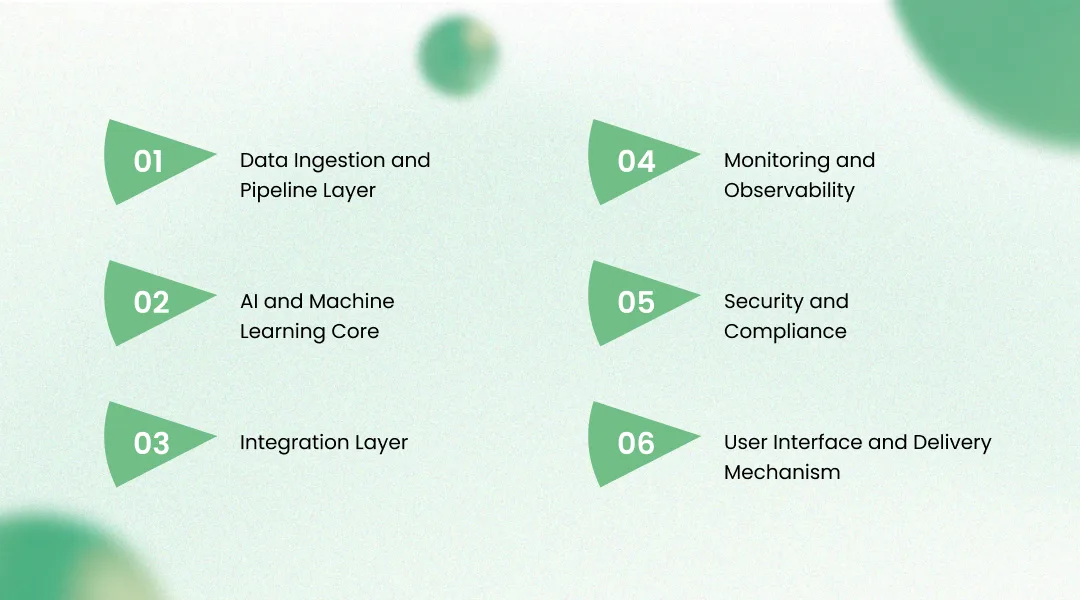
The data ingestion layer is built on Apache Kafka 3.6 as the central event streaming backbone. Product data arrives from change data capture streams from the client's SAP S/4HANA ERP system, REST API pulls from the Akeneo product information management system, and batch file ingestion from supplier feeds in CSV, XML, and JSON formats. All incoming data passes through a schema normalization service built with Apache Flink 1.18, which transforms heterogeneous supplier formats into a unified internal schema. Pipeline orchestration is managed by Apache Airflow 2.7. The pipeline processes an average of 12,000 product enrichments per hour at peak throughput.
The machine learning core operates as horizontally scalable microservices on dedicated GPU-enabled node pools within Amazon EKS. The title generation model was trained using distributed training across eight NVIDIA A100 GPUs managed by Ray Train. Model serving is handled by vLLM with INT8 quantization using the AWQ method, reducing the memory footprint from approximately 22 gigabytes in FP16 to under 6 gigabytes while maintaining generation quality within 1.2% of the full-precision baseline. This quantization was critical for meeting the client's latency requirement of under 180 milliseconds at the 95th percentile. The vision model produces attribute predictions with 94.2% accuracy across 47 categories. Embeddings are stored in Pinecone using HNSW indexing with cosine similarity, enabling sub-10-millisecond searches across the full catalog. A Feast feature store maintains both online and offline serving paths for model features.
The integration layer connects the AI platform to the client's existing technology stack through event-driven and request-driven patterns. Enriched records are published to Kafka topics that the Akeneo PIM system consumes for automatic master data updates. A versioned REST API at v2 exposes enrichment capabilities to internal systems including campaign management tools and the mobile app backend. Internal communication between microservices uses gRPC with Protocol Buffers for low-latency, strongly-typed calls. Webhook triggers push enriched data into the Elasticsearch 8.x search index within 90 seconds of processing. A circuit breaker pattern using Resilience4j ensures that downstream failures do not cascade into the enrichment pipeline, with dead letter queues capturing failed events for manual review.
KriraAI implemented a monitoring stack built on Prometheus and Grafana providing real-time visibility into platform health. Data drift detection uses the Population Stability Index to compare incoming distributions against training baselines, with alerts triggered when PSI exceeds 0.25. Model performance is tracked daily against a held-out evaluation set of 50,000 products, with automated alerts when accuracy drops below 91%. Feature distribution shift is monitored using KL divergence on a rolling 7-day window. Latency is tracked at p50, p95, and p99 percentiles, with p95 budgets of 180 milliseconds for title generation and 120 milliseconds for attribute extraction. Automated retraining pipelines trigger when performance crosses degradation thresholds, managed by MLflow for full experiment reproducibility.
The platform is deployed within a private AWS VPC with no public endpoints. All data in transit is encrypted using TLS 1.3, and all data at rest uses AES-256. Role-based access control governs every endpoint, with attribute-level data masking preventing exposure of sensitive fields like supplier cost prices. Every model input and output is logged to an immutable append-only store on Amazon S3 with Object Lock in governance mode for tamper-proof compliance auditing. The platform complies with PCI DSS requirements for payment-adjacent data. All personally identifiable information is tokenized before entering the pipeline. Network policies enforce strict pod-level communication rules, and all container images are scanned for vulnerabilities before deployment using Trivy.
KriraAI delivered a React and TypeScript admin dashboard styled with Tailwind CSS that gives the catalog team full visibility into and control over the enrichment process. The dashboard provides a real-time view of the enrichment queue showing each product's status, confidence scores, and specific changes. Catalog managers can review, approve, or override any AI-generated title, description, or attribute. A quality scoring panel displays per-category accuracy breakdowns, drift alerts, and model performance trends. The dashboard uses a GraphQL API for flexible querying and integrates with the client's identity provider via SAML 2.0 single sign-on. The interface was designed through weekly design reviews with the catalog team, ensuring the workflow matched how the team actually works.
The product data automation platform runs on AWS with compute orchestrated through Amazon EKS running Kubernetes 1.28. GPU inference runs on NVIDIA A10G node pools, while CPU-intensive pipeline processing uses Graviton3-based EC2 instances for cost optimization. Terraform manages infrastructure as code, and ArgoCD handles GitOps deployments. EKS was chosen over managed ML platforms because the client's engineering team needed full control over model serving infrastructure, including custom routing and observability integration. Terraform configurations use environment-specific workspaces for development, staging, and production environments that are structurally identical but independently scalable.
The data pipeline uses Apache Kafka 3.6 for event streaming, Apache Airflow 2.7 for orchestration, and Apache Flink 1.18 for stream processing. Snowflake serves as the analytical warehouse. The ML layer is built on PyTorch 2.1 with Hugging Face Transformers, Ray for distributed training, and vLLM for quantized model serving. Pinecone provides HNSW-indexed vector storage, and Feast bridges online and offline feature serving. MLflow tracks experiments and Evidently AI handles drift detection.
The API layer uses FastAPI for REST, gRPC for internal services, and GraphQL for the dashboard. Pinecone was selected over Weaviate or Milvus for its managed service model, eliminating self-hosted vector database operational overhead at the scale of 2.3 million products. FastAPI was chosen for native async support and automatic OpenAPI documentation generation, which reduced integration burden for the client's frontend and mobile engineering teams. Snowflake was selected as the analytical warehouse because the client's data team was already proficient in SQL-based analysis and needed seamless access to enrichment metrics for business reporting.

KriraAI began with a three-week discovery phase combining catalog audits, stakeholder interviews, and technical infrastructure assessments. The catalog audit revealed that data quality problems were more severe than initially communicated. Twenty-three percent of product images were below the minimum resolution for reliable vision model inference. Twelve percent of supplier feeds contained structural errors including mismatched column headers and encoding issues. These findings reshaped the project plan and added two weeks to the data pipeline timeline.
Stakeholder interviews identified a critical unspoken requirement: the catalog team needed human-in-the-loop review capability, not full automation. This insight shaped the entire architecture, leading KriraAI to design the admin dashboard as a first-class component. The discovery phase also included a three-day data engineering sprint to build a prototype ingestion pipeline, which validated that the proposed Kafka and Flink architecture could handle the client's peak throughput of 15,000 events per second without backpressure.
Development proceeded across three parallel workstreams over eight weeks: data pipeline, ML engineering, and integration. The first major challenge was that schema normalization required far more complex entity resolution than anticipated. Products from the same manufacturer arrived under different brand names depending on the supplier, and variant-level products were inconsistently represented. KriraAI built a custom entity resolution engine combining fuzzy string matching on product identifiers with image perceptual hashing, reducing duplicate records by 14%.
The second challenge surfaced during model training. The initial title generation model produced generic, keyword-stuffed titles. KriraAI addressed this with reinforcement learning from human feedback, using 8,000 pairwise preference judgments from the catalog team. The RLHF fine-tuning narrowed the quality gap with human-written titles to under 3%. This was a pivotal moment in the retail AI implementation journey, demonstrating that domain-specific reward signals could dramatically improve output quality.
Testing used a controlled A/B test against a holdout group of 150,000 SKUs over four weeks. The enriched group showed a 28% click-through rate improvement and a 19% conversion rate improvement, with statistical significance at p less than 0.001. These results were independently validated by the client's data science team, which confirmed both the methodology and statistical rigor.
Deployment followed a phased rollout: 10% of the catalog in week one, 50% in week two, and full coverage in week three. Each phase included automated rollback triggers based on predefined error rate thresholds and manual sign-off from the client's VP of engineering. KriraAI provided three weeks of post-deployment support including team training, code handover, and operational runbook documentation.
Within six months of deployment, the client measured significant improvements across every targeted metric. Search visibility increased by 34%, meaning 34% more products appeared in the first three pages of search results. The product discovery rate improved by 41%. Click-through rate on enriched listings rose by 28%, and conversion rate improved by 19%. The system's automated attribute extraction achieved 94.2% accuracy, up from 67% with the previous manual process. Product listing enrichment time dropped from 12 minutes per product to under 45 seconds. The catalog team reallocated 60% of its time from manual data entry to strategic merchandising activities including category planning and supplier performance management.
The finance team validated an estimated annual revenue impact of $8.4 million, derived from a controlled analysis comparing enriched against unenriched products while controlling for seasonality, category, and price point. The client's board of directors reviewed and approved the results. At peak capacity, the system processes more than 12,000 product enrichments per hour, handling the full catalog refresh cycle in under 48 hours. The e-commerce search optimization results exceeded discovery-phase targets on every metric. The platform has since been expanded to handle marketplace seller onboarding and now supports three additional product categories previously excluded from the site due to data quality constraints. The client's merchandising VP credited the platform with enabling a strategic shift from reactive data cleanup to proactive catalog intelligence.
The architecture KriraAI delivered was designed as a foundational platform, not a single-use solution. As the catalog grows from 2.3 million to a projected 5 million SKUs, horizontal scaling within EKS allows additional nodes without architectural changes. The modular microservices design means new enrichment capabilities can be added as independent services that plug into the existing Kafka event stream and share the common feature store.
The client's 24-month AI roadmap includes three planned extensions that build directly on the deployed infrastructure. First, a personalized ranking model using buyer behavior signals on the existing embedding infrastructure to reorder search results based on individual preference patterns. Second, a supplier quality scoring system using the pipeline's confidence scores and error correction rates to automatically evaluate and rank supplier data quality on an ongoing basis. Third, a multilingual catalog expansion for three European markets using the same title and description generation models fine-tuned on localized product data. Each extension requires only new model development, not new platform engineering.
For other e-commerce companies facing similar challenges, the key architectural principle is the separation of enrichment logic from delivery mechanisms. By decoupling AI models from specific PIM and search systems, the product data automation platform adapts to different technology stacks without rebuilding core intelligence. The event-driven architecture allows new data sources as Kafka consumers, and the versioned API contract lets downstream systems adopt new capabilities at their own pace. The platform was engineered to compound in value over time, not depreciate with each new requirement.
Three insights from this engagement stand out. From a technical perspective, the decision to use quantized model serving with vLLM was the single most impactful engineering choice, enabling sub-180-millisecond inference on an 11 billion parameter model without sacrificing quality. From an operational perspective, the human-in-the-loop review capability was essential to adoption. The catalog team became active participants rather than observers of an opaque system. From a strategic perspective, the modular architecture means the client's AI investment compounds over time, with each new use case building on the deployed foundation.
This e-commerce AI solution case study demonstrates that the real value of enterprise AI is not in any single model but in the platform that makes models operational, observable, and extensible. The companies that will win with AI in e-commerce are not the ones with the cleverest models. They are the ones with the most robust platforms for putting those models into production and keeping them there.
KriraAI brings this same level of engineering rigour and delivery discipline to every client engagement. Every architecture decision is grounded in production experience. Every model is validated against real business metrics. Every system is built to operate reliably at enterprise scale. If your organization is grappling with product data challenges that are costing you revenue and competitive position, bring that challenge to KriraAI and let us show you what a production-grade AI solution looks like in your environment.
AI transforms e-commerce catalog management by automating the enrichment of raw product data into structured, search-optimized listings. In this e-commerce AI solution case study, transformer-based models generate optimized titles incorporating high-volume search terms, while vision models extract visual attributes like color, material, and style from product images. A retrieval augmented generation pipeline produces unique, SEO-optimized descriptions by combining product attributes with search trend data. These capabilities operate within an event-driven architecture processing thousands of products per hour, replacing manual workflows that required twelve minutes per listing. The resulting AI product catalog enrichment platform scales with catalog growth without proportional headcount increases.
Based on this e-commerce AI solution case study, companies can expect measurable returns within six months. The client achieved a 34% search visibility improvement, a 28% click-through rate increase, and a 19% conversion rate improvement. The validated annual revenue impact was $8.4 million, driven by previously invisible products becoming discoverable. The AI product catalog enrichment platform reduced per-product enrichment time from 12 minutes to under 45 seconds, enabling 60% time reallocation to strategic work. The e-commerce search optimization results demonstrated the investment paid for itself within the first quarter of full deployment, making it one of the highest-return technology investments the client had made in five years.
This retail AI implementation journey spanned 20 weeks from kickoff to full catalog deployment. This included three weeks of discovery with catalog audits and stakeholder interviews, two weeks of architecture design, eight weeks of parallel development across data pipeline, ML model, and integration workstreams, four weeks of A/B testing and validation, and three weeks of phased rollout with post-deployment support. The parallel development approach compressed what would typically be a 30-week engagement into 20 weeks. Phased deployment starting with 10% of the catalog ensured operational stability while building organizational confidence in the system.
KriraAI's product data automation platform combines enterprise-grade technologies across its architecture. The AI models include a fine-tuned FLAN-T5 XXL transformer with 11 billion parameters for title generation, a Vision Transformer (ViT-L/16) for image attribute extraction, and a retrieval augmented generation pipeline for descriptions. The data layer uses Apache Kafka for event streaming, Apache Airflow for orchestration, and Apache Flink for stream processing. Embeddings are indexed in Pinecone with HNSW for sub-10-millisecond searches. Model serving uses vLLM with INT8 quantization, and the platform deploys on Amazon EKS with GPU node pools. A Feast feature store maintains online and offline serving paths, and MLflow tracks experiments for full reproducibility.
AI substantially improves search relevance by addressing the root cause of poor performance, which is typically inconsistent product data rather than search engine configuration. In this e-commerce AI solution case study, enriching 2.3 million SKUs with AI-generated titles, visually extracted attributes, and optimized descriptions improved search visibility by 34% and product discovery rate by 41%. The e-commerce search optimization results showed previously invisible products became discoverable because the AI system fixed the structural data problems preventing them from matching buyer queries. A contrastive learning model further strengthened alignment between product descriptions and search behavior. The key insight is that AI-driven search relevance improvements are most effective when they fix the data feeding the search engine, not when they try to work around bad data.
Founder & CEO
Divyang Mandani is the CEO of KriraAI, driving innovative AI and IT solutions with a focus on transformative technology, ethical AI, and impactful digital strategies for businesses worldwide.