Here’s the simplest way I explain it to clients.
Deep Learning is the brain. AI Agents are the decision-maker using that brain.
Still confused?
Good. That means you’re asking the right questions.
Because the real debate - AI Agents vs Deep Learning 2026, isn’t about which is better. It’s about what problem you’re solving.
An AI agent is a system that can observe, decide, and act, without constant human input.
Not just predicting. Not just analyzing.
Acting.
Think of it like this:
Deep learning says: “This customer might churn.”
An AI agent says: “Send a retention offer now. Monitor response. Adjust strategy.”
That’s the difference between insight and action.
When people ask me, “What are AI Agents in 2026?” I tell them: They’re not tools anymore. They’re operators.
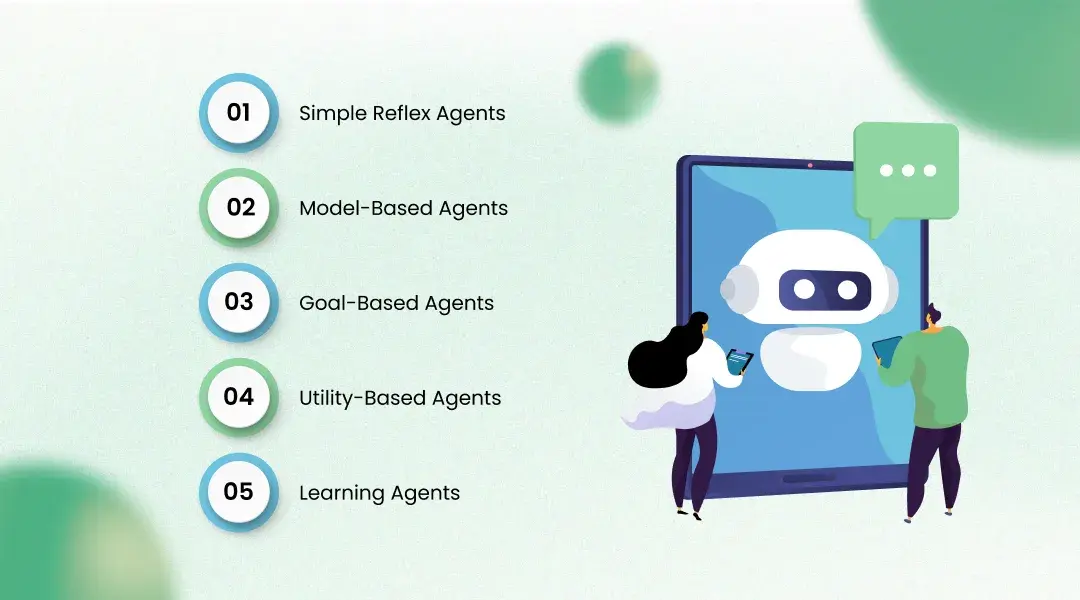
React instantly. No memory. Good for basic automation.
Use internal models to understand the world.
Work toward specific objectives.
Optimize decisions based on value or outcomes.
Adapt over time. This is where things get… powerful.
Let’s kill a myth.
Chatbots are not AI agents.
A chatbot responds. An AI agent decides.
Example:
Chatbot: Answers customer query
AI Agent: Resolves issue, updates CRM, schedules follow-up
One reacts. The other owns the outcome.
Let me give you real use cases I’ve worked on:
Healthcare: AI agent that prioritizes patient cases automatically
SaaS: Agent that manages customer onboarding workflows
E-commerce: Dynamic pricing agent adjusting in real time
These aren’t experiments.
These are production systems delivering results.
And yes, most of them still rely on Deep learning models examples under the hood.
Here’s where things get serious.
In 2026, AI agents for business are being used for:
Customer support automation
Sales decision optimization
Fraud detection and response
Supply chain adjustments
But here’s the twist.
Companies aren’t asking: “Should we use AI?” They’re asking: “How autonomous should it be?”
That’s the shift.
From what I’ve seen across 25+ deployments:
Faster decisions
Reduced manual work
Real-time adaptability
Better ROI compared to static models
And most importantly?
Consistency.
Humans get tired. Agents don’t.
Let’s not pretend it’s perfect.
Because it’s not.
Complex setup
Requires clean data
Risk of wrong decisions at scale
Needs monitoring
I’ve seen a poorly designed agent create more problems than it solves.
Let me ask you something.
What happens when agents start managing other agents?
That’s not science fiction. That’s already happening.
We’re moving toward:
Multi-agent ecosystems
Fully autonomous operations
AI-to-AI communication
And this is where AI agents vs generative AI becomes relevant.
Generative AI creates. Agents execute.
Together? That’s where real transformation happens.
Most companies jump too fast.
Don’t.
Start here:
Identify repetitive decision-making tasks
Validate with simple automation
Introduce intelligence (deep learning if needed)
Scale into agents
If you’re unsure where to begin, this is exactly where working with a Best AI development Company or an experienced AI Company in India makes a difference.
Because building agents isn’t about tools.
It’s about understanding decisions.
So let’s settle this.
Difference between AI Agents and Deep Learning?
Deep Learning = Intelligence
AI Agents = Action
You don’t choose one over the other.
You combine them.
But you choose based on your problem.
That’s the part most people miss.
And that’s the part that determines whether your AI investment works… or becomes another expensive experiment.
Deep learning focuses on pattern recognition, while AI agents use those insights to make decisions and take actions autonomously.
Not better—different. AI agents often use deep learning, but add decision-making and execution layers.
They’re used for automation, decision-making, customer experience, and operational efficiency across industries.
Yes, but their capabilities are limited. Deep learning enhances their intelligence and adaptability.
Start with simple automation, validate use cases, and gradually introduce intelligent agents for scalable impact.
Founder & CEO
Divyang Mandani is the CEO of KriraAI, driving innovative AI and IT solutions with a focus on transformative technology, ethical AI, and impactful digital strategies for businesses worldwide.