Off-the-shelf voice AI platforms convert roughly 72 percent of inbound call intent correctly on generic conversational flows. For enterprises with domain-specific vocabulary, complex multi-turn dialogue requirements, or regulated data environments, that number routinely falls below 55 percent, making production deployment commercially unviable. The gap between what packaged platforms promise in demos and what they actually deliver under real call volume, with real customers, speaking real industry-specific language, is where most voice AI initiatives stall or fail entirely.
Custom voice AI development solves this by giving your organisation full control over every layer of the voice stack, from how speech is transcribed to how dialogue is managed, from how responses are generated to how the system integrates with your existing telephony and data infrastructure. It is not a faster or cheaper path than buying a platform. It is the path you take when accuracy, latency, brand experience, regulatory compliance, or deep backend integration requirements cannot be satisfied by a configurable SaaS product.
This blog covers what custom voice AI development genuinely involves at the architecture level, the engineering decisions that determine whether your system performs or fails, the realistic investment and timeline required, when to build versus buy, and what a production-grade custom voice agent looks like when it is done right.
Custom voice AI development is the process of designing and engineering a production voice agent from architectural first principles rather than configuring within a vendor's predefined capability set. It means making deliberate technology choices at each layer of the voice stack, owning those choices end to end, and integrating them into a unified system that meets your specific performance, accuracy, latency, and compliance requirements.
The term is often misused. Teams that add a company-specific greeting to a vendor bot are not doing custom voice AI development. Teams that fine-tune a language model on proprietary data within a vendor's managed environment are doing partial customisation, not full custom development. True custom development means you own the architecture decisions, you own the training pipelines where applicable, you own the integration layer, and you own the path to production.
This matters because the decision to pursue custom development versus platform adoption is one of the most consequential technical and financial choices a voice AI initiative faces. The right answer depends on factors specific to your organisation, and the wrong answer in either direction carries significant cost.
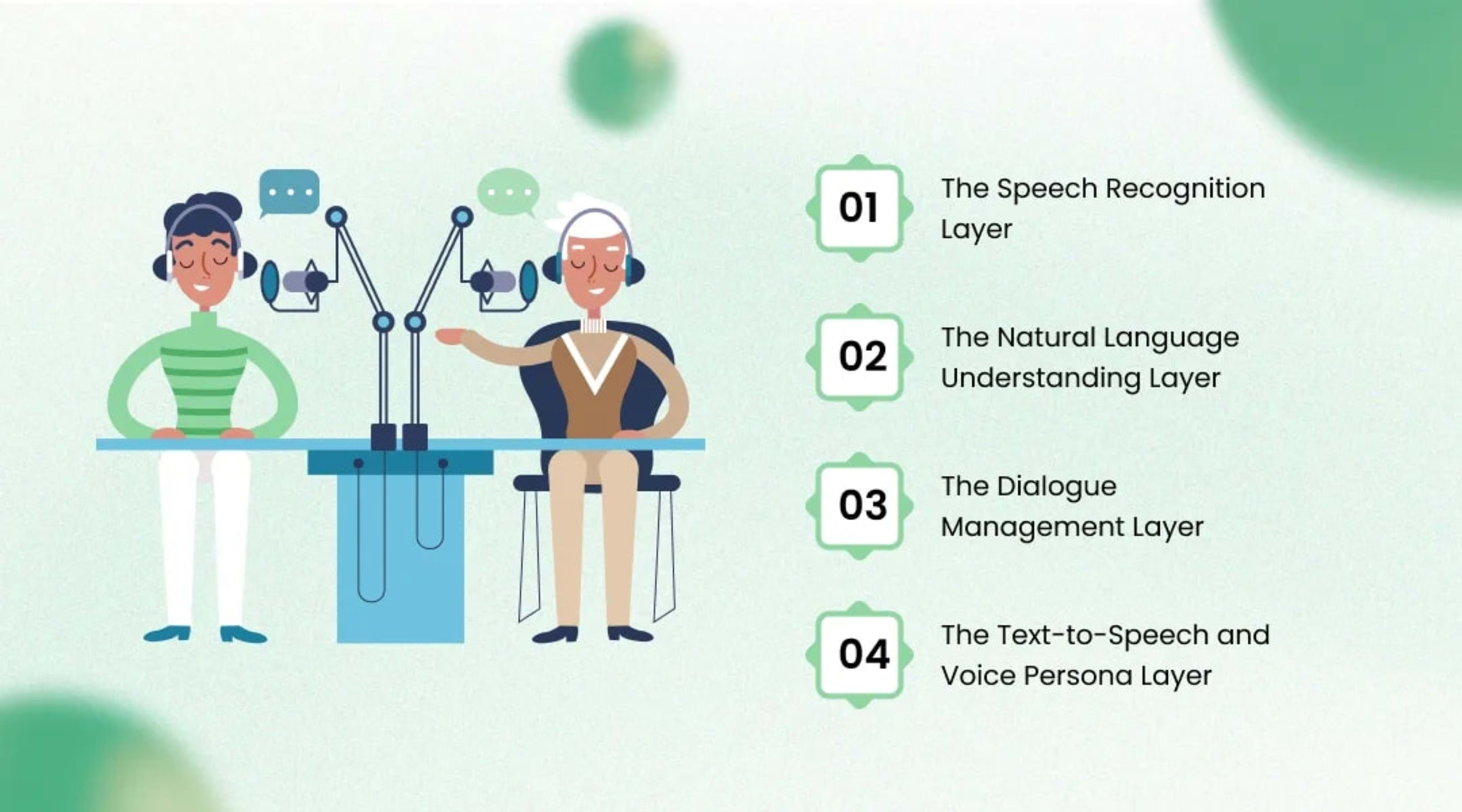
Understanding what custom voice AI development requires starts with understanding the complete technology stack. A production voice agent is not a single model or a single API call. It is a system of interconnected layers, each with its own engineering complexity and performance characteristics, where the output quality of each layer constrains the quality of the next.
Automatic speech recognition is where voice input becomes text, and it is where the most fundamental quality problems originate. Off-the-shelf ASR models trained on general speech corpora perform poorly on domain-specific vocabulary, industry jargon, proper nouns, and accented speech from your specific user population.
Custom voice AI development means choosing your ASR architecture deliberately. Whisper large-v3 and its fine-tuned variants deliver strong accuracy on clear speech but carry a 200 to 400 millisecond transcription latency that is incompatible with conversational responsiveness unless you implement speculative transcription or streaming partial outputs. Conformer-based architectures, particularly the Conformer-CTC family, reduce streaming latency to under 120 milliseconds for partial transcripts but require more data for domain adaptation. RNN-T architectures, used in production by Google and Amazon for their commercial ASR, offer the best streaming performance for telephony deployments but require significant infrastructure investment and specialised expertise to fine-tune. The right architecture for your system depends on your latency budget, your vocabulary complexity, and whether you are deploying over traditional telephony, where audio quality is highly variable, or over WebRTC-based channels, where you have more control.
Domain adaptation through targeted fine-tuning on transcribed examples from your specific domain typically recovers 8 to 15 percentage points of word error rate on domain-specific terminology. For industries with specialised vocabulary such as healthcare, legal, financial services, and industrial operations, this fine-tuning step is not optional if you want production-grade accuracy.
Once speech is transcribed, the NLU layer must extract meaning: what is the caller trying to do, which entities matter, what state are we in, and what should happen next. The architecture choice here has major consequences for both performance and cost.
A fine-tuned BERT or RoBERTa classifier trained on labelled examples from your specific domain delivers intent classification accuracy above 94 percent on in-distribution utterances and inference latency under 20 milliseconds on standard GPU hardware. The limitation is that it requires labelled training data, handles poorly phrased or out-of-distribution utterances poorly, and needs retraining when your intent taxonomy changes.
A zero-shot LLM-based classifier using a model like GPT-4o-mini or Claude Haiku can handle novel phrasings and new intent types without retraining but carries 60 to 120 millisecond inference latency and significantly higher per-call token cost. Hallucination risk in entity extraction also requires careful output validation.
Production custom voice AI systems increasingly use a hybrid architecture: a fast fine-tuned classifier for high-confidence in-distribution requests, falling back to LLM-based classification for low-confidence cases. This hybrid approach achieves classification latency under 30 milliseconds on 85 percent of calls while maintaining robustness on the long tail of unusual utterances.
Dialogue management governs how the system tracks conversation state, decides what to ask or say next, handles clarification, manages interruptions, and escalates to human agents. This is the layer where the conversational intelligence of your voice agent is most visible to callers and where most off-the-shelf platforms show their limitations.
Finite state machines provide deterministic, auditable dialogue control that is easy to monitor and debug. They work well for structured, bounded workflows such as appointment scheduling or payment processing but fail under natural conversation variability where callers jump between topics, correct themselves mid-sentence, or request things outside the expected flow.
Frame-based dialogue managers add flexibility by maintaining a slot-filling model of conversational state rather than a rigid state graph, allowing the system to handle partial information, multi-step correction, and out-of-order information provision. Most enterprise voice AI deployments at production scale use a frame-based manager for their core workflows.
Retrieval-augmented LLM dialogue management, where a language model generates responses conditioned on retrieved context from your knowledge base, policy documents, and live data, offers the most natural conversational experience but requires careful architecture to manage hallucination risk, control response latency, and maintain auditability for regulated industries. KriraAI builds production voice agents using a hybrid approach that uses frame-based management for transactional workflows and retrieval-augmented generation for open-domain information requests within the same call, routing between them based on intent confidence.
The voice your agent speaks in is not a cosmetic concern. It is a significant determinant of caller experience and brand perception. Custom voice AI development gives you full control over voice persona, but exercising that control well requires understanding what the TTS architecture actually offers.
Neural TTS systems using VITS architecture or its successors such as VITS2 and StyleTTS2 can produce voices indistinguishable from human speech in quality evaluations and support fine-grained prosody control, emotion expression, and speaking rate adjustment. Synthesis latency for a 15-word response averages 80 to 140 milliseconds on GPU hardware with streaming synthesis, where audio begins playing before the full response is synthesised. This streaming capability is essential for keeping conversational latency under the 500 millisecond threshold that callers perceive as natural response timing.
Voice cloning from as few as 30 minutes of recorded speech allows organisations to deploy an AI voice that is recognisably consistent with their existing brand voice talent. This creates continuity between human agent interactions and AI-handled calls that callers perceive positively in usability studies.
A voice AI system that works perfectly in a lab environment but cannot handle the audio quality degradation, packet loss, codec variability, and concurrent call volume of real telephony infrastructure is not a production system. This layer is where many custom development projects encounter their hardest engineering problems.
Production telephony integration requires implementing SIP trunk connectivity to route calls from your PSTN carrier or existing contact centre platform to your voice AI processing infrastructure. WebRTC provides a higher-quality path for browser and app-based voice interactions but does not replace SIP for traditional phone calls. RTP handles the actual audio stream transport, and the codec negotiation between your carrier and your ASR system, typically G.711 ulaw at 8kHz for PSTN calls, directly constrains ASR accuracy because the codec compresses frequency information that the ASR model was trained on full-bandwidth audio to use.
At scale, your voice AI infrastructure must handle concurrent call peaks that may be 5 to 10 times your average load during high-traffic periods. A contact centre receiving 500 concurrent calls at peak requires ASR, NLU, dialogue management, TTS, and backend integration components to each handle 500 simultaneous sessions with less than 30 milliseconds of additional latency per session under load. This requires careful horizontal scaling design, GPU resource allocation for ASR and TTS, and load balancing architecture that does not introduce session state inconsistency.
KriraAI engineers production voice AI infrastructure on containerised architectures using Kubernetes-based orchestration with GPU node pools for inference workloads, allowing compute resources to scale with call volume while maintaining session affinity for dialogue state. Integrations with contact centre platforms including Twilio, Amazon Connect, Genesys, and Avaya are delivered through their respective SIP or API integration pathways, and telephony testing is conducted under simulated load at 2x expected peak before production launch.
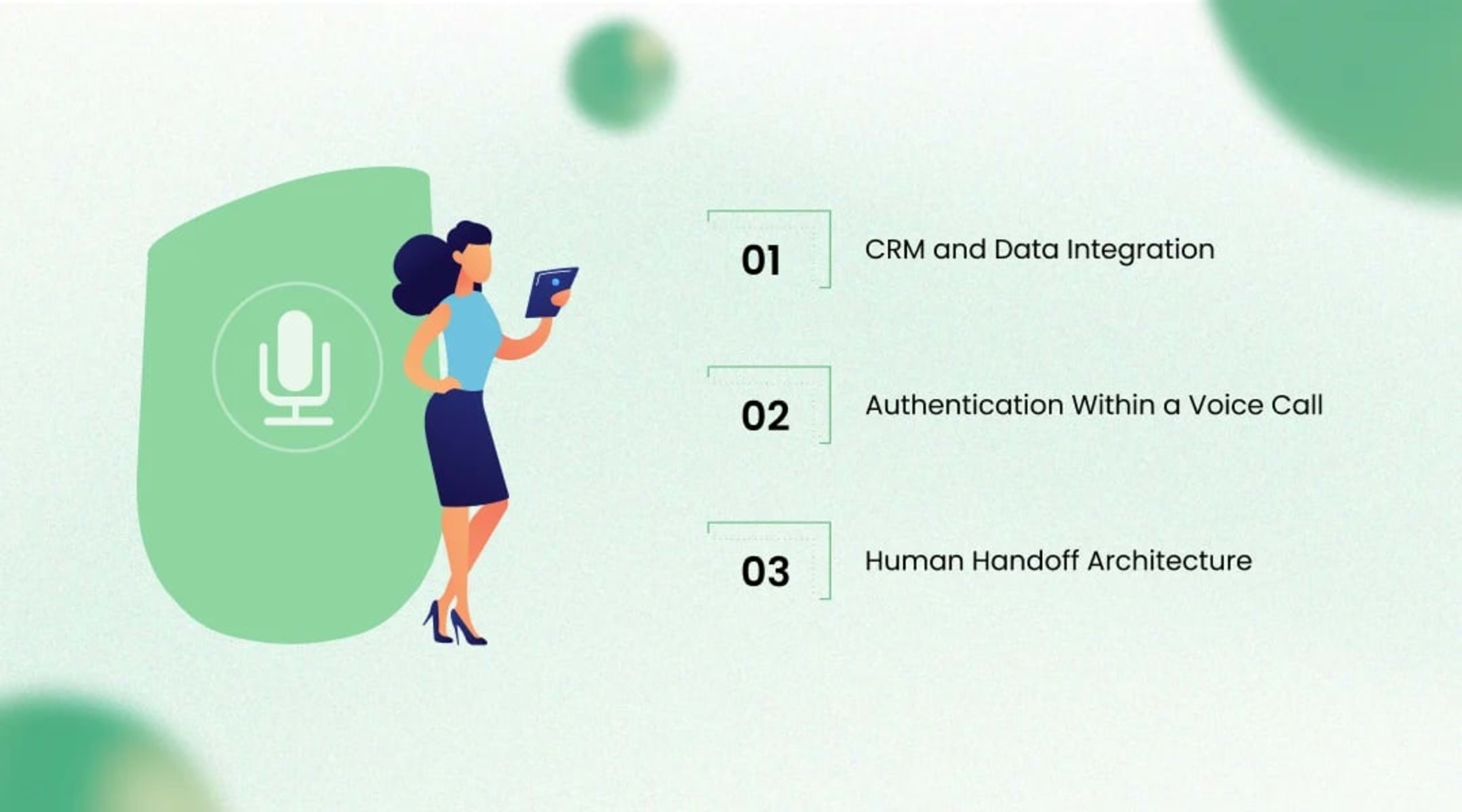
A voice agent that cannot access your data and trigger your workflows in real time during a call is not solving your business problem. Backend integration is often underestimated in early custom voice AI development planning and frequently becomes the longest pole in the project timeline.
Real-time caller identification, context retrieval, and post-call record update require low-latency API integration with your CRM. A caller authentication flow that takes 4 seconds to complete a Salesforce API lookup and render the account context is not acceptable in a conversational voice context where 400 milliseconds of silence sounds like a failure to the caller. Production voice AI systems must architect these integrations with local caching of frequently accessed data, predictive prefetching based on caller ID before the greeting completes, and circuit breaker patterns to degrade gracefully when backend systems are slow or unavailable.
Many enterprise voice agent deployments require the caller to authenticate before accessing account information or performing transactions. Voice-channel authentication must complete within the conversational flow without creating an experience that feels like filling out a form by speaking. Best-practice architectures combine passive voice biometrics running on the audio stream during the greeting with a lightweight knowledge-based challenge, reducing explicit authentication steps to near zero for returning customers while maintaining security posture.
Every production voice agent needs a well-engineered handoff to human agents for calls that fall outside its handling capability. The handoff architecture must transfer the full conversation transcript, the extracted intent and entity data, the caller's authentication status, and any backend data already retrieved so the human agent does not make the caller repeat information. Integration with your ACD or skill-based routing system determines how quickly and accurately the call reaches the right human resource. Poorly designed handoff creates the worst possible caller experience: a technically working voice agent that still frustrates customers because the transition to human support feels broken.
Custom voice AI development is the right choice for a specific and well-defined set of situations. It is not automatically the right choice simply because an organisation has engineering resources or wants maximum control.
Build a custom system when your domain vocabulary is so specialised that off-the-shelf ASR without fine-tuning produces a word error rate above 20 percent on your specific content. This is common in healthcare, legal, financial services, and industrial operations.
Build a custom system when your conversational workflows are complex enough that they cannot be expressed in the configuration paradigm of available platforms without creating unmaintainable workarounds. If your call flows have more than 40 distinct intents with significant inter-dependencies, most platforms will show serious limitations.
Build a custom system when your regulatory or data residency requirements prohibit sending audio or transcript data to a third-party cloud service. This is a binary requirement in certain regulated industries that eliminates most SaaS platform options.
Build a custom system when your contact centre volume justifies the investment. The per-minute cost of a custom voice AI system at scale is typically 60 to 75 percent lower than a per-minute SaaS platform cost because you are not paying a platform margin on top of compute costs. At volumes above 500,000 minutes per month, the economics strongly favour custom development.
Platform adoption is the right choice when your use case is standard, your data environment is not restricted, your volume is below the custom economics threshold, and you need to be in production within weeks rather than months. Be honest about where your organisation falls on these dimensions before committing to a development path.
Custom voice AI development timelines in production environments, built by teams with relevant experience, follow a consistent pattern that organisations should plan around rather than be surprised by.
The architecture design and technology selection phase takes four to six weeks when done with the rigour required for a production system. This phase produces the system design, technology stack decisions, infrastructure blueprint, and integration specifications. It is the foundation that determines whether the system built in subsequent phases will perform.
The core system development phase, covering ASR integration and fine-tuning, NLU model development, dialogue manager implementation, TTS integration, and telephony connectivity, takes ten to sixteen weeks for a system of moderate complexity. Each week at this stage involves integration testing between layers because voice AI system failures are almost never isolated to a single layer.
The backend integration and testing phase adds six to ten weeks depending on the complexity and quality of your existing backend APIs. Organisations with well-documented, low-latency APIs and staging environments will move faster. Organisations whose CRM API responses average over 800 milliseconds or whose documentation is incomplete will move slower.
A realistic timeline from architecture kick-off to production launch for a well-resourced custom voice AI project is six to nine months. Teams that try to compress this to three months consistently produce systems that fail in production under real call volume and real conversational variability.
Investment should be assessed at two levels: the initial build investment and the ongoing operational cost. A production custom voice AI system for a mid-size contact centre requires a team with ASR engineering, NLU modelling, dialogue design, telephony integration, and backend API development skills, which translates to an initial build investment typically ranging from $250,000 to $700,000 depending on complexity and team composition. Ongoing operational costs for inference compute, model retraining, and system maintenance average 15 to 25 percent of the initial build cost per year.
A production custom voice AI system must be measured continuously against a set of metrics that reflect real business performance, not just technical benchmarks captured in lab testing. The metrics that matter are specific and should be instrumented into your system before launch, not retrofitted afterward.
End-to-end conversational latency measures the time from when the caller finishes speaking to when the agent's voice response begins playing. This should be below 600 milliseconds for 95 percent of turns in production. Human conversational response time is typically 200 to 300 milliseconds, and callers begin to perceive responses above 800 milliseconds as uncomfortably slow.
Task completion rate measures the percentage of calls where the caller achieved their stated objective without requiring human escalation. A well-built custom voice agent should achieve task completion above 82 percent on in-scope calls within six months of production launch, rising to above 88 percent after twelve months of continuous improvement.
Containment rate measures the percentage of total inbound volume handled to completion by the voice agent without human involvement. This is the primary commercial metric because it directly determines cost savings and ROI. Each percentage point of containment improvement on a contact centre handling one million calls per year represents approximately 10,000 calls that no longer require human agent time.
Escalation analysis is as important as the aggregate escalation rate. Reviewing transcripts of escalated calls weekly and categorising escalation causes, whether intent not recognised, information not available, caller preference, or system error, drives the continuous improvement cycle that separates production systems that improve over time from ones that plateau.
KriraAI instruments all production voice AI deployments with a real-time analytics pipeline that tracks these metrics at the individual call level, aggregates them by intent type, time of day, caller segment, and dialogue path, and surfaces anomaly alerts when metrics deviate from baseline. This monitoring infrastructure is built in parallel with the voice agent itself and is a non-negotiable part of production readiness.
Three conclusions from this analysis of custom voice AI development stand out as decision-critical for any organisation evaluating this path. First, the technology stack involved is genuinely complex, and the performance of the complete system depends on the quality of decisions made at each layer independently and at the integration points between them. Generic platforms that abstract these decisions away also abstract away the performance control you need for demanding enterprise deployments. Second, the economics strongly favour custom development at scale, but the crossover point is real, and organisations below approximately 500,000 monthly call minutes should run the numbers honestly rather than assuming custom development is financially justified. Third, timeline compression is the most common cause of production failures in custom voice AI projects, and teams that build in the full six to nine months required consistently produce better systems than teams that rush to a four-month launch.
KriraAI designs and deploys production-grade custom voice AI development systems for enterprises that need voice agents to perform reliably at real scale, in real regulated environments, with real conversational complexity. The engineering depth KriraAI brings to voice architecture design, ASR domain adaptation, dialogue system engineering, and telephony integration reflects experience building systems that handle hundreds of thousands of calls per month without the failure modes that characterise underpowered voice AI deployments. If you are evaluating whether custom voice AI development is the right path for your organisation, and what it would concretely involve for your specific environment, we invite you to bring that conversation to KriraAI.
A production-grade custom voice AI system requires six to nine months from architecture design to live deployment for a mid-complexity contact centre application. This timeline covers ASR fine-tuning on domain data, NLU model development and validation, dialogue manager implementation, telephony integration, backend API connectivity, and staged load testing. Teams attempting to compress this to under four months consistently encounter quality failures in production because voice AI systems require iterative testing across real call variability, which cannot be safely simulated in shortened development cycles.
Custom voice AI development carries a higher initial investment, typically $250,000 to $700,000 for a production system of moderate complexity, compared to a SaaS platform deployment that may cost $50,000 to $150,000 to configure and launch. However, the per-minute operational cost of a custom system at scale is 60 to 75 percent lower than SaaS platform pricing because you eliminate the platform margin. Organisations processing more than 500,000 call minutes per month reach total cost parity with SaaS platforms within 18 to 24 months and generate substantial savings beyond that point.
Regulated industries often have data residency, data handling, and audit trail requirements that prohibit routing patient or customer speech audio to third-party cloud platforms. HIPAA in healthcare, for example, requires Business Associate Agreements and specific data handling controls that most SaaS voice platforms cannot satisfy for audio data. Custom voice AI development allows organisations to deploy ASR and NLU inference on infrastructure within their own cloud tenancy or on-premises environment, ensuring audio and transcript data never leaves their controlled environment. This is a binary compliance requirement, not a preference, and it eliminates most platform options for affected organisations.
Production voice AI system performance should be evaluated against four primary metrics: end-to-end conversational latency below 600 milliseconds on 95 percent of turns, task completion rate above 82 percent on in-scope calls, containment rate improvement of at least 3 percentage points per quarter through the first year, and a call escalation analysis showing reduction in intent-not-recognised escalations over time. These metrics must be instrumented in the system before launch. Post-hoc metric reconstruction from call logs is unreliable and delays the improvement cycles that separate systems that improve from systems that plateau.
Multilingual custom voice AI development requires language-specific ASR model selection or fine-tuning because ASR accuracy degrades substantially when a model trained on one language variant is applied to another accent or regional dialect. For a system serving callers across five or more languages, the ASR layer typically uses separate model instances per language with language identification as a pre-processing step, adding 40 to 80 milliseconds of latency before the main ASR begins. The NLU and dialogue management layers can share infrastructure across languages if the intent taxonomy is language-agnostic, but entity extraction models often require language-specific fine-tuning. End-to-end latency targets are achievable in multilingual deployments but require careful infrastructure planning to avoid the language identification step creating perceptible response delays.
Ridham Chovatiya is the COO at KriraAI, driving operational excellence and scalable AI solutions. He specialises in building high-performance teams and delivering impactful, customer-centric technology strategies.