I built chatbots for four years before I ever touched an AI copilot. Good chatbots. The kind that handled 60% of tier-one support queries and made my clients genuinely happy.
So trust me when I say this: I'm not here to trash chatbots. I'm here to explain why comparing a corporate AI copilot to a chatbot is like comparing a calculator to a financial analyst. Both work with numbers. One of them actually understands what the numbers mean.
The confusion between AI copilot vs chatbot is everywhere right now - boardrooms, LinkedIn threads, vendor pitches. And it's costing businesses real money, because they're either over-investing in chatbots that can't grow with them, or dismissing copilots as rebranded chat widgets. Neither is true.
I've led three full migrations from chatbot-only setups to AI copilot architectures at KriraAI. This article is everything I wish someone had told my clients before they spent six months stretching a chatbot past its breaking point.
A chatbot is a software program designed to simulate conversation with users, typically through text. It follows predefined rules, scripts, or basic natural language processing to respond to queries.
Most business chatbots operate on decision trees or keyword matching. User says "refund," bot routes to the refund script. More advanced versions use intent recognition, but even those are working within a closed set of trained scenarios. They don't think. They pattern-match.
FAQ handling, appointment scheduling, order tracking, basic lead capture. Chatbots excel at high-volume, low-complexity interactions. And honestly? For that specific job, they're still perfectly fine.
Let me say that again, because nuance matters: chatbots are not obsolete. They're limited.
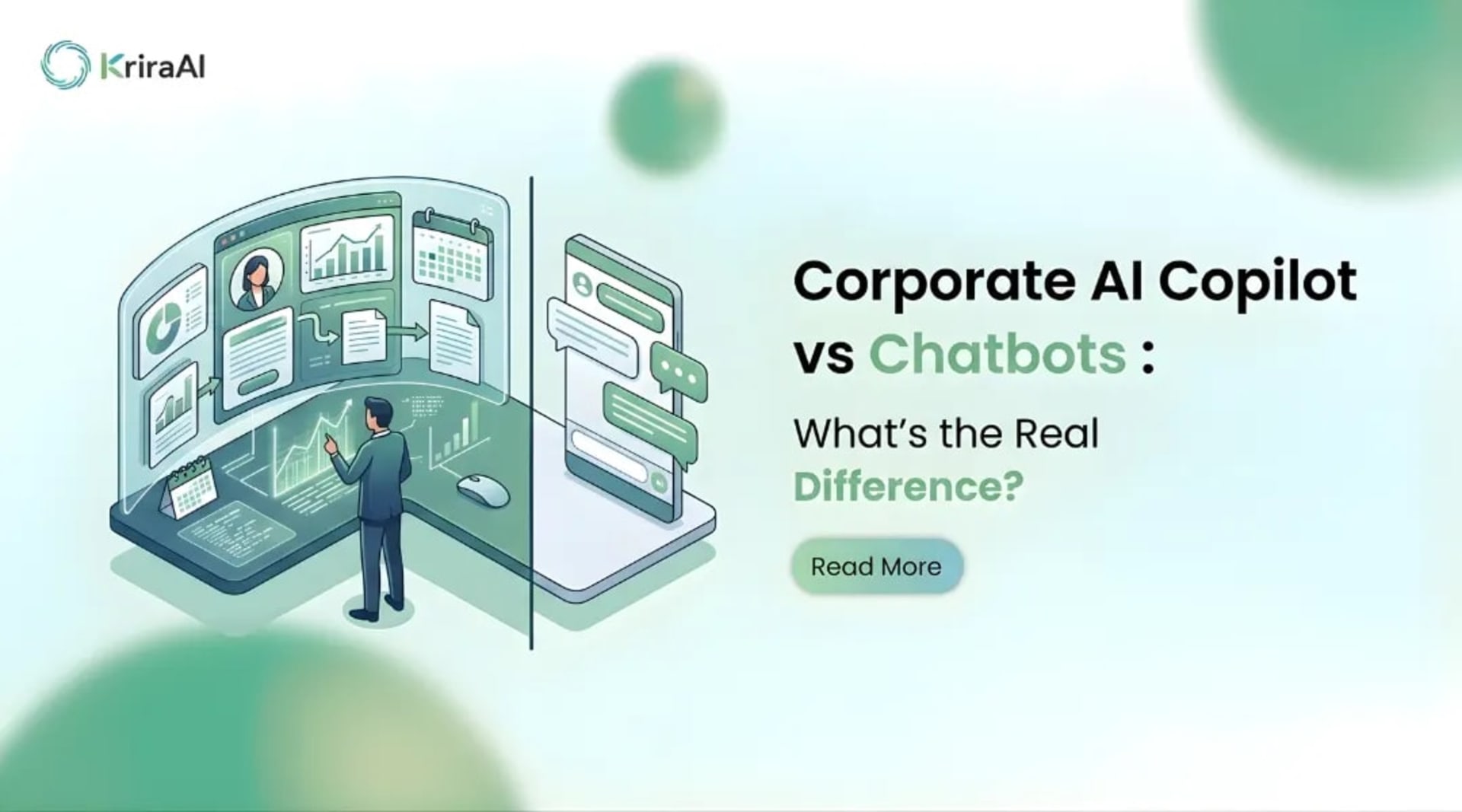
A corporate AI copilot is an intelligent system embedded into your enterprise workflows that collaborates with employees in real time. It doesn't wait for questions. It understands context, surfaces relevant information, and proactively assists with complex, multi-step tasks. The what is corporate AI copilot question really boils down to this: it's the difference between a tool and a teammate.
An AI copilot for business uses large language models, retrieval-augmented generation, and deep integration with your enterprise data to build a persistent understanding of your operations. It reads your CRM history, your Slack threads, your ERP data and connects the dots between them. This is what separates conversational AI vs intelligent AI systems: the copilot doesn't just converse, it comprehends.
Where chatbots sit at the front door answering questions, AI copilots for employees sit at the desk alongside your team. They draft reports, flag anomalies, suggest next actions, automate approval chains, and reduce the cognitive load on your best people. They're smart AI systems for decision making, not just conversation handlers.
Here's where I need you to really pay attention, because this is the section that will save you from making a $100K mistake.
Chatbots are static. They know what you've taught them and nothing more. A copilot learns from your business data, adapts to context, and gets more useful over time. The difference between chatbot and AI copilot is architectural, not cosmetic.
A chatbot asks: "What category does this query fit?" A copilot asks: "Given everything I know about this customer, this department, and this quarter's priorities, what's the best action right now?" One follows rules. The other applies judgment.
Chatbots wait. Copilots anticipate. That single word - anticipate, is where the ROI lives.
Here's the head-to-head breakdown of chatbot vs AI assistant capabilities. Bookmark this.
Feature | Traditional Chatbot | Corporate AI Copilot |
Intelligence Level | Rule-based / basic NLP | LLM-powered, contextual reasoning |
Learning Capability | Static (manual retraining) | Continuous (adapts with data) |
Decision-Making | None—routes to humans | Recommends actions with rationale |
System Integration | Surface-level (APIs, widgets) | Deep (CRM, ERP, databases, comms) |
Interaction Style | Reactive Q&A | Proactive assistance + automation |
Business Impact | Deflects queries | Transforms workflows |
The table makes it clinical. But here's the personal version: every time I've shown this comparison to a CTO who was "happy with their chatbot," I've watched the same slow realization cross their face. We've been solving the wrong problem.
Chatbots break the moment a user goes off-script. And users always go off-script. The chatbot limitations in business are most visible when a customer asks a question that spans two departments, or references a previous interaction the bot can't recall.
"I want to change my order, apply last month's credit, and update my shipping address." That's one sentence. Three systems. Zero chance your chatbot handles it without escalation.
A chatbot can tell you the status of an invoice. It cannot tell you whether that invoice should be flagged, why it's unusual compared to the vendor's history, or what action to take next. That requires intelligence. Not scripts.
(Are you starting to see why the chatbot vs generative AI debate isn't even close?)
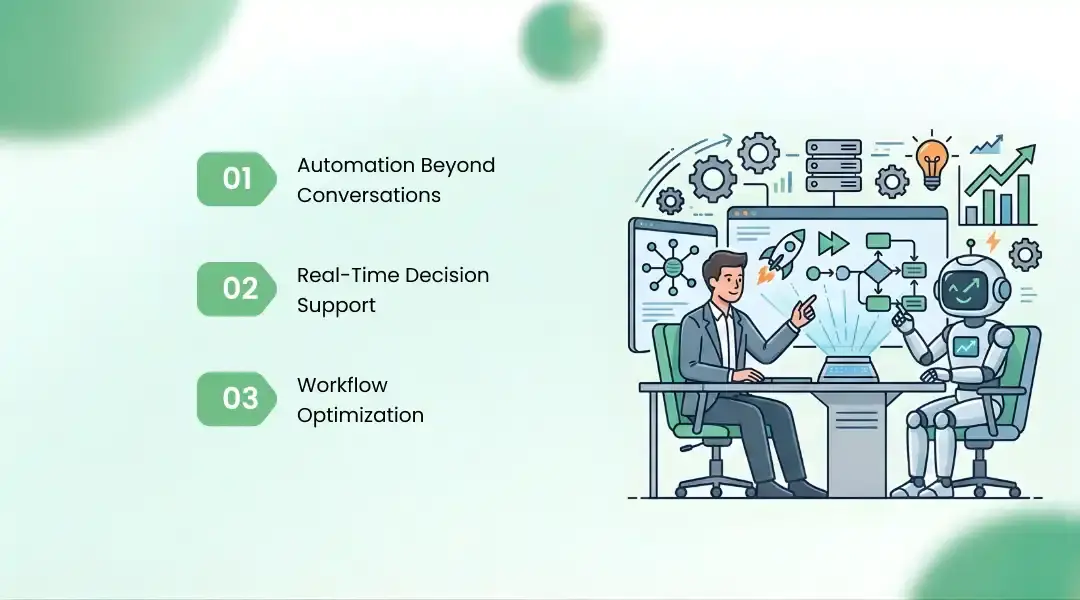
AI copilots for workflow automation don't just talk—they do. They trigger processes, draft documents, update records, and close loops. The benefits of AI copilot for business extend far beyond the chat window.
Your operations manager shouldn't spend 45 minutes assembling a report to make a decision that an AI copilot for business could surface in seconds. That's not efficiency. That's institutional stubbornness.
When AI automation tools for business sit inside your stack—not beside it—they eliminate handoffs, reduce errors, and compress cycle times. The AI copilot use cases in enterprises I've implemented have consistently delivered 25–40% efficiency improvements within the first quarter.
Chatbot: answers "Where's my order?" Copilot: notices the customer has asked three times this week, flags the fulfillment delay, drafts a proactive apology with a discount, and alerts the logistics team. Same trigger. Completely different outcome.
Chatbot: helps employees find the leave policy PDF. Copilot: tells an HR manager which team is approaching burnout based on leave patterns, overtime data, and project timelines.
Chatbot: asks "Are you interested in a demo?" and logs the answer. Copilot: scores the lead based on behavioral data, drafts a personalized follow-up, and prioritizes the pipeline. The AI assistant vs chatbot in enterprises gap is widest here.
Chatbot: doesn't do this. Full stop. A copilot pulls cross-system data, generates summaries, and highlights anomalies your team would've missed until next quarter's review.
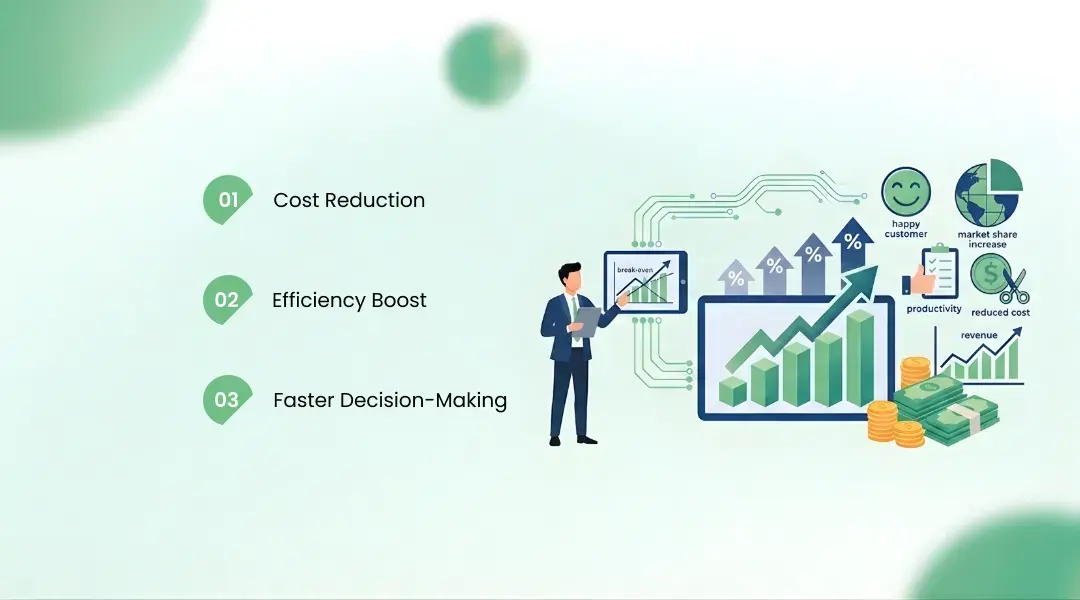
Let me give you numbers, not promises, from actual enterprise AI copilot solutions I've been part of delivering.
One fintech client replaced 60% of their manual report generation with a copilot. Estimated annual savings: ₹45 lakhs. That's not hypothetical. That's an invoice I watched them stop paying.
A logistics company using an enterprise AI assistant India deployment saw their operations team reclaim 12 hours per week—per person—that was previously spent aggregating data across three systems.
When your copilot surfaces the right data at the right moment, decisions that took days collapse into hours. In one project, procurement approval cycles dropped from five days to same-day.
If you're a small business with straightforward FAQ-style customer queries—a well-built chatbot is still smart money. No shame in that. But if your workflows involve cross-functional data, multi-step decisions, or employee-facing complexity, you've outgrown chatbots. You need a copilot.
External-facing, high-volume, low-complexity? Chatbot. Internal operations, decision support, workflow automation? Copilot. The real question isn't which one is "better"—it's which one matches your actual problem.
Here's what I recommend to most clients: keep your chatbot for front-line interactions and deploy a copilot behind the scenes for your team. This is where a best AI development company earns its keep, architecting the right system for the right layer, not selling you one tool for every job.
The market is moving from "AI tools that do tasks" to "AI systems that understand your business." That shift—from conversational AI vs intelligent AI systems—is already happening. The companies that recognize it early will operate at a fundamentally different speed.
The next evolution beyond copilots? Autonomous agents that handle entire workflows end-to-end, with human oversight at critical decision points. We're building early versions of this at KriraAI through our enterprise AI assistant development services, and the results are promising enough that I'm comfortable saying: this is where everything is heading.
Here's the uncomfortable truth: most businesses asking "should I replace my chatbot with an AI copilot?" already know the answer. Their chatbot hit a ceiling six months ago. They're just looking for permission or a clear framework to make the move.
This article is that framework.
Chatbots handle conversations. Corporate AI copilots handle work. If your team is still manually bridging the gap between what your chatbot can do and what your business actually needs, the gap is the answer.
My team at KriraAI has walked this path with companies across fintech, logistics, and e-commerce. We don't push copilots on businesses that need chatbots, and we don't build chatbots for problems that demand copilots. We build what's right.
If you're evaluating the difference between chatbot and AI copilot for your own operation, let's talk. I'll be honest about what you actually need. Even if the answer surprises you.
A chatbot follows scripts to answer specific questions. An AI copilot understands business context, integrates with enterprise systems, and proactively assists with complex tasks, decisions, and workflows—not just conversations.
Not necessarily. If your chatbot handles high-volume, simple interactions well, keep it. But if your team is constantly bridging the gap between chatbot output and real business decisions, a copilot addresses that gap directly.
For enterprise-scale operations involving multi-system data, complex workflows, and decision support—yes, substantially. Chatbots serve a narrower function well, but copilots operate at the level where enterprise complexity actually lives.
By eliminating manual data aggregation, automating multi-step tasks, surfacing relevant insights proactively, and reducing the time between "I need information" and "I can make a decision." Teams I've worked with typically reclaim 10–15 hours per person per week.
Absolutely and they often should. A chatbot handles front-line customer interactions while an AI copilot supports internal teams with deeper analysis, automation, and decision-making. The hybrid approach is often the smartest first step.
Founder & CEO
Divyang Mandani is the CEO of KriraAI, driving innovative AI and IT solutions with a focus on transformative technology, ethical AI, and impactful digital strategies for businesses worldwide.