I’ve seen two types of businesses invest in AI customer support automation.
The first group buys software because everyone else is doing it. They attend one webinar. See one shiny demo. Swipe the card.
Six months later? Low adoption. Angry customers. Wasted budget.
The second group asks harder questions.
They understand that customer support automation using AI is not about replacing humans. It’s about designing smarter systems.
If you're reading this, you're probably somewhere between curious and cautious.
Good. That’s where smart decisions begin.
Let’s talk reality.
Your support team grows as your customer base grows. Salaries. Training. Infrastructure. It compounds.
One of the biggest benefits of AI customer service automation is predictable scaling. An AI doesn’t demand overtime pay.
Your customers message you at 2 AM. On weekends. During holidays.
A 24/7 AI customer support system doesn’t sleep. And that’s not a luxury anymore, it’s expected.
Manual teams hit a ceiling.
A properly implemented AI customer service platform handles thousands of queries simultaneously. No burnout.
Response time is trust.
An AI chatbot for customer support can reply instantly to FAQs, order tracking, refund policies, onboarding questions.
But here’s the uncomfortable question:
Are you choosing AI because you want innovation… or because your current system is breaking?
Be honest.
Not all AI customer support solution providers are equal. Some sell scripts wrapped in marketing.
Here’s what actually matters.
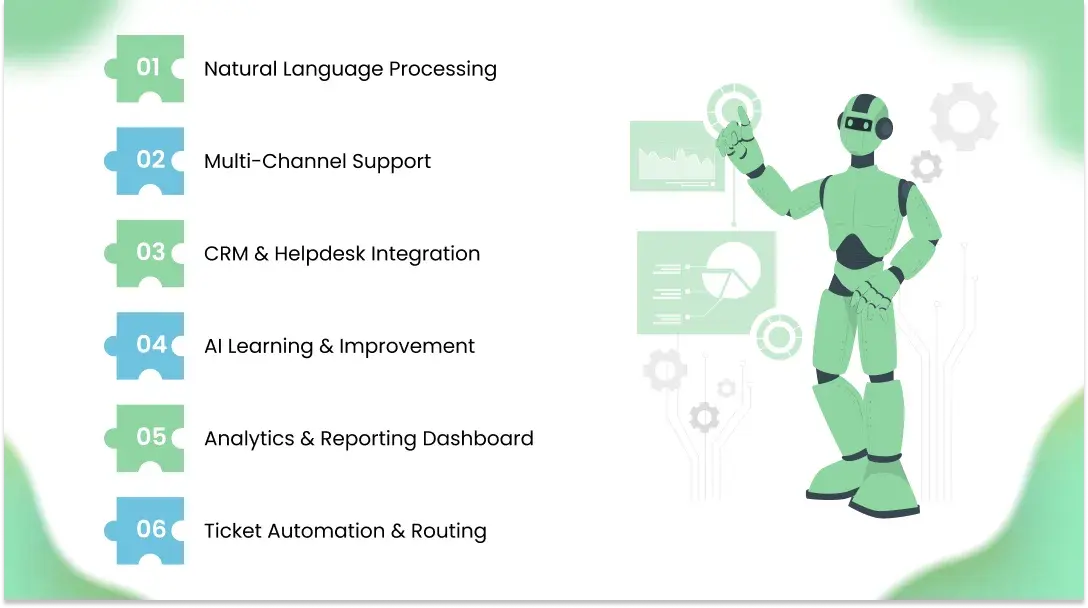
Your system must understand messy human language. Slang. Typos. Emotion.
Without strong NLP, your AI in customer support becomes a glorified FAQ page.
Website chat. WhatsApp. Email. Instagram.
Your AI live chat automation should work everywhere your customers are.
If it doesn’t integrate with your CRM, it will create chaos.
Good AI helpdesk automation syncs with tools like ticketing systems and CRMs so your data flows cleanly.
A real AI ticket automation system improves over time.
If the vendor says, “It’s pre-trained and doesn’t need updates,” run.
You need visibility. Query types. Resolution rate. Escalation trends.
Without data, you’re guessing.
Your AI should not just respond. It should route complex issues intelligently to human agents.
That’s real automation.
You Googled: How to choose AI customer support software.
Here’s my practical framework.
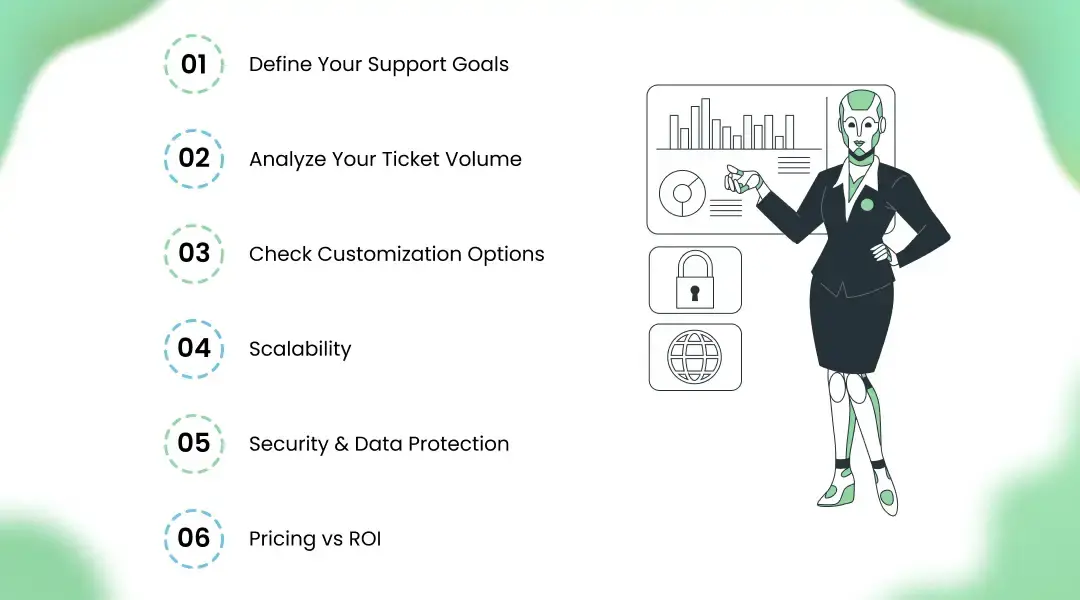
Are you reducing cost? Improving response time? Increasing CSAT?
Without clarity, even the best AI customer support software will disappoint you.
If 70% of your tickets are repetitive, you’re a strong candidate for automated customer service tools.
If every ticket is unique and emotional? You’ll need hybrid automation.
Avoid rigid tools.
Customer support automation using AI must reflect your brand tone, escalation flow, policies.
(If every chatbot sounds robotic, customers feel it.)
Will the system handle 10x growth?
Especially important for SaaS and e-commerce brands.
If you're handling payments, health data, or financial info, compliance matters. Especially in Fintech and Healthcare.
Don’t ask, “How much does AI customer support automation cost?”
Ask instead:
“How much are we losing without it?”
I’ve seen these repeatedly.
Low-cost tools often lack real conversational AI for customer service capabilities.
You save today. You will suffer tomorrow.
If your AI doesn’t integrate, agents manually copy data.
That defeats the purpose of customer service automation tools.
AI isn’t magic.
It requires structured training data, testing, and continuous optimization.
This one hurts.
AI support for small businesses works best as augmentation first, replacement later.
Gradual improvement. That’s the realistic path.
Different industries. Different needs.
Order tracking. Returns. Refund policies.
AI live chat automation reduces repetitive tickets dramatically.
Onboarding. Feature explanations. Billing queries.
A smart AI ticket automation system ensures technical queries reach the right team instantly.
Appointment scheduling. Basic FAQs. Data sensitivity.
Security-first AI customer support solution is critical.
Admission queries. Course details. Deadlines.
High volume. Predictable patterns. Perfect for automation.
Transaction status. KYC updates.
Compliance-focused AI helpdesk automation is mandatory.
Let’s talk money.
Ticket volume
Channels integrated
Custom AI model vs template solution
Industry compliance requirements
I worked with an e-commerce brand spending ₹12 lakhs annually on support staff.
After structured AI customer service automation, 55% of tickets were automated.
Support cost dropped by 48%.
The goal is simple:
Reduce customer support cost with AI while improving experience.
That balance is everything.
Here’s the math I use with clients.
Identify repetitive tickets.
Automate 50–70% of them.
Reallocate human agents to complex issues.
Efficiency increases. Resolution time drops. Customer satisfaction improves.
And suddenly, your team stops firefighting and starts thinking.
That’s when automation feels less like software… and more like infrastructure.
AI customer support automation is not about replacing your team.
It’s about designing a smarter operating model.
If you choose wisely, it becomes one of the highest ROI investments you’ll make.
If you choose blindly, it becomes expensive shelfware.
The difference?
Clarity.
It depends on ticket volume, customization, and integrations. Basic solutions start lower, but tailored systems cost more and deliver better ROI.
No. AI handles repetitive queries. Complex, emotional issues still require humans.
Yes, especially if repetitive queries consume time. Even small teams benefit from partial automation.
Typically 4 - 12 weeks depending on complexity and integrations.
Choosing tools without clear goals or expecting instant 100% automation.
Founder & CEO
Divyang Mandani is the CEO of KriraAI, driving innovative AI and IT solutions with a focus on transformative technology, ethical AI, and impactful digital strategies for businesses worldwide.