Let me say this upfront.
Most people don’t need a multi agent system.
Yeah. I said it.
I’ve worked with founders who wanted to build “autonomous AI teams” when all they needed was a well-structured API call and some logic. They burned months. And money.
But when you do need a multi agent system? It changes everything.
This guide isn’t theory. It’s how I actually design systems at KriraAI systems that businesses use daily to automate decisions, reduce manual work, and yes… AI to Save Time and Cut Costs in ways that are measurable.
Let’s build one. Properly.
A single agent is like a solo freelancer. A multi agent system is a coordinated team.
Simple.
Single agent → handles one workflow end-to-end
Multi-agent → divides tasks across specialized agents
Think about it:
Would you hire one person to handle sales, support, marketing, and analytics?
No. (Unless you enjoy chaos.)
Same logic applies here.
Use it when:
Tasks require specialization
Workflows involve multiple decision layers
Outputs depend on collaboration
Avoid it when:
Your use case is linear
You don’t have clear task boundaries
Be honest with yourself here. This decision alone can save weeks.
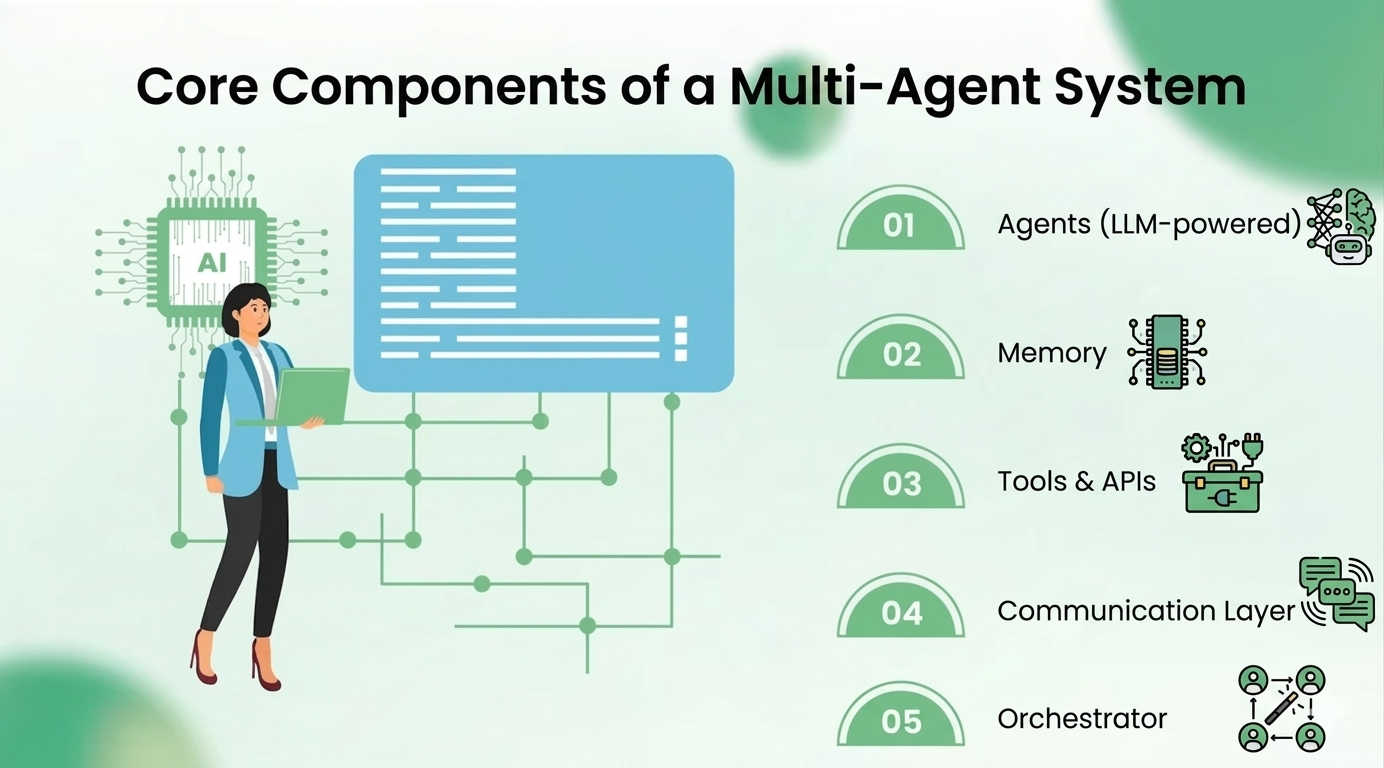
Let’s break the machine.
Each agent has a role:
Research agent
Writer agent
Validator agent
They don’t “know everything.” They do one thing well.
Short-term + long-term context.
Without memory, your agents are goldfish.
Agents don’t live in isolation. They call:
APIs
Databases
External tools
This is where real-world power comes from.
Agents need to talk.
This includes:
Message passing
Shared context
Event triggers
Poor communication = broken system.
This is the brain.
It decides:
Who does what
When tasks move forward
How conflicts are resolved
I’ve seen more systems fail here than anywhere else.
Let’s address the obvious question.
“Which framework should I use?”
Flexible
Widely adopted
Good for experimentatio
Built specifically for multi agent collaboration AI
Cleaner structure
Faster to prototype
Autonomous workflows
Less control, more exploration
Structured
Reliable
Strong for production
Here’s the truth.
No framework will save you from bad architecture.
Pick one. Learn it deeply. Move on.
Centralized: One orchestrator controls everything
Decentralized: Agents interact independently
Most real-world systems? Hybrid.
This is critical.
Tasks should be:
Clearly defined
Assigned based on capability
Tracked through states
Bad delegation = infinite loops. Yes, I’ve seen it happen.
Think in flows:
Input
Processing
Validation
Output
Not “magic AI.”
Structure beats hype. Every time.
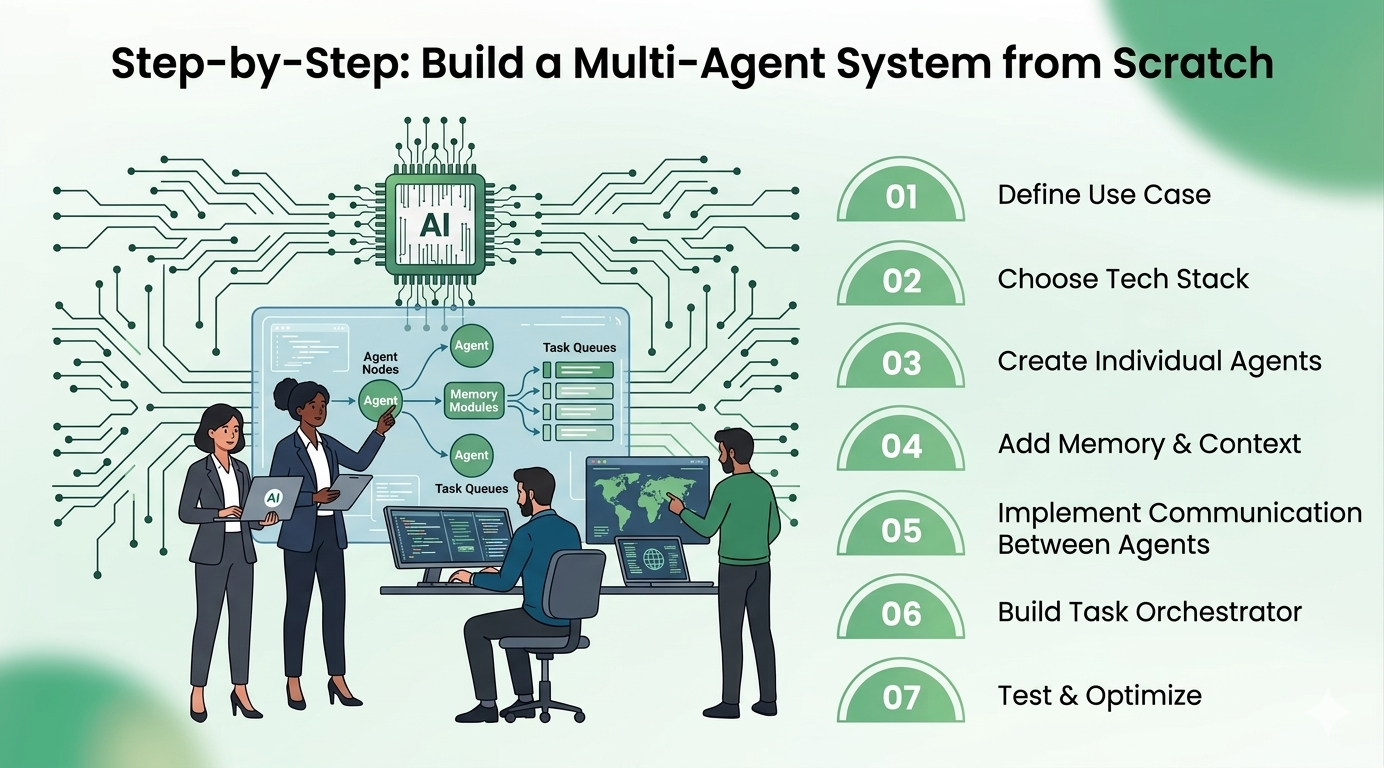
Alright. Let’s build.
Start here. Always.
Example:
Customer support automation
Content generation pipeline
If your use case is vague, your system will be worse.
Python
APIs
Framework (LangChain / CrewAI)
This is your foundation.
Define roles:
Research agent
Execution agent
Review agent
Each agent = clear responsibility.
Use:
Vector databases
Session memory
This enables continuity.
Here’s where most tutorials fail.
Agents must:
Pass structured messages
Share outputs
Handle failures
Otherwise, your system collapses silently.
This is your agent orchestration system.
It:
Routes tasks
Tracks progress
Resolves errors
Don’t rush this. Seriously.
Test like a pessimist:
What breaks?
What loops?
What costs too much?
Because it will.
(Quick question: Are you building something real… or just experimenting? Your answer should change how deep you go here.)
Agents:
Query understanding agent
Response generator
QA validator
Result:
Faster responses
Consistent quality
Agents:
Topic research
Draft writing
SEO optimization
This is a classic LLM agents workflow.
And yes we’ve built this for clients through our AI services at KriraAI.
Let’s not pretend this is easy.
Agents misinterpret tasks. Outputs conflict.
More agents = more API calls.
Costs creep up quietly.
Multiple steps = slower responses.
Users don’t like waiting.
(Here’s the part nobody tells you: most failures aren’t technical—they’re architectural.)
Don’t create “super agents.” They fail.
Break everything into components.
Future you will thank you.
Track:
Cost
Speed
Accuracy
If you’re not measuring, you’re guessing.
We’re heading toward something interesting.
Entire workflows handled by AI agents.
Minimal human intervention.
Agents working across platforms, companies, systems.
Not isolated anymore.
But here’s my honest take.
The winners won’t be the ones with the most agents.
They’ll be the ones with the best-designed systems.
A multi agent system isn’t just about connecting AI models.
It’s about designing a system that behaves predictably under pressure.
That scales. That doesn’t break silently. That solves a real problem.
If you get that right, everything else becomes easier.
And if you don’t?
Well… you’ll join the long list of “AI experiments” that never made it to production.
Start with a clear use case, define agent roles, implement communication, build an orchestrator, and test extensively. Focus on architecture first, not tools.
CrewAI is better for structured collaboration, while AutoGPT suits autonomous exploration. Your choice depends on control vs flexibility needs.
It includes agents, memory, tools, communication layers, and an orchestrator. These components work together to handle complex workflows.
Through structured message passing, shared memory, and event-based triggers. Poor communication design is a common failure point.
Customer support automation, content generation, analytics workflows, and business process automation are some common examples.
Founder & CEO
Divyang Mandani is the CEO of KriraAI, driving innovative AI and IT solutions with a focus on transformative technology, ethical AI, and impactful digital strategies for businesses worldwide.