
Best AI Development Company in 2026: Why Businesses Choose KriraAI
Choosing the best AI development company in 2026 is less about finding the biggest name and more about finding the partner that fits your problem, your data, and your budget. Enterprise AI has gone mainstream, and the numbers back it up. McKinsey's State of AI report, published in November 2025, found that 88 percent of organizations now use AI in at least one business function, up from 78 percent a year earlier. Yet the same report noted that most companies are still stuck in the piloting stage, with only about a third beginning to scale. This guide explains how to evaluate an AI development partner, what the work actually involves, and where a company like KriraAI fits.
What an AI development company actually does
An AI development company is a specialized software firm that designs, builds, and deploys artificial intelligence systems tailored to a specific business problem. That work ranges from machine learning models to generative AI applications and autonomous AI agents. A good partner covers the full lifecycle, not just the exciting model-building part in the middle.
Most vendors in this space offer some mix of the following services:
Custom AI software development and AI integration into existing systems
Machine learning and predictive analytics models for forecasting, scoring, and detection
Generative AI and large language model (LLM) applications, including chatbots and copilots
AI agents and multi-agent systems, sometimes called agentic AI
Natural language processing, computer vision, and speech capabilities
AI strategy and consulting, from a first proof of concept to full production
MLOps work: deployment, monitoring, and retraining after launch
The market context matters here. According to Grand View Research, the global AI market was valued at 390.9 billion dollars in 2025 and is projected to reach 539.5 billion dollars in 2026, with services making up the single largest component. That growth is exactly why so many firms now claim AI expertise, and why choosing carefully has become harder.
How an AI development engagement works, step by step
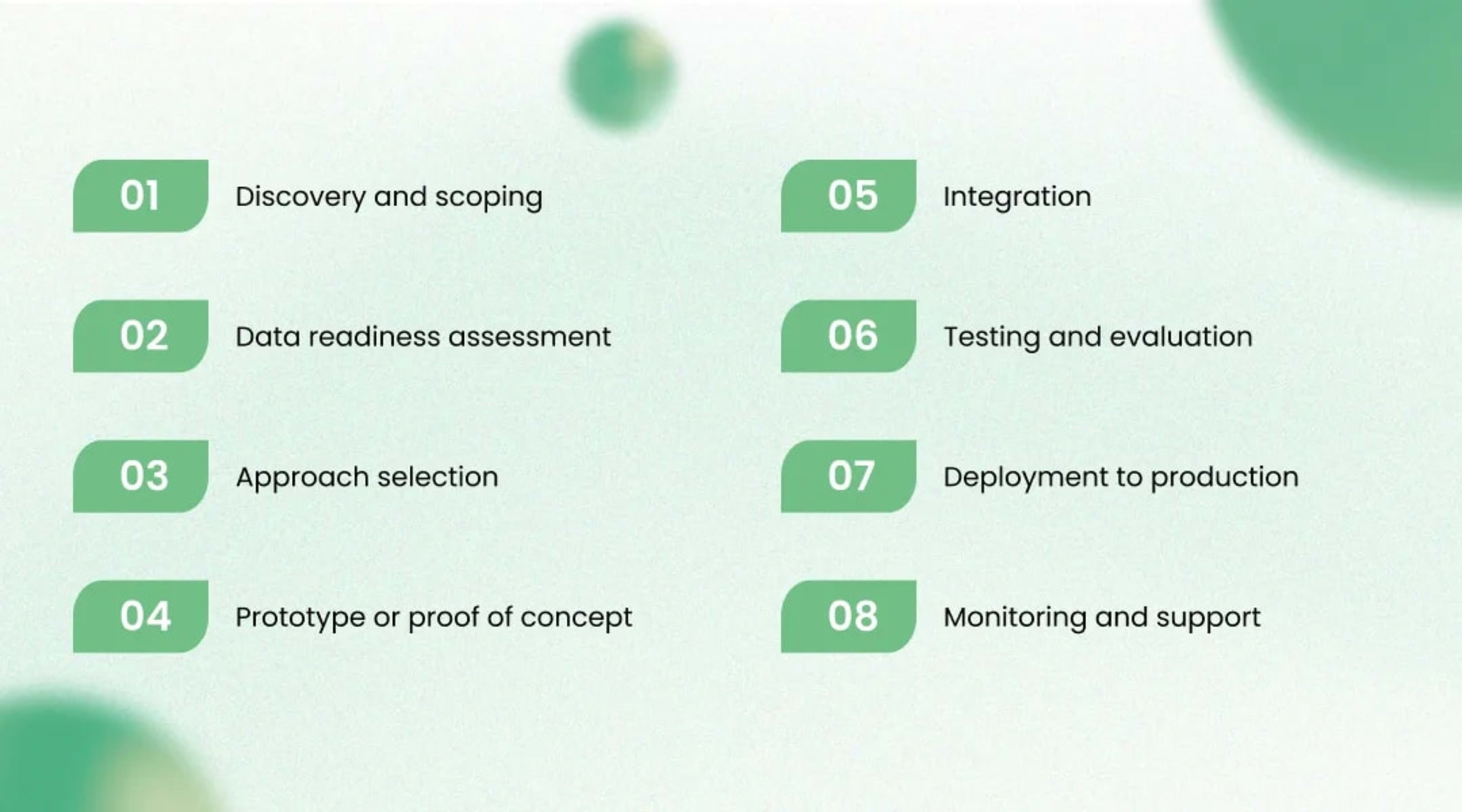
Most AI development projects move through the same pipeline: discovery, data preparation, model building, integration, deployment, and ongoing monitoring. Understanding this sequence helps you spot a partner who skips steps or oversells the easy parts. It also tells you where your own time and data will be needed.
Here is the end-to-end flow a typical engagement follows:
Discovery and scoping. The team clarifies the business problem, the success metric, and the constraints before writing any code.
Data readiness assessment. They check whether you have enough clean, relevant data, since data quality shapes everything downstream.
Approach selection. The team decides between integrating an existing model, applying retrieval-augmented generation (RAG), fine-tuning a model, or building one from scratch.
Prototype or proof of concept. A narrow version proves the idea works before a larger investment.
Integration. The system connects to your software, databases, and internal tools through APIs and connectors.
Testing and evaluation. The team measures accuracy, adds guardrails, and often keeps a human in the loop for sensitive decisions.
Deployment to production. The system goes live in a secure, monitored environment.
Monitoring and support. Ongoing MLOps work tracks performance, retrains as data drifts, and fixes issues.
Steps one, two, and eight are where weaker vendors cut corners. A partner who wants to jump straight to model building without understanding your data is a warning sign, not a time-saver.
What separates the best AI development company from an average one
The best AI development company proves its value through production experience, domain knowledge, and honest communication, not through buzzwords or the longest capability list. When people compare providers, they often focus on team size or review counts, which say little about whether a vendor can solve your specific problem. The signals below are far more predictive of a good outcome.
What to look for | Why it matters | Question to ask |
Production track record | Demos are easy; running AI reliably at scale is hard | "What have you shipped that is live today, and what did it change?" |
Domain experience | Fraud detection and clinical tools need different knowledge | "What projects have you delivered in my industry?" |
Data and MLOps maturity | Models drift, so monitoring and retraining are essential | "How do you handle a model that underperforms after launch?" |
Compliance and AI governance | Regulated work needs auditability and clear controls | "How do you handle GDPR, HIPAA, or our sector's rules?" |
Communication and process | AI projects are iterative and uncertain by nature | "Who works on my project, and how will you report progress?" |
Post-deployment support | Value comes after launch, not at handover | "What does ongoing support and retraining include?" |
The clearest signal is delivered work, so ask any shortlisted vendor for case studies that connect the technical work to a measurable business result. If you want a sense of what that looks like in practice, you can see our AI portfolio and judge the outcomes for yourself. Patterns across several projects tell you more than any single polished example.
In-house team, freelancer, or AI development agency: which fits you
An AI development agency is usually the right choice when you need production-grade systems quickly but do not have a full in-house AI team, while freelancers fit small, well-defined tasks and in-house hires fit long-term core intellectual property. Most lists of top AI development companies skip this decision, but it shapes everything that follows. Getting the model of engagement right often matters more than the specific vendor.
Option | Best for | Trade-offs |
In-house team | Long-term products where AI is your core advantage | Slow and expensive to hire; hard to staff every skill |
Freelancer or contractor | Small, clearly defined tasks and quick experiments | Limited capacity; little support after delivery |
Specialized agency | Production systems built fast without a standing team | Requires clear scope and good vendor selection |
Many companies blend these over time. A common path is to hire an agency to build and launch the first system, then bring maintenance in-house once the value is proven. There is no universal right answer, only the one that matches your timeline and internal capacity.
How much AI development costs and what drives the price
AI development costs depend far more on scope, data quality, and integration complexity than on any published day rate, so treat fixed price tags with caution. A simple integration of an existing model sits at the low end, while a custom model with heavy data preparation and multiple integrations sits much higher. As a general pattern, a focused proof of concept can take a few weeks, and a production system often runs a few months.
The main cost drivers are worth knowing before you ask for a quote:
Data preparation. Messy or missing data is the most common source of budget overruns.
Model approach. Using an existing model through an API is cheaper than fine-tuning or training from scratch.
Integration depth. Connecting to legacy systems and many data sources adds real work.
Ongoing costs. Hosting, monitoring, and periodic retraining continue after launch.
Teams searching for an AI software company near me often weigh a nearby vendor against a specialized offshore partner, and both can work. What matters is transparency, not location. A trustworthy partner breaks the numbers out clearly rather than hiding maintenance behind a low headline price.
Different projects also call for different commercial structures:
Engagement model | How you pay | Best when |
Fixed price | One agreed sum for a defined scope | Requirements are clear and unlikely to change |
Time and materials | Hourly or by sprint | Requirements may shift as you learn |
Dedicated team | Monthly for a committed team | Long-term work needing consistent capacity |
Red flags: how to spot AI hype before you sign
The biggest red flag in vendor selection is a partner who promises certainty, because real AI work involves experimentation, iteration, and honest talk about what might not work. Some firms lean on impressive language while avoiding specifics, and the gap usually shows up mid-project. Watching for these signs early saves money and frustration.
Vague, confident answers to pointed technical questions
No case studies with quantifiable results in your industry
Reluctance to discuss data requirements or limitations
A quote that looks far cheaper than everyone else, which often hides maintenance costs
Pressure to sign before a discovery call or data assessment
Claims of guaranteed accuracy before seeing your data
Pay attention to how a vendor talks about failure. A team that can explain, plainly, what happens when a model underperforms is usually one that has shipped real systems.
What an AI development company can't do
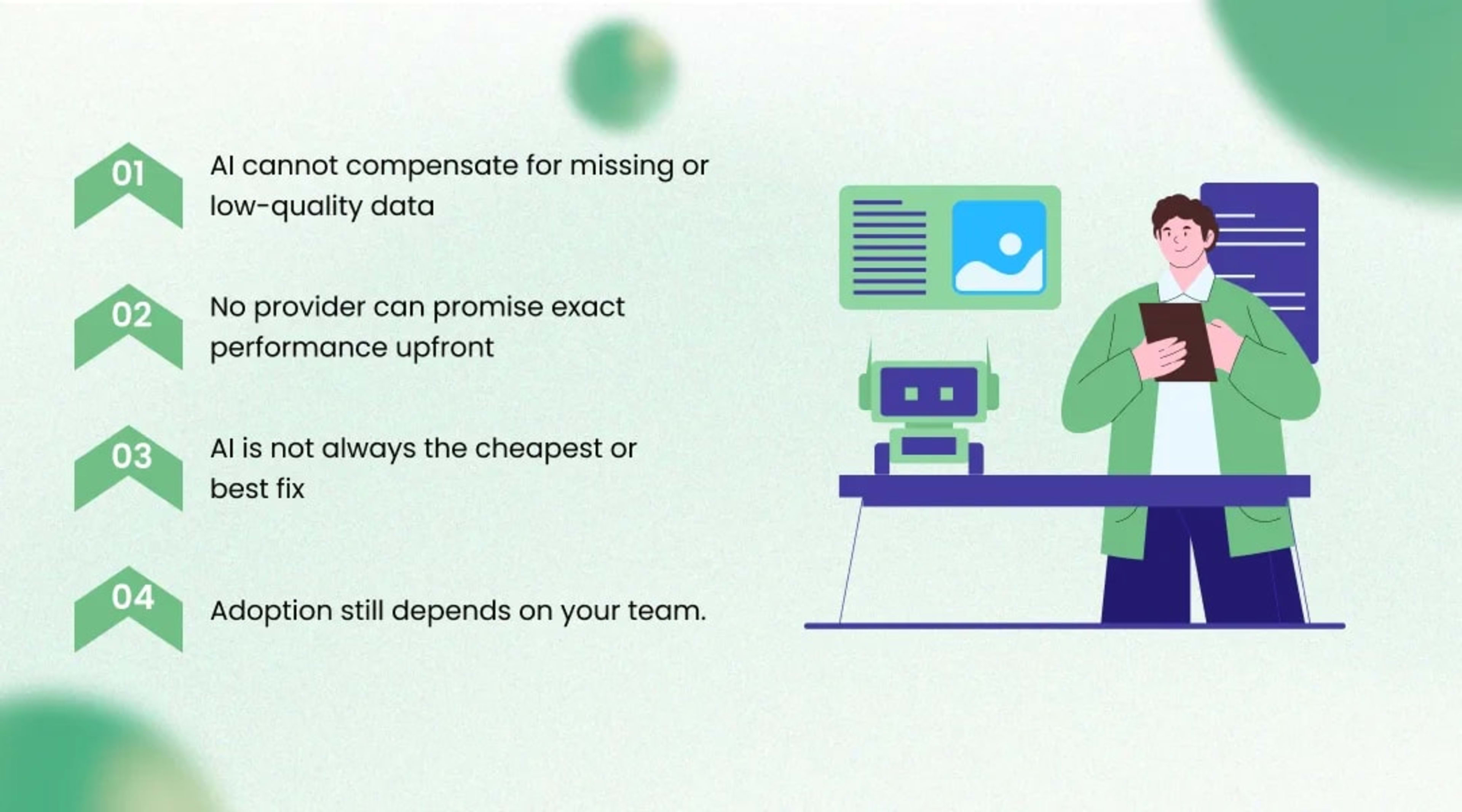
Even the best AI partner cannot fix bad data, guarantee a specific accuracy number in advance, or make AI the right answer for every problem. These limits are not a knock on any provider; they are the nature of the technology. Knowing them protects you from disappointment and from vendors who pretend otherwise.
A few honest boundaries are worth stating clearly:
AI cannot compensate for missing or low-quality data. Without enough clean, relevant data, results stay weak regardless of the team's skill.
No provider can promise exact performance upfront. Reputable partners commit to an evaluation process, not a guaranteed number before the work begins.
AI is not always the cheapest or best fix. Some problems are solved better with simple automation or a rules-based system, and a good partner will tell you so.
Adoption still depends on your team. A working model delivers little if internal processes are not redesigned around it, which is a large part of why so many pilots stall.
If your problem is small, one-off, or clearly rules-based, a full AI development engagement may be more than you need. Being honest about that upfront is itself a sign of a partner worth trusting.
Why businesses choose KriraAI as their AI development partner
Businesses choose KriraAI when they want an India-based AI development partner that ships production systems, works across many industries, and stays involved after launch. The company is headquartered in Ahmedabad and was founded by Divyang Mandani, with more than 50 partnerships and delivery experience spanning over 22 industry verticals. That breadth means the team has usually seen a problem close to yours before.
The technical depth sits in modern agentic tooling rather than a single framework. KriraAI builds on LangChain, LangGraph, CrewAI, AutoGen, LlamaIndex, and the Model Context Protocol, and works with models including Claude and GPT-4 across AWS, GCP, and Azure. For teams operating in India, the multilingual capability across English, Hindi, Gujarati, Tamil, and Marathi is a practical advantage for real customer-facing systems.
The engagement itself is structured rather than open-ended, with a defined multi-step delivery process and published timelines so you know what to expect. The company's core work spans AI agent development, custom AI software, and consulting, and you can explore the full range through KriraAI AI development services. This matters in a market where India's technology sector is projected to reach roughly 315 billion dollars in FY26, with AI revenue of 10 to 12 billion dollars, according to NASSCOM's 2026 strategic review.
KriraAI is not the right fit for everyone. If you need a single afternoon's script or a throwaway experiment, a freelancer will likely serve you better and cheaper. The team is built for businesses that want a production system and a partner for the long run, not a quick one-off.
The bottom line
The best AI development partner is the one that understands your problem, ships working systems, and stays honest about trade-offs, not the one with the flashiest pitch. Use a clear process: define the problem, evaluate a few finalists on production evidence, match the engagement model to your needs, and watch for anyone who promises certainty. The technology is powerful, but the partnership is what determines whether it delivers.
If you have a use case in mind and want a candid assessment of whether AI is the right fit, book a free consultation with the KriraAI team and start with a plan rather than a guess.
FAQs
There is no single best AI development company for everyone, because the right partner depends on your problem, industry, data maturity, and budget. The strongest vendors share common traits: real production experience, clear communication, and honesty about limits. Evaluate two or three finalists against your specific use case before you decide.
Define your problem and success metric first, then shortlist three to five vendors and ask each for case studies with measurable outcomes in your industry. Use a discovery call to test how they handle data gaps and underperforming models. Verify their claims through references and independent reviews before signing anything.
Cost depends on scope, data quality, and integration complexity rather than a fixed rate, so a small proof of concept costs far less than a fully integrated production system. Ask for a written proposal that separates the build, data preparation, and ongoing support. Be cautious of any quote that looks suspiciously low, since it often hides the cost of maintenance.
Timelines vary with complexity, but a focused proof of concept often takes a few weeks while a production-grade system usually runs a few months. Data readiness is the single biggest factor, since clean, labeled data speeds everything up. A vendor who promises a complex build in days is usually cutting corners somewhere.
Yes, small businesses can afford AI development by starting with a narrow, high-value use case instead of a broad platform. Integrating an existing model through an API costs much less than training a model from scratch. Many partners offer proof of concept engagements so you can validate the value before committing to a full build.
Most AI development firms integrate with existing systems through APIs, connectors, and modular deployment rather than replacing your stack. They can add an AI layer to legacy software and connect to your databases, CRMs, and internal tools. Ask about their experience with your specific platforms during the discovery call.
Ownership should be defined in writing before the project starts, and a responsible partner hands over full code, model artifacts, documentation, and credentials at the end. Confirm that your proprietary data will not be used to train models for other clients. Clear intellectual property terms protect you from vendor lock-in.
A mature partner plans for underperformance with evaluation criteria, monitoring, and a retraining process rather than treating launch as the finish line. Models drift as real-world data changes, so ongoing tuning is normal. Ask what triggers a model refresh and what post-deployment support is included.
You do not need perfect data, but you should be honest about its state, because a good partner runs a data readiness assessment early. Hiding data quality problems almost always causes expensive surprises mid-project. If your data is thin, the partner can advise on collection, cleaning, or an alternative approach.
Founder & CEO
Divyang Mandani is the CEO of KriraAI, driving innovative AI and IT solutions with a focus on transformative technology, ethical AI, and impactful digital strategies for businesses worldwide.