Here's the number that changed my mind about AI copilots: according to Gartner, 40% of enterprise applications will include task-specific AI agents by the end of 2026 - up from less than 5% in early this year. That's not a forecast for the distant future. That's happening right now, inside your competitors' workflows.
I'll be honest. Five years ago, if you'd told me a corporate AI copilot would become essential infrastructure for businesses, I'd have laughed. I was a backend developer who'd seen too many "revolutionary" tools flame out after the pilot phase. But after leading 30+ AI copilot deployments at KriraAI across startups, mid-market firms, and enterprise operations — I've stopped laughing and started paying very close attention.
This article breaks down what an AI copilot for business actually does (minus the jargon), where it delivers real value for both enterprises and startups, and the honest tradeoffs nobody talks about. If you're evaluating whether this technology fits your operation, I wrote this for you.
A corporate AI copilot is an AI-powered assistant embedded directly into your business workflows that understands context, takes action, and learns from your organization's data — not just the public internet.
Think of it as the difference between a search engine and a colleague who already knows your company. You don't ask generic questions. You say, "Pull last quarter's churn data, compare it against our onboarding changes, and draft a summary for the leadership meeting." And it does.
Under the hood, an enterprise AI copilot solution combines natural language processing, your company's proprietary data (CRM, ERP, internal docs), and workflow automation into a single interface. The copilot interprets what you need, retrieves relevant information, and either completes the task or presents options - all within the tools your team already uses.
Three forces are converging that make this unavoidable:
Rising operational complexity. As businesses scale, the number of tools, data sources, and cross-functional dependencies multiplies. Employees spend more time searching for information than acting on it. McKinsey estimates that knowledge workers spend nearly 20% of their week just looking for internal information.
Demand for speed. Customers expect faster responses. Leadership expects faster decisions. Your competitors - at least 51% of enterprises, according to G2 research, already have AI agents running in production environments. Waiting is a competitive risk.
Competitive pressure. Gartner forecasts worldwide AI spending will reach $2.5 trillion in 2026. Companies not investing in business AI automation tools aren't "cautious." They're falling behind.
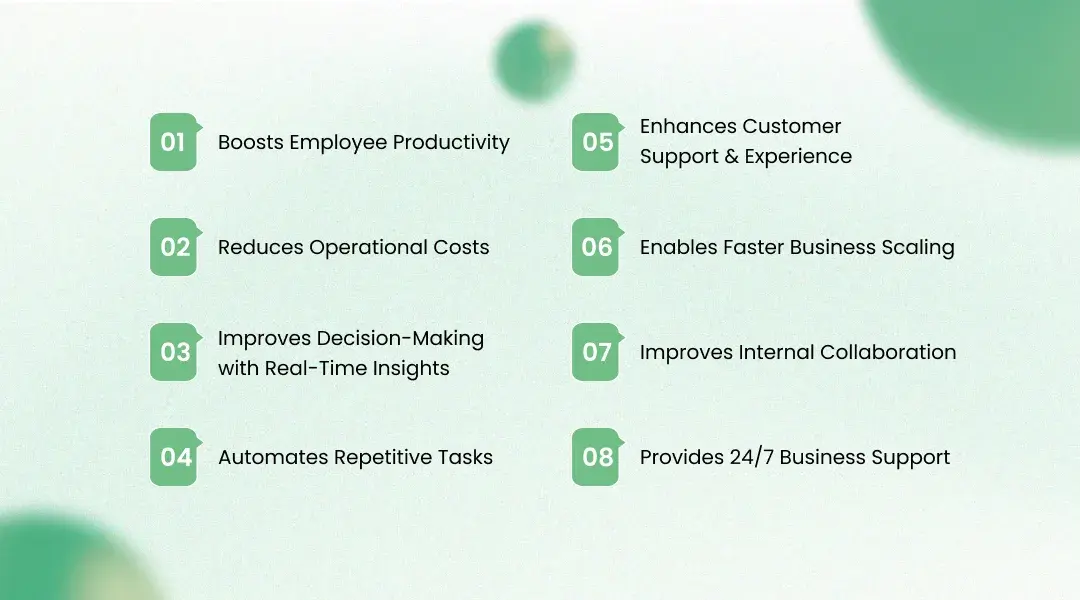
Microsoft's early Copilot access data found users saving an average of 1.2 hours per week. At 1,000 employees, that's 1,200 recovered hours weekly. Those aren't theoretical — they're hours previously lost to searching, summarizing, and formatting.
An AI copilot for enterprises doesn't just speed things up; it replaces the need for certain tasks entirely. Analyst models show well-executed copilot deployments can yield up to 450% ROI over three years, that's $4.50 returned for every $1 invested.
Instead of waiting for a weekly dashboard, you ask a question in natural language: "Which product line had the highest margin decline this month?" The copilot queries your data warehouse and responds in seconds. Decisions get faster because the bottleneck — data access - disappears.
Meeting summaries. Status report drafts. Data entry validation. Invoice categorization. A corporate AI assistant handles these on autopilot, freeing your team for work that actually requires human judgment.
AI copilots integrated into support workflows can resolve common queries instantly, surface relevant knowledge base articles, and pre-populate agent screens with customer context — cutting first-response times dramatically.
Scaling doesn't have to mean proportionally scaling headcount. With an enterprise AI assistant handling process-heavy work, a three-person team can now operate at the output level that previously required eight.
When a copilot tracks action items across meetings, assigns follow-ups, and surfaces relevant documents before anyone asks, collaboration shifts from administrative coordination to actual thinking.
Your copilot doesn't clock out. For globally distributed teams or businesses with customers across time zones, that always-on availability isn't a luxury. It's a requirement.
Dimension | Traditional Automation (RPA, Rule-Based) | Corporate AI Copilot |
Input type | Structured, predefined rules | Natural language, unstructured data |
Adaptability | Breaks when inputs change | Learns and adapts from context |
Scope | Single-task, single-system | Cross-system, multi-step workflows |
Setup | Heavy developer involvement | Low-code or natural language config |
Intelligence | None — executes scripts | Understands intent, makes decisions |
Traditional automation follows scripts. An AI copilot for business understands goals. That's not a subtle distinction, it's the difference between a calculator and a colleague.
Customer Support Automation
A SaaS company I worked with at KriraAI deployed a copilot that resolved 60% of Tier-1 support tickets without human intervention, handling account questions, billing inquiries, and feature guidance in real time.
Sales & Lead Management
Copilots score leads, draft personalized outreach, and surface deal-risk signals from CRM data. Sales teams spend less time on admin and more time closing.
HR & Employee Assistance
From answering policy questions ("How many sick days do I have left?") to generating offer letters, AI copilots reduce HR's administrative burden by 30–40% in our deployments.
Finance & Reporting
Automated report generation, anomaly detection in expense data, and natural-language queries against financial databases. What used to take an analyst half a day now takes minutes.
Operations & Workflow Automation
Inventory forecasting, vendor communication drafts, logistics tracking summaries - the copilot handles the coordination layer so operations teams focus on exceptions, not routine.
Let me tell you something counterintuitive: AI copilots might matter more for startups than enterprises.
Cost efficiency. Startups can't hire for every function. An AI copilot for startups acts as a force multiplier - your four-person team operates like twelve.
Faster growth. Speed is a startup's only real advantage. When your copilot handles onboarding docs, investor update drafts, and customer analytics, founders spend time on strategy instead of spreadsheets.
Lean team advantage. I've seen a 6-person SaaS startup use a custom copilot to manage customer success, internal knowledge, and board reporting — work that would've required 3 additional hires. That's not theory. That's a real deployment we built at KriraAI.
When you have 5,000 employees generating reports, processing requests, and coordinating across departments - even a 10% efficiency gain translates to hundreds of recovered FTEs.
Enterprise AI copilot solutions identify bottlenecks humans miss. One of our Enterprise AI Assistant development services projects uncovered that a manufacturing client's procurement approval workflow had 4 redundant steps - the copilot flagged it within its first week of deployment.
Enterprises don't lack data. They lack accessible data. A copilot that sits on top of your data lake and responds to plain-English questions turns every manager into a data-informed decision-maker.
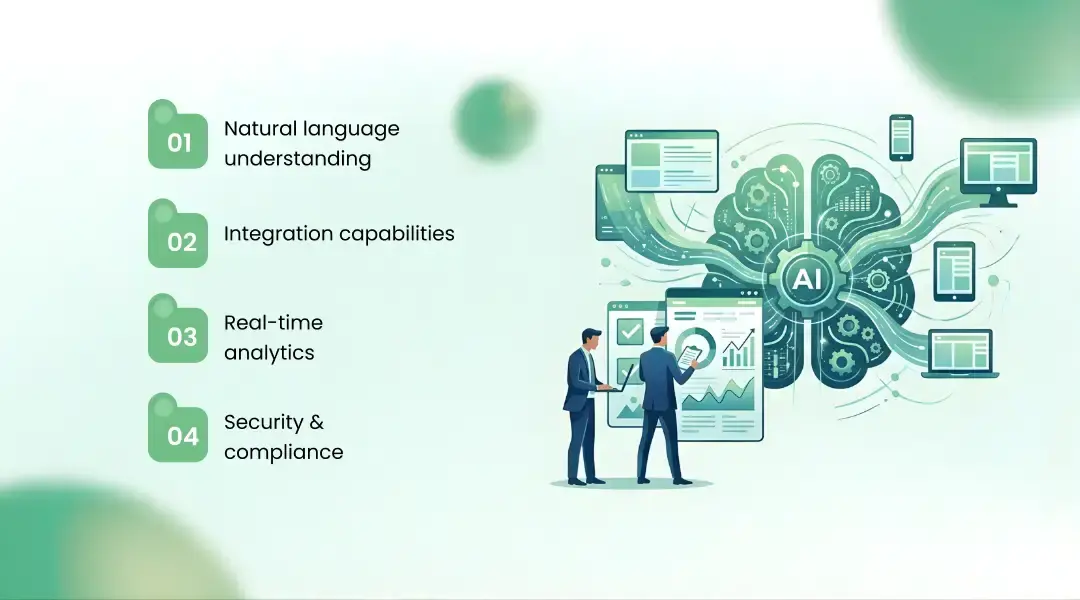
Before you sign any vendor contract, evaluate these four non-negotiables:
If the copilot can't handle how your team actually speaks - including industry jargon, abbreviations, and messy inputs - it's a toy, not a tool.
Your copilot must connect to your existing CRM, ERP, HRMS, communication tools, and databases. If it requires you to move to a new ecosystem, walk away. The best AI development company will build around your stack, not force you onto theirs.
A copilot that takes 30 seconds to retrieve data is just a slower version of your current process. Sub-second response times on structured queries is the minimum.
Your copilot sits on proprietary data. It must support role-based access, data encryption, audit logs, and compliance with regulations relevant to your industry — GDPR, HIPAA, or India's DPDP Act, depending on your context.
I'd be doing you a disservice if I didn't flag the hard parts.
Your copilot processes sensitive business data. If your vendor can't clearly explain where your data goes, how it's stored, and who has access - that's a dealbreaker.
Legacy systems with inconsistent APIs make copilot deployments harder and slower. Budget 2–4 extra weeks for integration testing in environments with heavy technical debt. (Most vendors underestimate this. We don't.)
The biggest risk isn't the technology failing, it's your team ignoring it. Change management matters. Train early, celebrate small wins, and let power users become internal champions.
A corporate AI copilot isn't a novelty feature. It's infrastructure. The AI copilot benefits for both enterprises and startups are measurable: productivity recovery, cost reduction, faster decisions, and the ability to scale without proportionally scaling headcount.
Three things to remember: first, copilots work best when they're embedded into your existing workflows, not layered on top as another tool to manage. Second, the ROI compounds — early deployments at KriraAI consistently show 40%+ improvement in year one, with gains accelerating in year two. Third, the startups and enterprises winning with AI aren't the ones with the biggest budgets. They're the ones that started with a specific, well-scoped problem and expanded from there.
If you're exploring how a custom AI copilot fits your operation - not a generic chatbot, but a system trained on your data, connected to your tools, and designed for your team — talk to KriraAI. We'll tell you honestly whether it makes sense for your business. And if it doesn't yet, we'll tell you that too.
A corporate AI copilot is an AI assistant integrated into business tools that understands natural language, accesses your company's data, and completes tasks like generating reports, answering queries, and automating workflows. It combines natural language processing with your proprietary systems — CRM, ERP, and internal docs — to provide context-aware assistance specific to your organization, not generic internet responses.
AI copilots reduce costs by automating time-intensive tasks like report generation, data entry, meeting summaries, and Tier-1 support. Studies show well-executed deployments can yield up to 450% ROI over three years. The savings come from reduced reliance on external contractors, lower operational overhead, and recovered employee hours redirected toward higher-value work.
Yes, arguably more so than for large enterprises. A startup with 5–10 people can't hire for every function. An AI copilot acts as a force multiplier, handling customer success, internal knowledge management, investor reporting, and analytics work that would otherwise require additional hires. Most startups see meaningful ROI within 3–6 months when the copilot is scoped to their highest-volume workflows.
Four non-negotiables: natural language understanding (handling jargon and messy inputs), deep integration with your existing stack (CRM, ERP, HRMS), real-time analytics with sub-second response times, and enterprise-grade security including role-based access, encryption, audit logs, and regulatory compliance (GDPR, HIPAA, or DPDP Act depending on your market).
Traditional automation follows rigid, predefined scripts and breaks when inputs change. A corporate AI copilot understands intent, adapts to context, works across multiple systems, and handles unstructured input like natural language. RPA is a calculator — it executes what you program. An AI copilot is a colleague — it understands what you need and figures out how to deliver it.
Founder & CEO
Divyang Mandani is the CEO of KriraAI, driving innovative AI and IT solutions with a focus on transformative technology, ethical AI, and impactful digital strategies for businesses worldwide.