Businesses running outbound call operations spend an average of $1.20 to $1.50 per minute on human agent time when fully loaded costs are accounted for, including wages, management overhead, training, attrition, and infrastructure. An AI-powered automated calling software deployment, fully productionised, operates at $0.05 to $0.12 per minute at scale. That cost gap is not incremental. It is structural, and it is why the global conversational AI market is projected to exceed $32 billion by 2027, with outbound call automation representing one of its fastest-growing segments.
Yet most organisations that evaluate automated calling software either purchase underpowered tools that fail in production or overinvest in platforms that require years of configuration before delivering value. The gap between what vendors promise and what actually works in a live calling environment comes down to one factor: technical architecture. A robocall dialler is not automated calling software. A scripted IVR with pre-recorded messages is not automated calling software. True automated calling software is a production AI voice agent system that listens, understands, reasons, responds naturally, integrates with your data systems, and handles real-world conversational variability at scale.
This guide covers everything a decision-maker or technical evaluator needs to know: how the technology works at an architectural level, what separates performant systems from brittle ones, how to evaluate vendors, what implementation actually requires, and how to measure success with honest numbers.
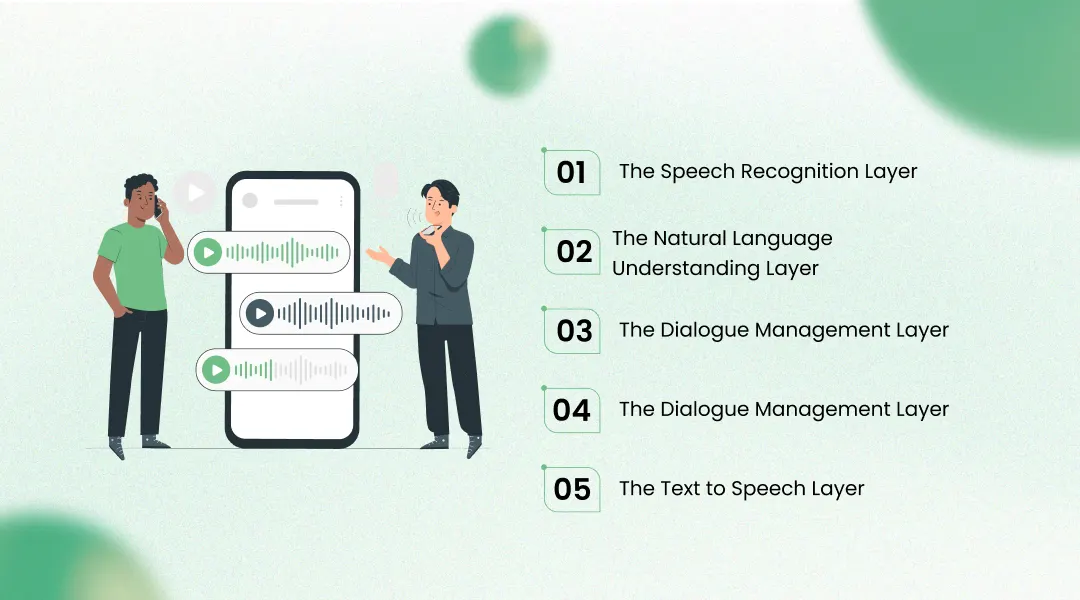
Automated calling software is not a single technology. It is a pipeline of interconnected systems that must each perform within tight latency and accuracy budgets for the overall call experience to feel natural and for the automation to deliver its intended business outcome.
When a called party speaks, the system must convert that audio to text quickly and accurately. This is the automatic speech recognition layer, and it is where many lower-cost automated calling platforms fail in practice. The two dominant ASR architectures used in production voice agent systems are RNN-T (Recurrent Neural Network Transducer) and Conformer-based hybrid CTC models. RNN-T models provide strong streaming performance, meaning they can produce word-by-word transcription in real time rather than waiting for the speaker to pause, which is critical for low-latency calling scenarios. Conformer models, which combine convolutional local feature extraction with transformer-based global attention, achieve state-of-the-art word error rates on general speech but carry a higher computational cost per inference.
For automated calling software specifically, the choice of ASR architecture must account for two constraints that general-purpose speech recognition ignores. First, telephone audio arrives over narrowband or wideband codecs, typically G.711 or G.729, sampled at 8 kHz rather than the 16 kHz that most consumer ASR models are trained on. A model not adapted for telephone audio will show significantly degraded accuracy on real call audio. Second, the vocabulary relevant to any specific calling use case, whether it is appointment confirmation, insurance renewal and debt collection calls, or lead qualification, contains domain-specific terminology that general ASR models have seen rarely or not at all in their training data. Production deployments need ASR models fine-tuned or adapted with domain vocabulary to achieve word error rates below 8%, which is the practical threshold for downstream NLU to function reliably.
Once the caller's speech is transcribed, the system must understand what the caller actually means. This is the natural language understanding layer, and the architectural choice here has the largest single impact on the capability ceiling of the automated calling software.
Older automated calling systems used rule-based intent matching, essentially checking whether specific keywords appeared in the transcript. These systems are brittle and fail whenever callers deviate from expected phrasings. Modern systems take one of three approaches. Fine-tuned transformer classifiers, based on BERT or RoBERTa, can achieve intent classification accuracy above 93% on well-defined intent taxonomies with sufficient training data, and they run inference in under 20 milliseconds on GPU hardware. Zero-shot LLM-based classifiers, using models in the 7B to 13B parameter range, offer much broader intent coverage without task-specific training data, but they add 200 to 400 milliseconds to the response latency depending on hardware configuration. Hybrid approaches, which use a fast fine-tuned classifier as a first-pass filter and invoke an LLM only for out-of-distribution inputs, represent the current production best practice for automated calling software that needs to handle both common and unexpected conversational moves.
The dialogue management layer determines what the system does next, given the current state of the conversation and the understood intent. This is where the difference between sophisticated automated calling software and a glorified IVR system becomes most visible.
Finite state machine dialogue managers, which define every possible conversation path as an explicit graph of states and transitions, are predictable and auditable but break completely when callers take unexpected paths. Frame-based dialogue managers, which track conversation slots that need to be filled regardless of the order in which the caller provides information, handle a more natural conversation flow but still require explicit definition of every conversation goal. LLM-based dialogue managers, where a large language model with a carefully constructed system prompt manages the full conversation context and generates the next conversational move, offer the most natural interaction but require careful prompt engineering, output validation, and fallback logic to prevent hallucination or off-topic responses in a live calling environment.
The best production implementations of automated calling software use a structured combination: a frame-based or goal-directed manager as the outer structure, with LLM generation used for natural language response formulation within each state, constrained by output schemas that prevent the system from generating responses that deviate from the permitted set of conversational actions.
The response generated by the dialogue manager must be converted to audio and played back to the caller. Neural TTS systems have advanced dramatically, with VITS (Variational Inference with adversarial learning for end-to-end Text-to-Speech) and related architectures producing voice quality that is genuinely difficult for most people to distinguish from a human speaker in a telephone audio context. The key performance parameter for automated calling software is TTS latency, specifically the time from when the first character of the response text is available to when the first audio chunk begins streaming to the caller.
Streaming TTS, where audio is synthesised and transmitted in overlapping chunks rather than waiting for the entire response to be synthesised before playback begins, reduces perceived latency to under 200 milliseconds for the first word of each response, even for responses that take 400 to 600 milliseconds to fully synthesise. Voice persona design matters for automated calling software in a way that it does not for text chatbots. The caller forms an immediate impression of the brand and the call's legitimacy based on voice characteristics. Custom voice cloning, built on a sample of target voice recordings using YourTTS or proprietary voice cloning systems, allows organisations to define a consistent, recognisable voice persona across all automated calls.
The telephony layer is where automated calling software connects to the actual phone network. Production systems use SIP (Session Initiation Protocol) trunks to connect AI agent infrastructure to the PSTN (Public Switched Telephone Network), with media streamed over RTP (Real-time Transport Protocol). The major cloud telephony platforms, including Twilio, Vonage, Amazon Connect, and Genesys Cloud, all expose SIP or WebRTC interfaces that AI voice agent frameworks can connect to.
The critical architectural concern at the telephony layer is concurrency. A deployment handling 500 simultaneous outbound calls requires the AI pipeline to process 500 concurrent audio streams, each running ASR, NLU, dialogue management, and TTS in real time. This demands careful capacity planning, stateless pipeline design so that individual call sessions can be load-balanced across compute nodes, and circuit-breaker patterns that gracefully handle backend system failures without dropping live calls.
The end-to-end latency of an automated calling software system, measured as the time between when the caller finishes speaking and when the AI agent begins its response, is the single technical metric that most directly determines whether the call feels like a natural conversation or an awkward robotic interaction.
Human conversational latency, the time between one person finishing a sentence and another beginning their response, typically falls between 200 and 350 milliseconds in natural dialogue. Latencies above 700 milliseconds are perceived as uncomfortable pauses that signal something is wrong with the call. Latencies above 1,500 milliseconds cause callers to begin speaking again, thinking the system has not heard them, which creates cascading recognition errors.
A well-engineered automated calling software pipeline can achieve end-to-end response latencies of 400 to 600 milliseconds. This breaks down approximately as follows:
ASR streaming transcription finalisation: 80 to 150 milliseconds after the end of speech detected
NLU inference (fine-tuned classifier): 15 to 25 milliseconds
Dialogue management decision: 30 to 60 milliseconds (more for LLM-based generation)
TTS first chunk generation and streaming: 150 to 250 milliseconds
Network and codec overhead: 20 to 50 milliseconds
LLM-based response generation, if not carefully optimised, is the primary source of latency overruns. A 7B parameter model generating a 30-token response on a single A100 GPU takes approximately 300 to 450 milliseconds. Teams at KriraAI, which designs and deploys production-grade AI voice agent systems for enterprise clients, address this through response caching for common conversational moves, parallel generation of likely next responses during the caller's speech window, and strict response length budgets that prevent the LLM from generating verbose responses that add unnecessary synthesis time.
Buying automated calling software requires evaluating along six dimensions that vendor marketing materials routinely obscure or misrepresent.
A vendor demonstration using a cooperative, script-following caller proves almost nothing about how the system performs in production. Evaluate automated calling software using adversarial test calls that include:
Simultaneous speech, where the caller and agent speak at the same time
Mid-sentence topic changes and non-sequitur responses
Accented speech and regional dialect variation
Background noise typical of the caller's environment (traffic, office noise, children)
Caller requests to speak with a human
Questions the system was not designed to handle
Track word error rate on these test calls, intent classification accuracy, task completion rate, and escalation rate. Any vendor that cannot provide these metrics from production deployments should be treated with significant scepticism.
Automated calling software that cannot retrieve caller data before the call begins, look up account information mid-call, update CRM records in real time based on call outcomes, and trigger downstream workflows upon call completion is not genuinely useful for enterprise operations. Evaluate the integration layer carefully.
Specifically assess whether the system supports: pre-call data hydration from CRM or contact database APIs, mid-call lookup with sub-300-millisecond response time requirements, webhooks or event streaming for real-time call event publication, post-call transcript storage with structured data extraction, and native connectors to your existing telephony platform and CRM the same integration depth covered in KriraAI's guide to AI voice agents in logistics, where dispatch and CRM integrations follow an identical pattern.
Every automated calling software deployment will encounter callers who need or demand a human agent. The quality of the escalation experience, specifically how quickly and gracefully the system identifies the need to escalate, summarises the conversation for the receiving agent, and transfers the call, is a critical success factor. Evaluate escalation latency, warm transfer versus cold transfer capability, and whether the system passes a structured conversation summary to the human agent.
Outbound calling is subject to regulations,s including the Telephone Consumer Protection Act in the United States, GDPR call recording requirements in Europe, and sector-specific regulations in financial services and healthcare. Evaluate whether the automated calling software includes built-in consent management, do-not-call list integration, call recording with appropriate retention and access controls, and audit logging sufficient to demonstrate regulatory compliance.
Organisations with dedicated AI engineering teams often consider building automated calling software on open-source components. A realistic build assessment should account for:
6 to 12 months of engineering time to build a production-ready pipeline (typically 3 to 5 senior engineers)
Ongoing model fine-tuning and dialogue optimisation as call patterns evolve
Infrastructure cost of GPU compute for real-time inference at scale
Telephony platform integration and ongoing maintenance
Quality monitoring, conversation analytics, and continuous improvement tooling
Most organisations find that purpose-built automated calling software from a specialist vendor, or a deployment partnership with a company like KriraAI that brings production AI voice agent engineering to the engagement, delivers faster time-to-value at lower total cost than a fully bespoke build for all but the highest-scale, most differentiated use cases.
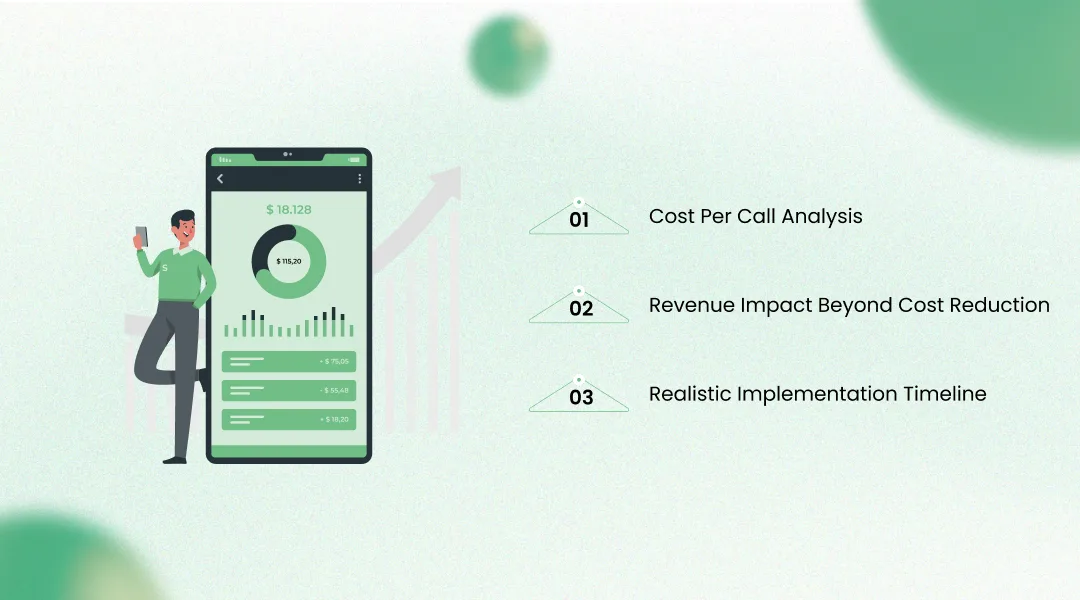
The financial case for automated calling software is well-established in aggregate, but the specifics depend heavily on use case, call volume, and baseline operating cost. Decision-makers should build their business case around realistic numbers from comparable deployments rather than vendor-supplied optimistic projections.
A human agent handling outbound calls at a blended cost of $18 per hour, including all overhead, can complete approximately 20 to 25 calls per hour in a dialling operation with reasonable contact rates. This yields a cost per completed call of $0.72 to $0.90. An AI automated calling software deployment, including platform cost, telephony, compute, and management overhead, typically operates at $0.08 to $0.20 per completed call, depending on call duration and platform pricing. For a calling operation completing 10,000 calls per month, this represents a monthly saving of $5,200 to $8,200 at mid-range estimates, or $62,000 to $98,000 annually.
For organisations running high-volume outbound operations, the numbers scale proportionally. A centre completing 100,000 outbound calls per month can realistically target savings of $600,000 to $900,000 annually after full implementation costs are accounted for. These figures assume the AI system achieves comparable task completion rates to human agents, which requires a well-designed and properly implemented system.
Automated calling software generates revenue impact beyond direct cost reduction through three mechanisms. First, AI agents can call at scale and at times that human teams cannot, including early mornings, evenings, and weekends, increasing contact rates by 15 to 35% in typical outbound campaigns. Second, AI agents are perfectly consistent in following approved scripts and compliance requirements, eliminating the variability that human agents introduce and reducing regulatory risk. Third, AI agents never experience fatigue, mood variation, or motivation issues, which means their performance on the 500th call of the day is identical to their performance on the first call, an advantage that compounds significantly in high-volume appointment scheduling, payment reminder, and lead qualification programmes, a dynamic explored in depth in KriraAI's breakdown of AI voice agents for fitness businesses, where booking and payment recovery calls follow this exact pattern.
Organisations should plan for90- 90180-day day implementation timeline from contract signature to full production deployment of automated calling software, broken into three phases:
Phase 1 (weeks 1 to 4): Call data analysis, dialogue design, integration architecture, compliance review, and voice persona design
Phase 2 (weeks 5 to 10): System integration, dialogue development, test call programme with escalating call volumes
Phase 3 (weeks 11 to 16): Phased production rollout beginning at 5 to 10% of call volume, performance monitoring, dialogue optimisation, and scaling to full volume
Organisations that attempt to compress this timeline by skipping dialogue testing or phased rollout consistently experience poor production performance, high escalation rates, and caller experience problems that generate customer complaints.
The most expensive mistakes in automated calling software deployments are not technical failures. They are architectural and operational decisions that look reasonable at the time but create persistent performance problems in production.
The dialogue system, specifically the structure of the conversation, the handling of unexpected inputs, the escalation triggers, and the language used in each conversational move, is the most important determinant of call success rates. Organisations that treat dialogue design as a quick configuration task rather than a serious design and testing discipline consistently see task completion rates 25 to 40 percentage points below what a well-designed system achieves. Invest heavily in dialogue design, use recordings from human agent calls to inform realistic conversation modelling, and plan for three to five iterations of dialogue refinement after initial production deployment before the system reaches its performance ceiling.
A production automated calling software deployment must handle everything gracefully, including ASR failures, backend system timeouts, callers who speak a language the system does not support, callers who become abusive or distressed, and regulatory scenarios that require specific language or disclosures. Every one of these scenarios needs an explicit fallback path that either provides a graceful recovery or escalates to a human agent without creating a poor caller experience. Teams that focus only on the happy path during design and testing routinely discover these gaps at the worst possible time, during high-volume production calling.
Automated calling software deployments degrade over time if not actively monitored. Caller language patterns evolve. Product offers change. Backend system behaviour shifts. New compliance requirements emerge. Organisations need conversation quality monitoring, including automated scoring of intent recognition accuracy, task completion rates, escalation rates, and call duration distributions, running continuously in production with alerting that triggers human review when metrics shift outside acceptable bounds. KriraAI, which deploys production AI voice agent systems for enterprise clients across multiple industries, treats monitoring and continuous improvement infrastructure as a first-class deliverable in every engagement, not an afterthought.
Automated calling software that achieves its business task but creates a poor caller experience produces short-term results and long-term brand damage. Callers who feel manipulated, confused, or disrespected by an automated call associate that experience with the brand. Caller experience design includes the voice persona, the opening of the call (which has the highest impact on whether the caller stays engaged or hangs up), the pacing and naturalness of the dialogue, and the experience of the 10 to 30% of callers who will escalate to a human. Every element of the caller experience deserves the same design attention as the operational performance metrics.
The automated calling software market includes a wide range of players: horizontal cloud telephony platforms that have added AI calling features, specialised AI voice agent platforms purpose-built for outbound calling, and AI services partners that design and deploy custom voice agent systems on top of best-of-breed components.
For organisations with call volumes above 50,000 calls per month, specific domain requirements that demand custom dialogue design, complex backend integrations, or regulated environments, working with a specialist partner that understands both the technical architecture and the operational realities of high-volume calling delivers significantly better outcomes than self-implementing a horizontal platform. KriraAI works as that kind of partner, bringing the engineering depth to design custom ASR adaptation, dialogue systems, and telephony integration alongside the operational experience to run phased deployments that protect call quality throughout the scaling process.
For organisations with simpler use cases, lower volumes, and strong in-house technical teams, purpose-built automated calling software platforms with pre-built connectors and managed infrastructure can be deployed successfully with less external support. The evaluation framework in the previous section applies regardless of whether the organisation is evaluating platforms for self-implementation or partners for managed deployment.
Performance measurement for automated calling software must go beyond the vanity metrics that most platforms surface by default. The metrics that actually matter are the ones that tie call operation performance to business outcomes.
Operational metrics that every deployment should track include:
Task completion rate: the percentage of calls in which the intended goal (appointment booked, payment arranged, lead qualified) was achieved without human agent involvement
First-call resolution rate: the percentage of calls where the caller's need was fully resolved in the first automated interaction
Escalation rate: the percentage of calls routed to a human agent, and specifically the rate of unplanned escalations driven by system failures versus legitimate caller preference
Average handling time: call duration, which affects both per-call cost and caller experience
Contact rate: the percentage of dialled numbers that result in a live conversation, which reflects dialler logic quality
Business outcome metrics that tie call performance to results include:
Cost per completed task (appointment booked, payment received, lead qualified)
Revenue influenced per automated call hour
Compliance incident rate relative to human agent benchmarks
Customer satisfaction scores are measured through post-call surveys or NPS correlation analysis
A well-implemented automated calling software system with a mature dialogue design should achieve task completion rates of 65 to 80% for well-defined transactional tasks such as appointment confirmation and payment reminders, and 45 to 65% for more complex qualification or sales-assist conversations. Escalation rates in mature deployments should fall below 20% for straightforward use cases.
The three most important things to take from this guide are the following. First, the architecture of automated calling software is not a commodity. The specific choices made at the ASR, NLU, dialogue management, and TTS layers determine whether the system achieves 70% task completion rates or 40%, and whether callers experience natural conversation or uncomfortable robotic interactions. Technical evaluation must go beyond surface-level demos. Second, the business case for automated calling software is real and substantial, but it requires honest assumptions about task completion rates, implementation timelines, and the ongoing investment required to maintain dialogue quality in production. Organisations that build their business case on optimistic vendor projections consistently find themselves managing underperforming deployments against inflated expectations. Third, implementation quality matters more than platform selection. The same platform can deliver dramatically different production outcomes depending on how well the dialogue is designed, how thoroughly the integration is tested, and how rigorously the phased rollout is managed.
KriraAI designs and deploys production-grade AI voice agent systems for enterprise organisations that need automated calling software to work reliably at scale, not just in a proof-of-concept environment. The team brings deep engineering capability across the full voice agent stack, from ASR adaptation and dialogue architecture to telephony integration and production monitoring, combined with the operational experience to run deployments that protect both call quality and business outcomes through every phase of implementation. If your organisation is evaluating automated calling software and wants to discuss your specific use case, call volumes, and technical requirements with engineers who have built these systems in production, reach out to KriraAI to start the conversation.
Automated calling software in the modern AI sense refers to a system that conducts real, two-way voice conversations with called parties using a combination of speech recognition, natural language understanding, dialogue management, and neural text-to-speech synthesis. This is categorically different from a robocaller, which plays a pre-recorded message with no ability to respond to what the called party says, and from a traditional IVR (Interactive Voice Response) system, which only responds to keypad inputs or very narrow voice commands within a rigid menu structure. Modern automated calling software can understand natural speech in full sentences, handle conversational variation, look up caller-specific information in real time, and complete structured tasks such as booking appointments, confirming deliveries, or qualifying sales leads through a natural back-and-forth conversation. The distinction matters enormously for compliance, caller experience, and task completion rates.
Speech recognition accuracy in production automated calling software, measured as word error rate on real telephone audio, typically falls between 5% and 12% for English across a range of accents and audio conditions when the ASR model has been properly adapted for telephone codec audio. Unadapted general-purpose ASR models applied to 8 kHz telephone audio can show word error rates of 18% to 30%, which is too high for reliable downstream intent recognition. Domain adaptation, which involves fine-tuning the ASR model on recorded audio from the specific calling use case using vocabulary and terminology relevant to that domain, typically reduces word error rate by 30 to 50% compared to a generic baseline. For non-English languages and heavily accented speech, additional model adaptation is required and accuracy targets should be validated separately rather than assumed to match English performance.
Compliance requirements for automated calling software vary by country, sector, and use case, and organisations should always obtain specific legal advice for their situation. In the United States, the Telephone Consumer Protection Act (TCPA) regulates outbound automated calls to mobile phones and requires prior express written consent for marketing calls made with an automated telephone dialling system. The FTC's Telemarketing Sales Rule imposes additional restrictions including call time restrictions, do-not-call list compliance, and specific disclosure requirements. In the European Union, GDPR regulates the processing of personal data involved in call operations, including the storage of call recordings and transcripts. Financial services, healthcare, and debt collection each carry additional sector-specific regulatory requirements. Production automated calling software deployments in regulated environments should include built-in consent management, integrated do-not-call list checking before each call, call recording with appropriate access controls and retention policies, and comprehensive audit logging.
A realistic enterprise implementation timeline for automated calling software, from initial project scoping to full production scale, is 90 to 180 days. The range depends on the complexity of backend integrations required, the number of distinct conversation flows the system needs to handle, the regulatory environment, and the internal readiness of the organisation's data and telephony infrastructure. The implementation divides into three phases: a design and integration phase of four to six weeks covering dialogue design, system architecture, and compliance framework; a development and testing phase of five to seven weeks covering system build, integration testing, and a structured test calling programme; and a phased production rollout of four to eight weeks beginning at low call volumes and scaling to full operation while optimising dialogue performance. Organisations that attempt to compress this timeline by skipping dialogue testing or phased rollout consistently experience significantly worse production performance than those that follow a disciplined implementation approach.
Calculating the ROI of automated calling software requires comparing the fully loaded cost of your current human calling operation against the total cost of the automated alternative, then applying realistic assumptions about task completion rate and contact rate improvements. Start by calculating your current cost per completed call, including all agent compensation and benefits, supervisory overhead, telephony, workspace, and training costs. A typical outbound call centre has a fully loaded cost of $0.70 to $1.20 per completed call depending on geography and call complexity. Automated calling software typically operates at $0.08 to $0.20 per completed call at scale. The ROI also needs to account for implementation costs (platform, integration, and project management typically totalling $80,000 to $300,000 for enterprise deployments), ongoing optimisation costs, and any human agent costs retained for escalation handling. Revenue impact from higher contact rates, consistent compliance, and extended calling hours should be credited on the benefit side. Most enterprise deployments achieve full payback on implementation investment within 8 to 14 months at call volumes above 30,000 calls per month.
Krushang Mandani is the CTO at KriraAI, driving innovation in AI-powered voice and automation solutions. He shares practical insights on conversational AI, business automation, and scalable tech strategies.