The global voice AI agents market was valued at $2.4 billion in 2024 and is projected to reach $47.5 billion by 2034, growing at a compound annual growth rate of 34.8%. That is not an incremental change. That is a fundamental restructuring of how businesses communicate with their customers. By 2026, 80% of businesses plan to integrate AI voice agents into their customer service operations, and the companies that have already made the shift are reporting 20 to 30 percent reductions in operational costs. The question is no longer whether voice AI automation will replace legacy phone systems, but how quickly companies that resist will fall behind.
For decades, customer service phone interactions followed the same frustrating pattern. Customers waited on hold, navigated clunky interactive voice response menus, repeated their information to multiple agents, and often hung up without resolution. AI voice agents are dismantling that experience entirely, replacing it with AI voice agent solutions that understand natural language, resolve issues autonomously, and learn from every interaction. Production voice agent deployments grew 340% year over year across more than 500 organizations through 2025, and the acceleration is continuing.
This blog examines how AI voice agents work, what measurable business outcomes they deliver, the implementation roadmap companies should follow, the challenges that remain, and the future landscape that will separate market leaders from those left behind.
The traditional customer service model is under enormous pressure from multiple directions, and the cracks have become impossible to ignore. Rising customer expectations, labor shortages, cost inflation, and the sheer volume of interactions have pushed legacy systems past their breaking point. Understanding these pressures is essential before examining how AI provides the solution.
Contact center agent turnover remains one of the most persistent problems in the industry, with annual attrition rates hovering between 30 and 45 percent across most sectors. Every departing agent represents a direct cost of $10,000 to $20,000 in recruiting, hiring, and training. This churn also creates indirect costs through inconsistent service quality, knowledge loss, and additional burden on remaining staff. Companies cannot train their way out of this problem because the root causes, including repetitive work, emotional fatigue, and limited career mobility, are structural to the role itself.
Customer expectations have shifted dramatically in the past five years. Consumers now expect instant responses, personalized interactions, and seamless transitions between channels. A customer who can get a product recommendation from a smart assistant in two seconds has no tolerance for a 15-minute hold time. The gap between what customers expect and what traditional call centers deliver is widening every quarter.
Cost pressures compound these challenges. The average cost per call center interaction ranges from $6 to $12 for routine inquiries, and complex calls can exceed $25. For companies handling millions of calls annually, scaling a human workforce proportionally to interaction volume is financially unsustainable. The competitive dynamics add further urgency as companies across financial services, healthcare, and e-commerce watch competitors deploy intelligent virtual agents that handle routine inquiries instantly and operate around the clock.
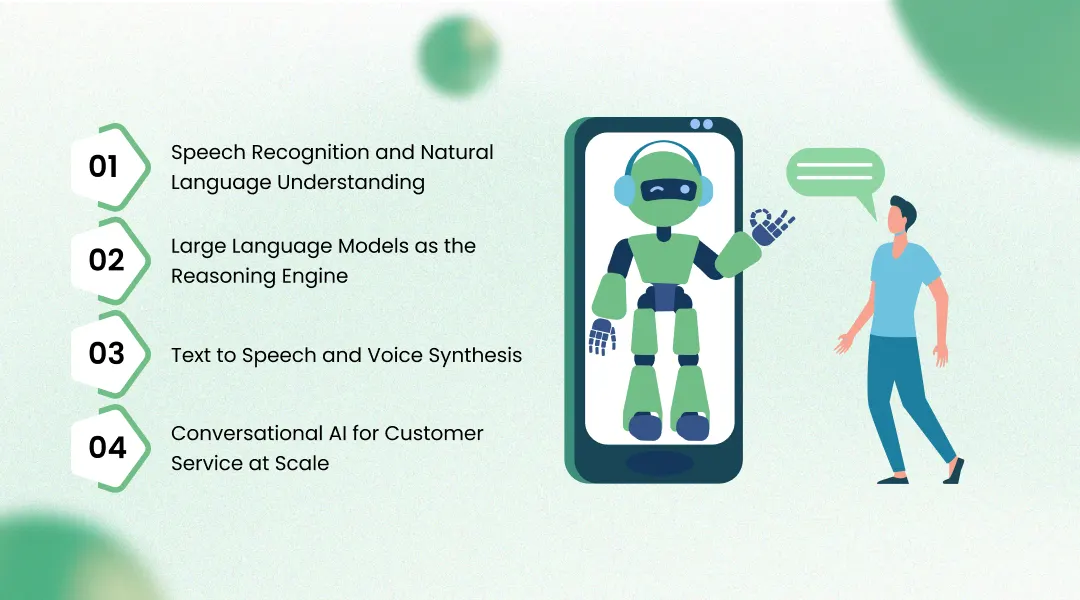
AI voice agents represent the convergence of several mature technologies working together to create systems that can understand, reason, and respond in natural conversation. The transformation is not driven by any single breakthrough but by the integration of multiple AI capabilities into a coherent, production-ready architecture.
Modern automatic speech recognition has achieved accuracy rates that rival or exceed human transcription in controlled environments. These systems convert spoken language to text in real time, handling diverse accents, background noise, and conversational speech patterns. The critical metric here is latency. Humans expect a conversational turn in under 800 milliseconds, and delays beyond 1.5 seconds cause users to assume the system has failed. Today's leading ASR engines deliver sub-300-millisecond response times, making conversations feel natural rather than stilted.
Natural language understanding layers sit on top of speech recognition to extract meaning, intent, and context from what the caller says. These systems go beyond keyword matching to understand the semantic relationships between words, detect sentiment, and maintain conversational context across multiple turns. When a customer says "I need to change my flight to something earlier next Tuesday," the NLU layer identifies the intent (flight modification), the constraint (earlier time), and the temporal reference (next Tuesday) simultaneously.
The integration of large language models into voice agent pipelines has been the most significant technical development of the past two years. LLMs provide the reasoning capability that allows voice agents to handle ambiguous requests, generate contextually appropriate responses, and navigate complex multi-step workflows. Unlike rule-based systems that could only handle predetermined scenarios, LLM-powered voice agents can reason through novel situations and adapt their approach based on conversation flow.
KriraAI has observed that the most successful voice AI automation deployments combine the generative capabilities of LLMs with strict guardrails and business logic layers. This hybrid approach prevents the model from hallucinating or providing incorrect information while preserving the natural conversational quality that makes the interaction feel human.
The output side of the voice agent pipeline has advanced equally dramatically. Modern text-to-speech systems produce voices that are nearly indistinguishable from human speech, complete with natural pauses, intonation patterns, and emotional inflection. Companies like Rime have developed models that produce natural laughs, sighs, and breathing patterns, making AI voices feel conversational rather than robotic. This matters commercially because when AI voices sound mechanical, users disengage, and conversion rates suffer.
The practical applications span virtually every customer-facing function. In retail, AI voice agents handle order status inquiries, process returns, and provide product recommendations. In financial services, where voice AI solutions handle authentication through voice biometrics, agents also process routine transactions without added friction. Healthcare organizations use them for appointment scheduling and patient follow-up calls. Telecommunications providers deploy them for billing inquiries and service outages.
What makes these applications transformative is the scale at which they operate. A single AI voice agent can handle thousands of simultaneous conversations, something that would require hundreds of human agents to match. One major telecom provider reduced call handling time by 35% after implementing voice AI, while simultaneously improving customer satisfaction scores.
The financial case for AI voice agents has moved beyond theoretical projections into documented results. Companies across industries are reporting specific, quantifiable improvements that justify the investment and accelerate broader adoption. Gartner forecasts that conversational AI will reduce contact center labor costs by $80 billion in 2026 alone, a figure that underscores the magnitude of this shift.
AI call center solutions deliver cost reductions through multiple channels simultaneously. The most direct savings come from handling routine interactions without human agent involvement. Well-configured AI voice agents achieve 92 to 96 percent call resolution rates for standard business scenarios, including appointment booking, information requests, and routine account management. Each resolved call represents a direct cost avoidance of $6 to $12 compared to human handling. For a mid-size contact center processing 500,000 calls monthly, redirecting even 40 percent of those calls to an AI agent generates annual savings exceeding $14 million.
Beyond direct call deflection, voice AI automation reduces costs associated with agent training, quality assurance, and workforce management. AI agents do not require onboarding periods, do not call in sick, and do not need supervisory oversight for routine interactions. They also generate consistent quality metrics automatically, eliminating the need for manual call monitoring programs that typically require dedicated QA staff.
The impact extends beyond cost-cutting into active revenue generation. AI voice agents equipped with customer data and product knowledge can identify upsell and cross-sell opportunities during service interactions. When a customer calls to ask about their current plan, the agent can analyze their usage patterns and suggest a more suitable option. Companies implementing these intelligent virtual agents report 15 to 25 percent increases in conversion rates on service-to-sales transitions.
Customer retention improvements provide additional revenue impact. Faster resolution times, 24/7 availability, and consistent service quality directly influence customer satisfaction and loyalty. Research shows that 89 percent of customers say they are more likely to choose brands that offer voice AI support, suggesting that voice agent capabilities are becoming a competitive differentiator rather than a cost center. KriraAI works with enterprises to design voice AI implementations that balance cost optimization with revenue growth, ensuring that automation serves both the bottom line and the customer experience.
Importantly, the debate over AI voice agents vs traditional call centers isn't about elimination — the most successful AI voice agent deployments do not simply eliminate human roles. They transform them. By handling routine inquiries autonomously, AI agents free human staff to focus on complex, high-value interactions that require empathy, judgment, and creative problem-solving. This shift improves agent job satisfaction, reduces burnout, and allows companies to invest in higher-skilled, better-compensated service roles. The result is a smaller but more effective human team supported by AI that handles volume and consistency.
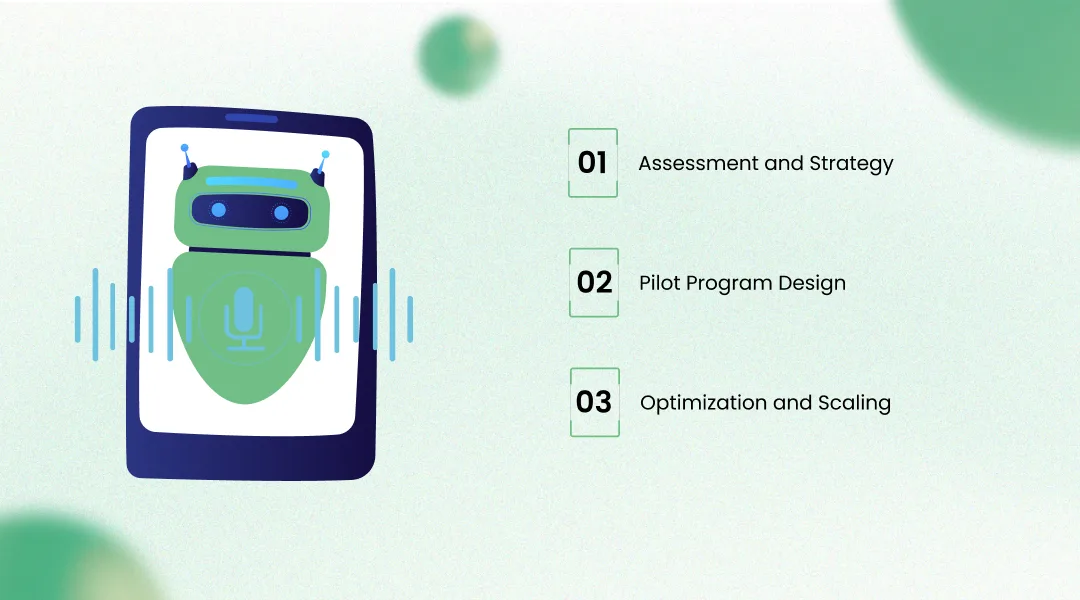
Implementing AI voice agents successfully requires a structured approach that accounts for technical, organizational, and strategic factors. Companies that rush to deployment without adequate preparation consistently underperform, while those that follow a disciplined roadmap achieve faster time to value and more sustainable results.
The implementation journey begins with a thorough audit of existing customer interaction data. This means analyzing call recordings, categorizing interaction types by volume and complexity, and identifying which conversations are candidates for automation. The goal is to find the high-volume, low-complexity interactions that represent the greatest opportunity for AI handling. Common starting points include appointment scheduling, order status inquiries, account balance checks, password resets, and FAQ responses.
Simultaneously, organizations must evaluate their technical infrastructure. AI voice agents require integration with CRM systems, telephony platforms, knowledge bases, and potentially payment processing systems. Understanding the current integration landscape and identifying gaps early prevents costly delays during deployment. Data readiness is equally critical. Gartner research indicates that 60 percent of AI projects without AI-ready data will be abandoned by 2026, making data preparation one of the most important early investments.
The pilot phase should target a specific, well-defined use case with clear success metrics. Rather than attempting to automate an entire contact center at once, successful implementations begin with a single interaction type on a dedicated phone line or customer segment. This contained approach allows teams to measure performance accurately and build organizational confidence.
Key metrics to track during the pilot include call resolution rate, average handle time, customer satisfaction scores, escalation frequency, and cost per interaction. These should be compared against baseline performance from the same interaction type handled by human agents. The pilot should run for a minimum of 60 to 90 days to capture sufficient data across different conditions.
Based on pilot results, teams should optimize the voice agent's performance before scaling. This includes refining conversation flows, improving intent recognition accuracy, and addressing edge cases that caused failures during the pilot. Optimization is iterative and data-driven, relying on conversation logs and customer feedback to identify specific improvement opportunities.
Scaling should proceed incrementally, adding new use cases and expanding to additional customer segments one at a time. Each expansion should be treated as a mini pilot with its own success metrics and review period. This approach prevents the compounding of small issues into systemic problems and maintains quality as the scope of automation grows.
The most frequent implementation mistake is treating voice AI as a technology project rather than a business transformation initiative. Companies must invest in change management, ensuring that contact center leadership and frontline agents understand how AI will change their workflows.
Another common error is setting unrealistic expectations for initial performance. AI voice agents improve over time, but their day-one performance will not match that of a veteran human agent on complex calls. The third critical mistake is neglecting ongoing maintenance. Voice agents require continuous monitoring, retraining, and updating as products and customer needs evolve. KriraAI emphasizes building operational processes around continuous improvement from the earliest stages, treating voice AI as a living system rather than a one-time deployment.
An honest assessment of the difficulties surrounding AI voice agent adoption is essential for any organization considering this technology. Despite the impressive results achieved by early adopters, significant challenges remain that can derail implementations if not addressed proactively.
Data quality remains the foundational challenge. Voice AI systems are only as good as the data they are trained on and the information they can access during conversations. Organizations with fragmented CRM systems, inconsistent data entry practices, or siloed customer information will find that their AI agents deliver inconsistent and sometimes incorrect responses. Cleaning, consolidating, and governing data is often the most time-consuming and expensive phase of implementation.
Regulatory and compliance constraints present additional complexity, particularly in healthcare and financial services. Voice interactions may be subject to recording consent requirements, data privacy regulations such as GDPR and CCPA, and industry-specific compliance standards. The security dimension is equally important, with voice cloning and deepfake impersonation emerging as genuine threats requiring robust authentication mechanisms.
Integration complexity should not be underestimated, and understanding how AI voice agents actually work under the hood makes it clear why connecting them to legacy enterprise systems requires significant engineering effort. Most AI voice agent challenges are architectural rather than model-related. Latency, context management, system integration, and compliance are the problems that separate functional demos from production systems.
The talent gap is another practical barrier. Building and maintaining voice AI systems requires expertise in machine learning, conversational design, telephony infrastructure, and data engineering. Many organizations lack these skills internally, making partnerships with specialized AI implementation firms a practical necessity.
The next three to five years will bring changes to voice AI that make today's capabilities look primitive in comparison. Several converging trends will reshape not just customer service but the entire landscape of human-to-machine communication.
By 2027, Gartner projects that 50 percent of customer service phone interactions in developed markets will be handled by AI without human involvement, up from approximately 25 percent in 2026. By 2028, voice AI will become the default first point of contact for 70 percent of businesses with phone-based customer service in North America and Western Europe. These are not aspirational targets. They are projections based on current adoption curves and technological maturity.
The distinction between voice agents and text-based chatbots will disappear as omnichannel AI systems unify voice, text, and messaging into a single intelligent platform, further expanding the voice AI use cases across industries that are already reshaping service delivery today. A customer who starts a conversation over chat will be able to continue it by phone without repeating any information. This convergence will eliminate the fragmented experience that plagues multichannel support today.
Emotional intelligence represents another frontier. Next-generation voice agents will recognize frustration, urgency, and satisfaction with high precision, adjusting their tone and approach in real time. The emotional intelligence market for AI is projected to reach $9 billion by 2030, reflecting the commercial importance of this capability.
Companies that delay adoption will face compounding disadvantages. Their competitors will accumulate proprietary conversational data, refine their AI systems through millions of interactions, and establish customer expectations that legacy providers cannot meet. Organizations that have not begun their voice AI journey by 2027 will find the gap nearly impossible to bridge.
Three critical insights emerge from this analysis of AI voice agents in 2026. First, the technology has matured beyond experimentation into production-grade infrastructure that delivers measurable, repeatable business results. Second, the financial impact spans both cost reduction and revenue generation, making voice AI one of the highest ROI investments available to customer-facing organizations. Third, implementation success depends far more on strategic planning, data readiness, and organizational commitment than on the technology itself.
The competitive implications are clear. Organizations that deploy AI voice agents effectively are building sustainable advantages through lower costs, better customer experiences, and the accumulation of proprietary conversational data that continuously improves their systems. Those who wait are not standing still. They are falling behind as customer expectations rise and competitors set new standards for speed, availability, and service quality.
KriraAI helps companies across industries implement AI voice agent solutions that are practical, measurable, and built for scale. From initial assessment through pilot deployment to full production scaling, KriraAI provides the technical expertise, industry knowledge, and implementation methodology that transforms voice AI from a concept into a competitive advantage. If your organization is ready to explore how intelligent virtual agents and AI call center solutions can reshape your customer service operations, reach out to KriraAI to start a conversation about what is possible.
AI voice agents are software systems that use advanced speech recognition, natural language understanding, and large language models to conduct natural conversations with callers. Unlike traditional IVR systems that rely on rigid decision trees and touchtone inputs, AI voice agents understand context, handle complex multi-turn conversations, and adapt their responses based on the caller's natural speech. Traditional IVR forces callers through predetermined menu paths, while AI voice agents identify intent directly and resolve issues without menu navigation. This fundamental architectural difference means AI voice agents handle a vastly wider range of scenarios and deliver conversational experiences that feel closer to speaking with a knowledgeable human representative.
The cost of implementing AI voice agents varies based on complexity, scale, and integration requirements. Small to mid size deployments using platform based solutions typically range from $25,000 to $100,000 for initial setup, with ongoing costs of $0.05 to $0.15 per minute of AI handled conversation. Enterprise deployments with custom integrations can exceed $500,000 in initial investment. However, organizations report 35 to 50 percent reductions in operational costs, with payback periods ranging from 6 to 18 months depending on call volume. The total cost of ownership should include integration engineering, conversation design, testing, and ongoing optimization, as well as the hidden costs of the status quo including agent turnover, training expenses, and declining service quality.
The industries seeing the greatest impact from conversational AI for customer service are financial services, healthcare, telecommunications, retail, and travel and hospitality. The banking and insurance sector leads voice AI adoption with approximately 32.9 percent market share, driven by applications in fraud detection, account servicing, and transaction processing. Healthcare follows closely, with voice AI projected to save the U.S. healthcare system $150 billion annually through appointment scheduling and patient follow up automation. Telecommunications providers benefit from high call volumes and repetitive inquiry types well suited to automation. The common thread across these industries is high interaction volume combined with a significant proportion of routine, repeatable inquiries.
AI voice agents are not designed to completely replace human customer service representatives. The most successful implementations use a collaborative model where AI and humans each handle the interactions they are best suited for. Current AI voice agents excel at high volume, routine interactions such as appointment scheduling, account inquiries, and order tracking, achieving resolution rates of 92 to 96 percent for these standard scenarios. However, complex situations requiring empathy, judgment, or sensitive communication still benefit significantly from human handling. The optimal approach is intelligent escalation, where AI handles first contact, resolves routine matters autonomously, and transfers complex cases to human agents with full context. This model reduces human workload by 40 to 60 percent while improving quality across both channels.
A typical AI voice agent deployment follows a phased timeline spanning three to nine months depending on scope. The assessment and strategy phase takes four to six weeks, involving analysis of existing call data and evaluation of technical infrastructure. The pilot phase runs for 60 to 90 days on a single, well defined use case. Optimization based on pilot results adds another four to six weeks before scaling begins. Full production deployment across multiple use cases generally takes two to four months of incremental expansion. Organizations should expect continuous performance improvement during the first 12 months. The most common cause of delays is inadequate data preparation, which is why KriraAI recommends beginning data readiness assessment before any technology decisions are made.
Founder & CEO
Divyang Mandani is the CEO of KriraAI, driving innovative AI and IT solutions with a focus on transformative technology, ethical AI, and impactful digital strategies for businesses worldwide.